Ka Wing Frances Wan, Joanne Yip, Ting Hin Alex Mak, Kenny Yat Hon Kwan, Mei-Chun Cheung, Benson Cheng, Kit Lun Yick, Sun Pui Ng (2023). Anomaly detection of bicep curl using pose estimation. In: Safety Management and Human Factors. AHFE Open Access, vol. 105, pp. 47–53. https://doi.org/10.54941/ahfe1003069
Resistance training exercises can cause adverse effects and even injuries if not executed correctly. The latest pose estimation technologies in computer vision could help provide real-time analysis on exercising motion using on-device cameras. However, to identify whether an individual is performing an exercise correctly, postural deviations or anomalies from the correct patterns must be identified. In this study, a versatile solution is formulated to detect and analyze a specific resistance training exercise – bicep curl using BlazePose and binary tree algorithms in machine learning based on specific pose features. Ten decision tree models are developed to identify ten target pose anomalies including deviated trunk angles and misplaced elbows and wrists. The model sensitivity ranges from 73.7% (external rotated shoulders) to 97.4% (over-flexed trunk). These predicted results would be very useful in giving specific postural advises to learners of fitness exercises. Our research outputs could be extended to other exercises, and be implemented in mobile applications for various purposes such as exergames and sports analysis.
Resistance training exercises involving external weights such as bicep curls, chest press, or even lunges are very beneficial to musculoskeletal health. These workouts, however, can cause adverse effects and even injuries if not per- formed correctly (Faigenbaum & Myer, 2010; Durall et al., 2001). Proper postures and correct use of muscles do not only maximize training efficiency in resistance workouts, but also minimize undesired stress on the ligaments and joints and hence minimize the risk of injuries.
To monitor human motion, computer vision is one of the most studied areas due to its simplicity in hardware requirement. The latest open-sourced
pose detection pipelines BlazePose (Bazarevasky et al., 2020) and Open- Pose have also greatly improved the accuracy of body landmarks placement and computation speed, which open a new realm of possibilities of appli- cations in real-time body motion analysis (Liu et al., 2022; Nakano et al., 2020; Chen et al., 2020). However, to identify whether an individual is performing an exercise correctly, postural deviations or anomalies must be identified.
Because of the large variations in body shapes and variability of camera view angles in practical environments, defining the correct norms of exercise is particularly challenging in computer vision, especially in single camera ope- rations where depth information is missing. In view of the complexity and variability of the definitions of correct forms of various exercises, a versatile method is required to define the correct norms and identify if critical mistakes exist for different exercises.
This paper presents our work on the establishment of a robust pose library of a popular resistance training exercise – bicep curl, which consists of fra- mes of the terminal poses extracted from webcam videos taken from different view angles, with volunteers of different height, age, gender, and body shape under the supervision of a qualified personal trainer; and proposes a versa- tile solution using binary decision trees to detect exercise poses, define the correct norms, and identify the pose anomaly based on specific pose vector features.
DEVELOPING POSE ESTIMATION ALGORITHMS BASED ON BLAZEPOSE AND ESTABLISHING A POSE LIBRARY FOR BICEP CURL In order to achieve real-time fitness exercise analysis for future on-device applications, BlazePose, which is shown to out-perform the widely accepted solution OpenPose in terms of prediction speed (Mroz et al., 2021), is sele- cted as the basis of our pose estimation model. Apart from its lightweight nature, BlazePose provides depth (z-coordinates) estimation on top of the two-dimensional body landmarks (x-, y-coordinates of the image plane), and “InFrameLikelihood” scores that indicate the probability of having the lan- dmark within the image frame. These features might be useful in validating data consistency in practical situations.
Data Collection To collect image samples for the pose library, 18 adults (Table 1) were invited to perform bicep curl under the supervision of a qualified personal trainer. A 5-camera array (Logitech C930e) was set up to collect video sequences (1920 × 1080 pixels; 30 Hz) from different view angles simultaneously.
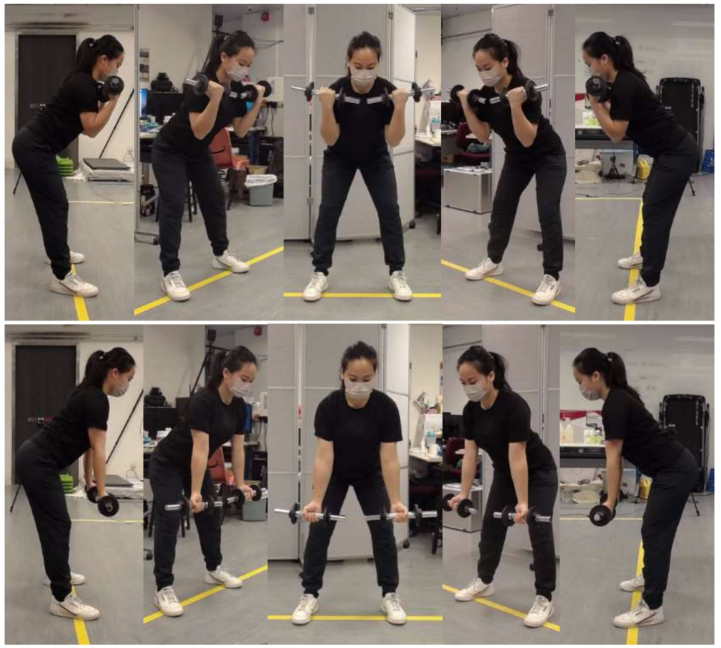
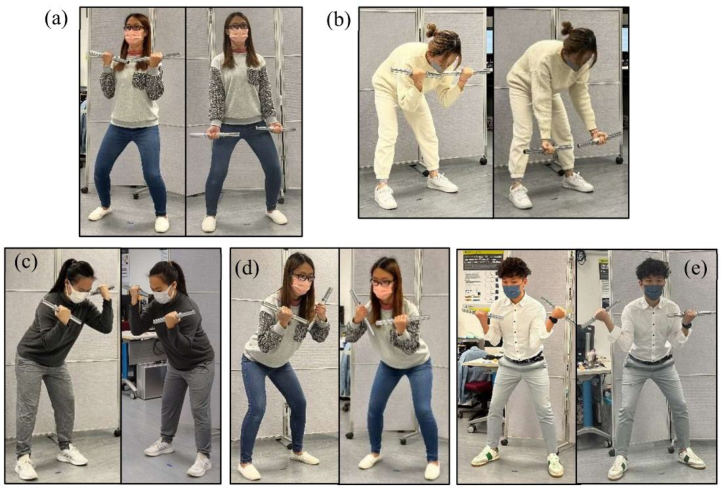
Each participant is required to perform 10 repetitions of bicep curls with a pair of dumbbells (2 - 3 kg) to demonstrate the correct forms (Figure 1) and ten common anomalies (Figure 2) that indicate misuse of other muscles and might lead to greater risks of injuries.
Frames of terminal poses, i.e., bicep contraction and extension, are extra- cted from the image sequences to build the pose library. A total of 10,800
Anomaly Detection of Bicep Curl Using Pose Estimation 49
Table 1. Demographic information of the participants.
Table available in the original PDF paper.
Categories (means ± S. D.) Male Female Number of subjects 8 10 Age 25.9 ± 5.1 27.4 ± 6.7 Height (cm) 172.8 ± 5.7 162.1 ± 7.3 Weight (cm) 63.7 ± 5.3 53.4 ± 5.7
Figure 1: The correct forms of double arm bicep curl – Up (top row) and down (bottom row).
frames are selected and their corresponding body landmarks are extracted for further processing.
Data Normalization and Feature Extraction For each selected frame, the 33 body landmark coordinates obtained from BlazePose are transformed to a local coordinate system defined by the spinal axis (vector from hip centre to shoulder centre) and re-scaled such that values of all coordinates lie between 0 to 1.
30 pose features including 27 distances and 3 vectors (Table 2) are then computed from the normalized coordinates to identify the bicep curl poses and detect pose anomalies listed in Figure 2.
Figure 2: Common pose abnormality of bicep curl: (a) over-flexed trunk (curl up and down); (b) slumped back (curl up and down); (c) flexed shoulder (left and right); (d) abducted shoulder (left and right); (e) external rotated shoulder (left and right).Table 2. Features calculated from normalized body landmarks to identify bicep curl poses and critical anomalies.
Table available in the original PDF paper.
Pose features Distances Centre - Shoulder centre to hip centre
Same side - Shoulder to elbow (L), Shoulder to elbow (R), - Shoulder to wrist (L), Shoulder to wrist (R), - Shoulder to knee (L), Shoulder to knee (R), - Shoulder to ankle (L), Shoulder to ankle (R), - Hip to wrist (L), Hip to wrist (R), - Hip to knee (L), Hip to knee (R), - Hip to ankle (L), Hip to ankle (R), - Knee to ankle (L), Knee to ankle (R), - Elbow to wrist (L), Elbow to wrist (R), - Wrist to ear(L), Wrist to ear (R) Between-side (parallel)
- Elbow (L) to elbow (R) - Wrist (L) to Wrist (R), - Knee (L) to knee (R) - Ankle (L) to ankle (R) Diagonal - Shoulder (L) to elbow (R) - Shoulder (R) to elbow (L)
Vectors Relevant to the world “up” axis (0, 1, 0)
- Trunk angle (mean of L & R) - Thigh angle (mean of L & R) - Calf angle (mean of L & R)
Anomaly Detection of Bicep Curl Using Pose Estimation 51
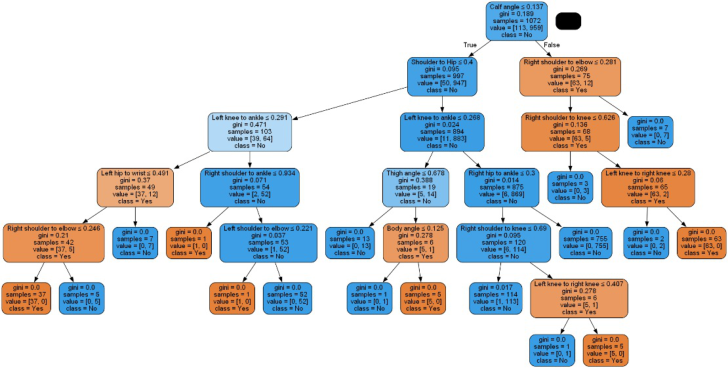
Figure 3: Decision tree of the abnormality “over-flexed trunk” during biceps contraction.
These features, mostly normalized distances, are selected because they effectively characterize the spatial relationship of major segments across the whole body and are reliable descriptors of body poses. They can be used fur- ther to detect poses involved in other common resistance training exercises, such as chest press, lunges, and sit-ups.
Defining Pose Anomaly We use a binary decision tree algorithm to identify whether a certain pose anomaly exist in a pose. Decision tree is a powerful classification and regres- sion tool in machine learning. It is highly intuitive and easy to interpret. In practical situations, multiple mistakes (anomalies) might exist in a sin- gle pose. It is necessary to examine the existence of all defined pose anomaly one by one for each studied pose.
In this study, we perform a 75–25 split to the collected image data to build the training and testing datasets. The training datasets (8,100 frames) are then fed to the binary decision tree algorithms. Ten decision tree models are developed to identify the ten target pose anomalies based on the selected pose features. Figure 3 shows the decision tree model resulted from the over-flexed trunk poses during bicep extension.
RESULTS AND DISCISSION Upon the establishment of the decision tree models, we assess their predi- ction performance with the testing dataset. Performance measures such as the sensitivity, specificity, precision, accuracy of the detection algorithm are summarized in Table 3.
Due to the large number of true negative cases in the testing dataset, the prediction accuracy is generally high (>94.5%) for all anomaly detection models, and 100% accuracy is achieved for all biceps extension poses. For
Table 3. Performance measures of the binary decision tree detection algorithms.
the biceps contraction poses, no false positive case is yielded for the “none” and “over-flexed back”poses, and their model sensitivity (none: 93.9%, over- flexed trunk: 97.4%) are the highest among all curl up poses. Next are the “slumped back”and “flexed shoulder”models, which yield similar sensitivity (87.2 – 89.5%), followed by “abducted shoulders” (left: 77%; right 83.8%). The “external rotated shoulders” yield the lowest sensitivity (left: 73.7%; right: 73.9%).
In general, poses related to trunk deviation yield the best results. This obse- rvation agrees with the work by Kulikajevas et al. (2021). The sensitivity and precision of detecting elbow and wrist deviations can yet be improved. New features such as diagonal distances involving the wrists (e. g. left ear to right wrist; right shoulder to left wrist) might be introduced to the model, for they might be more sensitive to the lateral wrist shifts and improve prediction accuracy for “external rotated shoulders”. Moreover, less important features can be removed to stabilize the model and avoid creating complex decision rules.
More in-depth analysis is required to identify the optimal view angles for certain anomaly detection and advise users to set up their camera accordingly.
Limitations Although we included participants of various sizes, our dataset size is still small. Additionally, all image sequences are collected at indoor environment with the same webcam model. Lastly, our testing datasets do not include poses where multiple anomalies exist simultaneously.
Anomaly Detection of Bicep Curl Using Pose Estimation 53
CONCLUSION
In this study, a versatile solution is formulated to detect and analyze a specific resistance training exercise – bicep curl using BlazePose. Our work demon- strates the feasibility of using normalized distance features extracted from BlazePose to detect multiple pose anomalies from correct norms by binary decision tree algorithms. The prediction results would be very useful in giving specific postural advises to learners of fitness exercises.
ACKNOWLEDGMENT
This work is supported by the Innovation and Technology Fund (ITSP Tier 3) granted to the Hong Kong Polytechnic University (ITS/042/20).
REFERENCES
Bazarevsky, V., Grishchenko, I., Raveendran, K., Zhu, T., Zhang, F. and Grundmann, M., 2020. Blazepose: On-device real-time body pose tracking. arXiv preprint arXiv:2006.10204. Chen, W., Jiang, Z., Guo, H. and Ni, X., 2020. Fall detection based on key points of
human-skeleton using openpose. Symmetry, 12(5), p. 744. Durall, C. J., Manske, R. C. and Davies, G. J., 2001. Avoiding shoulder injury from resistance training. Strength & Conditioning Journal, 23(5), p. 10. Faigenbaum, A. D. and Myer, G. D., 2010. Resistance training among young ath-
letes: safety, efficacy and injury prevention effects. British journal of sports medicine, 44(1), pp. 56–63. Kulikajevas, A.et al. (2021). Exercise Abnormality Detection Using BlazePose Skeleton Reconstruction. In:, et al. Computational Science and Its Applications – ICCSA 2021. ICCSA 2021. Lecture Notes in Computer Science, vol 12953. Springer, Cham. https://doi.org/10.1007/978-3-030-86976-2_7 Liu, W., Liu, X., Hu, Y., Shi, J., Chen, X., Zhao, J., Wang, S. and Hu, Q.,
2022. Fall detection for shipboard seafarers based on optimized BlazePose and LSTM. Sensors, 22(14), p. 5449. Mroz, S., Baddour, N., McGuirk, C., Juneau, P., Tu, A., Cheung, K. and Lemaire, E., 2021, December. Comparing the quality of human pose estimation with blazepose or openpose. In 2021 4th International Conference on Bio-Engineering for Smart Technologies (BioSMART) (pp. 1–4). IEEE. Nakano, N., Sakura, T., Ueda, K., Omura, L., Kimura, A., Iino, Y., Fukashiro, S. and
Yoshioka, S., 2020. Evaluation of 3D markerless motion capture accuracy using OpenPose with multiple video cameras. Frontiers in sports and active living, 2, p. 50.
LISTED IN THE AHFE DIGITAL BOOKSTORE CATALOGUE
Explore the complete digital volume
Safety Management and Human Factors
Read this individual research paper free through the original publisher, or explore the full digital proceedings book.
ISBN 978-1-958651-81-0
Explore this ISBN in the AHFE Bookstore ↗Listed in the July 2026 bookstore catalogue; search by ISBN to confirm current availability · Digital book purchase optional