Maria Grazia Gnoni, Fabiana Tornese, Giulio Paolo Agnusdei (2023). Barriers to Near Miss Management Systems adoption in the industrial sector: results from an exploratory survey in Italy. In: Safety Management and Human Factors. AHFE Open Access, vol. 105, pp. 9–15. https://doi.org/10.54941/ahfe1003064
In industry, the analysis of near miss events can support the improvement of safety on the workplace. Near miss events are usually defined as near accidents, unsafe acts or conditions, that did not cause significant harm to people and goods, but under slightly different circumstances could have turned into accidents. Near miss analysis can help companies to identify possible causes of adverse events and work to prevent future accidents, representing an important source for verifying the effectiveness of the safety management process. The adoption of near miss management systems (NMSs) is mostly diffused in sectors where safety is a crucial issue (e.g., mining, construction, nuclear, aviation, etc.), but it could be an important resource in other contexts as well. The aim of this work is to identify some of the main barriers and drivers for the implementation of NMSs, investigating on one side the reasons that keep companies from adopting NMSs, on the other side the possible actions that could help spreading the use of this tool. The study presents the results of an exploratory survey carried out in collaboration with the Italian National Institute for Insurance against Accidents at Work (INAIL), which included a sample of Italian companies from different sectors. The results presented can help identifying the main criticalities to address to support the diffusion of NMSs.
In industrial safety, near miss events are adverse events, unsafe acts or con- ditions, that occurred without causing significant harm to people or the environment, but under different circumstances could have turned into real accidents (Gnoni et al., 2022b). They are also defined as accidents precur- sors, for which the sequence was interrupted before the accident happened (Saleh et al., 2013). This definition in particular underlines the strict rela- tionship existing between near miss events and accidents: though having different outcomes, these two types of events share a common ground, that is the causes and factors that generated the chain of events. Very often, seri- ous incidents in industry have been preceded by near misses, underlining the importance of a thorough analysis of near miss events to the improve safety
level (Dee et al., 2013; Yorio et al., 2020). Therefore, near miss events are a potential source of useful information for reducing accidents occurrence by acting on the root-causes identified, through a preventive approach (Bird and Germain, 1996; Haas et al., 2020).
Consequently, near miss management systems (NMSs) are being increa- singly applied in different sectors. Starting from industries where safety is a pivotal issue (e.g., aviation, chemical, etc.), their application is now sprea- ding to other sectors, such as manufacturing and construction. However, their adoption seems to be more diffused among large companies, where occupati- onal health and safety (OHS) management prove to be more effective, than in small and medium ones, which show higher accident rates and poorer safety management processes, while employing most of the workforce worldwide (De Merich et al., 2020; Gnoni et al., 2022a).
This work aims at understanding the reasons behind the low adoption rate of NMSs among companies from different sectors, analysing the results of an exploratory survey distributed to Italian companies. The survey is part of the national project CONDIVIDO, carried out with the Italian National Institute for Insurance against Accidents at Work (INAIL) with the objective of evaluating the current level of adoption of NMSs in Italy. In this paper we present and discuss the responses of companies that do not apply a NMSs, investigating their main reasons and eventual barriers identified, as well as possible enablers for a near miss management.
The paper is structured as follows: in the next section, the research method is described, while the main results analysed are presented afterwards. The conclusion summarizes findings and future research developments.
METHOD
The main objective of the project CONDIVIDO is to develop a tool to sup- port knowledge and sharing management of near misses in industrial sectors. In this context, in the first phase of the project a survey has been carried out with the aim of understanding the current level of adoption of NMSs in Ita- lian companies and highlighting barriers and drivers to the implementation of such systems.
The survey has been structured in three parts: the first one collects general records of the companies, such as industrial sector, size, safety management standard applied, and if an NMS is adopted or not. Following this specific question, section 2 is dedicated to companies applying an NMS, while section 3 focuses on companies not applying any NMS. This work presents in par- ticular the results of this last section, where companies were asked about the main reasons for which they do not analyse near miss events, and which factors could enable the adoption of an NMS in the future.
Companies from different parts of Italy and different sectors were involved in the study. However, it must be noted that the sample is not representative of the whole Italian industrial sector, as the aim of the survey was to provide an exploratory field analysis.
The survey has been sent to more than 1000 companies, collecting in the end 192 valid answers that are analysed in the next section. The survey has
Barriers to Near Miss Management Systems Adoption in the Industrial Sector 11
been distributed through an online platform (Qualtrics) to representatives of companies that filled them out autonomously.
RESULTS
Of the 192 respondents, 105 state that they do not apply any NMS. The remaining companies are divided in two groups: those who have been appl- ying an NMS for years (60) and those who have just started the process (27).
Looking at their size, detailed in Table 1, the percentage of companies that do not apply an NMS yet is sensitively higher for micro (88%) and small companies (68%), while decreases at 35% and 8% for medium and large companies respectively. This confirms the trend registered in literature that sees smaller companies dedicating fewer resources to safety management and performing worse than large companies in OHS (De Merich et al., 2020).
In this work we analyse in detail the answers of the cluster of companies that do not apply any NMS.
The first section of the survey focuses on their general profile. Considering their sector, about half of these companies operate in manufacturing (metals, other materials, equipment) and construction. The rest of them are scattered in different sectors, including food and beverage, waste treatment, whole- sale, and others. Concerning the presence of a safety management system in the company, 62% of the 105 respondents of this cluster state that they do not follow any structured method or apply any standard for safety manage- ment. Only 24% declare to apply a national standard elaborated by INAIL, while the rest use other non-structured methods. Coherently, none of these companies adopts the ISO 45001 standard, which requires explicitly the implementation of a near miss management process. Moreover, 64% of the sample chose to externalize the prevention and protection service, confirming the low amount of internal resources expended in this field.
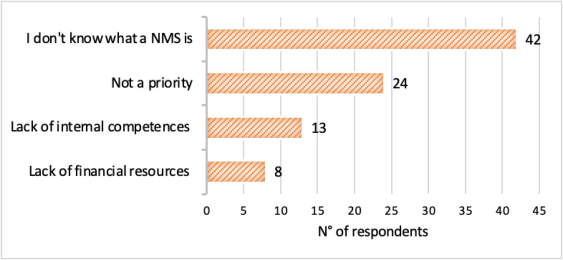
Section 3 of the survey investigates the approach of the company to near miss analysis and management, considering that they don’t apply any NMS. The first question tries to unveil the reasons of this choice, and the most recurring answers are depicted in Figure 1. 40% of the respondents say that they don’t know what an NMS is. This highlights a huge lack of knowledge among companies on such a useful tool to improve safety, and possibly a poor safety culture. Moreover, this answer is more diffused in micro enterprises (57% of them) than in small (37%) or medium ones (29%), suggesting that
Table 1. Distribution of the companies that apply or not a NMS, according to their size.
Figure 1: Most recurrent answers to the question “Why don’t you apply an NMS?”.
the attention to the safety domain increases with the company’s size. The next more diffused reason is that near miss analysis is not seen as a priority by the management, denoting a lack of comprehension of the benefits that this process could bring. Finally, many companies complain a lack of internal competences to dedicate to near miss analysis, or a lack of financial resources, which can be related to the scarce interest in near miss management.
The following question unveils that half of the respondents do not perform any kind of accident analysis beyond the mandatory reports requested by INAIL (52%). Table 2 shows that this percentage is confirmed when conside- ring only small companies (48%), but increases to 78% for micro enterprises, while for medium sized companies the accident analysis is performed in 65% of cases. Only 2 large companies are present in this cluster, therefore no conclusions can be drawn in this case.
Companies have been also asked if they are interested in applying a NMS in the next future: data outline that almost half of the respondents do not want to apply a NMS (47%). Interestingly, while this percentage stays high for small companies (54%), most micro enterprises that are not using an NMS declare that they would consider adopting one in the future (65%), as for medium sized companies (details in Table 3). This is a relevant finding, as 95% of the 4.3 million SMEs in Italy are micro enterprises, and that they employ 80% of the Italian workforce (European Investment Bank., 2021).
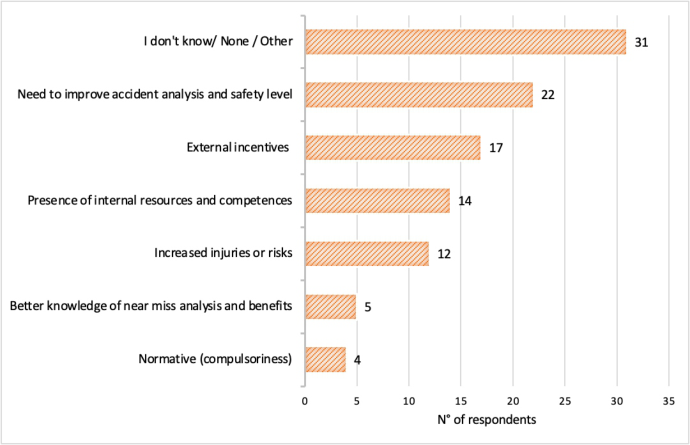
With the aim of exploring possible enablers to enhance the diffusion of near miss analysis, respondents have been asked what could be the factors that would push them to start implementing NMS in the next future. Figure 2
Table 2. Distribution of the companies that perform accident analysis, according to their size. (Only companies not applying an NMS.)
Table available in the original PDF paper.
Total
Company size No accident analysis
Perform accident analysis 1 to 9 employees (micro) 18 5 23 10 to 49 employees (small) 30 33 63 50 to 249 employees (medium) 6 11 17 250+ employees (large) 1 1 2 Total 55 50 105
Barriers to Near Miss Management Systems Adoption in the Industrial Sector 13
Table 3. Distribution of the companies that are interested in adopting an NMS in the future, according to their size. (Only companies not applying an NMS.)
Table available in the original PDF paper.
Total
Company size Not interested in future adoption of an NMS
Interested in future adoption of an NMS 1 to 9 employees (micro) 8 15 23 10 to 49 employees (small) 34 29 63 50 to 249 employees (medium) 6 11 17 250+ employees (large) 1 1 2 Total 49 56 105
Figure 2: Subdivision of answers outlining main factors that could boost the adoption of an NMS.
displays the answers collected, showing that about 20% of the companies declare that they would eventually consider adopting a NMS pushed by the need to improve accident analysis, or more in general the safety level, while more that 10% would do it if injuries or risks in the companies increased considerably. This shows that at least these companies acknowledge that an efficient near miss management process can improve the performance in the safety domain. Another enabling factor could be the introduction of external incentives to foster the diffusion of NMS (16%), which reflects the barrier previously identified related to the scarcity of resources to dedicate to safety. This is also confirmed by another answer, which identifies as a boosting factor the presence of internal resources and competences to employ for this mean (13%). A few respondents claim that a better knowledge of the topic or a normative compulsoriness could facilitate the introduction of near miss analysis. The remaining 30% declare that either they are not able to identify
any enabling factor, or that they are not interested in adopting an NMS in any case.
Another point investigated in the survey regards the willingness of the com- pany to receive an external support to implement an NMS in the future. While about 27% of the respondents confirm that they are not interested in this proposal, more than half declared that they would welcome support from employers’ or trade association (52%). A few others mentioned a possible help from external consultants or other sources. In particular, when asked for which phases of near miss management they would like to receive sup- port, 45% mentioned specific training for internal personnel, but also the events’ collection and analysis phases were pointed out in 35% and 30% of the answers respectively.
CONCLUSION
This work presents the partial results of a national exploratory survey carried out among Italian companies from different sectors about the implementa- tion of NMS, analysing responses from companies that do not conduct any kind of near miss analysis yet. The results presented allow to outline a few conclusions.
The trend highlighted in literature for which smaller companies dedicate less attention and resources to safety management is confirmed by the survey, as most of the micro and small enterprises interviewed do not apply any NMS and do not perform any accident analysis.
However, Most of the micro enterprises interviewed declared that they would consider applying a NMS in the future, denoting interest in the topic and room for diffusion of the near miss culture.
A huge lack of knowledge and consequent training on near miss manage- ment emerged from the survey, and can be identified as one of the main barriers to the implementation of NMS.
Companies also mention the resource scarcity that concur to relegate near miss analysis to a non-priority issue. This includes financial resources and human competences and skills.
Consequentially, external support and an increase of internal resources have been identified as possible enablers for a future adoption of NMS. Another factor highlighted is the need to improve safety or a future increase of injuries and risks in the company.
Most of the respondents would be interested in receiving a support for the implementation of a NMS, particularly for internal training of employees, events collection and analysis.
ACKNOWLEDGMENT
This paper presents some of the results of the project CONDIVIDO, BRIC ID 01/2019 planned and developed by Politecnico di Milano, Università del Salento and the Department of Occupational and Environmental Medi- cine, Epidemiology and Hygiene of INAIL (the Italian National Institute for Insurance against Accidents at Work), and granted by INAIL itself.
Barriers to Near Miss Management Systems Adoption in the Industrial Sector 15
REFERENCES
Bird, F. E., Germain, G. L., 1996. Practical loss control leadership. Det Norske Veritas, Loganville. De Merich, D., Gnoni, M. G., Malorgio, B., Micheli, G. J. L., Piga, G., Sala, G.,
Tornese, F., 2020. A Cloud-Based Tool for Integrating Occupational Risk Asses- sment Within Management Systems for SMEs. Safety 6, 47. https://doi.org/10. 3390/safety6040047 Dee, S. J., Cox, B. L., Ogle, R. A., 2013. Using near misses to improve risk management decisions. Process Saf. Prog. 32, 322–327. https://doi.org/10.1002/prs. 11632 European Investment Bank., 2021. The digitalisation of small and medium-sized
enterprises in Italy: models for financing digital projects : summary report. Publications Office, LU. Gnoni, M. G., Tornese, F., De Merich, D., Guglielmi, A., Pellicci, M., Micheli, G. J. L., Vitrano, G., 2022a. Adoption level of Near-Miss Management Systems in the industrial sector: an exploratory survey, in: Proceedings of the 32nd European Safety and Reliability Conference (ESREL 2022). Research Publishing, Singapore. Gnoni, M. G., Tornese, F., Guglielmi, A., Pellicci, M., Campo, G., De Merich, D.,
2022b. Near miss management systems in the industrial sector: A literature review. Saf. Sci. 150, 105704. https://doi.org/10.1016/j.ssci.2022.105704 Haas, E. J., Demich, B., McGuire, J., 2020. Learning from Workers’ Near-miss Reports to Improve Organizational Management. Min. Metall. Explor. 37, 873–885. https://doi.org/10.1007/s42461-020-00206-9 Saleh, J. H., Saltmarsh, E. A., Favarò, F. M., Brevault, L., 2013. Accident precursors,
near misses, and warning signs: Critical review and formal definitions within the framework of Discrete Event Systems. Reliab. Eng. Syst. Saf. 114, 148–154. https: //doi.org/10.1016/j.ress.2013.01.006 Yorio, P. L., Haas, E. J., Bell, J. L., Moore, S. M., Greenawald, L. A., 2020. Lagging or leading? Exploring the temporal relationship among lagging indicators in mining establishments 2006–2017. J. Safety Res. 74, 179–185. https://doi.org/10.1016/j. jsr.2020.06.018
LISTED IN THE AHFE DIGITAL BOOKSTORE CATALOGUE
Explore the complete digital volume
Safety Management and Human Factors
Read this individual research paper free through the original publisher, or explore the full digital proceedings book.
ISBN 978-1-958651-81-0
Explore this ISBN in the AHFE Bookstore ↗Listed in the July 2026 bookstore catalogue; search by ISBN to confirm current availability · Digital book purchase optional