Sara Amani, Noor Obeidat, Thomas Ferris, Kristi Shryock (2024). Enhancing the Onboarding Experience with Wearable Technology for Research Applications. In: Human Factors in Design, Engineering, and Computing. AHFE Open Access, vol. 159, pp. 958–967. https://doi.org/10.54941/ahfe1005662
Recent advancements in wearable technologies like the Apple Watch, Samsung Galaxy Watch, and Empatica EmbracePlus have revolutionized the real-time monitoring of physiological parameters. However, integrating such technologies into research settings hinges on the seamless onboarding of participants that are unfamiliar with these devices. Our project, conducted at a large R1 university, investigated how procedural steps and participant instructions in the onboarding and setup processes affect user interaction with these sophisticated technologies.Our methodology consisted of a multi-phase study starting with a front-end analysis that established fundamental user interactions with the devices and identified potential onboarding challenges. Subsequent phases involved cognitive task analysis and iterative testing with engineering students, focusing on user registration, app installation, device pairing, and data synchronization. Key interventions included simplifying login procedures and enhancing the instructional clarity of device setup. User feedback was integral, collected through surveys and direct observation, ensuring a user-centered design approach.Initial findings indicated several user-technology interaction challenges, particularly with complex login credentials and device pairing. Suggestions for improving these tasks have been explored and discussed. The study emphasizes the importance of human-centered design in the deployment of wearable technologies in research settings. Our findings indicate that even minor, focused alterations in the onboarding process can notably enhance the efficiency of technology adoptions within research environments. This research highlights the transformative potential of wearable technologies in academic data collection, emphasizing the crucial role of user-friendly design. Our findings demonstrate strategic design modifications that can significantly improve the efficiency and effectiveness of wearable technology usage in research settings.
Recent advancements in wearable technologies offer attractive instrumentation options for real-time physiological parameter monitoring in human subjects research. The Empatica EmbracePlus watch is one such technology that stands out as a sophisticated device designed to collect a wealth of physiological data unobtrusively. To use wearable technology
Enhancing the Onboarding Experience With Wearable Technology 959
in research studies in an efficient manner, the participant’s setup as a user must be streamlined and by comprehensive sociotechnical systems analyses. Although there are many similarities in the onboarding steps and related usability challenges facing all types of wearable devices, we chose to specifically explore the use of the EmbracePlus watch for human subjects research in the current study. This report provides a sociotechnical systems analysis of the process of onboarding participants in research studies utilizing the device, and identifies technological and system factors to potentially improve this process.
Numerous sensors on the Empatica Embrace Plus watch can track important physiological indicators, including body temperature, electrodermal activity, and cardiac (ECG-derived) measures. In addition, it has sophisticated algorithms for identifying physiological alterations suggestive of stress effects and / or medical events such as seizures, which makes it very pertinent for research and health monitoring purposes. This sociotechnical systems analysis serves as a preliminary study for future work involving measuring test anxiety in engineering students through wearables. At this stage, the researchers aim to understand the user experience of potential participants to develop a protocol guideline for experimenters to follow when using the watch for research on human subjects in a classroom setting. The boundaries of this system entail the onboarding process for research, including participant setup, device pairing, app installation, and data synchronization within the Empatica domain. Key components of our system include the Empatica EmbracePlus watch itself, the mobile app that accompanies it, the online portal for data management, and most importantly, the participants and researchers.
LITERATURE REVIEW
Wearable technologies have become more important in research settings because they allow for real-time monitoring of physiological data. Wearable gadgets like the Empatica EmbracePlus, Apple Watch, and Samsung Galaxy Watch have shown improvement in delivering continuous health monitoring, which is very useful in academic research. However, successful deployment in research settings is contingent on appropriate onboarding and setup processes in order to ensure that participants can use these devices seamlessly. The current study investigates the human, technological, and contextual factors affecting the wearable technology onboarding processes and strives to enhance the user experience by applying human-centered design methods.
Wearable devices have advanced significantly in sensor technology, data processing, and connectivity, making them indispensable instruments for health monitoring and data collection in research settings (Wright & Keith, 2014). These devices can monitor a wide range of physiological characteristics, including heart rate, electrodermal activity, and sleep patterns, providing researchers with extensive datasets (Seshadri et al., 2019). Despite their potential, incorporating these devices into research settings presents hurdles, notably regarding participant onboarding and setup (Piwek et al., 2016).
The onboarding process is important to the successful implementation of wearable devices in research. Initial setup processes include user registration, app installation, device pairing, and data synchronization (Motti & Caine, 2014). Complex login procedures and device pairing challenges are major roadblocks that can dissuade users and reduce data quality (Sullivan et al., 2015). Simplifying these processes is critical for improving user experience and ensuring accurate data gathering (Vandrico Solutions Inc., 2016). Enhancing the user experience (UX) of wearable devices involves addressing both functional and emotional aspects of user interactions. This includes simplifying login procedures, providing clear and straightforward setup instructions, and ensuring consistent device connectivity. (Hassenzahl, 2010). According to studies, excellent user experiences result in increased engagement and data quality, both of which are critical for the success of wearable technology research initiatives (Nielsen, 1994). User-centered interventions, like those used in our study, have been found to reduce setup time and errors, increasing the efficiency of technology adoption in research settings (Shneiderman & Plaisant, 2005).
FRONT-END ANALYSIS A “front-end analysis” (e.g. Lee et al., 2017) involves defining key sociotechnical systems “components” that may affect processes within the system, providing direction for subsequent analyses investigating interacting effects of these components in the overall system function. One key component is people, which in our analysis includes the researchers who need consistent protocols when installing the equipment, and the participants interfacing with the technologies. Another important system component concerns the tools and technologies associated with the experiment. In our analysis, this will include the Empatica EmbracePlus watch as well as the data collection app to sync key data from the watch. The tasks are the main component of this project and include all the steps that the researchers and participants follow toward the goals of the research project. Finally, the environmental component considers environmental restrictions in the research, as well as interacting effects with other system components, such as errors in data collection that arise when interacting with the technology under particular environmental contexts.
System Component: People
Table 1 below provides a breakdown of the roles, tasks, and needs of both user groups in the system, namely the participants and the researchers.
Enhancing the Onboarding Experience With Wearable Technology 961
Table 1. User analysis - roles and needs.
Table available in the original PDF paper.
User Group Roles and Tasks in the System
Needs Supported by the System
User Attributes That May Affect Processes
The instructions/protocols and wearable technology (watch)
Age Physical attributes Underlying health conditions
Participants Participate in a study on installing the Empatica EmbracePlus. Provide feedback on their experience.
Research familiarity with wearables Technical background
Observing/monitoring the participants during the process Participant cooperation and feedback
Researchers Provide clear protocols for the installation of wearable technology. Collect data on how to improve the protocol for future studies.
System Component: Tools and Technologies The Empatica EmbracePlus is equipped with sensors for monitoring physiological parameters and digital biomarkers through the user’s wrist. The data collected from each watch is paired with each participant’s phone to the Care Lab App via Bluetooth. The data from each phone app is then synced with the Empatica Cloud through an internet connection, and the researcher can visualize and access the data from all the participants through the Care Portal (Figure 1).
System Component: Tasks The system functions and examples of critical tasks in the onboarding process are outlined below.
Table 2. Task descriptions and attributes.
Table available in the original PDF paper.
Task Description Attributes / Factors User Registration Complexity of login credentials (e.g., length and format) Use of QR codes vs. manual entry Participants complete an informed consent form and agree to the terms and conditions of the study. Researchers provide participants with their randomized login credentials and watches as provided by the portal.
App Installation
Compatibility with different operating systems (e.g., iPhone vs. Android) Clarity of setup instructions
Participants download the associated application on their phones and configure settings according to study requirements such as enabling sensors and allowing notifications.
Device Pairing
Researchers assist participants in syncing their watches with the phone application via Bluetooth.
Ease of identifying the correct device (e.g., watch serial number visibility) Stability of Bluetooth connection Data Synchronization
Reliability of data transfer Network requirements (e.g., internet availability)
Participants ensure that data collected by the device is synchronized with the mobile application. Researchers ensure that they can view the data on the cloud-based platform.
System Component: Environment The primary environment for data collection included the office settings on campus. It was important to consider environmental aspects such as internet and Bluetooth connection, proximity to other devices, temperature, and sound.
DATA COLLECTION With the front-end analysis and identified system attributes of interest guiding the experimenters’ investigation, purposive sampling was conducted to test the protocol on 20 participants (55% female and 45% male students) from various demographic backgrounds. All participants were engineering students who were unfamiliar with the Empatica EmbracePlus device. The steps for data collection included obtaining informed consent, conducting a semi-structured observation of the tasks, and collecting feedback on the process through a feedback survey.
Enhancing the Onboarding Experience With Wearable Technology 963
Semi-Structured Observation of Tasks The subset of tasks mentioned above was converted into a detailed checklist on an Excel sheet. As participants completed the tasks in order, the researchers would take note of how that task was completed. The researchers also recorded the time that it took each participant to complete the onboarding process. This was to get a sense of how different potential problems could impact the overall efficiency of the onboarding process and to help identify potential improvements.
Feedback Survey Upon completion of the onboarding process, participants were sent a survey to complete that collected their demographic information such as gender, race, and first-generation student status as well as questions about their user experience. A mix of Likert-scale, select all that apply, multiple choice, and open-ended style questions were incorporated. This variety of question styles was useful to capture a comprehensive and nuanced understanding of the diverse participants’ experiences and perspectives.
RESULTS
All participants completed the required tasks and were eventually able to get onboarded. The average onboarding time was 9:36 minutes with the lowest and highest times being 5:13 and 16:31 minutes, respectively.
Experience Based on Observations The following challenges have been identified in the structured observation checklist as issues between user, technology, and environment interactions:
The username and password credentials generated by the portal for each participant ID are very long and complex, thus all of the participants immediately opted to scan the QR code to log in.
Participants with older model phones (e.g., iPhone7) were not able to log in to the application using their personal mobile devices. The manual mentions that the application is only compatible with later versions of both Apple and Android phones. This poses a challenge of being able to recruit participants of lower socio-economic backgrounds if researchers cannot provide mobile devices as part of their project funding.
Due to restrictions with internet or possible Bluetooth connections, some participants had to reload the screen several times to find the correct watch serial number to pair with their applications, causing slight frustration.
Identifying the serial number of the watch was difficult due to the small font size and low visibility on the back side.
Despite the few challenges mentioned above, most participants were able to complete all of the tasks independently and efficiently with minimal corrective instruction from the researcher. This indicates a relatively smooth onboarding process.
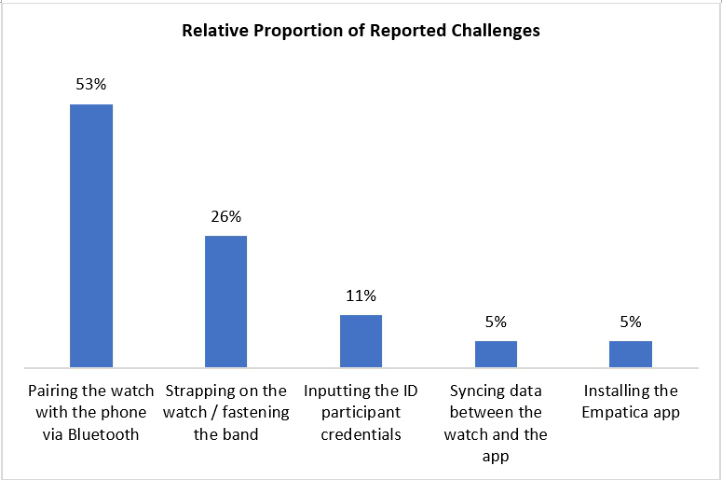
Experience Based on Survey Results When asked “On a scale of 1 to 10, how easy was it to set up your Empatica watch with the app on your phone? (1 being extremely difficult, 10 being extremely easy)”, the average answer provided was 8.6 indicating that most students found the setup and onboarding process relatively easy. Figure 2 provides a breakdown of the most challenging steps identified during the onboarding process.
Figure 2: Most challenging aspects of onboarding process.
According to the results in Figure 2, the majority of participants struggled the most with pairing the watch and smartphone via Bluetooth. This difficulty arose because they had to navigate multiple steps in the settings app to enable Bluetooth and complete the setup process. Some participants encountered issues with inputting the ID credentials due to their length and complex pattern or finding the serial number to make sure they pair the correct watch. Additionally, several participants experienced difficulties syncing data between the watch and the app, which increased their frustration levels and subsequently heightened their cognitive workload. It is interesting to note that the second biggest challenge noticed was the actual fastening of the watch. The researchers also observed that the younger students (undergraduate participants) struggled moreso with fastening the band compared to the older (graduate student) participants. This may be due to the fact that the EmbracePlus strap and clasp method are similar to traditional leather-strapped watches and not as prevalent in newer watches designed for younger users. This could be indicative of a generational shift in the style of watch bands that are becoming increasingly popular in the markets and was
Enhancing the Onboarding Experience With Wearable Technology 965
a unique challenge to notice. One participant commented on their experience, “It was very easy to follow! The only thing I could see being hard would be the physical act of securing the watch, but I was able to do that fine.”
When asked “Overall, how satisfied are you with the setup experience?” the average response was 4.5/5 showing that most students were satisfied with the onboarding process and would be able to easily participate in future studies using similar wearable devices.
DISCUSSION
The exploration of user interface challenges and the subsequent solutions for the Empatica EmbracePlus watch and its associated Care Lab application underscore the importance of user-centric design in healthcare technology. This discussion delves into the implications of the identified problems, evaluates the proposed solutions, and reflects on the broader impacts on user experience and data integrity.
Problem Analysis The primary issue identified in this research was the complexity of system- generated usernames and passwords. The analysis revealed that these credentials, while secure, were not user-friendly. The participants consistently opted to use QR codes for login, avoiding the cumbersome task of manually entering long, complex credentials. This behavior highlights a disconnect between the system’s security protocols and the user experience, suggesting that security measures, while essential, must be balanced with usability considerations to prevent user frustration and errors.
Practical Solution Evaluation The proposed practical solution—simplifying the username generation and allowing users to create their own passwords—addresses this balance effectively. By maintaining a system-generated username but simplifying its format, and allowing users to create memorable yet secure passwords, the solution reduces the cognitive load on participants. This approach aligns with human-centered design principles by acknowledging that users are more adept at remembering and accurately typing familiar credentials. The recommendation to adhere to established password complexity guidelines ensures that the security of the system is not compromised while improving usability.
Innovative Solution Insights One potential solution presents an innovative leap by leveraging biometric data for authentication. Utilizing the existing sensors on the EmbracePlus watch for fingerprint and heart rate variability (HRV) recognition transforms the login process into a seamless experience. This method not only reduces cognitive load but also enhances security by employing dual biometric authentication. The use of advanced techniques such as convolution neural
networks (CNN) and long-short-term memory (LSTM) models for PPG- based HRV authentication represents a forward-thinking approach that could set new standards in wearable technology.
Broader Implications and Future Research The proposed solutions have significant implications for the broader field of user interface design in wearable health technology. Simplifying login processes can lead to higher user satisfaction and better adherence to using health monitoring devices, ultimately resulting in more reliable data collection. Moreover, the adoption of biometric authentication could mitigate issues related to password fatigue and security breaches, common in traditional password systems.
Future research should focus on validating these solutions through empirical studies involving diverse user groups. Evaluating the effectiveness of simplified credentials and biometric authentication in real-world settings will provide deeper insights into their impact on user experience and data integrity. Additionally, exploring the integration of other biometric modalities, such as facial recognition or voice authentication, could further enhance the usability and security of wearable health devices.
CONCLUSION
In conclusion, our study highlights the critical role of human-centered design in successfully implementing wearable devices in research. By addressing onboarding and setup challenges, we propose practical and innovative solutions that improve the overall user experience. Simplifying login procedures, enhancing instructional clarity, and ensuring seamless device pairing and data synchronization can lead to a more efficient and user-friendly onboarding process.
Our findings emphasize the importance of aligning technology design with user needs, especially in research involving physiological data collection. Positive feedback from participants and the smooth completion of onboarding tasks show that even small adjustments can significantly boost user satisfaction and engagement. By focusing on user experience and solving practical issues, we enable broader adoption and successful use of wearable devices in various research settings.
REFERENCES
Empatica. (2024). Empatica Health Monitoring Platform. https://www.empat ica.com/platform/home/ Hassenzahl, M. (2010). Experience design: Technology for all the right reasons.
Synthesis Lectures on Human-Centered Informatics, 3(1), 1–95. Lee, J. D., Wickens, C. D., Liu, Y., & Boyle, L. N. (2017). Designing for people: An introduction to human factors engineering (3rd ed.). CreateSpace Independent Publishing Platform. Motti, V. G., & Caine, K. (2014). Human factors considerations in the design of
wearable devices. Proceedings of the Human Factors and Ergonomics Society Annual Meeting, 58(1), 1820–1824.
Enhancing the Onboarding Experience With Wearable Technology 967
Nielsen, J. (1994). Usability engineering. Elsevier. Piwek, L., Ellis, D. A., Andrews, S., & Joinson, A. (2016). The rise of consumer health wearables: Promises and barriers. PLOS Medicine, 13(2), e1001953. Seshadri, D. R., Li, R. T., Voos, J. E., Rowbottom, J. R., Alfes, C. M., Zorman, C. A.,
& Drummond, C. K. (2019). Wearable sensors for monitoring the internal and external workload of the athlete. NPJ Digital Medicine, 2(1), 1–18. Shneiderman, B., & Plaisant, C. (2005). Designing the user interface: Strategies for effective human-computer interaction. Pearson Education India. Sullivan, G. M., & Sargeant, J. (2015). Qualities of qualitative research: Part I.
Journal of Graduate Medical Education, 7(4), 550–551. Vandrico Solutions Inc. (2016). Wearable technology database. Retrieved from https: //vandrico.com/wearables/ Wright, R., & Keith, L. (2014). Wearable technology: If the tech fits, wear it. Journal
of Electronic Resources in Medical Libraries, 11(4), 204–216.
LISTED IN THE AHFE DIGITAL BOOKSTORE CATALOGUE
Explore the complete digital volume
Human Factors in Design, Engineering, and Computing
Read this individual research paper free through the original publisher, or explore the full digital proceedings book.
ISBN 978-1-964867-35-9
Explore this ISBN in the AHFE Bookstore ↗Listed in the July 2026 bookstore catalogue; search by ISBN to confirm current availability · Digital book purchase optional