Dezhi Liang, Shuk Fan Tong, Alistair Mcewan, Darryl Chiu, Joanne Yip, Kai-yu Tong (2025). Enhancing Motor Performance in Pediatric Cerebral Palsy: A Preliminary Study on Soft Knee Robotic. In: Healthcare and Medical Devices. AHFE Open Access, vol. 171, pp. 132–139. https://doi.org/10.54941/ahfe1006199
Crouch gait is a common pathology in individuals with cerebral palsy (CP), significantly affecting their daily activities. The soleus and gastrocnemius muscles in their shank are often too weak to generate sufficient force against body weight. Soft wearable robotics are compliant, lightweight, and portable. In this study, we aimed to address the gap in soft knee robotic systems for children with CP. This paper introduces the design of a textile-based knee actuator and a control system. It investigates the feasibility of this soft knee robotic system through a preliminary study involving two children with CP. The study includes 20 walking sessions to assess the system's performance.Methods: The actuator of the soft knee robot uses a PVC Nylon composite textile material. The actuator is worn on the back of the subject’s knee joint with a skin-friendly textile brace. The unilateral weight of the soft knee brace is only 0.2 kg. Two ground reaction sensors are placed on the forefoot and heel of the subject to detect gait events during the walking cycle. When the heel strikes the ground, the actuator inflates to assist knee joint extension until toe-off. The subjects participated in training twice a week, totaling 20 sessions over 10 weeks. Each session included 30 minutes of walking training with the soft knee robot.Results: Preliminary training results demonstrated the feasibility of the soft knee robot in improving crouch gait. The knee flexion angles of both subjects were reduced (Subject 1 from 20.56° to 1.9 ° and Subject 2 from 24.21°to 12.1°) during the mid-stance phase after 20 training sessions. The Modified Ashworth Scale (MAS) score of the paretic side knee joint reduced from 1+ to 0 and from 1+ to 1 respectively, indicating an improvement in muscle tone of the spastic knee joint. The subjects' gross motor function scale showed improvement.Conclusion: This work demonstrates the validation of the soft knee robot protocol for extension support in crouch gait with pneumatic and comfortable assistive torque. The pilot testing results indicate that the soft knee robotic system improves knee control and locomotor function during walking.
Crouch gait, characterized by excessive knee flexion during the stance phase of the gait cycle, is one of the most prevalent gait abnormalities associated with cerebral palsy (CP), with a reported prevalence of up to 76%. Among individuals with CP, more than 50% of those affected by crouch gait have spastic diplegic cerebral palsy (Pandey et al., 2023; Abbasi et al., 2021). According to data from the U.S. Centres for Disease Control and Prevention in 2020, approximately 41% of children with CP experience limitations in fundamental motor activities like crawling, walking, running, or playing (Centers for Disease Control and Prevention, 2022). Some children with cerebral palsy experience a decline in mobility and may lose their ability to
Enhancing Motor Performance in Pediatric Cerebral Palsy 133
walk as they reach adulthood (Sarajchi et al., 2021). In addition, crouch gait may cause joint pain and increase the risk of degenerative arthritis due to excessive joint contact forces (Snodgrass et al., 2023). Enhancing motor function is a primary focus in improving the quality of life for children with CP, and early intervention plays a crucial role in optimizing treatment outcomes. Initiating rehabilitation at an early stage increases the likelihood of effectively addressing motor impairments and mitigating long-term functional limitations (Morgan et al., 2021; Bufteac et al., 2020).
To manage crouch gait, ground reaction ankle foot orthoses (GRAFOs) with an anterior shell are commonly used interventions (Pandey et al., 2023; Ries et al., 2019). However, these orthoses are passive intervention tools that limit their ability to actively facilitate gait training. Multiple research studies have shown that changing knee movements to increase extension angle can improve balance control while walking in the anterior/posterior direction. These enhancements in motor control can lead to more energy- efficient walking (Lerner et al., 2016; Lerner et al., 2017). To address this issue, robotic gait rehabilitation systems have emerged as possible assistive devices for children with CP which are primarily categorized into two types: (1) rigid exoskeletons and (2) cable-driven systems. Rigid exoskeletons can generate substantial torque, and had weight of the device is 5.8 kg (Hunt et al., 2022). On the other hand, cable-driven systems utilize electric motors and cables to transmit force while providing force feedback through load cells, thereby reducing overall structural mass (Cho et al., 2022). However, these systems often generate high shear forces on the user’s body and require large frames, compromising both compactness and wearability.
Given these limitations, there is a growing need to explore soft, lightweight robotic solutions for gait rehabilitation, particularly for children with CP, who are physically more vulnerable. In this study, we proposed a soft knee robotic device with pneumatic pressure control designed specifically for gait training in children with CP and crouch gait. This device is both lightweight and capable of generating sufficient force to address key challenges, including weight burden, adjustability, ease of use, and comfort. The objective of this study is to evaluate the effectiveness of this soft robotic device in improving knee kinematics and motor control in children with CP and crouch gait.
EXPERIMENT Soft Knee Robotic Gait Training System
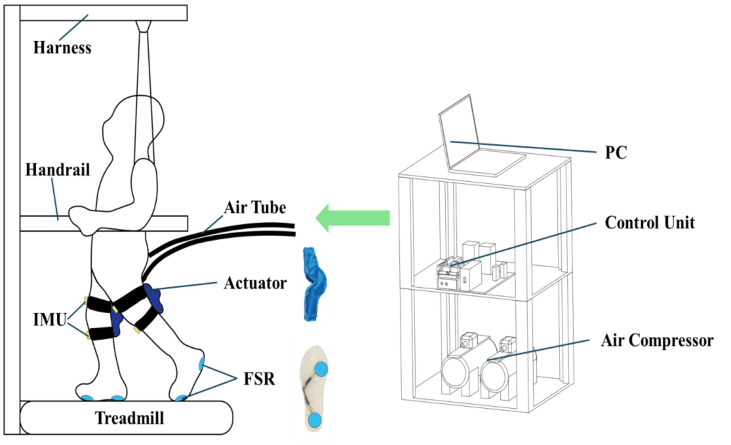
In this study, we designed a soft knee robotic device with a pneumatic pressure control system for gait training as shown (see Figure 1). The soft knee robotic training system comprised a pair of soft knee robotics with pneumatic paddings and a control system. The soft knee robotic consisted of a soft textile-based actuator and a custom-made textile knee brace. The actuator was made of PVC Nylon composite fabric, and the textile knee brace was made of nylon and spacer fabrics. The textile knee brace, which was the skin contact part, was soft, breathable, and skin-friendly which can reduce the
chance for the development of skin problems like redness and pressure ulcers even for prolonged wearing. Also, textile knee materials were stretchable and foldable which not only improves comfort and reduces the bulkiness but also beneficial for the exoskeleton’s design and accommodates the deformity of their joint. The actuator was worn on the back of the subject’s knee joint with only 0.2 kg unilateral weight. For the gait training, a walking treadmill, speed range from 0.5–6.0 km/h, was used and the harness and handrails were installed to ensure the safety of the participants. The walking training started from subjects’ comfortable speed.
Figure 1: Soft knee robotic device with pneumatic pressure control system.
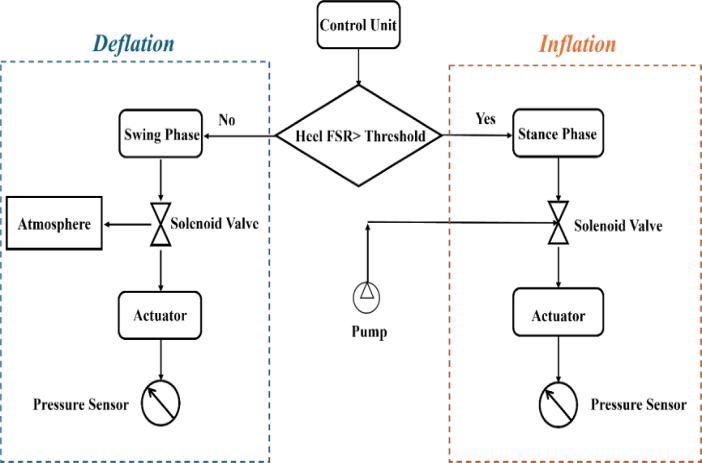
For the control system, it consisted of an air compressor, a control unit and the ground reaction force sensors (FSR). The air pressure was provided from the compressor (JUN-AIR, 6–4, Hong Kong) and adjusted by the pneumatic pressure regulator (SMC, ITV2050-212L, Japan). The control unit switched the solenoid valve to inflate and deflate the actuator. Two FSR (Tekscan A401, Inc. Norwood, U.S.A.) were placed on the heel and forefoot of the subjects’ feet. The threshold of the force sensor was collected during the participant’s full standing phase. When the subject’s heel strikes the ground, the actuator inflated to assist knee extension when the force sensor value was over the threshold. When subjects lifted the heel in the toe-off phase, the actuator deflated during the swing phase until the next gait cycle. The knee flexion angle acquisition was based on two IMUs (Hi221, SEA LAND Science and Technology Ltd., Taiwan) mounted around the knee joint. The workflow of the control system was illustrated (see Figure 2).
Enhancing Motor Performance in Pediatric Cerebral Palsy 135
Figure 2: Workflow of the control system.
Participants To evaluate the effectiveness and feasibility of the proposed soft knee robot for pediatric cerebral palsy, a pilot study was conducted and the inclusion criteria for participants were as follows: (1) diagnosis of CP at Gross Motor Function Classification System (GMFCS) levels I to III; (2) age between 2 and 12 years; (3) ability to walk on a treadmill for at least five minutes with or without hand-held assistance; and (4) ability to understand and follow simple instructions. Exclusion criteria consisted of: (1) uncontrolled seizures; (2) botulinum neurotoxin injections or orthopedic surgery within the previous six months or during the study period; (3) unhealed skin lesions in the lower limbs; (4) exhibiting aggressive or self-harming behaviors, severe cognitive impairment, or any health condition other than CP that could affect participant safety. Ethical approval was granted by the Joint Chinese University of Hong Kong–New Territories East Cluster Clinical Research Ethics Committee (The Joint CUHK-NTEC CREC), Ref. No. CREC 2021.171. Before enrolment, all participants and their guardians received a detailed explanation of the potential risks of experiments and signed an informed consent prior to their participation in this study.
Two individuals with CP diagnosed with crouch gait (aged 4 and 12 years) were recruited for the gait training. The subject demographic is shown in (see Table 1). Both subjects are classified as GMFCS level II.
Table 1: Subject demographics.
Table available in the original PDF paper.
Subject 1 Subject 2 Age (y/o) 12 4 Gender Female Male GMFCS Level II II
Continued
Table 1: Continued
Table available in the original PDF paper.
Subject 1 Subject 2 Affected Side R R Body Mass (kg) 37.5 15.2 Body Height (cm) 152 97.1 Baseline Condition AFO AFO& Walker
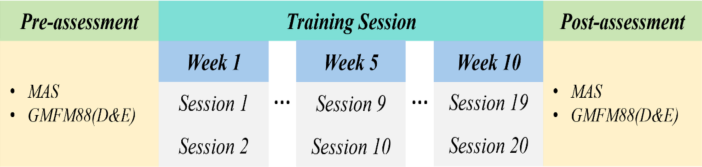
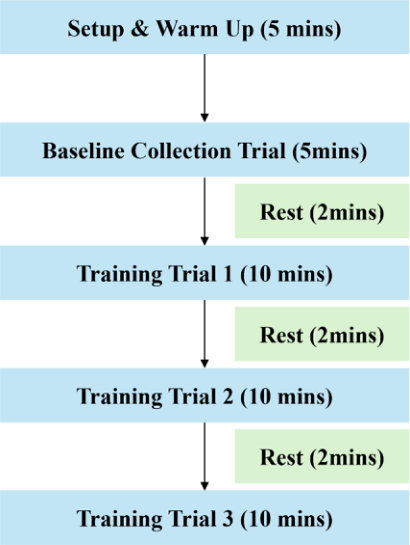
Clinical Training Protocol Each subject participated in a total of 20 sessions of soft knee robotic walking training. Twice a week, the whole protocol is completed within 10 weeks (see Figure 3). In the first and last visit of subjects, the clinical score and baseline condition were recorded as the pre and post assessment. The spasticity of the lower limb was evaluated by the Modified Ashworth Scale (MAS). Gross Motor Function Measure (GMFM 88 (D) and (E)) were adopted to assess individuals’ standing (GMFM 88 (D)) and walking function (GMFM 88 (E)). Before starting the training, participants were given 5 minutes for warm-up. Afte that, participants start to walk on the treadmill at their self- selected speed for 5 minutes with no assistance as the baseline collection trial. Then, after 2-minute rest, 3 trials of 10-minute walking with assistance were implemented sequentially to exercise the knee extension and 2-minute was given during each 10-minute walking trial (see Figure 4).
Figure 3: Gait training study design.
RESULTS
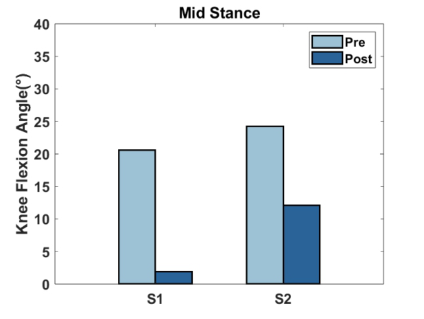
Two subjects completed 20 sessions training with soft knee robotic system. In post assessment, it was found that the knee flexion angle of Subject 1 during the midstance reduced from 20.56
to 1.9
while that of Subject 2 was reduced from 24.21
to 12.1
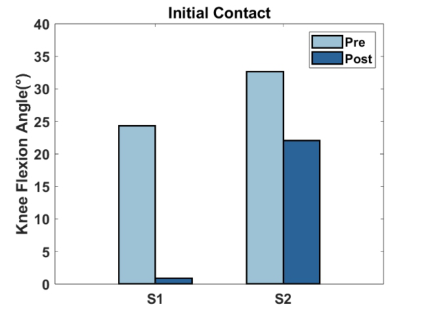
(see Figure 5–6, and Table 2). The results demonstrated that both subjects showed the enhanced fully knee extension in stance phase. Compared to the pre assessment, the knee flexion angle is closer to the typical developmental individuals. The more extended knee ensured support during the stance phase and during bodyweight transfer, preventing joint deformation and injury.
For clinical performance, MAS score of the paretic side knee joint of both subjects were assessed before and after training. The lower the score, the lower the muscle tone. From the results, the MAS score of Subject 1 was
Enhancing Motor Performance in Pediatric Cerebral Palsy 137
reduced from 1+ to 0 and Subject 2 was alleviated from 1+ to 1. It indicated that there is an improvement in muscle tone of the spastic knee joint in both subjects after training. Less spasticity of extensor furtherly mitigated the risk of contracture.
Figure 4: Flow chart of the training protocol.Figure 5: Knee flexion angle of subjects during midstance phase (S1: subject1; S2: subject2).
In specific lower limb function items, GMFM 88 (D) and (E) evaluated the gross motor function in walking and standing. Both subjects had higher
score in GMFM 88 (D) and (E) after training which indicated their lower limb locomotor skills and independence in standing and walking were strengthened (see Table 2). Preliminary training results demonstrated the feasibility of the soft knee robot in improving crouch gait. The scenarios of GMFM 88(D&E) contained basic daily scenarios of voluntary lower limb movements. Both subjects’ GMFCS level improved from II to I.
Figure 6: Knee flexion angle of subjects during initial contact phase (S1: subject1; S2: subject2).Table 2: Results of knee flexion angle, MAS, and GMFM 88 (D) & (E) scores.
This work demonstrates the validation of the soft knee robot protocol for extension support in crouch gait with pneumatic and comfortable assistive torque. Aimed at young age children with cerebral palsy, our proposed soft knee robotic training system is easy to accept and adapt quickly to clinical application. The pilot testing results indicate that the soft knee robotic system improves knee control and locomotor function during walking of both 12 and 4-year-old subjects. Especially for the 4-year-old subject, his training result strengthens the feasibility of early intervention for young children during the toddler period. Based on the results of this preliminary study, for future studies, a larger sample size of subjects will be implemented with an optimized lower limb independence training protocol.
Enhancing Motor Performance in Pediatric Cerebral Palsy 139
ACKNOWLEDGMENT
The authors are grateful for the financial support from the Innovation and Technology Fund of Hong Kong (ITS/156/20FP) and Cerebral Palsy Alliance Research Foundation & The University of Sydney (Project ID PG10818).
REFERENCES
Abbasi, L., Rojhani-Shirazi, Z., Razeghi, M., & Raeisi-Shahraki, H. (2021).
Kinematic cluster analysis of the crouch gait pattern in children with spastic diplegic cerebral palsy using sparse K-means method. Clinical Biomechanics, 81, 105248. Bufteac, E. G., Andersen, G. L., Spinei, L., & Jahnsen, R. B. (2020). Early intervention and follow-up programs among children with cerebral palsy in Moldova: Potential impact on impairments? BMC pediatrics, 20, 1–10. Cho, S., Lee, K. D., & Park, H. S. (2022). A mobile cable-tensioning platform to
improve crouch gait in children with cerebral palsy. IEEE Transactions on Neural Systems and Rehabilitation Engineering, 30, 1092–1102. Hunt, M., Everaert, L., Brown, M., Muraru, L., Hatzidimitriadou, E., & Desloovere, K. (2022). Effectiveness of robotic exoskeletons for improving gait in children with cerebral palsy: A systematic review. Gait & Posture, 98, 343–354. Lerner, Z. F., Damiano, D. L., & Bulea, T. C. (2017). A lower-extremity exoskeleton
improves knee extension in children with crouch gait from cerebral palsy. Science translational medicine, 9(404), eaam9145. Lerner, Z. F., Damiano, D. L., Park, H. S., Gravunder, A. J., & Bulea, T. C. (2016).
A robotic exoskeleton for treatment of crouch gait in children with cerebral palsy: Design and initial application. IEEE Transactions on Neural Systems and Rehabilitation Engineering, 25(6), 650–659. Morgan, C., Fetters, L., Adde, L., Badawi, N., Bancale, A., Boyd, R. N.,... & Novak, I. (2021). Early intervention for children aged 0 to 2 years with or at high risk of cerebral palsy: International clinical practice guideline based on systematic reviews. JAMA pediatrics, 175(8), 846–858. Pandey, R. A., Johari, A. N., & Shetty, T. (2023). Crouch gait in cerebral palsy:
Current concepts review. Indian Journal of Orthopaedics, 57(12), 1913–1926. Ries, A. J., & Schwartz, M. H. (2019). Ground reaction and solid ankle–foot orthoses are equivalent for the correction of crouch gait in children with cerebral palsy. Developmental Medicine & Child Neurology, 61(2), 219–225. Sarajchi, M., Al-Hares, M. K., & Sirlantzis, K. (2021). Wearable lower-limb
exoskeleton for children with cerebral palsy: A systematic review of mechanical design, actuation type, control strategy, and clinical evaluation. IEEE Transactions on Neural Systems and Rehabilitation Engineering, 29, 2695–2720. Snodgrass, J., Yan, S., Lim, H., Hameedduddin, I., & Wu, M.(2023, July). Design and Implementation of a Portable Knee Actuator for the Improvement of Crouch Gait in Children with Cerebral Palsy. In 2023 45th Annual International Conference of the IEEE Engineering in Medicine & Biology Society (EMBC) (pp. 1–4). IEEE. U.S. Department of Health and Human Services. What is Cerebral Palsy? | CDC.
Centers for Disease Control and Prevention. https://www.cdc.gov/ncbddd/cp/ facts.html (2022).
LISTED IN THE AHFE DIGITAL BOOKSTORE CATALOGUE
Explore the complete digital volume
Healthcare and Medical Devices
Read this individual research paper free through the original publisher, or explore the full digital proceedings book.
ISBN 978-1-964867-47-2
Explore this ISBN in the AHFE Bookstore ↗Listed in the July 2026 bookstore catalogue; search by ISBN to confirm current availability · Digital book purchase optional