Kazuhiko Shinohara (2025). Ergonomic investigation on Interventional Radiology in the era of robotic surgery. In: Healthcare and Medical Devices. AHFE Open Access, vol. 171, pp. 99–104. https://doi.org/10.54941/ahfe1006195
Interventional Radiology(IVR) is a minimally invasive treatment by using the small-caliber catheter and X-ray fluoroscopy. As the IVR technique can perform the dilation, occlusion and selective cannulation of the vessel and digestive canal without open-surgery, so demand and clinical cases have increased rapidly. However ergonomic problems of IVR had not been considered. Ergonomic problems during the IVR procedures of arterial catheterization are analyzed and investigated in this study. There are ergonomic problems such as neuro-muscular fatigue and asthenopia due to remote operation under X-ray fluoroscopy, small caliber catheters and inadequate working postures. Development of robotic catheter manipulator for IVR partially solved these problems. However, developments of robotic catheter manipulator are still limited such as coronary and carotid artery diseases, and manual operation by the physician still remains. Ergonomic and technological problems of IVR treatments should be further resolved through further workflow analysis of medical devices and medical staffs.
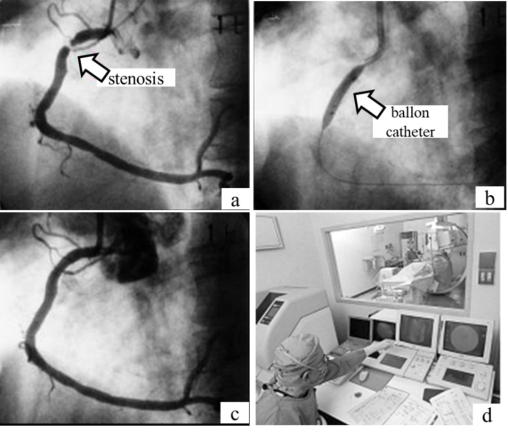
IVR is a minimally invasive treatment for vascular and digestive disease by using the small-caliber devices such as vascular catheters and stent. These devices are delivered to the target lesion under the image guidance of X-ray fluoroscopy. IVR can perform dilation, occlusion and selective cannulation in the blood vessel and digestive organs without open-surgery, so indication and cases of IVR are rapidly increasing. However ergonomic problems of IVR for physicians had not been considered. Development of robotic catheter manipulator for IVR partially solved these problems. Ergonomic problems and countermeasures of IVR in the era of robotic surgery are investigated in this study (see Figure 1, Figure 2).
MATERIAL AND MEFHODS Ergonomic problems of the devices and procedures of typical IVR therapy such as percutaneous coronary artery intervention, catheter ablation for
arrhythmia, vascular and biliary stenting are analyzed and investigated in this study.
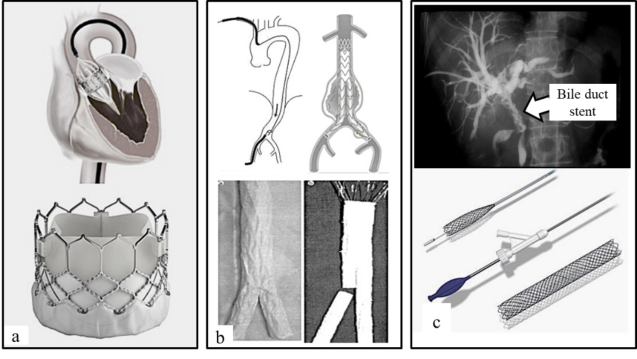
Figure 1: Scenes of IVR and IVR room, a: stenotic coronary artery, b: dilatation by ballon catheter, c: post angioplasty, d: IVR room.Figure 2: Advances of IVR, a: trans catheter implantation of aortic valve, Edwards SAPIEN 3TM, b: implantation of covered stent in the aorta by IVR, c: implantation of stent in the stenotic bile duct.
RESULTS
1. Neuro-muscular fatigues, perspiration, slip and fall risk by wearing X-ray protectors.
Ergonomic Investigation on Interventional Radiology in the Era of Robotic Surgery 101
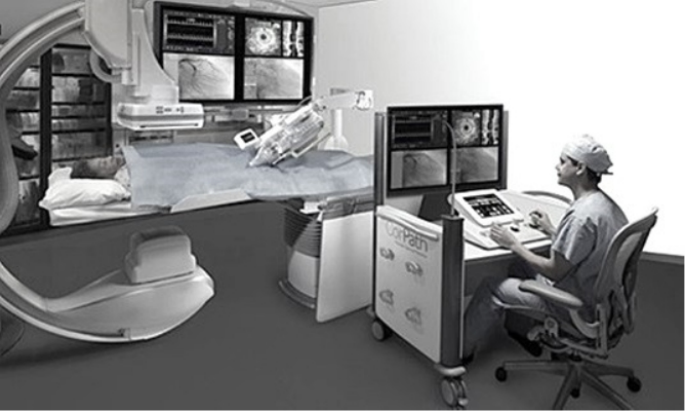
2. Inadequate working postures forced by the placements of medical instruments such as X-ray fluoroscopy, ultrasonography, ablation system and their displays. 3. Impaired maneuverbility of devices and asthenopia induced by X-ray fluoroscopy and X-ray protection goggle under dimmed lightning. 4. Impaired maneuverability and neuro-muscular fatigue forced by small caliber devices for intra-vascular catheterization. 5. Lacks of standardized human machine interface of IVR devices and instruction documents. 6. Ergonomic problem of impaired maneuverability and neuro-muscular fatigue forced by small caliber catheter for intra-vascular catheterization has been improved by using the IVR manipulator (see Figure 3, Figure 4, Figure 5).
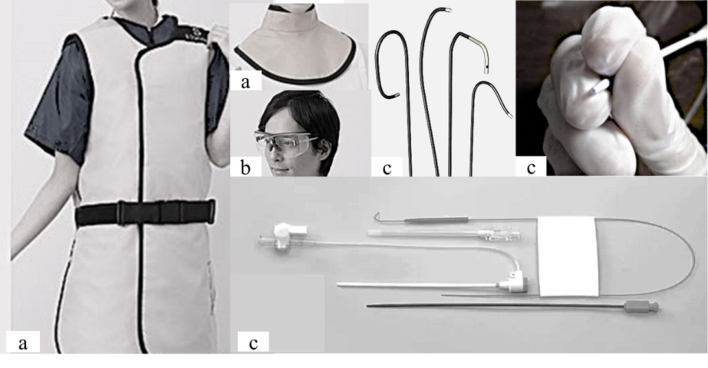
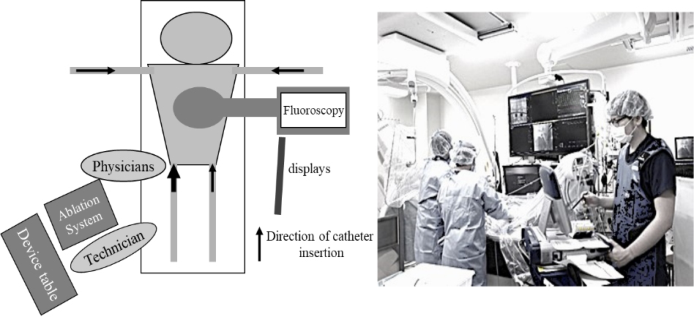
Figure 3: Equipments for IVR, a: X-ray protector, b: X-ray protection goggles, c: catheters for IVR.Figure 4: Layout of medical devices for angiography and ablation therapy.
IVR is a minimally invasive treatment for vascular and digestive disease by using the small-caliber devices delivered by under the image guidance of X-ray fluoroscopy. IVR can perform the treatment of dilation, occlusion, selective ablation, selective drug and device delivery without open-surgery. In recent years, Trans-catheter Aortic Valve Implantation (TAVI) and Trans- catheter Mitral Valve Clipping become the routine field of IVR. Indication and cases of IVR had widely applied to brain, heart, vascular, hepatobiliary and gastrointestinal diseases. IVR has now become an indispensable part of medical treatments, along with endoscopic surgery. Therapeutic devices of IVR are delivered to the lesion under the guidance of X-ray fluoroscopy and ultrasonic imaging. Therapeutic accuracy and safety highly depend upon both device itself and physician’s technique. Research and developments of devices for IVR are rapidly proceeding. However ergonomic consideration for IVR physicians had been neglected except the radiation health management. Most of the IVR procedures are performed under the guidance of X-ray fluoroscopy, so physician must wear X-ray protector which weight more than 4kg and X-ray protection goggle. These are main causes of fatigues, perspiration, and cervico-omo-brachial syndrome. Also these are risk for slip and fall incident.
Placement of X-ray apparatus, display, operating table cannot be changed and arranged freely. Physicians are forced to stare at imaging displays and operate the instruments under ergonomically poor posture. As an example, physicians are forced manipulate catheters by widely twisting body, neck and wrist.
Most of the IVR operation under X-ray fluoroscopy are done under dimmed lightning. Working with X-ray protective goggle and clothing under these environments can lead to eyestrain, asthenopia, neuro-muscular fatigue,
Ergonomic Investigation on Interventional Radiology in the Era of Robotic Surgery 103
impaired maneuverability of devices and risk of improper manipulation of devices during the IVR procedure.
As the IVR devices are delivered to the aimed lesion via blood vessel or endoscopy, most of their calibers are designed less than 2mm. Physician have to operate these small caliber devices with sterilized gloves during IVR-procedure. This is also essential causes of neuro-muscular fatigue of physician’s hand and impaired maneuverability of catheters. Designs and how to use of IVR devices differs by manufacturer and no standardization are established in the medical device industry. Also legibility and comprehensibility of user’s manual are unsatisfactory. These are barriers of intuitive uses of IVR devices and risk factors of mal-practice during IVR treatments.
Problems of perspiration by wearing heavy X-ray protectors can be improved by using cooling material and devices. However the weight saving of the protector is limited to keep the capability of X-ray protection. Inadequate working postures forced by the placements of imaging apparatus can be improved by the head-mounted displays which presents X-ray and other images to physicians. Impaired maneuverability and neuro-muscular fatigue forced by small caliber devices can be reduced by developing adequate aids and gloves which can conduct appreciate friction and holding forces. For the improvements of usability of IVR devices and user instruction manual, standardization and ergonomic improvement of IVR devices and instruction manual should be considered.
The recently developed endovascular robotics, CorPath GRXTM allows remote control of guidewire, catheter and stenting devices. The endovascular robotics has helped to resolve ergonomic issues in IVR (see Figure 5). However, developments of endovascular robotics still limited such as coronary and carotid artery diseases, and manual operation by the physician still remains. In particular, the placement of covered vascular stent for aortic aneurysm depend on manual operation by doctors. There is a demand for the development of IVR robotics with greater versality. In the field of general surgery, surgical robots for endoscopic surgery enable the intuitive surgical operations inside the patient’s body successfully. However, burdens on human resources and required time required for preparation, tidying-up and sterilization of surgical robots remains unresolved. Same problems in the IVR robotics should be considered for the further development of endovascular robotics. Ergonomic and technological problems of IVR treatments should be further resolved through the workflow analysis of medical devices and medical staffs.
CONCLUSION
Indication and cases of IVR had widely applied to brain, heart, vascular, hepatobiliary and gastrointestinal diseases. IVR has now become an indispensable part of medical treatments as a minimally invasive treatment for various disease. For the smooth and safe development of IVR, ergonomic and technological problems should be further resolved including ergonomic
104 Shinohara
solution of small-caliber devices for IVR, educational software, head- mounted displays through the analysis of the workflow of the medical devices and medical staff involved. Also development of IVR robotics with greater versality is needed.
REFERENCES
Shinohara, K. (2015): Ergonomic investigation of interventional radiology, Procedia Manufacturing 3. pp. 308–311; Elsevier B. V. Shinohara, K. (2019): The Feasibility of Ontological Description of Medical Device
Connectivity for Laparoscopic Surgery. In: Lightner, N. (Ed..) Advances in Human Factors and Ergonomics in Healthcare and Medical Devices, pp88-95, 2019. Springer, Heidelberg. Siemens Healthineers press release (2021.11.2). Siemens Healthineers Website: https://www.siemens-healthineers.com/jp/press-room/press-releases/ pr-20211102-corpath-grx
LISTED IN THE AHFE DIGITAL BOOKSTORE CATALOGUE
Explore the complete digital volume
Healthcare and Medical Devices
Read this individual research paper free through the original publisher, or explore the full digital proceedings book.
ISBN 978-1-964867-47-2
Explore this ISBN in the AHFE Bookstore ↗Listed in the July 2026 bookstore catalogue; search by ISBN to confirm current availability · Digital book purchase optional