Chiara Fasanotto, Annalisa Corradi, Rossella Onofrio, Paolo Trucco (2025). Socio-Technical Risk Analysis for the Digitalized Transfusion Process: the e-TRAST Tool. In: Healthcare and Medical Devices. AHFE Open Access, vol. 171, pp. 112–122. https://doi.org/10.54941/ahfe1006197
The digital transformation of the healthcare sector, while innovative for diagnoses and treatments, presents new challenges related to patient safety and the need to maintain a patient-centered approach. Among complex healthcare contexts, the transfusion sector, inherently both safety-critical and mission-critical, is increasingly characterized by the integration of digital solutions. These technologies, which play a crucial role in managing clinical data and supporting medical decision-making, are essential for ensuring the safety and efficiency of the transfusion process. However, the adoption of such tools has highlighted the need to consider Human and Organizational Factors (HOFs) to ensure the effective and safe integration of technology in high-risk healthcare settings. Although studies and hemovigilance reports have pointed out significant errors—including interoperability issues and inadequate management of IT alerts—that increase process complexity and risks, the literature has shown a lack of models to address these challenges. This master's thesis aims to fill this gap by exploring the impact of digitalization on the transfusion process through a qualitative and quantitative analysis of the risks associated with the interaction among technology, operators, and organizational structure.Methodology: The research process was developed in three main phases. First, a literature review was conducted to identify and classify relevant HOFs in the context of digital healthcare. Then, these findings were integrated into a risk analysis applied to e-health solutions in the transfusion process, resulting in the development of a theoretical model and the creation of a practical tool implemented in an Excel file. This tool was subsequently validated in collaboration with two hospitals and the developer of the software under analysis. Finally, the methodology was tested in a transfusion department of a hospital in Lombardy to calibrate the tool's parameters and verify its effectiveness.Results: The e-TRAST (digitalized Transfusion Risk Analysis from a Socio-Technical perspective) framework was developed by integrating Failure Modes, Effects, and Criticality Analysis (FMECA) with the Cognitive Reliability and Error Analysis Method (CREAM). This combination enables an in-depth analysis of failure modes within the digitalized transfusion process and their root causes. The tool’s underlying logic supports both safety and risk assessments that incorporate human, organizational, and technological factors, providing a holistic perspective on risk and facilitating the contextualization of e-health solutions within their operational environments.The Excel tool revealed that over 25% of failure modes present a higher likelihood of occurrence than previously estimated when human and organizational factors are considered. This tool proved to be effective in pinpointing areas for improvement—both for healthcare institutions, through enhanced training programs and stress management strategies, and for technology developers, by addressing system usability and reliability. In conclusion, the e-TRAST framework facilitates the safer and more efficient adoption of digital technologies within high-risk healthcare environments, ensuring patient safety and operational effectiveness.
Since the advent of the Internet and computerization, the healthcare sector has undergone profound changes, and digital solutions have become central to improving clinical practices (Yaqoob et al., 2020). However, the digital transformation of the healthcare sector presents new challenges related to patient safety and the need to maintain a patient-centered approach (Renaud, 2023). Indeed, the adoption of such tools has highlighted the need to consider Human and Organizational Factors (HOFs) to ensure effective and safe integration of technology in high-risk healthcare settings.
Socio-Technical Risk Analysis for the Digitalized Transfusion Process: The e-TRAST Tool 113
Among the complex contexts, the transfusion sector, inherently both safety-critical and mission-critical, is increasingly characterized by the integration of digital solutions. These technologies, which play a crucial role in managing clinical data and supporting medical decision-making, are essential for ensuring the safety and efficiency of the transfusion process (National Italian Blood Center (CNS), 2024).
The transfusion process involves multiple actors, including laboratories, blood centers, physicians, and nurses, who must remain aligned and coordinated to ensure timely and safe blood administration (Narayan, 2024). Such coordination is facilitated by digitization, which enables the rapid and secure transmission of critical information, such as blood supply levels, patient needs, and test results, thereby reducing the risk of human error and improving patient outcomes. However, despite these benefits, the rapid expansion of digital health solutions is often not accompanied by a structured understanding of their impact, resulting in concerns about usability, integration within healthcare organizations, and cybersecurity vulnerabilities (Welzel et al., 2023; Tase et al., 2022). Hemovigilance studies and reports have highlighted significant errors related to HOFs, including interoperability issues and inadequate management of IT alerts, which increase the complexity of the process (Narayan, 2024).
This is particularly relevant in the case of Software as a Medical Device (SaMD), which requires rigorous risk assessment not only to evaluate the impact of HOFs on patient safety but also to ensure compliance with regulatory requirements for certification and market approval, as mandated by European the Medical Device Regulation (MDR) (EU) 2017/745.
The aim of this study is to fill this gap by developing an integrated risk assessment methodology that analyses human, technological, and organizational factors to enhance the effectiveness and security of digital technologies, with a specific focus on the transfusion sector.
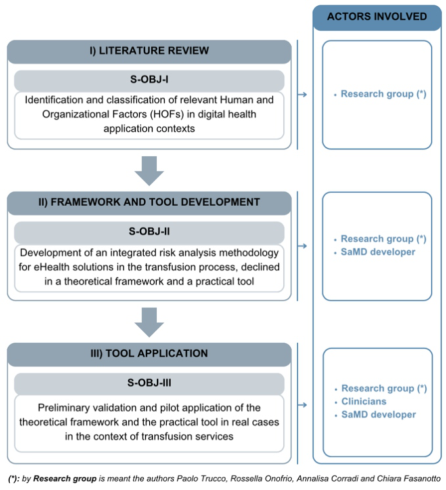
The aim can be turned into the following sub-objectives: I. S-OBJ-I: Identification and classification of relevant HOFs in digital health application contexts II. S-OBJ-II: Development of an integrated risk assessment methodology for eHealth solutions in the transfusion process, declined in a theoretical framework and a practical tool III. S-OBJ-III: Preliminary validation and pilot application of the theoretical framework and the practical tool in real cases in the context of transfusion services.
RESEARCH METHODOLOGY The research methodology is articulated in three main phases, each aligned with the specific study objectives (Figure 1).
Phase 1: Addressing S-OBJ-I, to fully understand the current state of knowledge and provide a relevant contribution to the academic debate, it was necessary to conduct a careful investigation of the surrounding context. This phase involves a Literature Review (LR) aimed at answering the following
research question: “What are the critical HOFs that influence the safety performance of eHealth solutions?”
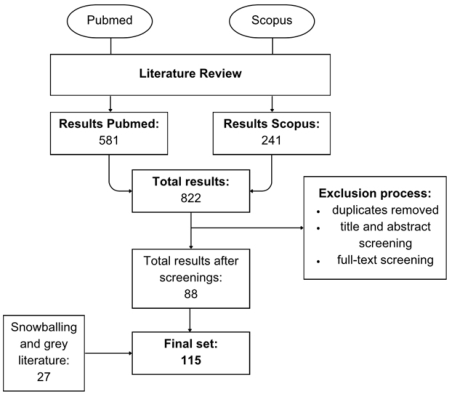
The process of collecting and screening papers from the literature is illustrated in Figure 2.
Figure 1: Overview of the research methodology.Figure 2: Flow chart of the literature review.
The careful analysis of preexisting research within the scientific landscape helped to establish a theoretical foundation and clarify the scope of the
Socio-Technical Risk Analysis for the Digitalized Transfusion Process: The e-TRAST Tool 115
study. Key findings were organized into thematic areas that emphasize the current challenges of incorporating HOFs in risk management for digitalized healthcare; they are presented in the “Results”section. This groundwork was essential to identify gaps and to define the areas where further methodological enhancement was needed.
Phase 2: Responding to S-OBJ-II, this phase focused on developing an integrated risk analysis methodology specific to transfusion-related eHealth solutions. The research context was carefully defined, analyzing the overview of the Italian transfusion system and the most widely used management software in Italian healthcare facilities, which support data management and decision-making throughout the transfusion process. Since this software is classified as a SaMD, it will hereafter be referred to as such.
The Failure Modes, Effects, and Criticality Analysis (FMECA) and Cognitive Reliability and Error Analysis Method (CREAM, Hollnagel, 1998) frameworks were presented in this phase, along with an explanation of how these techniques were modified and combined to evaluate failure modes from a socio-technical perspective that took organizational, technological, and human factors into account. The creation of a customizable practical tool at the end of this phase allowed healthcare facilities to use the methodology and modify the risk analysis to suit their unique requirements.
Phase 3: Aligned with S-OBJ-III, the final phase validated the framework with clinical experts and the company referees responsible for the SaMD’s development and ownership (hereafter referred to as ‘the SaMD developers’) and then piloted the tool in a real-world setting at the Immunohematology and Transfusion Medicine Service (SIMT) of an Italian hospital. The tool was implemented with input from a clinical expert, allowing for data customization, empirical validation, and result analysis, identifying strengths and areas for potential improvement.
RESULTS
The results of the three research phases are respectively represented in the following sections.
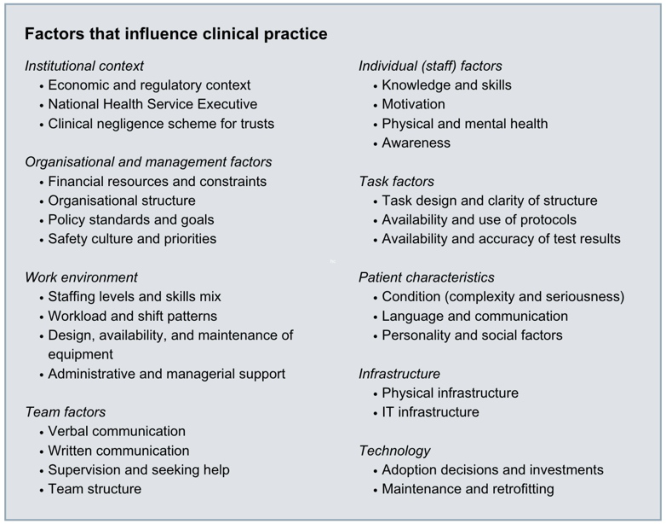
HOFs Identification and Classification The first key result of the study was the development of a comprehensive framework for classifying HOFs affecting patient safety and the interaction between healthcare professionals and digital technologies, which were identified through literature review. To structure these findings, Vincent’s established framework (1998) was used, which organizes risk factors across seven categories (Vincent et al., 1998). However, recognizing that technological advances and the increasing integration of digital tools introduce new risks — such as device usability issues, software compatibility, connectivity, and cybersecurity vulnerabilities — we integrated the original framework with new elements and categories.
The integrations consisted of an “Awareness” element within the “Individual factors” category, emphasizing personal awareness of cybersecurity risks like social engineering. Additionally, two new categories
were introduced: “Infrastructure,” covering both physical and IT infrastructures essential for digital health operations, and “Technology,” which considers adoption decisions and the maintenance of healthcare technologies. The framework’s categories are presented in Figure 3.
Figure 3: Integration of different categories/elements into Vincent’s framework.
Development of e-TRAST To accomplish the second research objective, the e-TRAST (digitalized Transfusion Risk Analysis from a Socio-Technical perspective) framework was developed as a comprehensive theoretical model for risk assessment, combining the established FMECA tool (Marx & Slonim, 2003) with the CREAM model (Hollnagel, 1998) to address specific needs in this context. e-TRAST investigates potential failure modes throughout the “digital journey” of the blood bag inside the SaMD, tracing these failures back to their root causes. This framework was implemented as an Excel- based tool, designed for practical use by healthcare organizations.
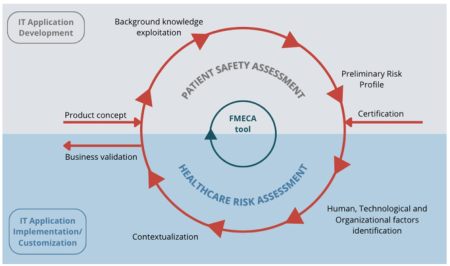
LOGICAL ARCHITECTURE OF THE FRAMEWORK During the development of a new generic IT solution, it undergoes an integrated process cycle designed to ensure a comprehensive security and clinical risk assessment during its lifecycle (Figure 4).
Socio-Technical Risk Analysis for the Digitalized Transfusion Process: The e-TRAST Tool 117
Figure 4: Integrated cycle for safety and risk management.
The cycle is made of two main phases. The first one is the Patient Safety Assessment and involves a systematic risk evaluation by the technology provider during the development of the digital solution (ex-ante), ensuring that design decisions are evidence-based. The second phase, Healthcare Risk Assessment, tailors the risk profile to the specific healthcare setting (ex-post), allowing for targeted adjustments that facilitate integration. Finally, a Feedback Loop, intrinsic to the cycle, allows for continuous improvement of the digital application, using real-world data to address emerging risks and maintain safe operations within the healthcare environment.
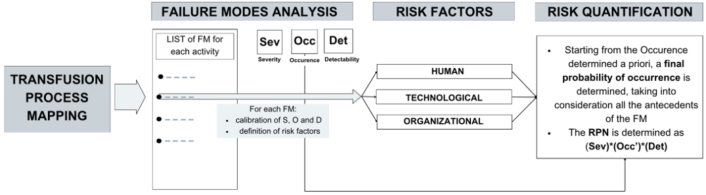
Given this approach, the e-TRAST framework was developed as follows (Figure 5), allowing for both the preliminary patient safety assessment of the IT solution and the healthcare risk assessment of the IT solution implementation in a specific healthcare setting. First, the transfusion process was mapped across its phases and activities, focusing on those involving the SaMD. For each activity, potential failure modes were identified, and key FMECA parameters - severity, occurrence, and detectability - were assigned. Next, each failure mode was analyzed in detail to identify risk factors (i.e. root causes), classified as human, technological, or organizational. In the final step, the risk was re-quantified, adjusting the occurrence parameter based on the identified risk factors, and the Risk Priority Number (RPN) was calculated by multiplying severity, the adjusted occurrence, and detectability.
Figure 5: The e-TRAST framework.
Methodological Background of the Framework The e-TRAST framework was grounded in Failure Modes, Effects, and Criticality Analysis (FMECA), a widely recognized and established risk analysis tool frequently used in high-risk sectors like industry and healthcare. Its structured methodology allows for clear application in clinical settings, providing a solid foundation for the initial phase of e-TRAST by systematically identifying and mitigating technical failures.
In addition to FMECA, e-TRAST incorporates Erik Hollnagel’s Cognitive Reliability and Error Analysis Method (CREAM) for Human Reliability Analysis (HRA) to mitigate the risk of human error in complex systems (Hollnagel, 1998). CREAM offers a robust framework to analyze the interactions among the operator, technology, and organization, making it particularly valuable for understanding how human factors contribute to risk in healthcare contexts. The method classifies failure modes as general effects (i.e. error phenotypes) and associates each effect with specific general antecedents (i.e. error genotypes) to identify underlying causes (Hollnagel, 1998). This dual approach improves the analysis by making sure that human errors resulting from interactions with digital systems are appropriately understood and managed in addition to technical failures that are identified and mitigated through FMECA.
After demonstrating the efficacy of combining FMECA and CREAM, the use of CREAM in the context of digitalized transfusion showed certain limitations. Indeed, the general antecedents of CREAM, which was initially created for less digitalized environments, did not adequately address the unique difficulties presented by systems such as the SaMD, which introduce new risk factors associated with digital interfaces, system connectivity, and the intricacy of automated processes. Based on a review of the literature as well as specific hemovigilance reports, such as the Italian SISTRA (“Sistema Informativo dei Servizi Trasfusionali,” i.e. the Transfusion Services Information System) (National Italian Blood Center (CNS), 2024) and the English SHOT (Serious Hazards Of Transfusion) (Narayan, 2024), we expanded the set of antecedents to fill in these gaps.
To guarantee that the framework appropriately captured the requirements and hazards of digitalized transfusion procedures, this modification was necessary.
Practical Tool The general e-TRAST framework was eventually implemented into an Excel- based tool. The tool is organized into eight sheets, structured to guide users through each phase of the transfusion process.
The first five sheets — Donor Identification, Laboratory, Production, Traceability, and Distribution — correspond to the phases outlined in the SaMD’s user manual. Each sheet lists specific activities within each phase, along with potential failure modes.
Supporting these main sheets, the tool includes additional sheets for reference and analysis:
Socio-Technical Risk Analysis for the Digitalized Transfusion Process: The e-TRAST Tool 119
Scoring Scales provides reference scales for severity, occurrence, and detectability.
Antecedents lists potential causes of failure modes with associated probability values.
Data Analysis includes pivot tables for analyzing the collected data and results.
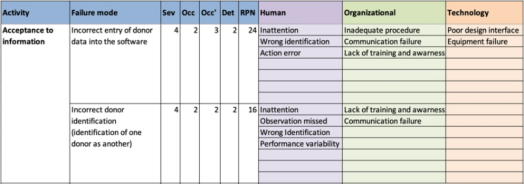
Each activity and failure mode are linked to customizable risk parameters, allowing users to edit values for severity, occurrence, and detectability. Using drop-down menus, users can choose from pre-filled antecedents based on the CREAM model, which provide specific organizational, technological and human factors pertinent to each failure mode.
Without having to comprehend the complexities of CREAM, users can concentrate on risk factors relevant to their specific clinical setting thanks to this methodical yet adaptable approach.
Figure 6: Example of donor identification worksheet on excel.
Risk Parameters Five major risk parameters were assessed for every failure mode in the Excel tool: severity, a priori and a posteriori occurrence, detectability and Risk Priority Number (RPN).
Severity indicates the potential impact an error could have on a patient, and it is determined by a five-level scale from the SISTRA hemovigilance. This scale, ranging from “No effect” to “Severe or Catastrophic,” provides a detailed assessment of clinical outcomes.
Occurrence represents the probability of a failure mode to occur during the transfusion process and is measured using two different kinds of metrics. A priori occurrence is an initial estimate based on general data and expert knowledge. It uses a predetermined scale with four levels: Rare, Remote, Occasional and Frequent. Each level corresponds to a certain probability range and provides a baseline likelihood of failure under ordinary conditions (Trucco & Cavallin, 2010).
The a posteriori occurrence then refines this initial estimate by incorporating the influence of specific human, technological, and organizational factors (antecedents) that contribute to each failure mode. By considering the probability of each antecedent, this “socio-technical” occurrence provides a realistic view of how actual operating conditions impact the likelihood of failures, enhancing the precision of risk estimates.
Detectability measures the ability to intercept an error before it has an impact on the patient. Using again a predefined scale (Trucco & Cavallin, 2010), it ranges from “High” (errors detected automatically) to “None” (no detection possible), giving an idea of the reliability of error detection mechanisms.
Risk Priority Number (RPN) is a numerical value that prioritizes risk mitigation actions by combining severity, a posteriori occurrence and detectability. Higher RPN values indicate higher risk, helping healthcare facilities to focus on the most critical failure modes.
Tool Validation and Pilot Application After developing the e-TRAST tool, a preliminary validation and calibration were conducted, involving the SaMD developers and two clinical experts. In terms of validation, both clinicians expressed strong support for the tool, recognizing its reliability and necessity for transfusion processes, while SaMD developer company’s representatives highlighted the tool’s utility in standardizing human factors for certification, tracking KPIs, and assessing risk impact from software updates.
The calibration, which took place at an Italian hospital, consisted in parameterizing key values, including the likelihood of antecedents and the severity, occurrence and detectability of failure modes. An important finding from this calibration was that incorporating human, technological, and organizational factors led to an upward adjustment in occurrence levels for 25% of failure modes. Specifically, out of 60 total failure modes, 15 were initially underestimated, with the majority found in the Donor Identification and Distribution phases, where distractions and environmental factors increase the likelihood of error. In contrast, phases like the Laboratory, with a more controlled environment, showed fewer adjustments, underscoring the relevance of contextual factors in risk assessment.
As the final part of the study, a data analysis was conducted on how human, organizational and technological factors contribute to failure modes within the digitalized transfusion process. Human factors, such as inattention and action errors, emerged as primary contributors, highlighting the need for focused training and stress management to reduce errors. Organizational factors, including poor interoperability, lack of training, and inadequate procedures, point to the need for standardized practices, enhanced training, and investments in compatible technologies. Technological factors, notably equipment failures and interface design issues, indicate areas for improvement in device reliability and usability. This analysis allows healthcare facilities to identify interventions for optimizing safety and efficiency in transfusion processes.
CONCLUSION
Theoretical and Practical Contributions From a theoretical perspective, this study introduces an integrated risk analysis framework for digital health that incorporates Human and
Socio-Technical Risk Analysis for the Digitalized Transfusion Process: The e-TRAST Tool 121
Organizational Factors, bridging for the first time the Cognitive Reliability and Error Analysis Method (CREAM) and Failure Modes, Effects, and Criticality Analysis (FMECA) models. This novel framework advances the understanding of risk in digital healthcare settings, offering a structured approach to analyzing risks associated with the interaction of human, technological and organizational elements.
On the other hand, this study’s practical contributions lie in the real- world applicability and impact of the developed tool within healthcare environments and for the SaMD developer as a provider.
For healthcare organizations, the tool enables targeted improvements throughout the process, including staff training, better environmental conditions and increased connectivity. This structured approach not only improves workflows but also fosters a culture of safety, transparency and continuous improvement, resulting in better patient care.
Furthermore, the tool helps the SaMD developer improve its products by focusing on key areas such as user interface, system stability and accessibility, all of which are essential for reliable performance in healthcare settings. Addressing the root causes of errors, it leads to more accurate occurrence rates and a deeper understanding of risk factors. Moreover, such an advanced analysis supports regulatory compliance, such as CE certification, and reinforces the SaMD’s developer reputation as a reliable provider of safe, compliant healthcare software.
Study Limitations and Further Research The main limitations of this research include model and application- related aspects. At the model level, the model does not incorporate causal relationships among antecedents, which often interact in the context of human and organizational factors; indeed, a more precise calibration would have required data which are still unavailable in existing official reports.
In terms of application, this study requires extensive validation since our preliminary validation involved clinical experts only from two Italian hospitals, limiting the empirical robustness of the model.
To address these limitations, future developments could include more extensive validation and testing across multiple hospitals, as well as extending the tool to other clinical areas. Moreover, this methodology may contribute to the improvement of the risk assessment process to comply to SaMD regulatory approach. Lastly, it would allow HOFs to be considered in decisions about adopting new healthcare technologies, improving overall safety and effectiveness.
REFERENCES
Hollnagel, E., 1998. CREAM: A Second Generation HRA Method. In: E. Hollnagel, a cura di Cognitive Reliability and Error Analysis Method (CREAM). Oxford: Elsevier Science Ltd, pp. 151–190. Marx, D. A. & Slonim, A. D., 2003. Assessing patient safety risk before the injury
occurs: An introduction to sociotechnical probabilistic risk modelling in health care. Quality & Safety in Health Care, 12(2), pp. ii33–ii38.
National Italian Blood Center (CNS), 2024. Centro Nazionale Sangue - Homepage.
[Online] Available at: https://www.centronazionalesangue.it. Narayan, S. e. a., 2024. The 2023 Annual SHOT Report, s.l.: Manchester: Serious Hazards of Transfusion (SHOT) Steering Group. Renaud, K., 2023. Human-centred cyber secure software engineering. Zeitschrift Fur
Arbeitswissenschaft, Volume 77, pp. 45–55. Tase, A., Ni, M. Z., Buckle, P. W. & Hanna, G. B., 2022. Current status of medical device malfunction reporting: Using end user experience to identify current problems. BMJ Open Quality, 11(2). Trucco, P. & Cavallin, M., 2010. Multidimensional FMECA for assessing the impact
of RFId technology on blood transfusion risks. London, Taylor & Francis Group, pp. 2217–2221. Vincent, C., Taylor-Adams, S. & Stanhope, N., 1998. Framework for analysing risk and safety in clinical medicine. British Medical Journal, 316(7138), pp. 1154–1157. Welzel, C. et al., 2023. Holistic Human-Serving Digitization of Health Care
Needs Integrated Automated System-Level Assessment Tools. Journal of Medical Internet Research, Volume 25. Yaqoob, T., Abbas, S. & Shafqat, N., 2020. Integrated Security, Safety, and Privacy Risk Assessment Framework for Medical Devices. IEEE Journal of Biomedical and Health Informatics, 24(6), pp. 1752–1761.
LISTED IN THE AHFE DIGITAL BOOKSTORE CATALOGUE
Explore the complete digital volume
Healthcare and Medical Devices
Read this individual research paper free through the original publisher, or explore the full digital proceedings book.
ISBN 978-1-964867-47-2
Explore this ISBN in the AHFE Bookstore ↗Listed in the July 2026 bookstore catalogue; search by ISBN to confirm current availability · Digital book purchase optional