Helen Fuller, Tamara Winden, Brandon Harpold, Somer Hand, Jacob Huffman, Timothy Arnold (2025). Human Factors in an Agile Environment: Capturing Value in Healthcare. In: Healthcare and Medical Devices. AHFE Open Access, vol. 171, pp. 11–20. https://doi.org/10.54941/ahfe1006186
1 Human Systems Integration, Office of Health Informatics, Office of Clinical Informatics, Digital Health Office, Veterans Health Administration, Department of Veterans Affairs Washington, DC, USA ↗
Increasingly, healthcare systems seem to be turning to management practices and tools used in manufacturing and software industries, including lean, to structure process improvement. They focus on identifying waste and delay to reduce bottlenecks and improve flow. There are, however, challenges to deploying such tools and methods in a healthcare environment. Expanding the ways we consider attributes such as value and waste and utilizing human factors methods to better understand how people are functioning in the system can assist with the translation of these manufacturing ideas into healthcare domains. By describing different types of value, including value associated with patient-centered care and resilient behavior, we were able to better capture important functionality of the healthcare system. We illustrate the importance of explicitly considering different types of value people may add to a system by examining the activities around delivering gastrointestinal (GI) specialty care to patients via referrals from primary care providers (PCPs). These expanded ways of looking at value and methods for understanding the activities of people within systems can contribute to better comprehension of systems and support more effective process improvement methods.
Healthcare systems are often faced with what appear to be capacity issues, where demand exceeds supply, and they may struggle to deliver care in a timely fashion. Increasingly, healthcare is turning to methods from manufacturing and software industries, including lean methodologies, to structure process improvement (e.g., Vashi et al.). Lean is a set of manufacturing principles that emphasizes reduction of waste while delivering value through continuous improvement efforts (Womack et al., 1990; Liker, 2004). Henrique and colleagues (2016) described how various groups have applied lean concepts in healthcare to manage processes and optimize flow.
An important tool used in manufacturing is value stream mapping (VSM), which aims to identify and analyze the flow of all activities involved in delivering products or services to a customer (Rother & Shook, 2003). VSM has been adapted for healthcare to consider the flow of information, product, and materials associated with care delivery (Henrique et al., 2016). While the adaptation offers an improvement over the traditional manufacturing VSM by supporting identification of operational bottlenecks and wastes that were not found with other mapping methods, it may not adequately consider all the ways in which waste and value are viewed and understood in healthcare.
Employing process improvement methods with considerations of human factors concepts may help us optimize systems for people. For example, it is important to understand how a system is currently functioning to avoid assuming the space is a blank slate onto which changes can be imposed with no unintended consequences or other challenges. This is especially true for complex adaptive systems such as healthcare. Human factors methods such as contextual inquiry and cognitive task analysis, conducted via semi- structured interviews and observations, can aid in describing and mapping work-as-done (WAD) as well as identifying pain points and features that are working well.
We will describe experiences working within a team using lean methods as human factors engineers at a large healthcare system. In particular, we will describe ways in which we have used human factors approaches to further adapt VSM to better describe workflows in the healthcare environment in order to understand waste and capture sources of value. We illustrate these adaptations by considering the activities around delivering gastrointestinal (GI) speciality care to patients via referrals from primary care providers (PCP). The systems understanding supported by this version of VSM can contribute to more effective process improvement methods.
CONSIDERATIONS WHEN IMPLEMENTING VSM IN HEALTHCARE Given that lean is traditionally used in manufacturing environments, it is important to consider some of the ways in which healthcare may differ. While variability in products is typically considered to be undesirable, patients possess inherent variability that may be managed to some degree but never completely controlled. For example, variability in patients’ biology and medical histories may influence time and level of effort required when ordering care, triaging care delivery, scheduling care, and delivering care.
Similarly, in a large healthcare system, different sites may have different resources and processes that have formed accordingly. If a goal is to improve patient outcomes across the system, some variability in how care is delivered may be necessary to accommodate variability of system resources and of patients. It is also important to recognize that healthcare itself is variable, and some aspects of the system may be better suited to process improvement using lean methods than others.
Human Factors in an Agile Environment: Capturing Value in Healthcare 13
Reflecting on Waste and Value in Healthcare When we began to consider VSM for the process of managing a referral for GI care, we found that the identification of waste and value was more complicated than anticipated. Some things that appear to be examples of waste could actually contribute to value at other points in the process or under certain conditions. For example, scheduling patient appointments is generally done by medical support assistants (MSAs). In some healthcare systems, we have observed registered nurses (RNs) or licensed practical nurses (LPNs) calling patients to schedule appointments when hospital leadership decided it is important to be able to address clinical concerns with patients during this contact. These conversations allow nurses to identify and respond to concerns that might prevent the patient from receiving the right care during the clinical appointment, such as identifying medications that the patient must stop taking prior to the appointment. When patients arrive at appointments not properly prepared or still taking certain medications, it may not be possible to conduct a procedure and the patient will not receive the needed care. In turn, the system functions more smoothly when there are fewer patient cancellations and instances when care must be rescheduled.
In addition to value depending on contextual factors, what is considered valuable varies by role and across individuals within each role. Table 1 describes different perspectives in the healthcare system, including the perspective of the system as a whole, and describes some possible values for each component, based on hospital site visit observations, interviews, and experience.
Table 1: What different components of the healthcare system, including patients, healthcare workers, and the healthcare system itself, may value in delivering specialty care to patients.
Table available in the original PDF paper.
System Component Things Valued
Accuracy of care, timeliness of care (at appropriate times and
Patient and support system (including caregivers) at desired times), patient-centric care, positive interactions with providers and staff, desired location, information flow (expectations, return of information), usability of information and instructions Healthcare workers
Patient satisfaction, job satisfaction versus burnout, ability to
(overall)
work at top of license, autonomy/control/agency, usability of and lack of frustration with policies/practices/tools, documentation to obtain workload credit Primary care
Most efficient delivery of information about the patient to
providers
the specialist, appropriate and timely specialty care for the patient, return of information about the care/results Specialty care
Receipt of complete information (including confidence that
providers
lack of information is not missing information), patient scheduled for the right level of care, few cancelled appointments, patient types staggered (e.g., new patients not in back-to-back appointment slots) Continued
Table 1: Continued System Component Things Valued
Table available in the original PDF paper.
Staff triaging care
Support for finding information in patient charts, decision
requests
support for types of care (within facility versus external, type of appointment, etc.) Schedulers Usable scheduling systems (ability to easily identify and book patients in open slots), support for scheduling conversation with patient (e.g., clinic locations relative to patients, availability at CC facilities, knowledge of patient preferences), support for reaching the patient Overall healthcare
Maximize use of system resources through fewer
system
cancellations, work at the lowest feasible/reasonable level, lowest reasonable work input (e.g., fewest touchpoints), no unnecessary rework, and appropriately prioritized patient care The values considered to be most important may vary across healthcare system, location, specialty area, time, and of course individuals. Human factors methods such as interviews and user surveys can aid in identifying and understanding values. By developing personas and journey maps that document these values, we can support thoughtful redesign of systems and promote change management activities.
Activities that consume resources but do not add value for a customer are considered to be waste. Lean methods seek to identify and minimize waste in systems. Seven types of waste were originally identified by Taiichi Ohno as part of the Toyota Production System (TPS), and an eighth (skills) was later introduced (Narusawa & Shook, 2009; Cunningham, 2020).
We propose inclusion of a ninth type of waste—brittleness—for complex systems such as healthcare. Brittleness, within the context of systems engineering, describes the risk of sudden failure when a system exceeds its ability to handle variation and is generally considered to be in opposition to resilience, which is the ability of systems to maintain or resume normal operations under expected and unexpected demands (Woods, 2015). While brittleness is not directly an activity, it represents the potential for additional, non-value-added work in an attempt to avoid failure when the system is unable to gracefully accommodate changes as well as the potential for the system to fail to deliver any value.
Human factors methods such as observation, interviews, and contextual analysis can support the identification of waste. Task and workflow mapping can help lean team members visualize the system and identify points at which waste may be occurring.
The types of waste commonly referenced in lean along with the new proposed type of waste are listed in Table 2. The table also includes examples of these types of waste identified during interviews and observations of GI care delivery.
Human Factors in an Agile Environment: Capturing Value in Healthcare 15
Table 2: Descriptions of types of waste currently identified in lean (Narusawa & Shook, 2009; Cunningham, 2020) and a proposed ninth type with examples from healthcare.
Table available in the original PDF paper.
Type of Waste Description Healthcare Example Transportation Excess movement of the Scheduling a patient for
product or patient in the system
appointments on different days and requiring extra trips to the medical facility rather than on the same day Inventory Keeping more of an item than
Sending colonoscopy prep
is needed for the process at that point in time
materials to a patient earlier than needed, introducing the risk that the patient may misplace the prep materials Motion Movement of employees Switching between the patient
Waiting for patient referrals to be
electronic health record and a referral management software to gather information to perform a triaging task Waiting Points in the process where processed prior to scheduling
nothing is happening; operators or equipment standing idle Overproduction Creating an excess of a
Sending the patient for
product or service
additional lab tests when the patient’s most recent tests are considered current Overprocessing Unnecessary work or work to
Scheduling unnecessary
a higher quality than needed
A referral sent for the wrong
screening may introduce risk while uncovering a slow-growing cancer that would not otherwise be relevant to that patient Defects Work activities that are not
completed correctly the first time
type of care or without sufficient information to triage the care request Skills Failing to fully use the
LPNs rather than MSAs scheduling patient appointments
knowledge, skills, and abilities of employees; healthcare workers not working to the top of their license Brittleness The risk of sudden failure
Scheduling software that does not support a waiting list to fill cancelled appointment slots
when a system exceeds its ability to handle variation and changes (Woods, 2015); the absence of resilience; sometimes related to tight couplings in systems
Lean thinking considers what the customer values, and some activities that might be labelled as waste may also add value to the system. This leads us to ask how we can identify and label different types of value in the healthcare system to help us understand how the system is functioning. Doing so could help us work to preserve value during redesign efforts and communications with leadership. It can also give us language to support conversations with end users and stakeholders that can lead to learning about what is valuable in their systems.
An example of an activity that could be identified as waste but that may provide value in the area of GI care is sending colonoscopy preparation medications to the patient as soon as they are scheduled for a colonoscopy. Though the procedure may be scheduled for some time in the future, having the materials early can avoid negative outcomes of shipping delays if the materials were sent closer to when they were needed and also allow for the patient to be scheduled into an earlier slot that opens when another patient cancels because they will already have the materials on hand to prepare for the appointment. Of course, this value must be balanced against the risk that the patient may lose the materials prior to an appointment or may begin the preparation process too early.
Sending these medications early promotes resilience, defined as the ability of a system to respond to expected and unexpected demands to allow continuation or resumption of normal operations (Woods, 2015). Hence, we label the value this brings “resilience value.” Other values we categorized as relevant in healthcare include system resources value, patient-centered value, and investment value. These values are described in Table 3.
Table 3: Descriptions of types of value proposed for healthcare processes. Some activities may support multiple types of value.
Table available in the original PDF paper.
Value Description and Healthcare Examples System resources Basic value related to the use of system resources such as staff time, materials, and funds Patient-centered Activities that consume resources but support patient-centered
care (e.g., taking additional time to describe care options to a patient); there may be tensions between value to an individual patient and value to the collective patient population Investment Activities that may initially consume resources or appear to be non-value-adding but lead to the potential for value later in the process Resilience Possibly resource-consuming or redundant steps developed to
accommodate complexity and variance and to promote resilience, defined as the ability of systems to respond to demands to allow continuation of normal operations (Woods, 2015); activities may be centralized or developed at distributed points of the system and may be the result of deliberate planning or emergent
Human Factors in an Agile Environment: Capturing Value in Healthcare 17
Identifying and Mapping Value Found During Site Visits Site visits allow us to explore, document, and understand work-as-done (WAD), which can often vary from the work-as-imagined (WAI) that may be described in policies or by managers. Human factors methods such as contextual inquiry, supported by interviews and observations, and cognitive task analysis facilitate this work. Mapping the workflows at different levels of granularity can aid with visualization of WAD and also allows us to map proposed waste and value to the process in ways that help us understand it in context. The result is similar to VSM, but it makes it easier to represent non- linear activities that may not organize around the movement of a particular material or individual while emphasizing findings that may be harder to quantify.
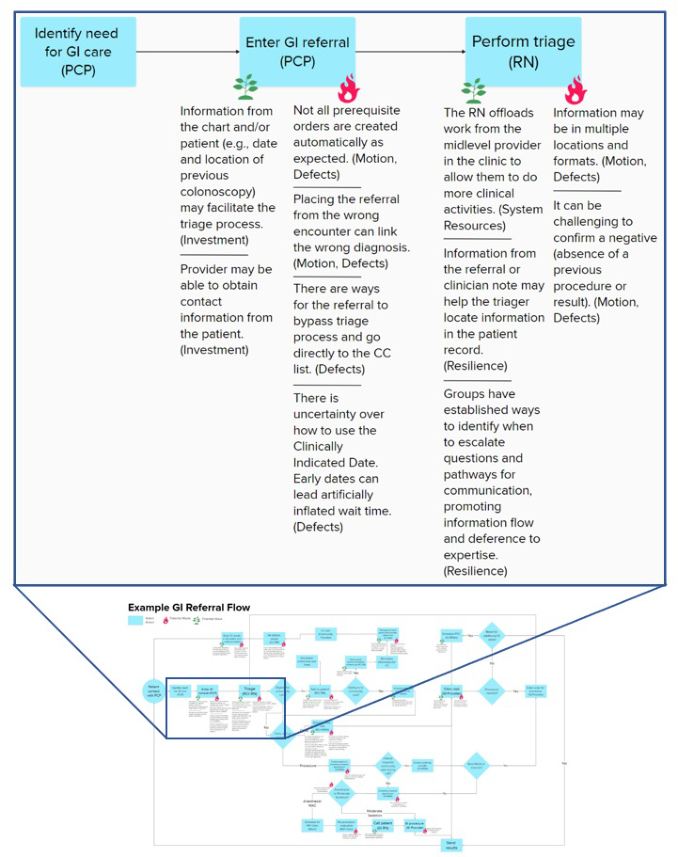
An example of this mapping is shown in Figure 1. The expanded portion of the figure shows the steps where a primary care provider (PCP) identifies that a patient requires care from a GI specialist and enters the request for care (commonly called a consult or referral). A nurse (RN) then triages the care request to determine the appropriate routing in the GI department.
We identified waste in the forms of motion and defects at these steps. We also found ways in which people added value in the forms of system resources, investment, and resilience.
There are opportunities during the patient interaction and care request entry for the PCP to complete some activities that will support work downstream in the system. For example, the PCP can document the date and location of a previous GI procedure, which will help the RN performing the triage to locate relevant records. It is especially valuable if the PCP documents that the patient reports no previous GI procedures, because this can save the RN considerable time trying to locate a record of care that does not exist. We label this activity as adding resilience value to the system, because it assists the RN in finding information that may be located in one of multiple different places and not necessarily searchable or labelled in a way that can be easily found.
The PCP also can add a note with guidance for how to contact the patient, which can make the scheduling step, which occurs later in the process, more efficient and more successful. We label this PCP activity as adding investment value. It is an additional step for the PCP and one that is not always necessary if all patient records are correct, but if the PCP can identify a patient who will be hard to reach and suggest alternatives to the scheduler it will improve the probability of successfully delivering the requested care to the patient.
Another resilience-adding activity is the ways RNs have found to communicate formally and informally with providers in the system. They can send messages using internal communications channels to ask for clarification from PCPs on items in the patient’s healthcare record and the type of care being requested. They can also reach out to providers in the specialty clinic to ask about the best routing for complex patients given current clinic workloads. These open communications support the flow of the patient through the system to reach the point of care delivery.
Figure 1: Example flow map for a GI referral process showing areas where certain activities can add waste and value.
DISCUSSION
Mapping a healthcare process and identifying activities that contribute to waste and value aids in facilitating a common understanding of the processes and the activities of actors in the system. This can help us to identify individuals to include in participatory redesign as well as facilitate design decisions that will support people in contributing to the success of the system.
It is important for this investigation and documentation of workflow with value and waste to occur at the appropriate level in the system. In some cases, it will be important to understand interactions between different units or groups of workers, so the mapping may need to encompass the entire system
Human Factors in an Agile Environment: Capturing Value in Healthcare 19
involved in delivering a specific type of care to a patient. When considering the redesign of interfaces, however, it is important to drill down to the level of the individual worker and consider the tasks and information needs at each step.
It is also important to consider trade-offs, because the same activity may contribute to waste and value. For example, moving patients in the schedule to fill a gap left by a cancellation could be considered overprocessing, but it eliminates waiting by avoiding downtime for a provider and a procedure room. The ability of schedulers to shift patients to accommodate changes demonstrates resilience.
The process of conducting site visits and mapping the work uncovered different types of variability. While variability is often considered to be something to reduce in lean efforts, in this case many of the activities appeared to be markers for resilient behavior, allowing the healthcare team to manage the variability inherent in a patient population. For example, a nurse reviewing a patient chart when triaging a care request might identify characteristics of the patient that are likely to make them challenging to contact via standard routes. If there is useful information in a patient note that could facilitate scheduling the patient, the nurse will document the information in a place available to the scheduler. This additional work at the triage stage will make it more likely the scheduler can successfully reach the patient and that the patient will receive the requested care. By describing this variability and the value it adds to the system, we can design to accommodate necessary variance and local autonomy in certain aspects of work. We can also find variability that may be problematic, work to understand its sources, and recommend alternatives.
CONCLUSION
While methods designed for industries such as manufacturing and software development might not appear to fit well in the healthcare environment, with careful adaptation they may have utility. By using human factors engineering approaches that promote consideration of human needs and tendencies throughout the system, it is possible to utilize methods from lean to understand types of waste and value and improve healthcare processes.
ACKNOWLEDGMENT
We thank those working at the Veterans Health Administration for their commitment to patient care. There were no relevant financial relationships nor any source of support in the forms of grants, equipment, or drugs. The authors declare no conflicts of interest. No AI was used in the creation of this document. The opinions expressed in this article are those of the authors and do not necessarily represent those of the Department of Veterans Affairs or the United States federal government.
REFERENCES
Cunningham, J. (2020). The Eight Wastes of Lean. Retrieved from https:// www.lean.org/the-lean-post/articles/the-eight-wastes-of-lean/ on 2-5-2025. Gellad, Z. F., & Day, T. E. (2016). What is value stream mapping, and how can it
help my practice?. Official Journal of the American College of Gastroenterology, 111(4), 447–448. Henrique, D. B., Rentes, A. F., Godinho Filho, M., & Esposto, K. F. (2016). A new value stream mapping approach for healthcare environments. Production Planning & Control, 27(1), 24–48. Liker, J. K. (2004). The Toyota Way. McGraw-Hill, New York. Narusawa, T., & Shook, J. (2009). Kaizen Express: Fundamentals for Your Lean
Journey. Lean Enterprise Institute. Rother, M., & Shook, J. (2003). Learning to See: Value stream mapping to add value and eliminate muda. Lean Enterprise Institute. Vashi, A. A., Lerner, B., Urech, T. H., Asch, S. M., & Charns, M. P. (2019). Lean
Enterprise Transformation in VA: A national evaluation framework and study protocol. BMC Health Services Research, 19, 1–11. Womack, J. P., Jones, D. T., & Roos, D. (1990). The Machine That Changed the World. New York: Rawson Associates. Woods, D. D. (2015). Four concepts for resilience and the implications for the future of resilience engineering. Reliability Engineering & System Safety, 141, 5–9.
LISTED IN THE AHFE DIGITAL BOOKSTORE CATALOGUE
Explore the complete digital volume
Healthcare and Medical Devices
Read this individual research paper free through the original publisher, or explore the full digital proceedings book.
ISBN 978-1-964867-47-2
Explore this ISBN in the AHFE Bookstore ↗Listed in the July 2026 bookstore catalogue; search by ISBN to confirm current availability · Digital book purchase optional