Helen Fuller, Kathleen Adams, Tee Achee, Timothy Arnold (2024). Incorporating Human Factors Methods into Healthcare Process Improvement Work. In: Healthcare and Medical Devices. AHFE Open Access, vol. 130, pp. 172–179. https://doi.org/10.54941/ahfe1004850
1 Human Systems Integration, Clinical Informatics and Data Management Office, Office of Health Informatics, Veterans Health Administration, Department of Veterans Affairs Washington, DC, USA ↗
2 Human Systems Integration, Clinical Informatics and Data Management Office, Office of Health Informatics, Veterans Health Administration, Department of Veterans Affairs, Washington, DC, USA ↗
3 Carl Vinson Veterans’ Administration Medical Center, Dublin, GA, USA ↗
4 Human Systems Integration, Clinical Informatics and Data Management Office, Office of Health Informatics, Veterans Health Administration, Department of Veterans Affairs Washington, DC, USA; University of Michigan, College of Pharmacy Ann Arbor, MI, USA ↗
Utilizing human factors engineering (HFE) methods and a human-centered design (HCD) process can be valuable in improving the functionality and safety of a system, process, or other product. While some HFE methods require advanced training for optimal use, others may be employed more easily or may be adapted for easier use. We identified HFE methods that appear most important for successful system design, found opportunities for deployment in existing redesign efforts, and developed education materials and tools to simplify their use with the intention of facilitating incorporation of these HFE methods into healthcare process improvement work.
Process improvement has an important role in healthcare organizations. Goals for redesign vary and might include standardizing a process in a facil- ity, reducing provider workload, improving documentation, or preparing for enterprise standardization.
The Veterans Health Administration (VHA) in the Department of Veterans Affairs (VA) has various resources to support process improvement and sys- tems redesign within the healthcare system. Some of these are administered out of the VHA Systems Redesign and Improvement group within Quality and Patient Safety (VHA, 2019), which was created in 2006. Others are dis- tributed at the regional or facility level. While there is important variability between sites, there are similarities in the processes and resources used. Some key tools include Plan-Do-Study-Act approaches and Lean methods.
An important part of designing any system is understanding characteristics and needs of the users of the systems, the environment in which the system will work, and how related systems are currently functioning. The science
Incorporating Human Factors Methods Into Healthcare Process Improvement Work 173
that helps us understand the capabilities and limitations of humans and how they interact with systems is referred to as human factors.
The importance of human factors in the healthcare domain has been dis- cussed extensively in the literature (e.g., Gosbee, 2002; Fairbanks & Wears, 2008; Gurses et al., 2012; Holden et al., 2013; Russ et al., 2013), and there is much precedent for including human factors and human-centered design (HCD) in designing healthcare systems, including at the facility and team levels. Gurses and colleagues (2012) called for building capacity for understanding human factors among healthcare workers. Russ and team (2010) invited participation from end-users and provided a Rapid Usability Evaluation method for clinical informatics that requires minimal usabil- ity instruction and described how it was successfully applied in healthcare settings. Many healthcare process improvement efforts relate closely to or explicitly draw upon human factors methods.
Within the VHA, Watts and colleagues (2018) described a fellowship pro- gram on patient safety that includes instruction on leadership, spreading innovations, medical improvement, and patient safety culture. Part of the learning activities in this curriculum included an introduction to human factors so learners could understand the ties to innovations and safety work. In partnership with the American Medical Informatics Association (AMIA), VHA offers the VA Health Informatics Certificate Program (AMIA 10x10) with a curriculum that integrates human factors courses into learning about informatics as well as practices and principles in process improvement (VA, 2024).
Even though the value of incorporating human factors ideas and methods into healthcare redesign seems clear, the implementation can be a challenge. Within the VHA’s Office of Health Informatics, we have a Human Systems Integration (HSI) division, which includes human factors practitioners. While these professionals can offer direct input on national-level projects, they have limited capacity to assist with facility-level efforts. To encourage the use of human factors methods, we created and delivered a training experience and job aids covering important aspects of usability and HCD.
Key Human Factor Methods for Healthcare Improvement When determining the concepts and methods to share with people engaged in process improvement at healthcare facilities, we considered utility and usability of the information. We felt it was important to provide a basic under- standing of usability followed by some simple tools that people could use to understand the context in which a design will be used, diagnose usability concerns, and identify possible corrections.
Providing Information to Facilities In the current efforts, we targeted two forms of information dissemination: a synchronous presentation with time for questions and a handout that would help the learners apply the concepts discussed in the presentation.
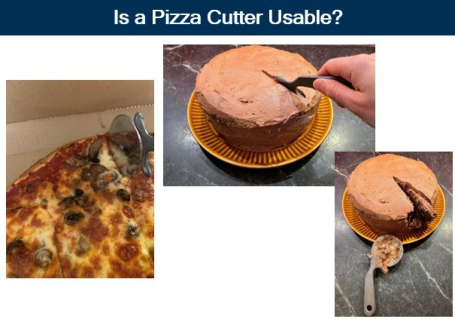
We began the presentation by sharing a definition of usability (ISO 9241–11, 2018). We then provided examples—both healthcare-related and everyday—to describe the importance of context of use when considering usability. One example was a pizza cutter, which can be very usable when
the task is to slice pizza but not very usable when slicing cake (Figure 1). We then described how to specify context of use, following the NISTIR 7432 Common Industry Specification for Usability – Requirements (2007).
Figure 1: Everyday example of importance of context of use for usability. The pizza cutter may be highly usable in one setting (slicing pizza) but not very usable in another (slicing a layer cake).
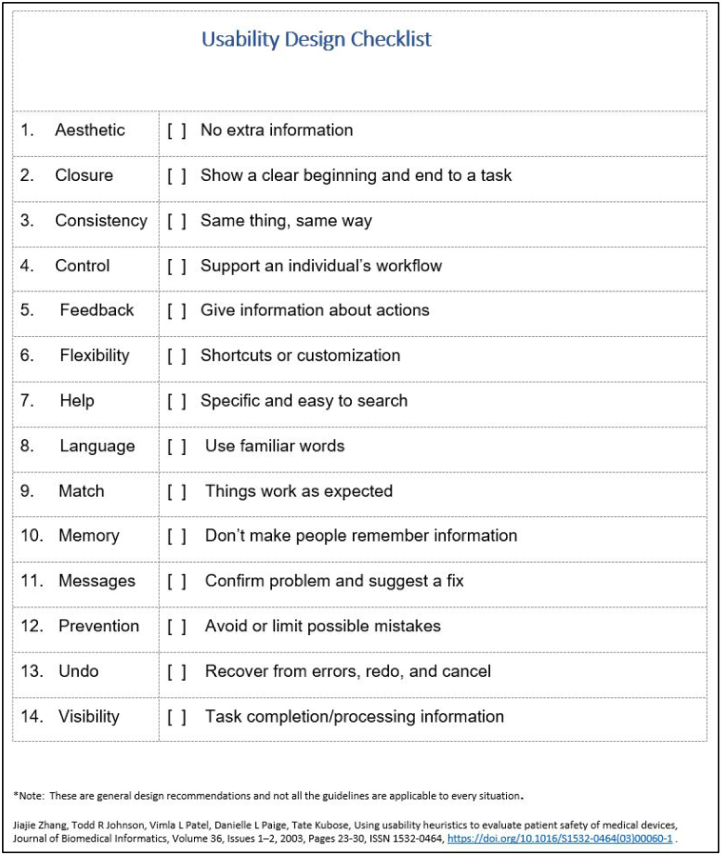
Following this background, we introduced the idea of usability design guidelines or heuristics and described how they could be used. We then stepped through 14 usability principles based on the work of Zhang and colleagues (2003). For each heuristic, we provided a simplified title, a brief description, and an example from an electronic health record (EHR) interface showing how good design can match the heuristic. Finally, we showed exam- ples of EHR interfaces with design concerns and demonstrated how heuristics can be used to identify the concerns and redesign the interfaces.
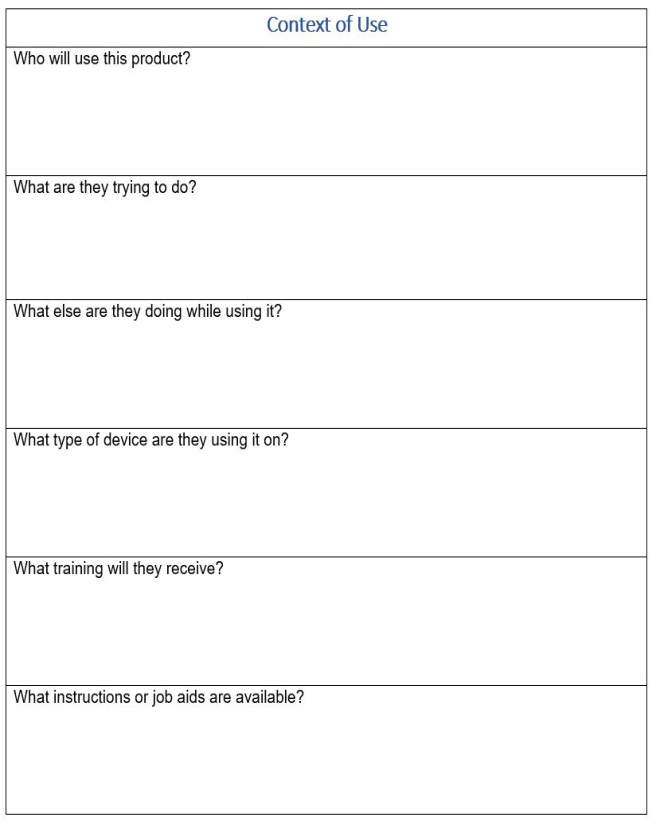
At the end of the presentation, we shared two tools we had developed that the facility might use during design. The first contained questions to help the team specify context of use for a new design following NISTIR 7432 (Figure 2). Thinking through the current system and documenting the answers to these questions should guide the team when making design decisions and assist with the HCD process.
The second tool contained a list of usability design guidelines or heuristics (Figure 3). This was intended to help the team review their designs and make modifications to align to the design principles. We instructed recipients about the nuances and the need to consider trade-offs with design heuristics. For example, in safety critical systems, error prevention and recovery may take precedence over an aesthetic consideration or flexibility of use.
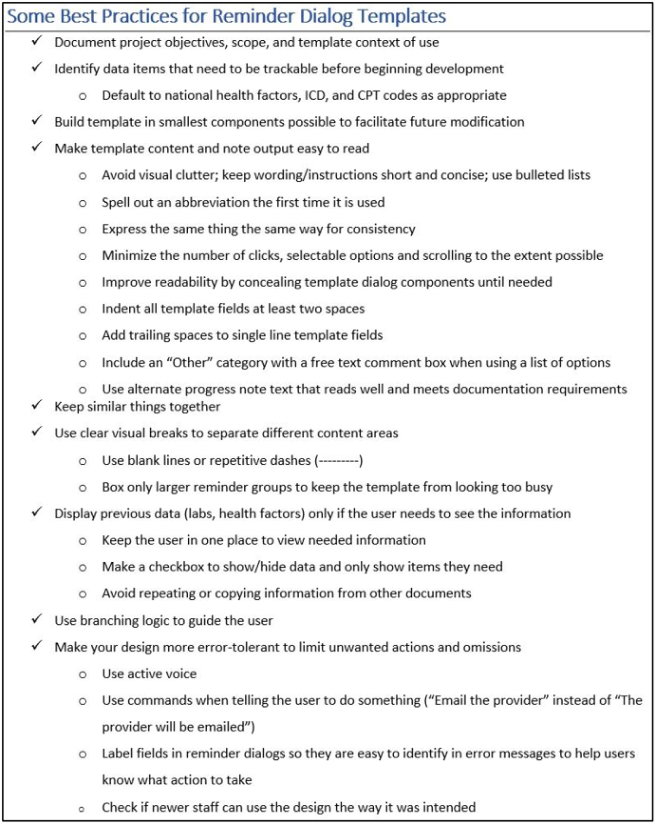
We also created a list of best practices for designing templates (Figure 4). However, we were attempting to limit the presentation of information to 45 minutes to include time for questions in the one-hour time slot we had available. In the interests of time and keeping the presentation rela- tively simple, we decided to leave the best practices information out of the presentation.
Incorporating Human Factors Methods Into Healthcare Process Improvement Work 175
Figure 2: Context of use form adopted from NISTIR 7432 (2007).
Reception by the Field We delivered the training and design tools to a team of clinical informaticists at one healthcare facility who were engaged in a project to reduce the number of EHR templates by standardizing where possible and eliminating redun- dancies. Participants seemed engaged in the presentation, asked questions, and reported that the context of use form and the usability design checklist appeared useful.
During their improvement project, the team followed principles of HCD, including creating an easy way for clinicians to report feedback on the tem- plate changes within the EHR. The project remains ongoing, but the team shared some incremental lessons learned.
Figure 3: Usability design checklist based on Zhang et al. (2003).
One key lesson was the importance of understanding how work is cur- rently done prior to proposing changes. The team stated that the Gemba walk cannot be overlooked and that much time needs to be spent observing current state work.
Another important lesson was that they needed a strong plan for change management before beginning any project. This includes commitment from facility leadership and full engagement of the service level teams to obtain agreement to any changes related to staff work requirements.
The team encountered some pain points related to design choices that led us to believe that the document with best practices for reminder dialog tem- plates would have been useful to the team during their redesign work. In retrospect, we may have tried to simplify too much during the presentation.
Incorporating Human Factors Methods Into Healthcare Process Improvement Work 177
Including specific design best practices and additional example cases might have prevented some of the design decisions that contributed to negative feedback and resistance to change from the users of the templates.
Figure 4: Best practices for EHR reminder dialog templates.
DISCUSSION
Culture in healthcare settings is complex and deeply rooted, and there is often a tendency toward blame (e.g., Watts et al., 2018). In addition, teams nearly always face time constraints that impede redesign efforts. Providing con- crete and usable tools that can guide designers in healthcare toward systems thinking may help to counter these cultural and temporal challenges.
In our experience, design is often most effective at achieving systems goals, meeting user needs, and being adopted when it is done locally or at least
with local involvement. For example, a successful crash cart standardization project we described previously followed an HCD approach that brought in stakeholders and end users at multiple points in the design cycle and was conducted at the healthcare facility level (Fuller et al., 2020).
In a large healthcare system such as the VHA, it can appear most effi- cient to manage design at a national level, and it is certainly easiest from a resource and staffing perspective. However, for designs to support the com- plex systems composing healthcare, it is important to distribute knowledge and capabilities to assist local efforts. We continue to explore different learn- ing opportunities and products to share with the field to facilitate usability and HCD work. Future efforts could integrate the proposed tools to develop a single more complete tool that would make explicit the relations between context, heuristics, and design choices.
Multiple strategies for improving human factors awareness and expertise may help with shaping and moving towards a critical mass in healthcare. There continues to be an overall deficit of human factors expertise in health- care, but integrating and connecting human factors principles and practices to other ways of doing work may help with understanding and adoption.
ACKNOWLEDGMENT AND NOTES We thank those working at the Veterans Health Administration for their commitment to patient care. There were no relevant financial relationships nor any source of support in the forms of grants, equipment, or drugs. The authors declare no conflicts of interest. The opinions expressed in this arti- cle are those of the authors and do not necessarily represent those of the Department of Veterans Affairs or the United States federal government.
REFERENCES
Fairbanks, R. J., & Wears, R. L. (2008). Hazards with medical devices: The role of design. Annals of Emergency Medicine, 52(5), 519–521. Fuller, H. J. A, Arnold, T., O’Neil, M. O., Wilson, D. P. (2023). Activities to Pro-
mote Resilience During Health Information System Transitions. Healthcare and Medical Devices 79: 191–197. Fuller, H. J. A., Arnold, T., Bagian, T. M., & Gunner, W. P. (2020). A Human Factors Framework and Heuristics for Diffusion of Innovations. In Advances in Human Factors and Ergonomics in Healthcare and Medical Devices: Proceedings of the AHFE 2020 Virtual Conference on Human Factors and Ergonomics in Healthcare and Medical Devices, July 16–20, 2020, USA (pp. 47–53). Springer International Publishing. Gosbee, J. (2002). Human factors engineering and patient safety. Quality & safety
in health care, 11(4), 352. Gurses A. P., Ozok A. A., Pronovost P. J. (2012). Time to accelerate integration of human factors and ergonomics in patient safety. BMJ Qual Saf 21:347–51. Holden, R. J., Carayon, P., Gurses, A. P., Hoonakker, P., Hundt, A. S., Ozok, A.
A., & Rivera-Rodriguez, A. J. (2013). SEIPS 2.0: A human factors framework for studying and improving the work of healthcare professionals and patients. Ergonomics, 56(11), 1669–1686.
Incorporating Human Factors Methods Into Healthcare Process Improvement Work 179
Hollnagel, E. (2015). RAG-resilience analysis grid. Intro- duction to the Resilience Analysis Grid (RAG), 3–5. https://erikhollnagel.com/onewebmedia/RAG%20Outline%20V2.pdf NIST Interagency/Internal Report (NISTIR) – 7432. (2007). Retrieved from https://www.nist.gov/publications/common-industry-specification-usability-requ irements on 2/9/24. Provan, D. J., Woods, D. D., Dekker, S. W., & Rae, A. J. (2020). Safety II professionals: How resilience engineering can transform safety practice. Reliability Engineering & System Safety, 195, 106740. Russ, A. L., Baker, D. A., Fahner, W. J., Milligan, B. S., Cox, L., Hagg, H. K., &
Saleem, J. J. (2010). A rapid usability evaluation (RUE) method for health infor- mation technology. In AMIA Annual Symposium Proceedings (Vol. 2010, p. 702). American Medical Informatics Association. Russ, A. L., Fairbanks, R. J., Karsh, B. T., Militello, L. G., Saleem, J. J., & Wears, R. L.
(2013). The science of human factors: Separating fact from fiction. BMJ Quality & Safety. VA Health Informatics Certificate Program (AMIA 10x10). (2024). Retrieved from https://vatraining.remote-learner.net/mod/page/view.php?id=5093 on 2/9/24. VHA Directive 1026.01. (2019). VHA Systems Redesign and Improvement Program. Woods, D. D. (2012). Essential characteristics of resilience. In Resilience Engineering
(pp. 21–34). CRC Press. Watts, B. V., Williams, L., Mills, P. D., Paull, D. E., Cully, J. A., Gilman, S. C., & Hemphill, R. R. (2018). Curriculum development and implementation of a national interprofessional fellowship in patient safety. Journal of Patient Safety, 14(3), 127–132. Zhang, J., Johnson, T. R., Patel, V. L., Paige, D. L., & Kubose, T. (2003). Using usabil-
ity heuristics to evaluate patient safety of medical devices. Journal of biomedical informatics, 36(1–2), 23–30.
LISTED IN THE AHFE DIGITAL BOOKSTORE CATALOGUE
Explore the complete digital volume
Healthcare and Medical Devices
Read this individual research paper free through the original publisher, or explore the full digital proceedings book.
ISBN 978-1-964867-06-9
Explore this ISBN in the AHFE Bookstore ↗Listed in the July 2026 bookstore catalogue; search by ISBN to confirm current availability · Digital book purchase optional