Layton Pratt, Ryan Robertson, Martin Mintchev (2024). Integrating Intelligent Control into Far UVC Wearable Garments for On-Demand Airborne Viral and Bacterial Protection. In: Healthcare and Medical Devices. AHFE Open Access, vol. 130, pp. 104–108. https://doi.org/10.54941/ahfe1004843
Far Ultraviolet C-range (Far UVC) emissions of sufficient intensity have been proven to successfully immobilize a vast family of airborne viruses and bacteria, while being harmless to humans. Recently, an innovative application of portable Far UVC light devices has been suggested in the form of wearable self-disinfecting garments for personal protection. While embedding a miniature Far UVC light fixture (e.g. Ushio's Care222®, Tokyo, Japan) into wearable garments such as vests and helmets can be a relatively straightforward engineering task, the very fact that the devices are battery-supplied implies that particular care and attention must be devoted to the design of an intelligent system for minimizing electrical power consumption based on direct need of use. The aim of this paper is to propose a design utilizing a contemporary microcontroller-based transmitter-receiver system to accomplish this task, and to test the resulting intelligent personal protection garments in real-life conditions. Two wearable garments embedding Ushio’s Care222® units were designed. In each garment, an Arduino-based microcontroller system was embedded along with infrared (IR) transmitter and receiver (Gikfun Infrared Diode LED IR Emission and Receiver for Arduino) to activate the Far UVC lamp when approached by another user wearing also such Far UVC garment if pre-programmed social distancing was violated. Both helmet- and vest-based disinfecting garments were prototyped and subsequently tested on three healthy volunteers working in routine laboratory conditions. The volunteers were encouraged to go about their regular daily work in the lab while wearing the intelligent Far UVC garments. Each volunteer signed consent forms required by the Research Ethics Committee of Howard Payne University. The intelligent Far UVC garment prototypes continuously performed reliably and safely. All three volunteers reported that the implements were minimally obstructive, and that they were able to perform routine multi-hour work in the lab continuously and without any impediment. The Far UVC light on each garment turned itself on only when a pre-programed social distancing (2 meters) was infringed, and turned themselves off when such distancing was exceeded. Due to the embedded intelligent control, power consumption was reduced allowing the garments to maintain operation for a full standard work day. An innovative intelligent control was designed, implemented, embedded and tested on Far UVC wearable garments for the purpose of continuous minimally-obstructive disinfection against airborne viruses and bacteria. The intelligent implements were found to be minimally obstructive by volunteers who wore them during their routine daily lab work.
Integrating Intelligent Control Into Far UVC Wearable Garments 105
INTRODUCTION
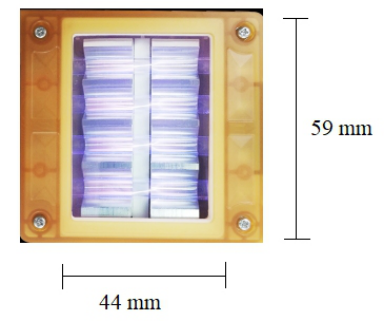
Viruses and bacteria have claimed many lives through their continual infil- tration of the human body. These losses have led to many technological developments aiming and creating sustainable barriers for these viruses and bacteria (Jagadeshvaran, 2021). Just as technology developed for viral and bacterial protection, so did the resilience of these harmful cellular and acel- lular microorganisms (Luria, 1943). Personal protective equipment (PPE) in the form of face masks, plastic face shields, and other mechanical barriers, although already routinely used in hospitals and other specialized profes- sional environments, became heavily utilized during the COVID-19 pandemic when protection became a law-imposed necessity for many members of the general public (Ruslina, 2020). A lesser-known form of viral and bacterial protection is the use of Ultraviolet C-range light (UVC) to inactivate and halt reproduction of harmful microorganisms. UVC disinfection has been com- monly used under strict safely protocols due to its negative effects on humans which has reduced the practicability of use in populated areas (O’Mahoney, 2022). Recently with the discovery of filtered Far UVC technology emitting UV light with wavelengths in the range of 200–230 nm, safe and contin- ued human exposure has been made possible (Buonanno, 2020). Filtered Far UVC excimer lamps have been mass produced and implemented as stationary sources of viral and bacterial inactivation and presently represent the small- est Far UVC sources powerful enough to disinfect against harmful airborne microorganisms (Ushio, 2020). Of the Far UVC excimer lamps in that cate- gory available on the open market, the Ushio Care 222® units have been the smallest design available (Figure 1).
Figure 1: Care 222® Far UVC excimer lamp by Ushio Inc., Tokyo, Japan. The overall dimensions of the entire unit are 97x75 mm, and the power supply invertor attached to it is 82x89 mm.
Recently, wearable, minimally-obstructive garments have been developed embedding Far UVC excimer lamps, aiming at dynamic protection of wearers from airborne microorganisms, including COVID-19 viruses (Pratt, 2023). Two designs were prototyped and tested on human volunteers, a wearable vest and a head helmet.
The aim of the present study is to integrate an intelligent, Internet-of- Things (IoT)-based control in such garments, so that wearers’ protection would be automatically activated when pre-programmed social distanc- ing is violated, but deactivated when static and/or non-human objects are approached, or when the established social distances between wearers are exceeded.
METHODS
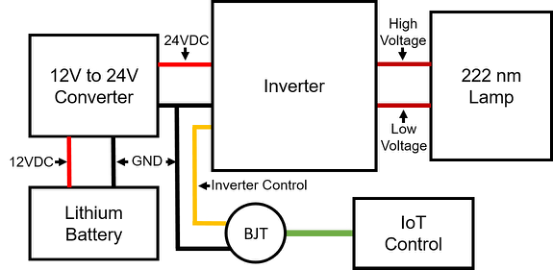
Two wearable garments embedding Ushio’s Care222® units were designed. A block-diagram of the battery-supplied wearable embedded Far UVC excimer lamp is shown on Figure 2.
Figure 2: Block-diagram of the wearable Ushio-based far UVC unit. The portable power supply is by a 12V DC Lithium-Ion battery (Zeee Power, Amazon standard identifica- tion Number: B07Y67MKQB). The control of the inverter is through a bipolar junction transistor (BJT), externally driven by an Internet-of-Things (IoT) circuitry.
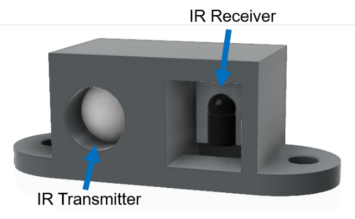
In each garment, an Arduino-based microcontroller system (LAFVIN Amazon Standard Identification Number: B07G99NNXL) was embedded along with an infrared (IR) transmitter and receiver (Gikfun Infrared Diode LED IR Emission and Receiver for Arduino). One IR transmitter and receiver were integrated into a 3-D printed housing that isolated each component from each other (Figure 3).
Figure 3: 3-D rendering of the sensor module containing both an IR transmitter and receiver.
Integrating Intelligent Control Into Far UVC Wearable Garments 107
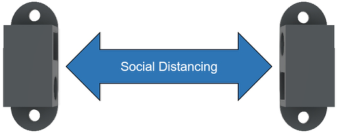
This construction forced the sensor module to only activate when approached by another module emitting the proper frequency. The sensors relay a message to the microcontroller which supplies power to the base of the bipolar junction transistor (BJT) to activate the Far UVC excimer lamp when approached by another user wearing a Far UVC garment if pre-programmed social distancing is violated (Figure 4).
Figure 4: The UVC garments activate based on Internet-controlled and programmable social distancing. The IR sensors are facing each other and activate the wearable garments when social distancing has been breached.
RESULTS
Both helmet- and vest-based disinfecting garments were prototyped and sub- sequently tested on three healthy volunteers working in routine laboratory conditions. The volunteers were encouraged to go about their regular daily work in the lab while wearing the intelligent Far UVC garments. Each vol- unteer signed consent forms required by the Research Ethics Committee of Howard Payne University.
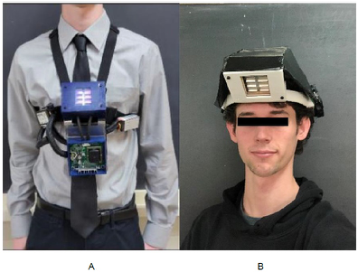
Figure 5 shows a human volunteer wearing the vest (A) and the helmet (B) during routine work/study schedules. The intelligent Far UVC garment prototypes continuously performed reliably and safely. All three volunteers reported that the implements were minimally obstructive, and that they were able to perform routine multi-hour work in the lab continuously and without any impediment. The Far UVC light on each garment turned itself on only when a pre-programed social distancing (2 meters) was infringed, and turned themselves off when such distancing was exceeded. Due to the embedded intelligent control, power consumption was reduced allowing the garments to maintain operation for a full standard work day.
Figure 5: A human volunteer wearing the disinfecting far UVC vest (A) and helmet (B).
CONCLUSION
An innovative intelligent control was designed, implemented, embedded and tested on Far UVC wearable garments for the purpose of continuous minimally-obstructive disinfection against airborne viruses and bacteria. The intelligent implements were found to be minimally obstructive by volunteers who wore them during their routine daily lab work.
ACKNOWLEDGMENT
The authors would like to acknowledge Ushio (USA) and Mr. Ryan Guidry for assisting with this research. The study was sponsored in part by Howard Payne University.
REFERENCES
Buonanno, Manuela, et al. (2020) “Far-UVC light (222 nm) efficiently and safely inactivates airborne human coronaviruses.” Scientific reports 10.1 pp. 1–8 Jagadeshvaran, P. L., Aishwarya Vijayan Menon, and Suryasarathi Bose. (2021)
“Evolution of personal protective equipment from its inception to COVID-19.” Current Science 120.7 pp. 1169–1183 Luria, Salvador E., and Max Delbrück. (1943). “Mutations of bacteria from virus sensitivity to virus resistance.” Genetics 28.6 p. 491 O’Mahoney, Paul, et al. (2022) “Potential harm to the skin from unfiltered
krypton chloride ‘far-ultraviolet-C’lamps, even below an occupational exposure limit.” Journal of Radiological Protection 42.4. Pratt, Layton C., Ryan D. Robertson, and Martin P. Mintchev. (2023) “Wearable Far UVC Technology for Continuous Dynamic Personal Protection on Demand.” 2023 3rd International Conference on Electrical, Computer, Commu- nications and Mechatronics Engineering (ICECCME). IEEE, 2023. Ruslina, Elli, and Rita Sekarsari. (2020) “Legal Protection of Medical Staff in
Hospitals during The Covid-19 Pandemic Era.” International Journal of Latin Notary 1.1 pp. 29–35. Ushio America Inc., (2020). Care222® Filtered Far UV-C Excimer Lamp, Available: https://www.ushio.com/product/care222-filtered-far-uv-c-excimer-lamp-module/
LISTED IN THE AHFE DIGITAL BOOKSTORE CATALOGUE
Explore the complete digital volume
Healthcare and Medical Devices
Read this individual research paper free through the original publisher, or explore the full digital proceedings book.
ISBN 978-1-964867-06-9
Explore this ISBN in the AHFE Bookstore ↗Listed in the July 2026 bookstore catalogue; search by ISBN to confirm current availability · Digital book purchase optional