Marco Santórum, Mayra Carrión, Patricia Acosta-Vargas, David Morales-martinez, Julian Galindo-losada, Camila Madera, Gloria Acosta-Vargas, Verónica-Gabriela Maldonado-Garcés, Manuel Ayala-chauvin, Mario Gonzalez, Esteban Ortiz Prado (2023). A Digital Platform for Respiratory Rehabilitation in Patients with post-COVID19: Design and Usability Evaluation. In: Human-Centered Design and User Experience. AHFE Open Access, vol. 114, pp. 683–691. https://doi.org/10.54941/ahfe1004289
2 Intelligent and Interactive Systems Laboratory, Universidad de Las Américas, Quito Ecuador; Facultad de Ingeniería y Ciencias Aplicadas, Universidad de Las Américas, Quito Ecuador ↗
3 Departamento de Informática y Ciencias de la Computación, Escuela Politécnica Nacional, Quito 170525, Ecuador ↗
4 Facultad de Enfermería, Pontificia Universidad Católica del Ecuador, Quito, Ecuador ↗
5 Facultad de Psicología, Pontificia Universidad Católica del Ecuador, Quito, Ecuador ↗
6 Centro de Investigación en Ciencias Humanas y de la Educación - CICHE Universidad Tecnológica Indoamérica, Quito, Ecuador ↗
7 One Health Research Group, Universidad de las Américas, Quito, Ecuador ↗
This article presents the outcome of creating a usable digital platform for therapeutic education in respiratory rehabilitation. The platform has been developed to address the growing need for remote rehabilitation services, particularly in the context of respiratory conditions following COVID-19. It provides therapeutic education and supports self-rehabilitation sessions, catering to the needs of patients while also assisting in the training and education of healthcare professionals and students in the field of respiratory rehabilitation.The design process followed a user-centered approach, incorporating inputs from rehabilitation therapy experts and collaborative meetings with representatives from educational institutions. Through a comprehensive analysis of requirements, the platform's functionalities were defined, resulting in a set of clear and precise functional and non-functional requirements. The platform was designed as a progressive web application (PWA) with responsive design for compatibility across multiple devices. It incorporates informative error messages and robust data encryption for user security.The platform consists of different modules: one for users or patients conducting self-rehabilitation, medical specialists and/or students, organization administrators, and the platform administrator. Each module offers specific functionalities tailored to the respective users' needs. Patients can register, access therapeutic educational materials, perform rehabilitation exercises, and track their progress. Medical specialists and students have tools to review and edit patient records, create rehabilitation plans, and monitor their progress. Organization administrators can manage users and evaluate platform usage, while the platform administrator oversees system management, parameterization, and maintenance.The platform's interface design emphasizes simplicity, effectiveness, and ease of use. Patients can easily navigate through welcome screens, access rehabilitation plans, view exercise videos, and generate progress reports. Medical specialists and students have intuitive interfaces to create rehabilitation plans, add new exercises, review patient records, and access comprehensive reports for monitoring progress. Multimedia elements, including videos, enhance the effectiveness of rehabilitation exercises.The platform's data model effectively captures information about organizations, patients, medical specialists, exercises, and evaluations. The navigation model facilitates intuitive interaction and efficient task completion. In addition to the design, this article also presents the implementation of usability testing.To evaluate the platform's usability, a protocol proposed by Abhay Rautela was followed, accompanied by the use of the Computer System Usability Questionnaire (CSUQ). The evaluation involved a group of participants who performed tasks relevant to their roles as physiatrists or patients. The CSUQ was used to collect feedback and assess user satisfaction. The results of the usability evaluation will be discussed, providing insights into the platform's strengths and areas for improvement.
The COVID-19 pandemic caused by SARS-CoV-2 has posed unprecedented challenges to global healthcare systems, necessitating efforts to contain its spread and minimize its impact on mortality. Addressing the long-term health effects experienced by COVID-19 survivors, especially respiratory condi- tions, has emerged as a significant concern, profoundly affecting the quality of life and functional abilities of recovering patients.
In response, the healthcare field has rapidly evolved with the emergence of Information and Communication Technologies (ICT), playing a piv- otal role during the pandemic by facilitating work and social interactions. Telemedicine and tele-rehabilitation have arisen as essential tools in providing comprehensive post-COVID-19 care, bridging the gap between patients and healthcare providers while ensuring the safety and accessibility of healthcare services.
The field of telerehabilitation has gained prominence as a valuable approach to delivering remote healthcare services, particularly in the con- text of the COVID-19 pandemic. Several telerehabilitation platforms have emerged to address the challenges of delivering rehabilitation interventions to individuals with COVID-19-related sequelae. Notable platforms include ReCOVery (Samper-Pardo et al., 2023), Rehab Guru (RehabGuru, 2022), Rehab My Patient (RehabMyPatient, 2023), and FreePT (FreePT, 2023). Additionally, platforms like Microsoft Teams, Zoom, Google Hangouts, Skype, Facebook Messenger, and Apple Facetime have played pivotal roles in facilitating telemedicine, offering video consultations with synchronous and asynchronous support for ambulatory patients.
For successful TR technology, usability is crucial, embracing principles and patterns that promote effectiveness, quality, and service usefulness. The evalu- ation of usability in TR platforms holds significance in assessing user satisfac- tion and optimizing system design. Abhay Rautela’s protocol (Rautela, 2018) and the Computer System Usability Questionnaire (CSUQ) offer structured methods for evaluating usability (Lewis, 2018). These frameworks guide the identification of user needs and preferences, shaping platforms that cater to user expectations.
Our research aims to advance post-COVID-19 care by developing a usable digital platform for therapeutic education in respiratory rehabilitation. We assess the platform’s usability using a proposed protocol and the Computer System Usability Questionnaire (CSUQ).
This article presents the findings of our research, focusing on the results of the usability evaluation and their implications for respiratory rehabilitation. By providing evidence-based insights, we make a significant contribution to the advancement of tele-rehabilitation and telemedicine as integral compo- nents of post-COVID-19 care. The article is organized as follows: Section 2 elaborates on the specifics of the conducted case study. Following that, Section 3 outlines the developed protocol for usability evaluation and the corresponding experimental process. Lastly, Section 4 presents the findings and ultimate conclusions.
A Digital Platform for Respiratory Rehabilitation in Patients With Post-COVID19 685
MATERIAL AND METHODS As contemporary healthcare landscapes become increasingly reliant on tech- nological solutions, the intricate interplay between user-centered design and efficacious rehabilitation interventions emerges as a focal point of investi- gation. The developed platform presents tele-rehabilitation with an asyn- chronous approach. The usability evaluation was conducted considering the platform’s main functionalities, focusing on those of greater value from the patient’s perspective.
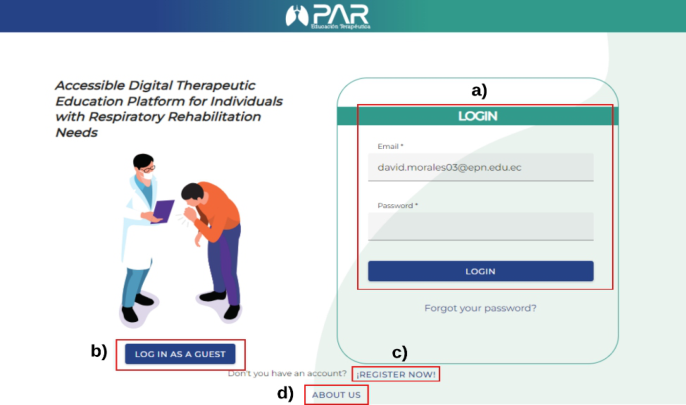
Case Study The platform provides free and open access to asynchronous tele- rehabilitation sessions for all users with COVID-19 sequelae. Figure 1 shows the main interface of the tele-rehabilitation platform, where four main sec- tions can be clearly identified. Section a) features a Log In for registered users, section b) presents a button to access the platform as a guest, section c) pro- vides a link for user registration on the platform, and section d) offers a link to learn more about the platform.
Figure 1: Principal interface of telerehabilitation platform.
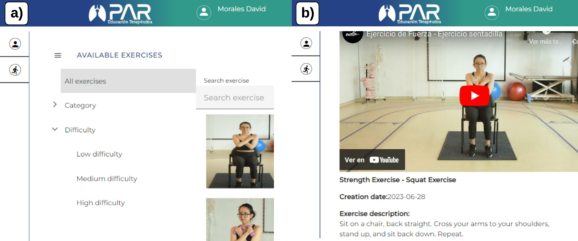
In section a), the user can access all the exercises on the platform, includ- ing comprehensive rehabilitation plans, as shown in Figure 2, section a). Once the exercise is selected, the patient can perform it by following the video demonstration, which clearly shows how to perform the exercise. Additionally, a description of the exercise can be read as detailed in section b).
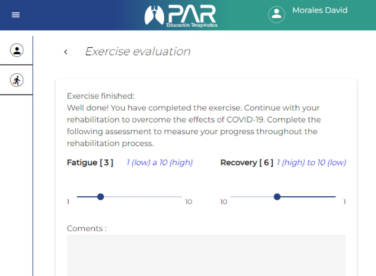
Users who do not wish to register on the platform can access tele- rehabilitation materials as guests. In this section, the user can view exercises with low difficulty and suitable for all audiences. However, they won’t be able to track their progress with exercise assessments, which are conducted after completing each exercise, as depicted in Figure 3.
Figure 2: Telerehabilitation exercises.
The feedback obtained from the exercise evaluation helps the platform keep a record of the patient’s progress and learn about their well-being during the tele-rehabilitation session.
Figure 3: Exercise evaluation.
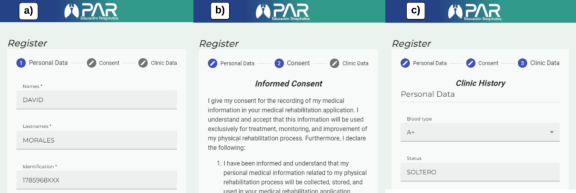
The platform allows users to register easily and intuitively by filling out forms, as shown in Figure 4. This involves entering their personal infor- mation in section a), providing consent for the handling of their personal information in section b), and specifying the specific aftermath they are experiencing in section c).
Figure 4: User registration.
A Digital Platform for Respiratory Rehabilitation in Patients With Post-COVID19 687
Section d) provides information about the platform, its creators, the pur- pose of the platform, and acknowledges all those who have contributed to its realization.
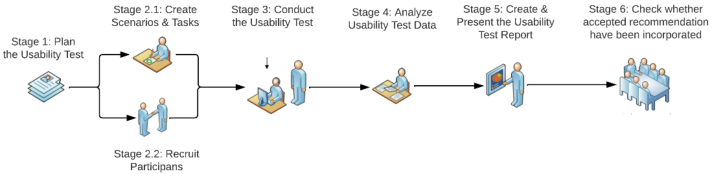
EVALUATION RESULTS AND DISCUSSION In this section, the usability evaluation process of the web platform PAR “Therapeutic Education” is described. The usability evaluation was carried out following the usability evaluation protocol proposed by (Rautela, 2018) see Figure 5. This protocol was accompanied by the inquiry method pro- posed by (Lewis, 1993, 2018) as seen in the Computer System Usability Questionnaire (CSQU).
Figure 5: Usability evaluation protocol.
Below, each of the stages of the protocol is described: Defining Evaluation Objectives
The following objectives are defined.
1. To use the inquiry method, CSQU questionnaire, to evaluate the PAR Web platform. 2. To understand the responses of patient users and their level of satisfac- tion regarding the platform.
Preparing the Evaluation In this stage, the necessary materials or documentation are prepared to be provided to each user. This documentation may include the follow- ing documents: consent letter, manuals, or tool instructions. In our case, an instructional guide was provided, which specifies a description of the platform and the details of the tasks to be performed by the users.
Participant Selection This evaluation process was carried out with 58 users considered patients who have experienced COVID, their ages ranging from 23 to 28 years old.
Usability Evaluation Execution During this stage, the usability evaluation session of the PAR web platform takes place, where the following points are explained:
General instructions on how the usability evaluation will be conducted.
Delivery of the necessary documentation or links to each user.
Tasks Among the specified tasks to be performed by each user are the following:
Table 1. Activities performed in the role of patient.
Table available in the original PDF paper.
Tasks and subtasks T1. Register as a patient on the Platform
1. Enter first name. 2. Enter last name. 3. Enter identification. 4. Enter date of birth. 5. Enter email address. 6. Enter a password 7. Select user type. 8. Confirm consent. 9. Enter medical history.
T2. Log in to the platform 1.Enter email address. 2.Enter password.
T3. Explore rehabilitation exercises by workout plans
1. Access the Rehabilitation menu. 2. Click on workout plans. 3. Select a workout plan. 4. Click on difficulty and review plans categorized as advanced, low, and basic. 5. Click on category and review the muscular and respiratory options.
T4. Follow a low-difficulty training exercise
1.Click on a video from the workout plans or free training based on your need. 2. Repeat what you see in the exercise video.
T5. Evaluate an exercise when it has been completed
1. Click on completed exercise. 2. Click and move the fatigue line according to your progress level considering 1 (lower) to 10 (higher). 3. Click and move the recovery line according to your progress level considering 1 (higher) to 10 (lower). 4. Click on Finish. 5. Check if the message “Exercise completed for the day” appeared.
T6. Disconnect from the platform
1. Click on the user with your name. 2. Click on Log Out.
Analyze and Present the Results of the Usability Evaluation In this stage, the obtained values are analyzed and presented through the inquiry method of the CSQU usability surveys (Lewis, 2018). The values ranged from 1 (Strongly Agree) to 7 (Strongly Disagree), including the “Not Applicable” (N/A) option; lower values were interpreted as indicators of
A Digital Platform for Respiratory Rehabilitation in Patients With Post-COVID19 689
higher satisfaction. To calculate the usability acceptance percentage, a cor- respondence between CSUQ and SUS values was established to transform the CSUQ scale values from 1 to 7 into a 0 to 100-point scale that matched the SUS scale for interpretation. Equation 1 presents the formula for this transformation.
!
!
P16
!
100
Equation reproduced from the original PDF.
−1
(1)
16
6
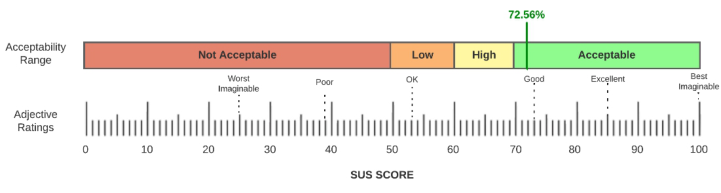
The process to obtain an equivalent score to that of the SUS from a CSUQ score involves subtracting 1 from the mean of the 16 individual CSUQ ques- tions and multiplying that value by 100/6 to extend it to a 0 to 100-point scale. Then, this value is subtracted from 100 to reverse the scale (Lewis, 2018). The transformation was carried out to utilize the SUS scale (Bangor, Kortum and Miller, 2009), presented in Figure 6, which allows us to com- pare adjective ratings and acceptability scores in relation to the obtained SUS score. As we can observe in the SUS scale (Brooke, 2013), it assigns the label “Acceptable” when the evaluation score is above 70, “Not Acceptable”when the value is below 50, and “Marginal” when it falls between 50 and 70.
Figure 6: SUS scale.
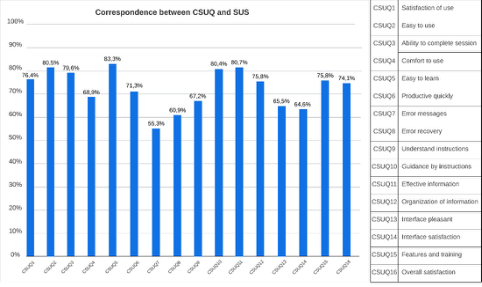
Figure 7 presents the results of the average analysis for each question and its correspondence between CSUQ and SUS, obtained from the usability eval- uation of the PAR platform. Its average is 72.56%, which falls within the “Acceptable” range according to the SUS scale, see Figure 6.
Figure 7: Usability evaluation results per question.
CONCLUSION
This paper has presented the development and evaluation of a digital plat- form for respiratory rehabilitation in post-COVID-19 patients. The platform addresses the growing demand for remote rehabilitation services, especially in the context of respiratory conditions resulting from COVID-19. By pro- viding therapeutic education and supporting self-rehabilitation sessions, the platform caters to the specific needs of patients while also facilitating the training and education of healthcare professionals and students in the field of respiratory rehabilitation.
The platform’s design process, guided by a user-centered approach, incor- porated insights from rehabilitation therapy experts and collaboration with educational institutions. The usability evaluation, conducted using the pro- tocol proposed by Abhay Rautela and the Computer System Usability Questionnaire (CSUQ), involved a cohort of 58 participants in roles sim- ulating patients. Through the CSUQ, feedback was gathered to assess user satisfaction and overall platform usability.
The results of the usability evaluation indicated that the platform’s usabil- ity falls within the “Acceptable” range based on the SUS scale. This research offers valuable insights into the strengths and potential areas for improve- ment of the platform. It serves as a significant step forward in advancing res- piratory rehabilitation, offering accessible and effective solutions for patients on their journey to post-COVID-19 recovery.
The study’s findings contribute to the ongoing evolution of tele- rehabilitation and telemedicine as integral components of post-pandemic healthcare. By prioritizing usability and user-centered design, this research assists healthcare providers in delivering high-quality, patient-centric care remotely. As we continue to navigate the challenges posed by the COVID-19 pandemic and its aftermath, the usability-driven solutions presented in this study hold promise for improving the lives of patients and the efficacy of healthcare services.
ACKNOWLEDGMENT
The authors would like to thank the “Corporación Ecuatoriana para el Desar- rollo de la Investigación y Academia – CEDIA”for the support of this research work, through the I+D+I-XVII-2022-27 program, especially for the fund- ing of the project: “Plataforma digital para educación terapéutica accesible hacia las necesidades de rehabilitación respiratoria”. The authors want to remark on the contribution of the “Laboratorio de Investigación de Sistemas de Información e Inclusión Digital” (LudoLab - https://ludolab.epn.edu.ec/) for the support for the research and publication of this article.
REFERENCES
Bangor, A., Kortum, P. and Miller, J. (2009) ‘Determining what individual SUS scores mean; adding an adjective rating’, Journal of usability studies, 4(3), pp. 114–23. Brooke, J. (2013) ‘SUS: A Retrospective’, The Physiologist, 49(2), pp. 29–40. FreePT (2023) FreePT - Secure Log in. Available at: https://securelogin.freept.com/F
reePt/login.do (Accessed: 28 March 2023).
A Digital Platform for Respiratory Rehabilitation in Patients With Post-COVID19 691
Lewis, J. R. (1993) IBM Computer Usability Satisfaction Questionnaires: Psychometric Evaluation and Instructions for Use, International Journal of Human- Computer Interaction. doi: 10.1080/10447319509526110. Lewis, J. R. (2018) ‘Measuring Perceived Usability: The CSUQ, SUS, and UMUX’,
International Journal of Human-Computer Interaction, 34(12), pp. 1148–1156. doi: 10.1080/10447318.2017.1418805. Rautela, A. (2018) The Usability Testing Process, ConeTrees. Available at: https://medium.com/conetrees/the-usability-testing-process-diagram-cone-tr ees-c77941edfeeb. RehabGuru (2022) Rehab Guru - Exercise Prescription. Available at: https://app.re habguru.com/dashboard (Accessed: 11 August 2023). RehabMyPatient (2023) Exercise prescription software for therapist | Rehab My
Patient. Available at: https://www.rehabmypatient.com/ (Accessed: 11 August 2023). Samper-Pardo, M. et al. (2023) ‘Effectiveness of a telerehabilitation intervention using ReCOVery APP of long COVID patients: a randomized, 3-month follow-up clinical trial’, Scientific Reports, 13(1). doi: 10.1038/s41598-023-35058-y
LISTED IN THE AHFE DIGITAL BOOKSTORE CATALOGUE
Explore the complete digital volume
Human-Centered Design and User Experience
Read this individual research paper free through the original publisher, or explore the full digital proceedings book.
ISBN 978-1-958651-90-2
Explore this ISBN in the AHFE Bookstore ↗Listed in the July 2026 bookstore catalogue; search by ISBN to confirm current availability · Digital book purchase optional