Gloria Acosta-Vargas, Juan Andrade, Carlos Lucano, Jose Rodriguez Aldaz, Janio Jadán-Guerrero, Isabel L. Nunes, Patricia Acosta-Vargas (2022). Most common accessibility barriers in native mobile applications used in Ecuador. In: Human Factors in Accessibility and Assistive Technology. AHFE Open Access, vol. 37, pp. 69–77. https://doi.org/10.54941/ahfe1001644
Aware that a significant portion of the world's population suffers from some form of disability, a test was designed to evaluate the level of compliance with accessibility requirements of Android mobile apps randomly taken from the Google Play Store available in Ecuador. The seven-phase manual method was used to evaluate the apps, the results revealed that the most significant number of accessibility problems were: 1) the size and space of the touch target (47.5%); 2) the instructions for custom gestures in the manipulation of the touch screen (28.2%), and 3) contrast problems (9.2%). The limiting factors in this research were the number of applications evaluated by the proposed method and the tests with end-users with some disabilities. Based on this analysis, applying this method is recommended to complement the automatic review method for future work. The study also suggests that there is still much to be done regarding public policies, regulations, and initiatives to improve the accessibility and inclusion of people with disabilities.
According to The World Health Organization report, 15% of the world’s population suffers from some form of disability. On the other hand, due to the COVID-19 pandemic, mobile apps have had a large-scale impact worldwide, especially in education, health, entertainment, and online shopping. How- ever, not all native mobile apps are inclusive because developers neglect to apply the accessibility requirements proposed by the World Wide Web Con- sortium (W3C) applied to mobile apps, which establishes standards for public use applications to have an acceptable level of accessibility. This situation is the motivation for this study, where an accessibility analysis was performed
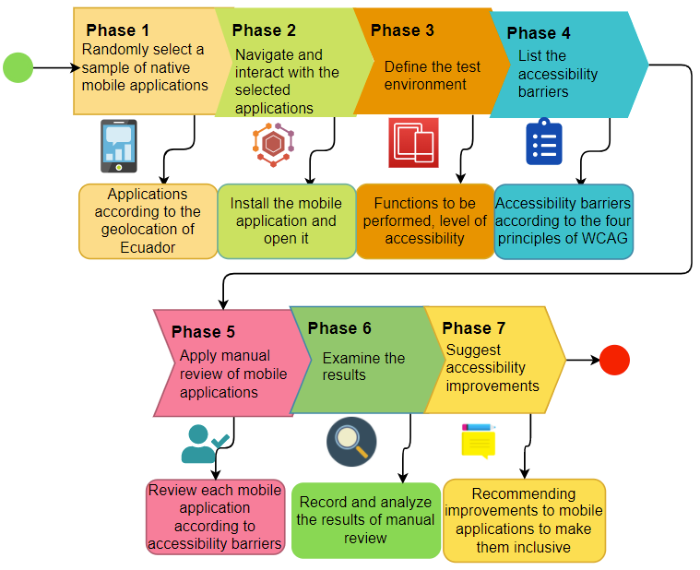
on a random sample of nine native mobile apps for Android. This article uses a manual evaluation of the most common accessibility barriers in native Android mobile apps. In the evaluation, we reviewed the level of compliance with the accessibility requirements of native mobile apps considering the Web Content Accessibility Guidelines (WCAG) 2.1 (World Wide Web Consortium, 2018) proposed by W3C. Our research proposes a manual review method to assess if an adequate level of accessibility was achieved, applying the WCAG 2.1 that includes the four accessibility principles: 1) Perceivable principle - for identifying user interface information; 2) Principle of operation - that refers to the user interface; 3) Understandable principles - related to user informa- tion and operations with the application, and 4) Robust principle - implies that it must be compatible with the technologies used by users. For our study, a sample of nine of the most popular mobile apps in the Google Play Store (Google Play, 2022) was randomly taken according to the geolocation for Ecuador. The proposed manual review method consists of seven phases: Phase 1: randomly select a sample of native mobile apps; at this stage, we randomly select nine native mobile apps.
Phase 2: navigate and interact with the selected applications; In this stage, we explore each application selected in Phase 1.
Phase 3: define the test environment; we define the functions to be per- formed in each mobile application, including the level of accessibility; in this case, it was applied up to level AA.
Phase 4: List the accessibility barriers, according to WCAG 2.1; in this phase, the accessibility barriers were classified according to the four principles of accessibility for mobile apps.
Phase 5: Apply manual review of mobile apps; at this stage, we request a manual review considering the barriers defined in the previous stage; the data were recorded in a spreadsheet. Three experts on accessibility in mobile apps participated in this stage.
Phase 6: Examine the results - in this stage, the descriptive statistical data were organized, dynamic tables and graphs were made in Microsoft Excel to establish correlations between variables. The study dataset is open and available in a dataset in the Mendeley repository Andrade et al., 2022).
Phase 7: Suggest accessibility improvements for mobile apps - finally, in this phase, the researchers suggest improvements to reduce accessibility bar- riers in native Android mobile apps based on the findings. This research can contribute to 1) Future studies related to the accessibility of mobile apps. 2) Carry out the study with the total sample of native mobile apps for Android according to the geolocation for Ecuador. 3) Design an Android application that includes artificial intelligence to help mobile application experts and developers evaluate accessibility considering WCAG 2.1.
The coming sections of the document are the following: a literature review, methodology applied in the study, outcomes and discussion, and finally, the conclusions and future work.
LITERATURE REVIEW
Currently, there are several studies related to accessibility in native mobile apps for Android. For instance, the research developed by Alajarmeh (2021)
Most Common Accessibility Barriers in Native Mobile Applications Used in Ecuador 71
showed problems of accessibility in mobile apps, especially those related to people with visual impairment, since these applications, for the most part, do not pay attention to accessibility details that can be decisive for such users. The mentioned research concludes that despite all the guidelines explained in the WCAG 2.1, there is still no actual compliance with these guidelines, which prevents people with visual impairments from making optimal use of many mobile apps.
The study done by Zaina et al. (2022) identified accessibility barriers in using design patterns to create graphical interfaces in mobile apps. The research involved 60 users of the applications; the results showed that the guidelines for prototyping user interfaces were applied correctly; from the participant’s perspective, the guidelines used were accessible and proper when interacting with the application.
The article from Serra et al. (2015) discusses the adaptations of WCAG 2.0 methods in the context of a mobile app and the limitations currently faced. The research concludes that there are many fundamental accessibility problems in the studied applications. The study reveals the importance of applying accessibility evaluation of mobile apps to provide users with more inclusive access.
The scoping review conducted by the authors in (Acosta-Vargas et al., 2021a) on accessibility in mobile apps elicited the most relevant articles publi- shed between 2000 and 2020 and revealed that WCAG 2.1 is not applied in mobile apps. Therefore, it is essential to raise awareness of WCAG 2.1 for companies and mobile app designers to achieve adequate accessibility. In addition, they suggest including machine learning tools based on artificial intelligence algorithms in the review.
Previous studies (Acosta-Vargas et al., 2021b) and (Acosta-Vargas et al., 2020) indicate that the development of accessible mobile apps has become a significant challenge for accessibility experts. Many mobile apps assist in daily activities, but not all of them are accessible, which means that many users cannot easily access and interact with them. These authors presen- ted a case study in which they applied Accessibility Scanner throughout the development cycle of the mobile app “Crossfit Coyote Fitness.” This research addressed the benefits of assessing and identifying accessibility bar- riers and correcting them to develop a more accessible and inclusive mobile application.
METHODOLOGY
The current case study evaluated the accessibility of nine Android mobile apps randomly taken from the Google Play Store (Google Play, 2022). To evaluate accessibility, we applied a manual review method based on WCAG- EM 1.0 (World Wide Web Consortium, 2014); the method used involved the following seven phases (see Figure 1).
Phase 1: According to geolocation, we randomly selected nine Android mobile apps downloads in Ecuador. Table 1 lists the nine apps evaluated, including app name, logo, reviewed version, downloads, and rating.
Figure 1: Evaluation of the accessibility.Table 1. Evaluated mobile apps.
Most Common Accessibility Barriers in Native Mobile Applications Used in Ecuador 73
Table 2. List of accessibility barriers based on WCAG 2.1.
Table available in the original PDF paper.
Description Level
Barriers Principle WCAG 2.1
Success Criterion
AA
Contrast Perceivable 1.4.3 Contrast (Minimum) AA Perceivable 1.3.5 Identify Input Purpose Provide instructions for custom touchscreen and device
Operable 2.5.5 Target Size AAA
Touch Target Size and Spacing
A
Operable 2.4.4 Link Purpose (In Context)
Small Screen Size Operable 2.5.3 Label in Name A Touchscreen Gestures Operable 2.5.1 Pointer Gestures A Grouping operable elements that perform the same action AA Understandable 3.2.4 Consistent Identification Provide a clear indication that elements are actionable
AA
Consistent Layout Understandable 3.2.3 Consistent Navigation A Robust 4.1.2 Name, Role, Value Support the characteristic properties of the platform
Phase 2: Each selected App was downloaded from the store and installed on the device determined for evaluation. App features were compared with the mobile accessibility parameters based on WCAG 2.1. This list of parame- ters includes a series of defined characteristics that qualify and differentiate an application created with accessibility focus in its design from one that only has the functionality but no attention to the interaction with the end-user.
Phase 3: A series of parameters were defined to standardize the applica- tions’ tests to eliminate analysis bias and ensure the tests were performed under the same conditions. We defined the versions of the applications to be downloaded and analyzed the mobile device to be used, among others. In addition, we considered the functions to be tested and checked to define a level of accessibility afterward.
Phase 4: Listing the accessibility barriers, according to the four pillars of the WCAG 2.1 (World Wide Web Consortium, 2015); it is essential to under- stand that there are more relevant factors than others within mobile apps. Table 2 presents the list of accessibility barriers selected by the authors and based on WCAG 2.1.
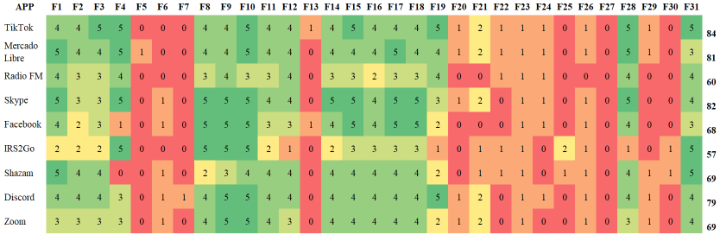
Phase 5: At this stage, a manual review of each of the mobile apps was applied based on the accessibility barriers defined in Table 2, for which it was necessary to tabulate the data. The data recorded when applying the manual evaluation contain the 31 features evaluated (see Figure 2); the evaluation is available in the Mendeley repository (Andrade et al., 2022).
Phase 6: Analysis of the manual review results related to the four accessi- bility principles. The success criteria considered in this study relate to target
Figure 2: Evaluation of the accessibility of nine mobiles for Android.Table 3. Summary of accessibility barriers.
Touch target Operable 2.5.5 AAA 207 47.5 Item label Understandable 3.2.3 AA 123 28.2 Text contrast Perceivable 1.4.3 AA 40 9.2 Item descriptions Perceivable 1.3.5 AA 28 6.4 Element type label Operable 2.5.3 A 13 3.0 Image contrast Operable 2.4.4 A 8 1.8 Clickable elements Operable 2.5.1 A 7 1.6 Type of element not supported Editable element tag Understandable 3.2.4 AA 3 0.7
size, consistent navigation, contrast, input purpose, name tag, link target, pointer gestures, name, function, value, and consistent identification. We use the Microsoft Excel tool with dynamic tables and graphs for the analysis. We expand the detail of the results in the outcomes and discussion section.
Phase 7: Recommendations for improvements to make the mobile apps more inclusive, based on the accessibility criteria categorized according to the level of accessibility they present. Improvements are detailed in the conclusions section.
OUTCOMES AND DISCUSSION
Table 3 summarizes the accessibility barriers found in the evaluation of the nine mobile apps, containing the name of the barrier, the accessibility princi- ple, the success criterion, the level, the errors detected and the percentage of errors.
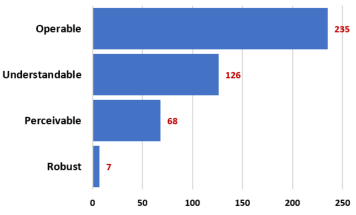
The operable principle presents 235 accessibility barriers corresponding to 53.9% that must be corrected urgently to help make mobile apps acces- sible, followed by understandable with 28.9%, in third place perceivable with15.6% and finally robust with 1.6% (see Figure 3).
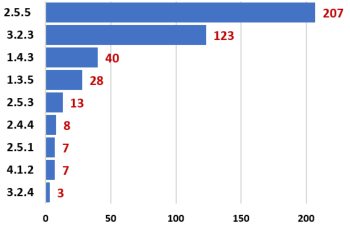
The highest number of accessibility problems is to success criteria 2.5.5 based on “touch target size and spacing,” with 207 barriers, representing 47.5%; followed by criteria 3.2.3 based on “provide instructions for custom
Most Common Accessibility Barriers in Native Mobile Applications Used in Ecuador 75
Figure 3: Accessibility principles analyzed in the Apps.Figure 4: Success criteria analyzed in the Apps.Figure 5: WCAG 2.1 accessibility levels in App.
touchscreen and device manipulation gestures,”corresponding to 28.2%, and criteria 1.4.3 related to “contrast” problems, representing 9.2%. The rest of the barriers represent a percentage of less than 6.5% (see Figure 4).
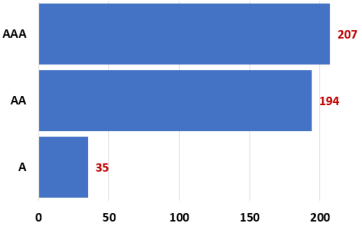
We found more accessibility problems at the AAA level with 207 barri- ers, equivalent to 47.5%, followed by the AA level with 194, representing 44.5%, and 35 barriers, the A level representing 8% (see Figure 5). The analy- sis reveals that the mobile apps evaluated do not have the minimum level of accessibility.
CONCLUSION
This study has revealed that the principle of operability is the one that most violates accessibility in the mobile apps evaluated, accounting for 53.9%.
We recommend implementing a monitoring policy to collect data on the most used mobile apps to identify problems in the future and measure a series of indicators related to the quality of the mobile application, the level of accessibility and compliance with standards. We suggest monitoring the Apps throughout the entire life cycle, not only in the initial stages, repeating the entire evaluation and review process; once launched to the market, the application may undergo significant changes that affect the interaction and accessibility with the end-user.
Analyzing the nine apps with the highest downloads from the Google Play Store, the following rating was obtained based on three environments. The one with the highest rating corresponds to TikTok, while the lowest weight corresponds to IRS2Go, and the App with an intermediate result was Shazam. The results revealed that, regardless of an adequate level of accessibility, there are thousands of downloads of various applications, TikTok being the most preferred by users. Finally, we suggest raising awareness among governments to include universal access to mobile apps in public policies by considering WCAG 2.1 in software designs.
In terms of limitations, it is worth mentioning that future studies can analyze a more significant number of mobile apps with a combined (Salvador- Ullauri et al., 2020b) or heuristic (Salvador-Ullauri et al., 2020a) method applied to mobile apps. We suggest applying an evaluation with end-users with disabilities to refine the applied method in future studies. This research can be a starting point for studies related to accessibility for mobile devices.
ACKNOWLEDGMENT
The authors thank PUCE and Universidad de Las Américas-Ecuador, an internal research project INI.PAV.20.01.
REFERENCES
Acosta-Vargas, P., Salvador-Acosta, B., Salvador-Ullauri, L., Villegas-Ch., W., Gonzalez, M. (2021 a). Accessibility in Native Mobile Applications for Users with Disabilities: A Scoping Review. Adv. Hum. Factors Syst. Interact. 11, 5707. https://doi.org/10.3390/APP11125707 Acosta-Vargas, P., Serrano-Costales, L., Salvador-Ullauri, L., Nunes, I.I., Gonza-
lez, M. (2020). Toward Accessible Mobile Application Development for Users with Low Vision 1207 AISC, 236–241. https://doi.org/10.1007/978-3-030- 51369-6_32 Acosta-Vargas, P., Zarate-Estrella, S., Mantilla-Vaca, F., Novillo-Villegas, S., Chimbo, C., Luján-Mora, S. (2021 b). Towards Accessibility and Inclusion of Native Mobile Applications Available for Ecuador in Google Play Store. Sustainability 13, 11237. Alajarmeh, N. (2021). Non-visual access to mobile devices: A survey of touchscreen
accessibility for users who are visually impaired. Displays 70, 102081. Andrade, S., Lucano, C., Rodriguez Aldaz, J., Jadán-Guerrero, J., Nunes, I.L., Acosta-Vargas, G., Acosta-Vargas, P. (2022). (Dataset) Accessibility Assessment in Mobile Applications for Android. Mendeley Data V1. https://doi.org/10.17632/ 2bddhb2zmj.1
Most Common Accessibility Barriers in Native Mobile Applications Used in Ecuador 77
Google Play (2022). Top free apps [WWW Document]. URL https://play.google.co m/store/apps/top (accessed 2.2.22). Salvador-Ullauri, L., Acosta-Vargas, P., Gonzalez, M., Luján-Mora, S. (2020a). A
Heuristic Method for Evaluating Accessibility in Web-Based Serious Games for Users with Low Vision. Appl. Sci. 10, 8803. Salvador-Ullauri, L., Acosta-Vargas, P., Gonzalez, M., Luján-Mora, S. (2020b).
Combined method for evaluating accessibility in serious games. Appl. Sci. 10. https://doi.org/10.3390/APP10186324 Serra, L.C., Carvalho, L.P., Ferreira, L.P., Vaz, J.B.S., Freire, A.P. (2015). Accessibility Evaluation of E-Government Mobile Applications in Brazil. Procedia Comput. Sci. 67, 348–357. https://doi.org/https://doi.org/10.1016/j.procs.2015.09.279 World Wide Web Consortium (2018). Web Content Accessibility Guidelines (WCAG) 2.1 [WWW Document]. URL https://www.w3.org/TR/WCAG21/ (accessed 1.26.22). World Wide Web Consortium (2015). Mobile Accessibility: How WCAG 2.0 and
Other W3C/WAI Guidelines Apply to Mobile [WWW Document]. URL https: //www.w3.org/TR/mobile-accessibility-mapping/ (accessed 2.2.22). World Wide Web Consortium (2014). Website Accessibility Conformance Evaluation Methodology (WCAG-EM) 1.0 [WWW Document]. URL https://www.w3.org/ TR/WCAG-EM/ (accessed 2.2.22). Zaina, L.A.M., de Mattos Fortes, R.P., Casadei, V., Nozaki, L.S., Paiva, D.M.B.
(2022). Preventing accessibility barriers: Guidelines for using user interface design patterns in mobile applications. J. Syst. Softw. 111213.
LISTED IN THE AHFE DIGITAL BOOKSTORE CATALOGUE
Explore the complete digital volume
Human Factors in Accessibility and Assistive Technology
Read this individual research paper free through the original publisher, or explore the full digital proceedings book.
ISBN 978-1-958651-13-1
Explore this ISBN in the AHFE Bookstore ↗Listed in the July 2026 bookstore catalogue; search by ISBN to confirm current availability · Digital book purchase optional