Janio Jadán-Guerrero, Alexandra Bermeo, Priscila Cedillo, Isabel L. Nunes (2022). Helping kids and teens deal with Cyberbullying through informative learning capsules. In: Human Factors and Systems Interaction. AHFE Open Access, vol. 52, pp. 354–363. https://doi.org/10.54941/ahfe1002176
Nowadays, communication through technological devices has become widespread, and thanks to it, in these times of pandemic, it has been possible to face labor, educational, social and recreational challenges, among others. Due to confinement, children and adolescents carry out many activities on the computer or mobile devices, including socialization, learning, entertainment. This activity, in some cases, has also led to negative behaviors, including cyberbullying among them, this being one of the main problems that affects their physical and mental health, generating episodes of anxiety and suffering. In this context, the article presents a methodology for the implementation and deployment of learning capsules with the purpose of preventing bullying and cyberbullying of children and adolescents. The study began with a systematic review of literature on Microlearning as well as existing practices and technologies on the market. The systematic review protocol considered the choice of four digital libraries for the search. The search method and selection of technological solutions was based on finding Apps and websites for parental control and early detection of cyberbullying. An evaluation of 16 technological solutions was carried out and some strategies were identified that will be useful to develop the learning capsules.
Due to COVID-19 pandemic confinement, children and adolescents may be affected by stress and boredom, leading to misuse of social networks and electronic devices (Delgado 2020). Some studies show that confinement strengthened and increased virtual communication, a phenomenon that has been evidenced through the growth of internet traffic during the pandemic with an increase of up to 63% in the transfer rate; being digital media the available resources to interact with other people; exposing individuals to pro- longed times of navigation and use of social networks, videoconferencing
Helping Kids and Teens Deal with Cyberbullying Through Informative Learning Capsules 355
applications, multimedia platforms, among others (Tavra 2020). This has increased the probability of virtual harassment or cyberbullying that affects the mental health of the victim and can even lead to suicide (Delgado 2020).
In recent years this has become more frequent, more intense and in multiple forms. On the one hand, Bullying occurs when children and adolescents are subjected to perverse and violent acts, the acts can be physical, psychological and verbal. On the other hand, Cyberbullying is a concept that is used when children and adolescents suffer a persecution by another or others through the Internet or any electronic device such as mobile phones (Vásquez 2019). Glo- bally, there is violence in children and adolescents where the perpetrators are usually found in the educational environment, family or other people close to the environment in which the victim is (Cardona 2017; Vásquez 2019).
Among the resources that are used virtually, we can find those related to education, which can include several areas of knowledge, including psychoe- ducation and can be disseminated through learning capsules, which are tools that provide information on a specific topic using multimedia resources of very limited duration (images, text, voice, video) (Vidal et al. 2019). These types of tools seek to change the paradigm in the learning process, since a structured message with clear objectives is transmitted at specific times and in specific situations, allowing meaningful learning that generates an imprint on the collective ideology of a society (Pintos 2005). In addition, unlike other types of learning, where people seek information on a specific topic, with these tools, transparent learning is allowed, which educates the population in values, pursuing a defined objective, which can be used to support social welfare.
Hence, this research seeks to combat and prevent bullying and cyber- bullying through the education and training of children and adolescents, educational systems and family environments through the creation of lear- ning classrooms. These learning capsules will be deployed taking advantage of the juncture between the massive use of technology (social networks, mes- saging platforms, gaming platforms) and the social isolation resulting from the pandemic, so the theme of the deployment according to the characte- ristics of the target audience, will be carefully analyzed and included in a methodology that allows institutions, governments and others the creation and effective dissemination of content. The central idea of this proposal is oriented to the creation and analysis for the dissemination of learning capsu- les, which will be based on and aligned with an existing methodology (Cedillo et al. 2021). This methodology will be adjusted for the different subsy- stems involved and themes according to the proposed research, which will enrich and enhance its application in the specific domain of cyberbullying, the reason for this proposal.
This research has several phases and this article describes the first phase of literature review.
BACKGROUD Despite technological advances and the development of communication stra- tegies that undoubtedly have an impact on the behaviors, attitudes and
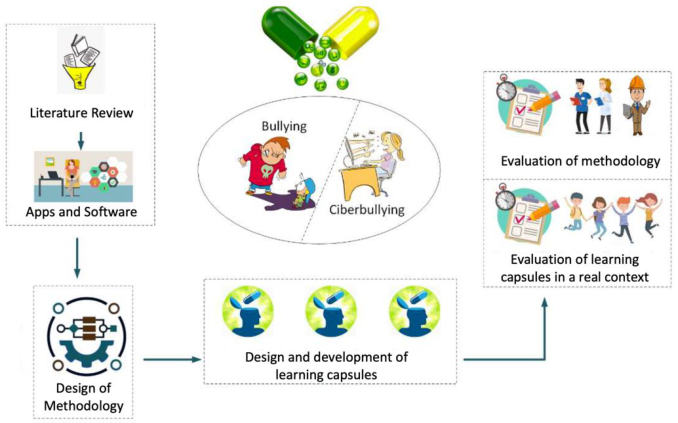
Figure 1: Method.
practices of a population, issues such as the prevention of domestic viole- nce have not been addressed. This is verified by means of the systematic review of the literature carried out by Gómez & Cedillo (2020) as a pre- vious part to the approach of this research. This review condenses the work that has been carried out in recent years in relation to methods, technologies and strategies for the creation of learning capsules in the area of microle- arning oriented to different population groups. This review was carried out following the guidelines proposed by Kitchenham and Charters (2007) and the following research question was posed: “What technologies, methods, strategies and tools are used for the implementation of learning capsules in the microlearning area?. The following research sub-questions were posed: i) What tools, platforms and technologies are used for the implementation of learning capsules in the area of microlearning? ii) What technologies are used to prevent bullying and cyberbullying? iii) What methods and strategies should be considered for the implementation of learning capsules in the area of microlearning? and iv) What methods and strategies should be considered for the implementation of learning capsules in the area of microlearning?
METHOD
The creation of the learning capsules has been necessary to align it to a metho- dology that allows its elaboration and specialization considering the children, adolescents, educational system, family members, among others involved; this will allow to generate an input oriented to the interests and needs of them. This solution could also be used by groups and institutions working on issues related to the prevention of bullying and cyberbullying, taking into consideration the rights of children and adolescents.
Figure 1 shows each of the elements of the proposal that will make it pos- sible to describe the achievement of the objective of our research. As a basis,
Helping Kids and Teens Deal with Cyberbullying Through Informative Learning Capsules 357
the state of the art is reviewed through a systematic review of the literature, on which the design of the methodology is based; as well as exploring the technological tools that have been developed to prevent cyberbullying.
With the information gathered, an instructional methodology will be designed before creating and developing the learning capsules, taking into account the micro contents of the topics to be transmitted. Subsequen- tly, the acceptance of both the methodology and the resulting products will be evaluated by means of case studies and/or controlled experiments applied to professionals in the associated areas (technical personnel, experts in the social and educational sciences) and the perception of the end users. This article describes the first part of the literature review explo- ring the existing tools on the market to prevent the risks of bullying and cyberbullying.
RESULTS
The systematic review protocol considered the choice of four digital libraries for the search. The authors conducted the search considering a period star- ting in 2005, the year in which the first formal academic meeting was held: Microlearning 2005: Emerging Concepts, Practices and Technologies after e-Learning, from which its editors (Hug, Lindner and Bruck 2005) published the results of the congress and the first attempts were made to systematize this learning perspective, acquiring new knowledge through interaction with micro-content (Mosel 2005).
In the case of platforms, it is evident that learning capsules are commonly deployed on social networks (33%), with Facebook and Twitter being the most frequent (Kovacs 2015; Polasek and Javorcik 2019; Sun et al. 2018; Dearman and Truong 2012; Chen et al. 2016; Ján 2018). Also, online learning platforms (39%) such as edX, Khan Academy, and Coursera have been employed for the deployment of microlearning capsules (Fitzgerald and Tisdell 2019; Sun, Cui, Shen, et al. 2017; Jahnke et al. 2020; Sun et al. 2018). Other types of platforms such as online video or messaging plat- forms are used to reach broader populations with diverse characteristics (Aldosemani 2019; Tingjun 2016; Fitzgerald and Tisdell 2019; Polasek and Javorcik 2019; Chen et al. 2016; Ján 2018; Sun et al. 2018), and even, in this context, ways of deployment in other media that are currently not considered to show learning capsules, but are oriented to other types of dissemination, mainly marketing (e.g., online games), where, for our obje- ctives, mechanisms can be introduced for the incorporation of these learning capsules.
In the case of Apps and Software the Table 1 shows 16 solutions found in Apps Store.
Analyzing some of the software presented in Table 1, it was possible to identify some of the categories that are used, among them: storytelling (Jadán-Guerrero et al. 2020), identifying hurtful messages, help notifica- tions, confronting the abuser, avoiding responding, blocking the contact, thinking before giving quick responses or entering virtual applications to report.
Table 1. Data collection techniques and instruments.
Table available in the original PDF paper.
Software Description Download https://bit.ly/33l42hf ReThink Use the keyboard to rethink hurtful messages when users are being typed on any platform or social network. When detecting this type of offensive messages, it recommends through an alert notification, to pause, review and rethink the words.
https://bit.ly/3BsEonh
Proofup Through this App a user can record the messages or conversations that reach the smartphones to have evidence of harassment. It also has an alert button in case of being in danger, which notifies the parents or the person who has been placed as a protector.
https://bit.ly/3gN4RCp
SafeToNet It is an application that serves to educate children in real time. This application warns children and adolescents if it detects any risk in a social network.
https://bit.ly/33k4E6E
Qustodio This free app is designed to monitor and protect minors’ use of their mobile devices. It has an online portal where parents can see how their children use devices and websites.
https: //apple.co/3sHsyBD
Bully Button Parent-Kid
Bully Button is a parenting app which helps to record bullying actions against kids. Kids can easily record it and send it to Parent and School authority.
https://bit.ly/3GJMtVz
KnowBullying The app focuses on detection within the home itself. A matter in which communication between parents and children is basic and an aspect that the app tries to improve. In addition, it allows them to access general information about bullying, open a chat with their children about it, set reminders to talk to their children at certain times, and so on.
https://bit.ly/3uNTjqK
Brave UP This tool seeks to improve communication and participation within school communities, in order to build a collaborative and healthy environment for learning and detect cases of school violence in time.
Continued.
Helping Kids and Teens Deal with Cyberbullying Through Informative Learning Capsules 359
Table 1. Continued.
Table available in the original PDF paper.
Software Description Download https://bit.ly/3H2rzS1 My Mobile Watchdog Allows guardians to know the messages and call history of minors in their care, set limits on the duration of calls and messages sent, access the contact list, locate user, block certain web pages and applications.
https://bit.ly/3sFnON9
Net Nanny Parental Control App
It allows us to monitor the actions of our children on the mobile phone and integrates some filters that can be activated (or not). The information it collects, in any case, is only stored for 24 hours.
https://bit.ly/3sJlRiq
Anonymous Alerts
It is a software to anonymously report these types of cases. An application with an easy and safe operation that allows, in addition to reporting incidents related to bullying and cyberbullying, others related to depression, family problems, drugs and weapons
https: //apple.co/3oOh26w
Bullying es Acoso escolar
With “Bullying is bullying” children can learn more about this problem, from such basic issues as what bullying is, to the typology, the type of profile of the bully and the bullied, the relationship between the two, the consequences and, of course, the tips you can put into practice to detect and avoid it.
https://bit.ly/3rOk1Oh
Basta de Bullying
It aims to end (prevent, detect and solve the different cases) with bullying at the hand of a series of educational and interactive resources. In fact, the app has a specific section to test the knowledge obtained, as well as other sections in which to play and watch related videos.
https://bit.ly/3uPm3zn
CyberBully Hotline
A service that provides assistance and support to victims of bullying and allows to react and prevent such problems. Its motto is to “end the fight before the first blow is thrown”, to enlist the support of witnesses to bullying and to protect the students concerned.
Continued.
Table 1. Continued.
Table available in the original PDF paper.
Software Description Download https://bit.ly/33k9Szi Andrea It is an App that accompanies children or teenagers at all times and helps them to recognize and anonymously report cases of bullying or cyberbullying.
https://b-resol.com
b-resol This App allows both victims and bystanders to alert the situation immediately and safely. Anonymity is guaranteed by default and there is the option of selecting the interlocutors of both a message and a chat. For its part, the educational center or gold type (sports, leisure, etc.) has a control tool with which it can carry out the monitoring of the incidence in full.
https: //apple.co/3sEVU3Q
Stop!t A tool that addresses the lack of preparation of teachers when dealing with these issues and allows them to detect it more easily. Likewise, and of course, it also allows those affected to report cases of abuse. Of course, it focuses rather on the so-called cyberbullying, that is, on those that take place through the network but that are also carried out by students.
CONCLUSION
The literature review highlights the importance of this research project, which will mainly consider the technological part to deploy the microcapsules; and, therefore, the content that the learner is required to consume. In addition, in this state of the art it has been evidenced that among the principles that a learning capsule must comply with in order to be considered as such (short learning units, short learning activities, reduced time, immediate feedback, on-demand).
Another important finding derived from this systematic review, which will shed light on the development of the methodology for the creation of lear- ning capsules, is that they have generally been designed for an unspecified age group (72%), e.g. (Sun, Cui, Beydoun, et al. 2017), by means of a learning analysis and educational data mining, were able to determine the learning patterns through open educational resources and the characteristics of the learning capsules. Learning through open educational resources and the cha- racteristics of students’ learning styles but did not consider age as a factor in the analysis. To a lesser extent, the specificities of adults (28%) (Dingler et al. 2017; Edge et al. 2012) and adolescents (11%) have been considered (Baldauf, Brandner and Wimmer 2017); leaving aside the sector of children
Helping Kids and Teens Deal with Cyberbullying Through Informative Learning Capsules 361
and older adults. Therefore, creating a methodology that allows the deve- lopment of learning capsules that consider the different types of families (extended, nuclear, single-parent, composite, among others) and the cha- racteristics of each of the members, result in the coverage of an important knowledge gap.
Through this analysis, it is also evident the need to generate new research focused on children and adolescents who are in situations of violence, such as bullying and cyberbullying. With this, it is determined that there is a need to implement this project in order to support the prevention of violence against children and adolescents, and protect their rights, integrity and life.
ACKNOWLEDGMENT
The authors would like to thank the Coorporación Ecuatoriana para el Desarrollo de la Investigación y Academia- CEDIA for their contribution in innovation, through the CEPRA projects, especially the project CEPRA- XVI-2022-04, “Implementación y despliegue de cápsulas de aprendizaje para combatir el bullying y el ciberbullying en niños, niñas y adolescentes”; also the Universidad Tecnológica Indoamérica, Universidad de Cuenca and Universidad del Azuay for the support for the development of this work.
REFERENCES
Aldosemani, T. (2019). Microlearning for Macro-outcomes: Students’ Perceptions of Telegram as a Microlearning Tool. En: L.M. Väljataga T. (ed.), Digital Turn in Schools—Research, Policy, Practice. Lecture Notes in Educational Technology. Singapore: Springer Singapore, pp. 69-81. ISBN 978-981-13-7360-2. Baldauf, M., Brandner, A., Wimmer, C. (2017). Mobile and gamified blended lear-
ning for language teaching - Studying requirements and acceptance by students, parents and teachers in the wild. ACM International Conference Proceeding Series, pp. 13–24. DOI 10.1145/3152832.3152842. Cardona, J. (2017). Jóvenes: bullying y ciberbullying. Revista de estudios de juventud, http://www.publicacionesoficiales.boe.es. Cedillo, P., Gómez, D., Prado-Cabrera, D., Bermeo, A., Illescas, L. (2021). Micro-
learning Method for Building Learning Capsules for Older Adults. Proceedings of the 7th International Conference on Information and Communication Tech- nologies for Ageing Well and e-Health [en l nea]. S.l.: SCITEPRESS - Science and Technology Publications, pp. 187–194. ISBN 978-989-758-506-7. DOI 10.5220/0010449201870194. Chen, J., Zhang, Y., Sun, J., Chen, Y., Lin, F., Jin, Q. (2016). Personalized microlearning support based on process mining. Proceedings - 2015 7th International Conference on Information Technology in Medicine and Education, ITME 2015, pp. 511–515. DOI 10.1109/ITME.2015.120. Dearman, D., Truong, K.N. (2012). Evaluating the implicit acquisition of second lan-
guage Vocabulary using a live Wallpaper. Conference on Human Factors in Com- puting Systems - Proceedings, pp. 1391–1400. DOI 10.1145/2207676.2208598. Delgado, P. (2020). El cyberbullying aumenta durante la pandemia Observatorio de Innovación Educativa. Observatorio de Innovación Educativa, https://observator io.tec.mx/edu-news/cyberbullying-en-aumento-durante-la-pandemia.
Dingler, T., Weber, D., Pielot, M., Cooper, J., Chang, C.C., Henze, N. (2017).
Language Learning on-the-go: Opportune moments and design of mobile micro- learning sessions. Proceedings of the 19th International Conference on Human- Computer Interaction with Mobile Devices and Services, MobileHCI 2017, DOI 10.1145/3098279.3098565 Edge, D., Fitchett, S., Whitney, M., Landay, J. (2012). MemReflex: Adaptive flashcards for mobile microlearning. MobileHCI’12 - Proceedings of the 14th International Conference on Human Computer Interaction with Mobile Devices and Services, pp. 431–440. DOI 10.1145/2371574.2371641. Emmery, C., Verhoeven, B., De Pauw, G. et al. (2021). Current limitations in
cyberbullying detection: On evaluation criteria, reproducibility, and data scarcity. Lang Resources & Evaluation 55, 597–633. https://doi.org/10.1007/s10579-020- 09509-1 Fitzgerald, J.H., Tisdell, C.C. (2019). The impact of educational microcontent on the student learning experience. ACM International Conference Proceeding Series, pp. 17–22. DOI 10.1145/3348400.3348412. Gómez, D., Cedillo, P. (2020). Propuesta metodológica para la creación de cápsulas
de aprendizaje para adultos mayores. S.l.: Universidad de Cuenca. Hug, T., Lindner, M., Bruck, P. (2005). Microlearning: Emerging concepts, practices and technologies after e-Learning. S.l.: s.n. ISBN 3-901249-83-4. Jadán-Guerrero, J., Sanchez-Gordon, S., Acosta-Vargas, P., Alvites-Huaman, C.,
Nunes, I.L. (2020). Interactive Storytelling books for fostering inclusion of Children with Special Needs, Advances in Intelligent Systems and Computing Jahnke, I., Lee, Y.M., Pham, M., He, H., Austin, L. (2020). Unpacking the Inherent Design Principles of Mobile Microlearning. S.l.: Springer Netherlands. ISBN 0123456789. Ján, M. (2018). Conceptual Framework of Microlearning-Based Training Mobile
Application for Improving Programming Skills., vol. 725, pp. 155-166. DOI 10.1007/978-3-319-75175-7. Kitchenham, B., Charters, S. (2007). Guidelines for performing Systematic Literature Reviews in Software Engineering. S.l. Kovacs, G. (2015). FeedLearn: Using facebook feeds for microlearning. Confere-
nce on Human Factors in Computing Systems - Proceedings. S.l.: s.n., ISBN 9781450331463. DOI 10.1145/2702613.2732775. Kumar, A., Sachdeva, N. (2019). Cyberbullying detection on social multimedia using soft computing techniques: a meta-analysis. Multimed Tools Appl 78, 23973– 24010 (2019). https://doi.org/10.1007/s11042-019-7234-z. Mosel, S. (2005). Self directed learning with personal publishing and microconte Nahar V., Unankard S., Li X., Pang C. (2012). Sentiment Analysis for Effective Dete-
ction of Cyber Bullying. In: Sheng Q.Z., Wang G., Jensen C.S., Xu G. (eds) Web Technologies and Applications. APWeb 2012. Lecture Notes in Computer Science, vol 7235. Springer, Berlin, Heidelberg. https://doi.org/10.1007/978-3-642-29253- 8_75 Pintos, J. (2005). Comunicación, construcción de la realidad e imaginarios sociales.
Utop a y Praxis Latinoamericana, vol. 10, no. 29. Polasek, R., Javorcik, T. (2019). Results of pilot study into the application of microlearning in teaching the subject computer architecture and operating system basics. Proceedings - 2019 International Symposium on Educational Technology, ISET 2019, pp. 196-201. DOI 10.1109/ISET.2019.00048.
Helping Kids and Teens Deal with Cyberbullying Through Informative Learning Capsules 363
Sun, G., Cui, T., Beydoun, G., Shen, J., Chen, S. (2017). Profiling and Supporting Adaptive Micro Learning on Open Education Resources. Proceedings - 2016 Inter- national Conference on Advanced Cloud and Big Data, CBD 2016, pp. 158–163. DOI 10.1109/CBD.2016.037 Sun, G., Cui, T., Shen, J., Xu, D., Beydoun, G., Chen, S. (2017). Ontological Learner
Profile Identification for Cold Start Problem in Micro Learning Resources Deli- very. Proceedings - IEEE 17th International Conference on Advanced Learning Technologies, ICALT 2017, pp. 16–20. DOI 10.1109/ICALT.2017.22. Sun, G., Cui, T., Yong, J., Shen, J., Chen, S. (2018). MLaaS: A Cloud-Based System for Delivering Adaptive Micro Learning in Mobile MOOC Learning. IEEE Tran- sactions on Services Computing, vol. 11, no. 2, pp. 292-305. ISSN 19391374. DOI 10.1109/TSC.2015.2473854. Tavra, P. (2020). El tráfico de internet en los hogares creció hasta 63 % en medio de
la pandemia del COVID-19. El Universo. Guayaquil, june 2020. Tingjun, L. (2016). Probing into potentials of WeChat in the field of higher education in China. ACM International Conference Proceeding Series, pp. 1–6. DOI 10.1145/3012258.3012259. Vásquez, L. (2019). Derecho Ecuador - bullying y ciberbullying en el ecua-
dor. Derecho Ecuador, Available at: https://www.derechoecuador.com/bullying- yciberbullying-en-el-ecuador. Vidal, M., Vialart, M., Alfonso, I., Zacca, G. (2019). Cápsulas educativas o informativas. Un mejor aprendizaje significativo. Revista Cubana Educación M dica Superior, vol. 33, no. 2, pp. 1904.
LISTED IN THE AHFE DIGITAL BOOKSTORE CATALOGUE
Explore the complete digital volume
Human Factors and Systems Interaction
Read this individual research paper free through the original publisher, or explore the full digital proceedings book.
ISBN 978-1-958651-28-5
Explore this ISBN in the AHFE Bookstore ↗Listed in the July 2026 bookstore catalogue; search by ISBN to confirm current availability · Digital book purchase optional