Shoichiro Fujisawa, Masaki Okegawa, Kenji Sakami, Jyunji Kawata, Jiro Morimoto, Yoshio Kaji, Mineo Higuchi, Shin-Ichi Ito (2022). On the stimulation and visibility by blinking light emitting block for low vision. In: Human Factors in Accessibility and Assistive Technology. AHFE Open Access, vol. 37, pp. 1–7. https://doi.org/10.54941/ahfe1001636
Approximately 80% of people with visual impairment have residual visual acuity. As such, the authors have developed a light-emitting block that is placed at the entrance of a pedestrian crossing to support those with visual impairment at night. A blinking light has generally been used for selectively distinguishing the target light source from the surrounding light source. However, this type of blinking (i.e., simple blinking) can be stimulating, making it suitable for night-time road construction sites but not for normal road environments. Therefore, the authors have focused on phase-in-phase-out blinking, which gradually brightens and darkens with each blink, thereby suppressing stimulation. This blinking pattern has been considered to reduce visibility just by suppressing the stimulus. However, focusing on the human sensory characteristics of adaptation and arousal, evidence has suggested the existence of a blinking cycle and pattern that awakens while suppressing stimuli.Therefore, the current study sought to identify blinking cycles and patterns that awaken while suppressing light stimulation. The intensity of light stimulation is evaluated via sensory evaluation. Based on the intensity of the stimulus and degree of arousal, we searched for the optimum blinking cycle that promotes adaptation, a human sensory characteristic, and arousal from the blinking pattern and verified the visibility of the obtained blinking pattern in individuals with visual impairment and healthy subjects. Previously, we had conducted an experiment in a region with a period of 4–7 s. This time, however, we conducted an experiment in a region with a period of 2– 3.5 s. This study verified that phase-in-phase-out blinking is effective for pedestrians while considering the surroundings.The purpose of this experiment was to determine the optimal blinking method for supporting people with visual impairment. Although it is desirable to provide support for people with visual impairment by promoting stronger visibility, introducing flashing blinks in public facilities may cause discomfort to healthy people around them. For instance, introducing a blinking light of approximately 1 Hz, which has a fast blinking cycle, at the entrance of a pedestrian crossing can enter the driver's field of vision, causing discomfort and making the driver look away, thereby leading to accidents. The ideal blinking light for support is that which limits arousal to some extent and does not induce discomfort. Based on the blinking patterns used in this experiment under the aforementioned condition, we believe that a fade-in-fade-out type pattern with a blinking cycle of 2 s and a lighting time of 2 and 3 s would be effective. The reason for this is that the intensity of the stimulus obtained from the sensory evaluation of healthy subject and those with visual impairment is suppressed, visibility is secured to some extent, and the blinking method does not induce discomfort. Thus, the fade-in-fade-out blinking method can be expected to suppress discomfort.
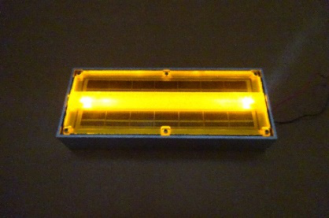
About 80% of persons with visually impairment have residual visual acuity. We have developed a light-emitting block for the visually impaired (see Figure 1). This light-emitting block is intended to help persons with visually impairment at night by laying it at pedestrian crossing entrances. Generally, the blinking light is adopted to selectively distinguish the target light source from the surrounding light source. However, simple blinking light is a sti- mulating light used at night at road construction sites, which renders it an unsuitable presentation method in a normal road environment. There-fore, we focused on phase-in/phase-out blinking, which gradually becomes brigh- ter and then gradually darkens while blinking to suppress stimulation. At first glance, this blinking pattern is thought to reduce visibility by suppressing the stimulus. However, when focusing on the human sensory characteristics of adaptation and arousal, it is thought that there is a blinking cycle and blinking pattern that awakens the senses while suppressing the stimulus. Therefore, this study aims to search for blinking cycles and blinking patterns that awa- ken the senses while suppressing light stimulation. We measured the intensity of light stimulation by sensory evaluation. We searched for the optimum blin- king be-tween the blinking cycle, in which adaptation (which is a human sensory characteris-tic) is seen from the intensity of the stimulus and arousal level, and the arousal by the blinking pattern, and verified the visibility of the obtained blinking pattern by people with visual impairment and healthy people. It was experimentally verified that the phase-in/phase-out blinking is effective for pedestrians while considering the sur-roundings.
RESEARCH METHOD In this study, we searched for a luminescence pattern with high arousal of brain waves, although the stimulus is suppressed in the sensory evaluation, and verified it in an empirical experiment—simple blinking that blinks on and off repeatedly and phase-in/phase-out that gradually brightens and gradually darkens, searching for the optimum pattern from off-relationships. The obtai- ned blinking pattern was adopted for the blinking of the issuing block. The effectiveness for pedestrians was verified by experimenting on the viewing distance of the light-emitting block by a healthy person and a visually impai- red person. In the experiment, the light-emitting block that is constantly lit (simple blinking) and the light-emitting block that blinks in phase-in/phase- out were gradually approached from a distance, and the viewing distance at which the light of the light-emitting block is visible was compared, as well as the blink-ing stimulus that affects the visibility. This visual distance experiment verifies the effectiveness of blinking in which phase-in/phase-out blinking can suppress irritation while ensuring the visual perception at the appropriate distance. By laying a light-emitting block that blinks in the opti- mum blinking pattern at the pedestrian crossing entrance, effective support for guiding visually impaired people is expected to be achieved while taking into consideration the remaining pedestrians and surrounding environment.
In this experiment, subjects were asked to evaluate each blinking pattern’s stimulus intensity, visibility, and discomfort based on the light of normal light.
On the Stimulation and Visibility by Blinking Light Emitting Block for Low Vision 3
Each subject responded using seven levels of psychological intensity (Stoelzel et al., 2015; Abolafia et al., 2011; Keller et al., 2017).
Experimental Method of Blinking Light We have conducted a verification experiment (Ikeda et al., 2013) on the effe- ctiveness of the developed light-emitting block but have also used ordinary lights. A verification experiment (Ikeda et al., 2015) was also conducted on the visibility of the light-emitting block when the lighting of surrounding sto- res is in the background, assuming the actual road environment. While testing the visibility by changing the height of the white light-emitting plate as if it were a light source in a surrounding store, it was found that the perception of the signal was affected by the light-emitting plate in the rear. In addition, we conducted a verification experiment (Nagahama et al., 2016) of the light- emitting block laid at the actual pedestrian crossing entrance, but in the actual pedestrian crossing, the headlights of the traveling car, the surrounding light sources, and the light-emitting block exist, so the light-emitting block must stand out. To guarantee this result, we have developed a blinking light that improves visibility while suppressing the stimulation caused by the blinking light. Focusing on arousal and adaptation to human stimuli, it has been con- firmed (Okada et al., 2017) that there is a pattern of awakening while feeling that stimuli are suppressed depending on the blinking cycle and the difference in light emission method.
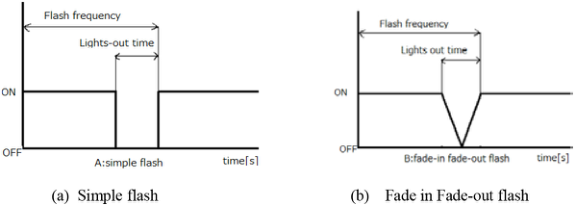
Blinking Pattern In a previous report, we reported a lighting pattern of 4–7 seconds, but here we per-formed various blinking patterns with a cycle of 2–3.5 seconds. The blinking parame-ters are blinking cycle and extinguishing. We tested three methods of time and blink-ing. A is a blinking method that turns on and off and is called simple blinking. B is a blinking method that gradually darkens the light and gradually brightens again when the light disappears completely. Therefore, there are three blinking parameters: blink-ing cycle, turn-off time, and blinking method. Figure 2 shows an image of the blinking method.
Outline of the Experiment The flashing light is presented to the subject, and the brain waves at the time of the flashing light are measured, and the sensory evaluation of the stimulus is performed. The size of the darkroom used in the experiment is 2 m in height, 2 m in width, and 4 m in depth. A dimmable LED line border light is used for the experi-mental environment. As a measure against the new corona virus, an intake/exhaust ventilation fan was installed.
The Outline of the experiment is shown below.
Subjects: 26 healthy subjects with an average age of 29.6 ± 16.1 years
Brightness of experimental environment: 20 lx (assuming brightness under street lights at night)
Number of blinking patterns: 12 types (patterns are shown in Table 1)
Viewing distance: 2 m
Randomly present blinking to the subject.
Figure 1: LED block.Table 1. Combination of blinking or ON-OFF patterns. A: simple flash B: fade-in fadeout flash.
Experimental Procedure The experimental procedure is shown below.
1) The electrodes of the electroencephalograph are attached to the subject. 2) The subject is adapted to the brightness of the laboratory luminance of 20 lx. 3) A constant light is presented for comparison with the blinking stimulus. Then the blinking light is presented for 30 seconds. 4) After presenting the flashing light for 30 seconds, the subject evalua- tes the strength, discomfort, and visibility of the flashing light stimulus compared to the normal light on a 7-point scale of -3 to +3. 5) The experiment is performed using the 12 blinking light patterns (see Table 1) once each with clear eyes and then with pseudoamblyopia goggles.
Experimental Procedure The experimental procedure is explained below.
1) Adapted the participant to the brightness of the laboratory with an illuminance of 20 lux.
On the Stimulation and Visibility by Blinking Light Emitting Block for Low Vision 5
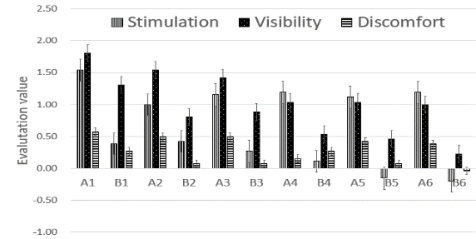
Figure 2: Blinking pattern.Figure 3: Results of sensory evaluation for each pattern (Sighted person).
2) Presented a normal light as a standard stimulus for comparison with the blinking stimulus. After that, present the blinking light for 30 s. 3) After presenting the blinking light for 30 s, the participant then evaluated the inten-sity of the light stimulus, visibility, and discomfort compared to the normal light on a 9-point scale of –4 to +4. 4) Performed this experiment with 12 blinking patterns, once each with normally sighted eyes and pseudo-amblyopia.
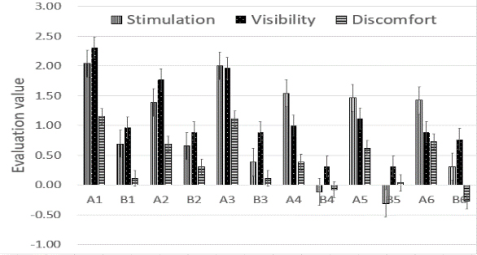
EXPERIMENTAL RESULTS Each of the 12 blinking light patterns was measured once for each of the21 sub-jects in the visual field of clear eyes and pseudo-cataract, and the average values of the stimulation intensity, discomfort, and visibility of the blinking light compared to the normal light of each blinking were measured. The sensory evaluation results are shown in Figure 3 and Figure 4.
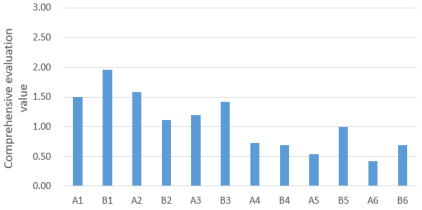
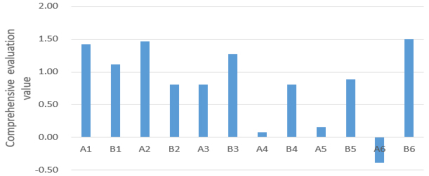
In addition, Figure 6 and Figure 7 show the comprehensive evaluation values of clear eyes and pseudoamblyopia of each blinking pattern. The comprehensive evaluation formula is as follows: Comprehensive Evaluation Value = Visibility×2 – Stimulation Intensity – Stimulation Discomfort
The intensity of light stimulus and discomfort were negative values, and the visibility was positive, but the positive visibility value was doubled for the two negative weights of light stimulus and discomfort. B1 and B3 were the
Figure 4: Results of sensory evaluation for each pattern (Pseudo-low vision person).Figure 5: Comprehensive evaluation value (Sighted person).Figure 6: Comprehensive evaluation value (Pseudo-low vision person).
blinking patterns in which visibility was ensured for both clear and pseudo- amblyopia while suppressing discomfort.
CONCLUSION
This experiment aimed to find the optimal blinking method to guide people with low vision. It is desirable to provide support for people with low vision with strong visual signaling, but strong flashing blinks in public facilities cause discomfort to the healthy circulating people. For example, a blinking light of about 1 Hz, with a fast blinking cycle is introduced at the entrance of a pedestrian crossing can enter a driver’s field of vision, causing discomfort and forcing him or her to look away, which would increase the likelihood of an accident. The advantage of the flashing light used for support of the visually impaired is that the alertness is secured to some extent and that it does not
On the Stimulation and Visibility by Blinking Light Emitting Block for Low Vision 7
induce discomfort. From the experiments here described, the fade-out/fade-in type patterns B1 and B3 with a blinking cycle of 2 seconds and a lighting time of 2 and 3 seconds can be effective. Using these patterns, we obtained the suppressed intensity of the stimulus from the sensory evaluation of the sighted person and the person with low vision; the visibility is secured to some extent, and the blinking method does not induce discomfort. Based on our study, it can be expected that the blinking method of fading in and out will suppress the discomfort.
ACKNOWLEDGMENT
This research is being carried out with the support of JSPS Grant-in-Aid for Scientific Research (C) (General) 20K12736. We would like to express our gratitude here.
REFERENCES
Abolafia J. M., Vergara R., Arnold M. M., Reig R., Sanchez-Vives M. V. (2011) Cortical Auditory Adaptation in the Awake Rat and the Role of Potassium Currents, Cereb Cortex Vol. 21, No. 5, pp. 977–990. Ikeda N., Takahashi K., Inagaki T., Sato K., Ito S.-I., Seiyama M., Takeuchi K., Ogino
H., and Fujisawa S. (2015) Visibility of LED Blocks Mounted on Crosswalk Boun- daries for low Visual Capacity, Assistive Technology, Studies in health technology and informatics (Stud Health Tech Informat), Vol. 217, pp. 512–517. Ikeda N., Takahashi K., Yamamoto G., Kimura Y., Ito S.-I., Sato K., and Fujisawa S.
(2013) Verification of LED Blocks used at Crosswalk Entrances for Persons with Visually Impairment, Assistive Technology Research Series, Vol. 33, pp. 982–987. Keller A.J., Houlton R., Kampa B. M., Lesica N. A., Mrsic-Flogel T. D., Keller G. B., Helmchen F. (2017) Stimulus relevance modulates contrast adaptation in visual cortex, eLife, 6, e21589, pp. 1–12. Nagahama H., Inagaki T., Ikeda N., Takahashi K., Takeuchi K., Ogino H., Sato K.,
Ito S.-I., and Fujisawa S. (Jul. 2016) Proof Experiment of LED Block Equipped with Projections to Locate Travel Direction for Blind and Vision Impaired Persons, Proceedings of the AHFE2016 International Conference on Human Factors in Transportation, pp. 159–169, Orlando. Okada T., Miyamoto T., Ito S.-I., Sato K., Ikeda N., Sueda O., and Fujisawa S. (July
2017) Research on Blinking-Luminescence Travel Support for Visually Impaired Persons, Proceedings of the AHFE 2017 International Conference on Human Factors in Transportation, Los Angeles, pp. 319–324. Stoelzel C.R., Huff J.M., Bereshpolova Y., Zhuang J., Hei X., Alonso J.-M., and Harvey A. (2015) Hour-long adaptation in the awake early visual system, J. Neurophysiol. Vol. 114, No. 2, pp. 1172–1182.
LISTED IN THE AHFE DIGITAL BOOKSTORE CATALOGUE
Explore the complete digital volume
Human Factors in Accessibility and Assistive Technology
Read this individual research paper free through the original publisher, or explore the full digital proceedings book.
ISBN 978-1-958651-13-1
Explore this ISBN in the AHFE Bookstore ↗Listed in the July 2026 bookstore catalogue; search by ISBN to confirm current availability · Digital book purchase optional