Sota Matsui, Tomoyuki Inagaki, Shoichiro Fujisawa (2025). Subjective Evaluation of Identifying Boundaries of Railroad Crossing by the Visually Impaired Based on Walking Experiment. In: Design for Inclusion. AHFE Open Access, vol. 169, pp. 59–67. https://doi.org/10.54941/ahfe1006154
In Japan, various safety measures have been installed to assist visually impaired individuals in walking outdoors, including at railroad crossings. Specifically, even with the installation of Tactile Walking Surface Indicators (TWSI), which focus on preventing deviations toward the roadway or ballast, there is a risk of misidentification between the inside and outside of the crossing because the bar blocks inside the crossing have the same shape as those on the sidewalk. Furthermore, the walking characteristics of visually impaired individuals have not been sufficiently considered. In this study, we conducted an evaluation experiment at a railroad crossing near Okusawa Station to clarify issues related to the TWSI installed both inside and outside the crossing from the perspective of visually impaired individuals. In the experiment, two types of trials were conducted with visually impaired individuals: first trial involved the use of TWSI both inside and outside the crossing, while in the second trial, walls or fences were used in place of the TWSI outside the crossing. After the trials, participants were interviewed about their “level of confidence in determining the position of the crossing boundary” and “ease of understanding the boundaries between the inside and outside of the railroad crossing.” The results indicated that participants found it more difficult to understand the boundaries when exiting the crossing than when entering it. This suggests potential issues with the current TWSI installations at railroad crossings.
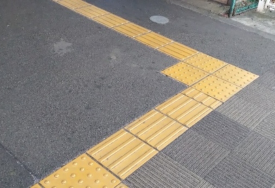
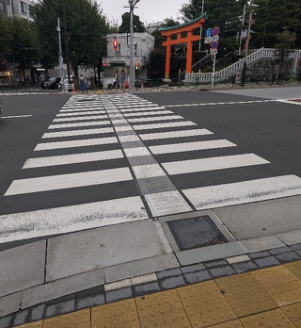
In Japan, various safety facilities, such as Tactile Walking Surface Indicators (TWSI), escort zones, and acoustic traffic signals, have been installed to assist visually impaired individuals in walking outdoors (Figs. 1 and 2). Similar safety measures have also been implemented at railroad crossings; however, insufficient consideration has been given to the walking characteristics of visually impaired individuals and the scales of railroad crossings. In April 2022, an accident involving a visually impaired person occurred at a railroad crossing in Nara Prefecture. The misidentification of the inside and outside of the railroad crossing was identified as a new cause of accidents
involving visually impaired individuals. In response, the Ministry of Land, Infrastructure, Transport and Tourism (MLIT) revised the “Guidelines for Universal Design of Roads” twice following this accident (MLIT, 2024). These revisions introduced specific standards for safety measures at railroad crossings, including the installation of dot blocks in front of the crossings. Additionally, the guidelines specified the use of guide projections inside the crossings, which differ from the TWSI and escort zones (Fig. 2).
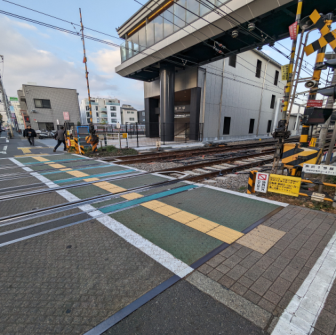
Before these guideline revisions, TWSI had already been installed inside a railroad crossing near Okusawa Station in Setagaya City, Tokyo, to assist visually impaired individuals in walking safely (Fig. 3). This measure has been positively evaluated for its effectiveness in preventing deviations toward roadways or ballasts. However, because the TWSI installed inside the crossing is identical in shape to that on the sidewalks, there is a risk of misidentification between the inside and outside of the crossing, as observed in Nara Prefecture.
In this study, we conducted a walking experiment at the railroad crossing near Okusawa Station to identify issues related to TWSI placement both inside and outside the crossing. Additionally, we examined challenges outside the crossing from the perspective of visually impaired individuals.
Subjective Evaluation of Identifying Boundaries of Railroad Crossing 61
While previous studies have investigated the universal design aspects of railroad crossings, most have been conducted in simulated environments. For example, the National Institute for Land and Infrastructure Management conducted experiments on the installation of guide projections at railroad crossings (MLIT, 2024). Four types of guide projections were placed at a simulated railroad crossing in the experimental environment, and participants were instructed to walk through each projection and evaluate their usefulness. The results of the experiment indicated that the pattern with bar projections placed on both sides of the dot projections which is similar to an escort zone, received high ratings. Furuhashi et al. examined the effectiveness of a bar projection in a simulated environment and demonstrated that, while it serves a certain role as a walking clue, several issues remain to be addressed, such as the need to improve the height of the projection (Furuhashi et al., 2023). However, few studies have been conducted in real-world environments, and prior research has largely overlooked the impact of the surrounding road environment, such as road alignment and external structures, on walking conditions at crossings. Many studies have focused on road crossing in real-world environments. For example, Yanagihara et al. conducted an experiment to investigate the crossing behavior of visually impaired individuals while clarifying behavioral characteristics at intersections they regularly use and the potential influence of surrounding traffic on their walking behavior (Yanagihara et al., 2007). In this way, conducting experiments in real-world environments is considered one of the important methods for examining modifications to the physical environment to ensure the safety of visually impaired individuals when walking outdoors. The novelty of this study lies in its focus on an actual railroad crossing and its consideration of the influences of the area outside the crossing.
Figure 3: The railroad crossing near Okusawa station.
OVERVIEW OF THE EXPERIMENT The railroad crossing near Okusawa Station extends in a north–south direction and is approximately 7 m long. The width of the pedestrian area is approximately 2.4 m. This is the only known case in Japan where TWSIs have been installed inside a railroad crossing.
Eleven visually impaired individuals (six males and five females) who had experience crossing railroads and regularly walked independently participated in this experiment. The mean age of the participants was 52.91. According to the disability classification based on the Regulation for Enforcement of the Act on Welfare of Physically Disabled Persons, eight participants were classified as Class 1, and three were classified as Class 2. The participants wore familiar shoes and used white canes during the experiment. Prior to the experiment, all participants signed a consent form, and we ensured conditions which experiment could be conducted safely.
METHOD
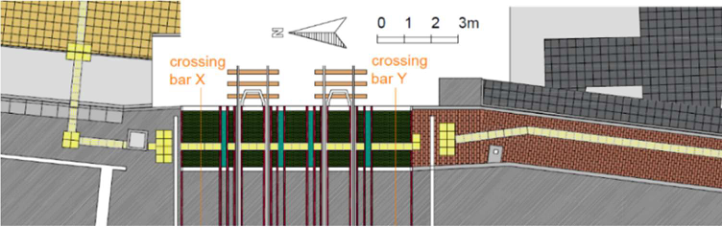
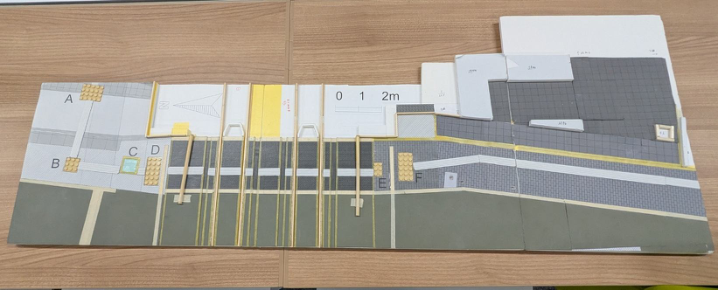
An overview of the railroad crossing near Okusawa Station is illustrated in Fig. 4. First, preliminary interviews were conducted to grasp the participants’ experiences with railroad crossings. Next, the experimental space was explained using a tactile kit (Fig. 5) to help participants fully comprehend the spatial environment. Additionally, an on-site explanation of the experimental space was provided, followed by a well-practiced walk.
Figure 4: Overview of the railroad crossing near Okusawa station.
We conducted two types of experiments to identify issues related to TWSI placement both inside and outside the crossing. In the first experiment, participants walked using the TWSI installed both inside and outside the crossing. In the second experiment, walls or fences were used outside the crossing in place of the TWSI. Each method involved four trials (two round trips).
During the trial, participants began walking upon hearing the staff’s call to start. They were instructed to provide a voice signal by saying “hai” twice: first when they judged that they had entered the crossing and again when they exited. Participants then stopped walking upon hearing the staff’s call of finish. After each trial, participants were interviewed. Following the experiment, a post-evaluation of the walking experience was conducted
Subjective Evaluation of Identifying Boundaries of Railroad Crossing 63
along with interviews to gather information about the participants’ personal profiles.
Figure 5: Tactile kit used in the description of the experimental space.
Evaluation Viewpoints To subjectively evaluate the degrees of safe and security of the railroad crossing environment from the participant’s perspective, interviews were conducted using a seven-point scale to assess factors such as their “level of confidence in determining the position of the crossing boundary” and “ease of understanding the boundaries between the inside and outside of the railroad crossing” during the trial. In addition, participants’ walking was recorded using a video camera during the experiment to obtain walking trajectories and to measure the gaps between the position where the crossing bar descended and the point at which participants gave their voice signal, saying “hai.” These data were then used to objectively evaluate the issues identified during the experiment.
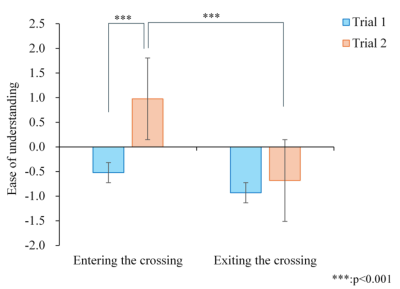
EVALUATION OF EASE OF IDENTIFICATION OF THE INSIDE AND OUTSIDE OF THE RAILROAD CROSSING The evaluation results for the “ease of understanding the boundaries between the inside and outside of the railroad crossing” by the 11 participants are shown in Fig. 6. An analysis of variance (ANOVA) with “Trial,” “Crossing Direction,” and “Entering the crossing (Enter)/Exiting the crossing (Exit)” as factors revealed a main effect for “Trial” and “Enter/Exit” at significance levels of 1% and 0.1%, respectively (Table 1). Furthermore, a significant interaction between “Trial” and “Enter/Exit” was observed. A multiple comparison using the Tukey method revealed a significant difference in Trial 2 between entering and exiting the crossing (p < 0.001), as well as in entering the crossing between Trials 1 and 2 (p < 0.001).
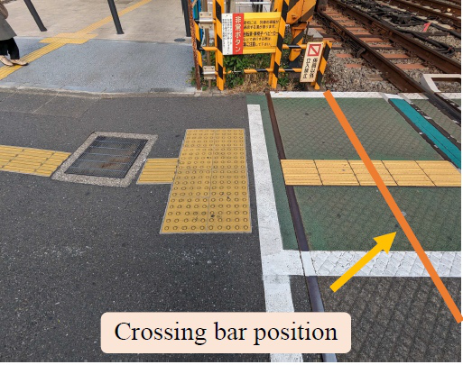
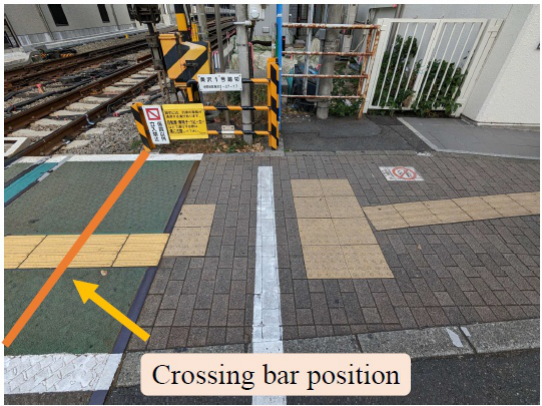
This result is thought to reflect the influence of the absence of clear landmarks at the boundaries of the crossing and the continuous installation of TWSI from the inside to the outside of the crossing (Figs. 7 and 8). In Trial 2, where walls and fences were used outside the crossing, the evaluation score for the exit was low. This may be due to the TWSI inside and outside the
crossing having the same shape, which made it challenging to distinguish the walking distance at the crossing. Additionally, the dot blocks at the crossing boundaries and the bar blocks inside the crossing were installed without spacing, which is likely another factor influencing the clarity of the crossing boundary.
Figure 6: Evaluation results of “ease of understanding the boundaries between the inside and outside of the railroad crossing”.Table 1: Analysis of variance results for “ease of understanding the boundaries between the inside and outside of the railroad crossing”.
Figure 7: Condition of the railroad crossing boundary (north side of the crossing).
Subjective Evaluation of Identifying Boundaries of Railroad Crossing 65
Figure 8: Condition of the railroad crossing boundary (south side of the crossing).
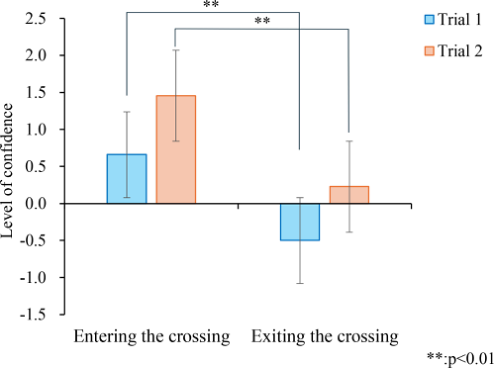
The evaluation results for the “level of confidence in determining the position of the crossing boundary” by the 11 participants are shown in Fig. 9. An ANOVA with factors including “Trial,” “Crossing Direction,” and “Enter/Exit” revealed significant main effects for “Trial” and “Enter/Exit” at the 1% and 0.1% significance levels, respectively (Table 2). Multiple comparisons using the Tukey method identified significant differences in Trial 1 between entering and exiting the crossing (p < 0.01), as well as in Trial 2 between entering and exiting the crossing (p < 0.01). Consistent with the results for the “ease of understanding the boundaries between the inside and outside of the railroad crossing,” ratings were lower when exiting the crossing. During post-trial interviews, many participants mentioned the absence of clear landmarks at the boundary when exiting and noted they had to rely on their steps and sense of distance to produce a voice signal. The current installation of the TWSI around the crossing boundary is believed to be one of the factors contributing to the low confidence ratings. Additionally, some participants were observed to slow down their walking speed or increase the movement of their white canes around the boundaries, suggesting more cautious walking behaviors due to the difficulty in identifying the crossing boundaries and the uniform shape of the TWSI inside and outside the crossing. These results indicate that conducting experiments in real- world environments enables the realistic capture of participant behavior in shared traffic spaces and highlight the importance of thoroughly considering environmental factors surrounding railroad crossings.
Table 2: Analysis of variance results for “level of confidence in determining the position of the crossing boundary”.
Figure 9: Evaluation results of “level of confidence in determining the position of the crossing boundary”.
CONCLUSION
This study involved a walking experiment with visually impaired participants at a railroad crossing where a TWSI was installed inside the crossing. Due to the low ratings for the “ease of understanding the boundaries between the inside and outside of the railroad crossing,” issues were identified with the current installation of the TWSI around the crossing. Additionally, evaluations varied depending on the clues used when approaching the crossing. These findings highlight the importance of considering the method of approach to the crossing. In some cases, participants deviated from the sidewalk onto the roadway or mistakenly identified the curb as the TWSI after exiting the railroad crossing. It was clarified that, even outside the crossing, the installation method of TWSI and the state of road structure may pose a risk of leading visually impaired individuals in the wrong direction. In particular, one of the factors contributing to deviation toward the roadway may be the installation of TWSI close to the roadway inside the crossing. When considering the guidance method inside the crossing, it is important to consider not only the challenges related to identifying the boundary between the inside and outside of the crossing, but also the influence on walking after exiting. Thus, some issues cannot be fully addressed through participants’ subjective evaluations alone. Therefore, it is necessary to analyze the participants’ walking trajectories recorded during the experiment in the
Subjective Evaluation of Identifying Boundaries of Railroad Crossing 67
future to objectively evaluate the problems. Furthermore, we aim to share our findings with railroad operators, road administrators, and other relevant stakeholders to discuss the applicability of the guidelines.
ACKNOWLEDGMENT
We would like to express our sincere gratitude to all those who provided support and cooperation in conducting this research. We also sincerely thank the participants and associated parties who generously dedicated their time to participate in this study. We also extend our deep appreciation to Kazuya Takahashi, a representative of the NPO Growing People’s Will, for his cooperation in recruiting participants and offering guidance in the creation of the tactile kit. This work was supported by JSPS KAKENHI (Grant number 24K15866).
REFERENCES
Ministry of Health, Labour and Welfare. “Table of Disability Levels for the Physically Disabled”. Ministry of Land, Infrastructure, Transport and Tourism. (2024). “Guidelines for
Universal Design of Roads”. Ministry of Land, Infrastructure, Transport and Tourism. (2024). “Provide information on policies and other information related to railroad crossing”. Tomonori, F., Jinro, T., Masayuki, T., Atsushi, H., Kyoko, H. (2023). Research to improve safety of use of railroad crossings by the visually impaired, Barrier-Free Promotion Project of the Foundation for Promoting Transportation Ecology and Mobility, Report of the Research and Activity Division in 2023. Takao, Y., Akihiro, M., Kiyoharu, K., Kazuhiro, F. (2007). Study on crossingbehavior
of visually disabled and effectiveness of guiding systems, Japanese Association for an Inclusive society, Vol. 8, No. 2, pp. 23–32.
LISTED IN THE AHFE DIGITAL BOOKSTORE CATALOGUE
Explore the complete digital volume
Design for Inclusion
Read this individual research paper free through the original publisher, or explore the full digital proceedings book.
ISBN 978-1-964867-45-8
Explore this ISBN in the AHFE Bookstore ↗Listed in the July 2026 bookstore catalogue; search by ISBN to confirm current availability · Digital book purchase optional