Shoichiro Fujisawa, Jyunji Kawata, Jiro Morimoto, Yoshio Kaji, Mineo Higuchi, Masayuki Booka (2022). Relationship between tire pressure and ride comfort of manually self-propelled wheelchairs. In: Human Factors in Accessibility and Assistive Technology. AHFE Open Access, vol. 37, pp. 152–157. https://doi.org/10.54941/ahfe1001654
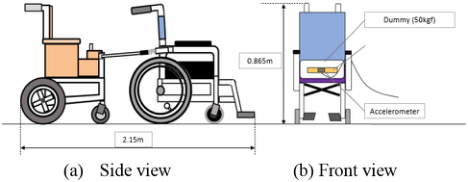
Along with the assisted wheelchair, a self-propelled wheelchair is also used as an assisted wheelchair by a caregiver; however, the problem with wheelchairs is that the vibration during driving causes motion sickness, discomfort, and annoyance for users. The tire pressure of the wheelchair is considered an influencing factor affecting the ride quality of the wheelchair; however, the extent of the effects of tire pressure on the wheelchair remains unknown. Therefore, this study aimed to evaluate the factors influencing the tire pressure changes of the self-propelled wheelchair on the vibration using the tire pressure indicator. Furthermore, this experiment aimed to improve data reliability by manufacturing a device that pushes out a self-propelled wheelchair using an electric wheelchair to run the self-propelled wheelchair at a constant speed. A dummy heavy object was placed on the seat of the self-propelled wheelchair of the vibration measuring device manufactured in this experiment, and a triaxial accelerometer was mounted on it. Moreover, an electric wheelchair is used to drive the uneven road surface at a constant speed at regular intervals. The tire pressure display manufactured in this study was attached to both sides of the rear wheel of the self-propelled wheelchair, and a dummy weight of 50 kg was placed on the seat. Then, acceleration in the vertical direction is measured by a three-axis accelerometer mounted on a heavy object. In this study, the effects of tire pressure on ride quality were considered by looking at the correlation between ride quality by sensory evaluation and vibration analysis.
The number of physically handicapped individuals in Japan was estimated to be about 4.28 million in 2016, and the number is increasing year by year. Of the handicapped, 1.93 million are said to be physically handicapped. Furth- ermore, it is expected that elderly population in Japan will be increasing in the future. Therefore, the demand for assistive devices is expected to increase. Among welfare equipment, wheelchairs–which are mobility aids–are used by many people, including the elderly and physically handicapped. While self- propelled wheelchairs are often used as as-sisted wheelchairs by caregivers, in
Relationship between Tire Pressure and Ride Comfort of Manually Self-Propelled 153
Figure 1: Equipment device.
recent years assisted wheelchairs have increase in use and popularity. How- ever, vibration during driving can result in motion sickness, discomfort, and annoyance for users (Di Giovine et al., 2015a, 2015b; Cook and Polgar, 2008; Kitazaki and Griffin, 1998; LaPlante and Kaye, 2010; Wilder et al., 1994; Booka, 2015). Previous studies have suggested that mul-tiple factors can influence wheelchair vibrations and ride quality. However, it remains unclear how exactly different wheelchair tire pressures impact vibration. One reason that it has been difficult to assess how tire pressure impacts wheelchair vibrations and performance is the use of English valves on wheelchair tires that limit accurate pres-sure measurements. Therefore, for the purposes of this study, a tire pressure indicator was manufactured with the cooperation of Hiroshima International University to accurately measure the tire pressure of a wheelchair. The purpose of this study was to evaluate the impact of dif- ferent tire pressures on manually-propelled wheelchair comfort at constant speed.
An electric wheelchair was used to drive a manually-propelled wheelchair across an uneven surface at a constant speed (Figure 1). Tire pressure was measured with an indicator for an English valve, which was attached to both sides of the rear wheels of the manually-propelled wheelchair. A dummy weight of 50 kg was placed on the seat of the electric wheelchair to ensure stability and constant velocity. The acceleration was measured by a three-axis accelerometer mounted on a heavy object.
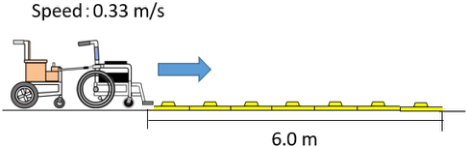
Expermental Method A 6.0 m long and 0.9 m wide track was used for the vibration experiment (Figure 2). The track consisted of 300 mm blocks with 70 mm ridges. The wheelchairs traveled at a constant speed of 0.33 m/s across the track at four different tire pressures (80, 160, 240, 320 kPa). Ten trials were run at each tire pressure, for a total of 40 trials. Table 1 shows the measurement pattern.
A fast Fourier transformation was used to analyze the 3-axis accelerometer data with MATLAB Math Works. Maximum power spectrum, frequency at maximum power, and integration values were evaluated according to tire pressure.
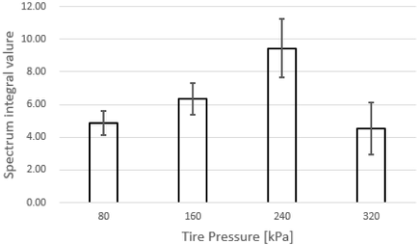
Figure 2: Experimental procedure.Figure 3: Integral value comparison.Table 1. Significance test between tire pressures.
Experimental Results Fig. 3 shows a comparison between the tire pressure of each self-propelled wheel-chair and the integrated value. The integrated value increased as the tire pressure increased, but the tire pressure decreased at 320 kPa. There was a significant differ-ence between the four tire pressures (P < 0.05 t-test and Tukey’s q 4,36; 3.809; Table 1).
RIDE QUALITY AT EACH TIRE PRESSURE Outline of Evaluation Experiment
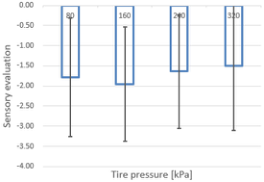
Twenty-one healthy subjects, average age of 30.8 ± 17.2 years, weight of 69.7 ± 15.5 kg, and a height of 169.9 ± 6.6 cm were used to evaluate ride qua- lity. The SD method was used for evaluation, and evaluation was performed using two types: stationary and running. The evaluation was based on sitting comfort, sense of security, buttocks comfort and sway strength. Responses were recorded using a 9-point scale from 4 to –4. Tire pressure was applied in 4 patterns of 80kpa, 160kpa, 240kpa and 320kpa.
Relationship between Tire Pressure and Ride Comfort of Manually Self-Propelled 155
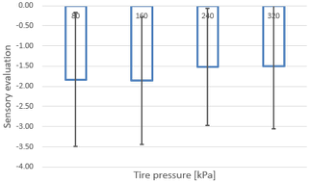
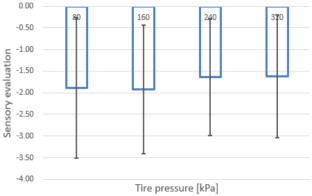
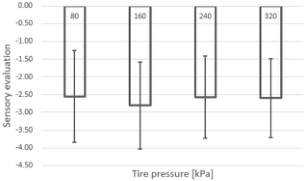
Figure 4: Seating comfort when driving.Figure 5: Feeling of security when driving.Figure 6: Comfort in the buttocks when driving.Figure 7: Strength of swing when driving.
Evaluation Experiment Method When pushing out a manually-propelled wheelchair, an electric wheelchair was used to keep the speed constant. The driving route was laid out with linear blocks so that it would be 6.0 m. Once, at each tire pressure, get on the assistive manual wheelchair at rest and answer the questionnaire. After that, get on the self-propelled wheelchair again and answer the questionnaire after driving. This was done with four tire pressure patterns.
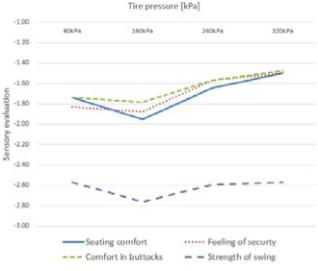
Figure 8: Comprehensive graph.
DISCUSSION
Vibration Measurement Experiment Wheelchair tire pressure had a positive correlation with sensory evaluation measures at tire pressure above 160 kPa. It is thought to be caused by the natural vibration of the wheelchair. Wheelchair velocity in the current expe- riment was relatively low (0.33 km/s) compared to previous research that reported a high speed (0.65 m/s) air pressure wherein comfort levels were all positively correlated (Booka et al., 2015) over similar tire pressures.
Ride Quality Evaluation at Each Tire Pressure of Wheelchair Except for the comfort of sitting, the tire pressure and sensory evaluation (sitting comfort, sense of security, sitting comfort of the buttocks, and strength of shaking) during running are shown in Fig. 3. It can be seen that it contradicts the relationship of the integral values of the vibration. Generally, it is considered that the higher the vibration, the lower the sensory evalua- tion; however, the opposite tendency was seen in the sensory evaluation. This tendency also contradicts the results of the previous experiment conducted at medium speed (0.65 m / s) (see Fig. 8). It seems that the running speed and the riding comfort are related.
CONCLUSION
In this study, a pneumatic indicator for an English valve was attached to a self-propelled wheelchair and vibration was measured under controlled con- ditions. As a result of conducting an experiment using the manufactured vibration measuring de-vice, it was found that there is a tendency peculiar to tire pressure and vibration. Overall, we found that the higher the tire pres- sure, above 160 kPa, the better the ride quality at a constant traveling speed of 0.33 km/s. It is necessary to further advance these analyses. Also, when the tire pressure decreases, the force required to push out the self-propelled wheelchair increases. Therefore, in the future, it will be necessary to investi- gate the optimum tire pressure for caregivers and caregivers according to the usage conditions.
Relationship between Tire Pressure and Ride Comfort of Manually Self-Propelled 157
REFERENCES
Booka M., Yoneda I., Hashizume T., Hokyoo L., Oku H., and Fujisawa S. (2015) Effect of Pressure to Physical Workload at Operating a Manual Wheelchair, Assi- stive Technology, Studies in health technology and informatics (Stud Health Tech Informat), Vol. 217, pp. 929–934. Cook, A. M., & Polgar, J. M. (2008) “In Cook & Hussey’s Assistive Technolo-
gies: Principles and Practice”, Framework for Assistive Technologies, 3rd ed., pp. 34–53. Di Giovine C., Darragh A., Berner T., and Duncan T. (2015a) “Research on Wheelchair Vibration Offers Consumer and Clinician Insight”, RESNA 2015. Di Giovine C., Darragh A., Berner1 T., Duncan T. (2015b) The Effect of Whole body
vibration on Power wheelchair mobility: a focus group, Resna Annual Conference 2015. Kitazaki, S., & Griffin, M. J. (1998) “Resonance behaviour of the seated human body and effects of posture”, J. of Biomechanics, Vol. 31, No. 2, pp. 143–149. LaPlante, M. P., & Kaye, H. S. (2010) “Demographics and trends in wheeled mobility
equipment use and accessibility in the community”, Assist Technol, Vol. 22, No. 1, pp. 3–17. Wilder, D., Magnusson, M. L., Fenwick, J., & Pope, M. (1994) “The effect of posture and seat suspension design on discomfort and back muscle fatigue during simulated truck driving”, Applied Ergonomics, Vol 25, No. 2, pp. 66–76.
LISTED IN THE AHFE DIGITAL BOOKSTORE CATALOGUE
Explore the complete digital volume
Human Factors in Accessibility and Assistive Technology
Read this individual research paper free through the original publisher, or explore the full digital proceedings book.
ISBN 978-1-958651-13-1
Explore this ISBN in the AHFE Bookstore ↗Listed in the July 2026 bookstore catalogue; search by ISBN to confirm current availability · Digital book purchase optional