Erico Monteiro, Alexandre Anibal Campos Bonilla, Milton Cinelli, Rafael Campos (2025). Wheelchair Virtual Reality Simulator ERA: A Real to Virtual Interface Investigation. In: Metaverse, Virtual Environments and Game Design. AHFE Open Access, vol. 178, pp. 8–17. https://doi.org/10.54941/ahfe1006340
Wheelchair users face significant mobility challenges, requiring innovative solutions to enhance accessibility. Virtual reality (VR) simulators offer a promising approach; however, existing systems are often costly and application-specific. This study focuses on advancing the ERA system, an open-source, modular, and cost-effective VR wheelchair simulator designed for diverse applications. The primary objective is to integrate real wheelchair tracking within the virtual environment, while the secondary objective is to generate comparative data between virtual and real wheelchair use. A between-subjects experimental design was conducted with 10 participants divided into two groups of five. Each group navigated a predefined path within a 9m × 7m virtual classroom using either a fully virtual wheelchair or a real wheelchair equipped with a VR controller for position and orientation tracking. Performance metrics, including task completion time, total displacement, and total rotation, were analyzed. Findings indicate that the VR controller provides a viable tracking solution, and the collected data offer valuable insights for enhancing the ERA system’s interface and simulation fidelity.
According to the World Health Organization (WHO, 2024), approximately 1% of the global population, over 80 million individuals, require a wheelchair for mobility assistance. This number is projected to rise due to factors such as an aging global population and an increase in chronic health conditions. The prevalence of wheelchair users varies across regions, influenced by factors like healthcare access, disability prevalence, and socio- economic development. In developed countries, such as the United States and Canada, there is a higher availability of wheelchairs, with about 30 wheelchairs per 10,000 people. In contrast, developing countries have significantly lower availability, with only about 2 wheelchairs per 10,000 people, highlighting disparities in access to mobility aids (The Borgen Project, 2017). Wheelchair users encompass all age groups, from children to older adults. Common conditions necessitating wheelchair use include spinal cord injuries,
Wheelchair Virtual Reality Simulator ERA: A Real to Virtual Interface Investigation 9
cerebral palsy, multiple sclerosis, muscular dystrophy, and limb amputations. The duration of wheelchair use can range from temporary, due to injuries, to permanent, resulting from chronic disabilities.
Many countries have enacted legislation to improve accessibility in public spaces, transportation, and buildings. However, the implementation and enforcement of such measures vary, leading to inconsistencies in accessibility.
Social attitudes and stigma surrounding disability also impact wheelchair users. Discrimination and limited opportunities for education and employment are prevalent challenges. Studies have shown that individuals with disabilities often face workplace discrimination, affecting their career progression and overall well-being (Parker Harris et al., 2019).
On another front, Virtual Reality (VR) technology has experienced significant advancements over the past decade, notably propelled by the launch of the Oculus Rift in 2016. This event marked a transition of VR from a niche technology to a mainstream platform, impacting sectors such as entertainment, education, and training (Parkin, 2014). Developed by Oculus VR, founded by Palmer Luckey, the Oculus Rift delivered consumer-friendly VR with notable enhancements in immersion, comfort, and affordability. Its success revitalized interest in VR across various industries, inspiring innovation and competition leading to the development of the Quest series (Meta, 2024).
VR wheelchair simulators are known to be valuable tools for rehabilitation, accessibility research, cognitive studies, and assistive technology development. They enhance mobility training by improving spatial awareness and motor coordination in safe environments (Harrison et al., 2009) and help assess architectural barriers for inclusive urban design (Ly et al., 2022). VR also aids in studying spatial cognition, stress adaptation, and social confidence in wheelchair users (Slater & Sanchez-Vives, 2016), while supporting the development of assistive technologies like autonomous wheelchairs and brain-computer interfaces (Friedman et al., 2020). These applications contribute to improve mobility, accessibility, and independence for wheelchair users.
The growing adoption of wheelchair VR simulators for various applications (Arlati et al., 2019) suggests that specialized simulators have been designed to address specific needs. To provide versatility and cost- effectiveness, the ERA system (ERA) is being developed with a focus on modularity, affordability, consumer-grade hardware, and open-source software, enabling adaptability for multiple needs (Monteiro, 2024).
Existing simulators typically utilize either a real wheelchair or a virtual one. The ERA simulator aims to integrate both approaches by offering a virtual wheelchair and supporting the use of a tracker attached to a real wheelchair. The main objective of this experimental applied research is to explore the feasibility of integrating a real wheelchair within the ERA simulator, while the secondary objective is to compare real-world wheelchair usage with its virtual counterpart to enhance the accuracy of virtual behavior. These leads to the following hypothesis.
H1: Using the VR hand controller attached to a real wheelchair will provide tracking to integrate it into the virtual environment.
H2: Applying an experimental virtual to real wheelchair comparison test will produce data to improve the ERA system.
METHODOLOGY
Experiment Design The ERA system is set up running on a Intel Core i7-10700K computer with 32GB of RAM and an NVIDIA Quadro RTX 4000 (8GB) GPU. The Meta Quest 2 is used as VR equipment and is connected to the computer throught a local generated 5GHz Wi-Fi network.
This between-subjects experiment employs a real and a virtual manual wheelchair factor. The total sample of 10 participants is divided into two subgroups of 5, with each subgroup navigating either the virtual or real wheelchair (S1 and S2) along the same predefined trajectory within a classroom setting.
In the ERA system, the virtual wheelchair is controlled by a seated participant using both VR hand controllers. In contrast, the real wheelchair is manually operated, with one controller securely attached in a position that remains visible to the tracking cameras of the VR headset. Within the ERA framework, the wheelchair module is hierarchically linked to the active VR hand controller node considering proper alignment of position and orientation.
Total time, position and rotation data are assessed upon task completion. The experimental procedure is outlined below.
Participants The sample consists of ten non-wheelchair users (5 females and 5 males) aged between 18 and 48 years. Participants complete a screening survey to confirm their ineligibility based on prior wheelchair experience (none preferred) or any impairments that could affect VR equipment use. Individuals who do not meet these criteria or are under 18 are excluded from the study. All participants are volunteers recruited from the Universidade do Estado de Santa Catarina campuses through board advertisements and direct invitations.
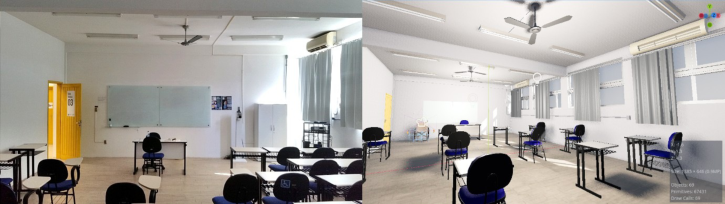
Stimuli The experiment is conducted in a standard school classroom measuring 9×7 meters. The physical environment, including key elements such as tables and chairs, is virtualized through measurement, 3D modeling and texturing (see Figure 1). The classroom layout consists of 12 student desks and chairs arranged with a minimum passage width of 1.2 meters, complying with Brazilian accessibility standards ABNT NBR-9050 (ABNT - Associacao Brasileira de Normas T’ecnicas, 2020) and aligning with the principles of Universal Design, as proposed by the Center for Universal Design (Mace, 1989).
Wheelchair Virtual Reality Simulator ERA: A Real to Virtual Interface Investigation 11
Figure 1: Real classroom and 3D modeled, textured and lit virtual classroom (made by the author, 2023).
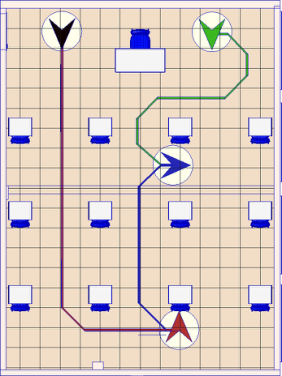
The stimulus involves a predefined 22.7-meter path beginning near the classroom door, passing through two checkpoints, and concluding at the professor’s desk, mimicking common student activities such as moving to their desk, visiting a peer’s desk, and approaching the board for presentations. The path follows a linear trajectory, is assembled using the eight cardinal directions, and maintains a minimum clearance of 0.6 meters from obstacles (see Figure 2).
Figure 2: Classroom layout and proposed path (made by the author, 2023).
Dependent Variables Raw measurements are recorded by the ERA system at a frequency of 60 frames per second and include the wheelchair’s X and Z coordinates (in millimeters) and its orientation (Y-axis rotation) with a precision of 1/100 degrees. The collected data is processed to derive key performance metrics: total time (seconds), total displacement (meters), and total rotation (degrees).
A longer completion time may indicate operational difficulties with the wheelchair. The expected total displacement is 22.7 meters, aligning with the predefined path, and significant deviations from this value may suggest
navigation challenges. Similarly, the optimal total rotation for the trajectory is set at 1080 degrees, though this is not revealed to the participants. Substantial deviations in rotation require further analysis to determine underlying causes.
Experiment Procedure The real classroom is cleared of any obstacles prior to the experiment.
Upon arrival, participants sign an informed consent statement, and the experimental procedure is explained. Motion sickness, a common side effect of VR usage, particularly for inexperienced users, is also addressed, including its symptoms and the protocol for discontinuing the test if necessary.
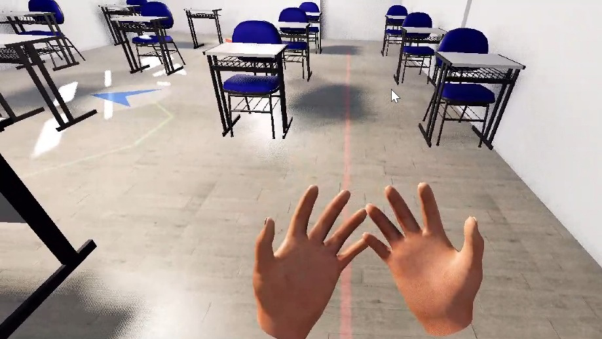
A single arm-less chair, matching the seat height of the wheelchair, is positioned to align with the simulation’s starting point. Participants in the first condition (S1) are seated and equipped with the VR headset, which initiates the simulation, presenting a virtual classroom with tables and chairs arranged accordingly. They are instructed to familiarize themselves with the VR controls, particularly the grip function—equivalent to closing the hands or grasping an object—which is required to propel the virtual wheelchair (see Figure 3). This familiarization phase lasts up to two minutes. The task involves navigating the virtual environment naturally, following a designated path marked on the ground, pausing for five seconds at each checkpoint.
Figure 3: Participant view testing the grip function (made by the author, 2024).
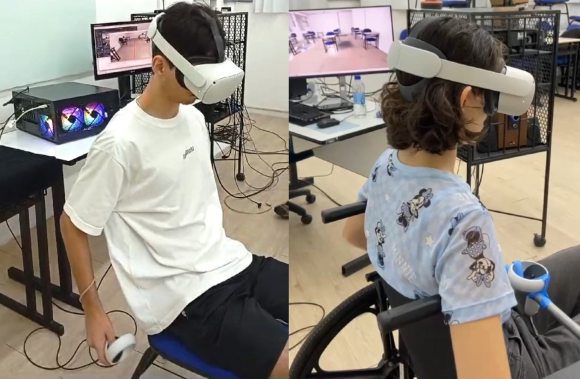
In the second condition (S2), the armless chair is replaced with a real wheelchair. Participants take their seats and wear the VR headset. One VR hand controlled is secured on the wheelchair as a tracker and the simulation starts with the same virtual environment. They are again given up to two minutes to familiarize themselves with the VR equipment and the real wheelchair operation. The wheelchair is then aligned with the virtual path’s starting position, and participants complete the same navigation task (see Figure 4).
This experiment has been approved by the Ethics Committee for Human-Related Research at the Universidade do Estado de Santa
Wheelchair Virtual Reality Simulator ERA: A Real to Virtual Interface Investigation 13
Catarina under authorization number 6.592.896, with CAAE reference 76042123.6.0000.0118.
Figure 4: Virtual and real wheelchair participants (S1 and S2) (made by the author, 2025).
Data Analysis The raw data is segmented to isolate task-related data, with the start and end of valid measurements determined by a Z-axis motion threshold of 2 cm within a 10-frame time window.
The extracted task data is processed to compute key performance metrics, including total time, displacement, and rotation for each participant (see Table 1). These metrics are then averaged within the S1 and S2 groups. To assess performance deviations, the absolute differences between the targeted total displacement and rotation, and the averaged observed values, are calculated (see Table 2).
Table 1: Key performance metrics (ERA data capture 2025).
Table available in the original PDF paper.
Virtual Wheelchair (S1) Real Wheelchair (S2) User Total Total Total Rot.
Finally, the outputs of S1 and S2 are compared, highlighting differences in deviation between the two conditions.
RESULTS
During the processing of raw data from the real wheelchair condition, no anomalies were detected in tracking the VR hand controller. All recorded metrics accurately reflected time, position, and rotation in both real and virtual environments. These findings support Hypothesis 1, confirming that a VR hand controller can provide precise real wheelchair tracking for virtual environment integration.
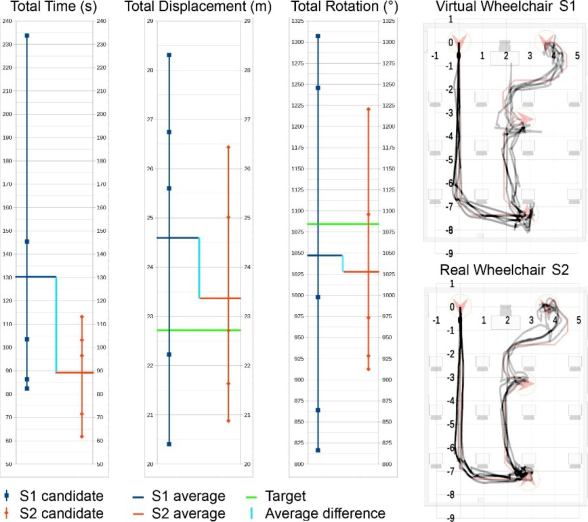
The average task completion time between groups differed by 41.02 seconds with the virtual wheelchair taking significantly longer by little above one third of the real wheelchair time (see Table 2 and 3). This discrepancy suggests that the virtual wheelchair’s physics calculations require adjustments to better match real-world wheelchair speed, or that the virtual hand-to-wheel interface is not effectively translating user input into motion.
Table 2: Metrics averages and target deviations (ERA processed data 2025).
Table available in the original PDF paper.
Virtual Wheelchair (S1) Real Wheelchair (S2) Total Total Total Total Total Total Time (s) Disp. (m) Rot. (
Table 3: Average differences between S1 and S2 (ERA processed data 2025).
Table available in the original PDF paper.
Average Metric S1 and S2 Difference Total Time 41.020 s Total Displacement 1.321 m Total Rotation 20.02
Nonetheless the registered differences on displacement and rotation, approximately 8.62% and 3.13% of their targeted values, represents a level of accuracy on the ERA’s virtual wheelchair reality parity when compared to 2.80% and 4.99% on the real one. However, compared to the real wheelchair, the virtual wheelchair’s total average displacement was around three times greater, while its total average rotation was about over half of that observed in the real wheelchair condition (see Table 2). The displacement data reinforces the conclusion that the virtual wheelchair may be operating at an unrealistic speed.
Additionally, a preliminary analysis of the rotational behavior on the blended group trajectories suggests that participants struggled with turning maneuvers in the virtual condition, indicating potential issues with the virtual hand-to-wheel interface (see Figure 5).
These preliminary results provide critical insights into the functionality of ERA’s virtual wheelchair. Further analysis of the extensive dataset can offer deeper understanding, supporting Hypothesis 2, which posits that comparing
Wheelchair Virtual Reality Simulator ERA: A Real to Virtual Interface Investigation 15
virtual and real wheelchair performance can yield valuable data to refine and enhance the ERA system.
Figure 5: Candidate results, averages, targets, differences and blended group trajectories (made by the author, 2025).
DISCUSSION
This applied study investigated the feasibility of integrating a real wheelchair within the ERA system and evaluated its potential for generating data to enhance simulation accuracy. The experimental results confirm that a VR hand controller can serve as a precise tracking device for real- wheelchair motion, demonstrating the system’s reliability. Additionally, the collected data offers valuable insights for refining and improving the ERA system.
The ability to incorporate both real and virtual wheelchairs within the ERA framework enhances its adaptability beyond previously reviewed simulation systems. This aligns with the system’s design goals of versatility and accessibility while maintaining a low-cost approach, as the VR hand controller is an integral component of the Quest 2 VR equipment.
However, certain limitations were identified. The use of a real wheelchair necessitates a sufficiently large, obstacle-free space, and the current Quest VR hardware restricts tracking to a maximum area of 10 × 10 meters. Additionally, environments featuring ramps or hazardous obstacles may pose practical challenges, limiting the system’s applicability in more complex real-world settings.
For future applications and research, the experimental wheelchair tracking capabilities demonstrated in this study can serve as a foundation for supporting future tracking devices within the ERA system. The dataset generated represents a complete record of the experience, allowing for playback and in-depth motion analyses, such as speed and acceleration evaluations, to further enhance the system. Overall, this experiment also provides validation towards the ERA system being applied as a practical tool for real-world scientific applications, demonstrating its capabilities and functional effectiveness.
ACKNOWLEDGMENT
This research was supported by The Laboratory of Interfaces and Interactions in Assistive Technology (Li2TA) at the Universidade do Estado de Santa Catarina (UDESC) and by Fundação Coordenação de Aperfeiçoamento de Pessoal de Nível Superior - CAPES (Programa de Demanda Social - DS) and Fundação de Amparo à Pesquisa e Inovação do Estado de Santa Catarina - FAPESC (CP No. 48/2022), Brazil.
REFERENCES
ABNT (2020). NBR 9050: Acessibilidade a edificações, mobiliário, espaços e equipamentos urbanos. Rio de Janeiro, BR: ABNT. Arlati, S. et al. (2019) ‘Virtual reality-based wheelchair simulators: A scoping review’, Assistive Technology, 32(6), pp. 294–305. doi: 10.1080/ 10400435.2018.1553079. Harrison A, Derwent G, Enticknap A, Rose FD, Attree EA (2009). The role of
virtual reality technology in the assessment and training of inexperienced powered wheelchair users. Disabil Rehabil. 2002 Jul 20-Aug 15;24(11-12):599–606. doi: 10.1080/09638280110111360. PMID: 12182799. Kim Ly, Pascal Karg, Julian Kreimeier, and Timo Götzelmann. 2022. Development and Evaluation of a Low-cost Wheelchair Simulator for the Haptic Rendering of Virtual Road Conditions. In Proceedings of the 15th International Conference on PErvasive Technologies Related to Assistive Environments (PETRA’22). Association for Computing Machinery, New York, NY, USA, 32–39. https:// doi.org/10.1145/3529190.3529195 Leeb R, Friedman D, Müller-Putz GR, Scherer R, Slater M, Pfurtscheller G. Self-paced
(asynchronous) BCI control of a wheelchair in virtual environments: A case study with a tetraplegic. Comput Intell Neurosci. 2007;2007:79642. doi: 10.1155/2007/ 79642. PMID: 18368142; PMCID: PMC2272302. Mace, R. L. (1989). Center for Universal Design. North Carolina, EUA: College of Design. Available at: https://design.ncsu.edu/research/center-for-universal-design/. [Accessed 21 ago. 2024]. Meta. (2024). Meta Quest VR Headsets, Accessories & Equipment — Meta Quest.
[online] www.meta.com. Available at: https://www.meta.com/quest/[Accessed 15 Mar. 2025]. MONTEIRO, E. P. (2024) Simulador de cadeira de rodas em realidade virtual - sistema era: uma ferramenta de avaliação multifuncional e modular. Universidade do Estado de Santa Catarina. Dissertation, Florianópolis. Available at: https://repositorio.udesc.br/handle/UDESC/20314. [Accessed 20 Jun. 2025].
Wheelchair Virtual Reality Simulator ERA: A Real to Virtual Interface Investigation 17
Parker Harris, S., Gould, R., and Mullin, C. (2019). ADA research brief: Experiences of discrimination and the ADA (pp. 1–6). Chicago, IL: ADA National Network Knowledge Translation Center. Parkin, S. (2014). Oculus Rift. [online] MIT Technology Review. Available at: https://
www.technologyreview.com/technology/oculus-rift/ [Accessed 2 Apr. 2025]. Slater M and Sanchez-Vives MV (2016) Enhancing Our Lives with Immersive Virtual Reality. Front. Robot. AI 3:74. doi: 10.3389/frobt.2016.00074. The Borgen Project. (2017). Mobility for Disabled Persons in Developing Countries.
[online] Available at: https://borgenproject.org/mobility-for-disabled-persons-in- developing-countries/. WHO. (2024). Wheelchair services. [online] www.who.int. Available at: https:// www.who.int/teams/health-product-policy-and-standards/assistive-and-medical- technology/assistive-technology/wheelchair-services.
LISTED IN THE AHFE DIGITAL BOOKSTORE CATALOGUE
Explore the complete digital volume
Metaverse, Virtual Environments and Game Design
Read this individual research paper free through the original publisher, or explore the full digital proceedings book.
ISBN 978-1-964867-54-0
Explore this ISBN in the AHFE Bookstore ↗Listed in the July 2026 bookstore catalogue; search by ISBN to confirm current availability · Digital book purchase optional