Juan Sebastian Ruiz Medina, Sungju Maeng, Nianzhi Tu, Makoto Itoh (2025). Exploring Virtual Reality for Drone Pilot Training: A Study on Japanese Certification Tasks with RealFlight. In: Human Factors in Design, Engineering, and Computing. AHFE Open Access, vol. 199, pp. 969–977. https://doi.org/10.54941/ahfe1006909
This study explores the potential of using Virtual Reality (VR) for supporting the Japanese second-class unmanned aircraft remote pilot certification training, by analyzing its effectiveness for development of maneuvering skills in the certification tasks. An experiment was conducted with six participants taking a drone school course, in which a flight simulator was used for the first day of the training. Instructors could monitor the participant’s view and, in addition, freely navigate the scenario from a controllable perspective, while flight path data was recorded. Using a simulation approach allowed instructors to monitor flight performance, identify motor skill issues, and use tools that helped them provide tailored feedback. Also, having independent views for the instructor and the participant made the guidance and correction comparable to traditional training. Despite variation in simulator performance, all six participants successfully passed the final certification exam. This outcome suggests that the VR training does not have a negative impact on the exam performance. Also, it might provide additional pedagogical value by highlighting and quantifying difficulties that are less apparent in live training environments. This study demonstrates that VR-based simulation can complement conventional training for Japan’s second-class drone certification. The results also suggest that the use of this technology is worth exploring for training more complex tasks. Despite variation in simulator performance, all six participants successfully passed the final certification exam. This outcome suggests that the VR training does not have a negative impact on the exam performance. Also, it might provide additional pedagogical value by highlighting and quantifying difficulties that are less apparent in live training environments. This study demonstrates that VR-based simulation can complement conventional training for Japan’s second-class drone certification. The results also suggest that the use of this technology is worth exploring for training more complex tasks.
Training and certification systems play an important role in ensuring operational safety and professional standards. However, despite the international efforts to standardize Unmanned Aerial Systems (UAS) certifications and airworthiness standards for drones, the development of these regulations is still in accordance with the actual situation of each country (Ahn, Park and Yoo, 2014). This lack of standardization would be the result of the continuous development in technologies like battery performance, miniaturization of sensors, and navigation systems, which have contributed to the rapid expansion of drone use across multiple sectors (Beninger and Robson, 2025), forcing countries and regions to develop their own certification frameworks. Based on this context, the present study
investigates the potential use of Virtual Reality (VR) as a tool to support the Japanese’s second-class unmanned aircraft remote pilot certification training, with a focus on evaluating its effectiveness in developing the maneuvering skills required for certification tasks.
Safeguards and certification frameworks change across countries and regions. Drones as products have to comply with conformity assessments and conditions for market distribution (Sándor and Pusztai, 2021). Then, regulations that seek to address social, economic, and environmental aspects are implemented through technical, policy, and public safeguards (Beninger and Robson, 2025). Within policy safeguards, regulations concerning operator licensing and certifications are defined. In the context of Japan, the Ministry of Land, Infrastructure, Transport and Tourism (MLIT) provides specific guidelines for certification courses, including the required theoretical content, practical tasks, and the number of practice hours trainees must complete to be eligible to take the certification test (MLIT, 2023). However, simulators are mostly used in the early stages of training to develop basic motor skills before moving to training with real drones.
Despite the growing use of drones across different sectors and the ongoing development of regulatory frameworks for pilot certifications, there is still a significant gap in understanding how training through simulators and immersive VR contributes to the acquisition of practical flight skills. Although many training courses use simulators in the early stages, we are still gathering data about their effectiveness and the parameters that influence performance outcomes. Recent experiments demonstrate that pre-training drone pilots with simulators can significantly improve flight displacement (Somerville et al., 2024). In addition, standardized methods and task scenarios in simulators can be used to provide qualitative and quantitative assessments of the pilot proficiency (Doroftei, De Cubber and De Smet, 2022). Correlations between simulated and real environments can be established through the analysis of trends in different flight metrics (Ruiz-Medina, Maeng, Tu and Itoh, 2025). Furthermore, attempts involving VR-based flight training simulators as alternatives to real-world training tasks, like building inspection exercises (Albeaino et al., 2022) or gamified training approaches (Cardona-Reyes et al., 2021), are taking place as efforts to reduce this gap. However, these efforts do not benchmark their outcomes against formal certification processes involving professional instructors and standardized examination procedures. Such certification- based evaluations are crucial, as they reflect the practical conditions and performance expectations present in real pilot qualification systems.
Building on these previous efforts, this exploratory study investigates the potential of integrating VR into the conventional drone training methodology used for Japanese’s second-class pilot certification. Specifically, it modified the introductory simulator-based training course of a drone school by introducing VR and compares the performance of the participants with that of previous course participants that used the traditional approach, in order to evaluate whether the use of VR has a positive or negative impact on performance.
Exploring Virtual Reality for Drone Pilot Training 971
METHODOLOGY
Experimental Design As an exploratory experiment, the study was designed to introduce the use of a VR-based training approach without altering the overall structure of the conventional drone training course. The training course lasts for three days, and the final exam is done on the fourth day.
During the first day of the introductory course, participants receive theoretical instruction from a certified drone instructor. This session covers topics such as flight safety, basic aeronautical regulations, operational guidelines, and good piloting practices. It also includes an introduction to drone components, control mechanisms, and basic flight principles, providing participants with the foundational knowledge necessary for safe and efficient drone operation. Concretely speaking, participants spend approximately two hours on preparatory lectures before any flight practice, covering written exam preparation, oral exam procedures before and after flight, aircraft inspection methods, and flight log creation. Once these four activities are completed, the hands-on flight training begins and typically lasts about two hours. In our experiment, a flight simulator was used for the first day of training. In comparison, in the conventional historical training, a real drone was used.
From the second day onward, including the final exam, the trainees visit a ground training site for both the training sessions and the final exam. The contents of the training and the final exam are completely the same as those in the conventional historical course.
Apparatus In the experimental condition, RealFlight Evolution 10.10 was used to ensure consistency in task structure. Participants perform the same flight exercises using a VR headset that reproduces spatial perception and situational awareness similar to real flight conditions. Simultaneously, instructors can observe the participant’s viewpoint and independently navigate within the virtual scenario from a separate interface. This configuration allows for real- time feedback, precise monitoring of flight trajectories, and a more immersive instructor–student interaction resembling real-world training.
The VR configuration used a Meta Quest 3 headset equipped with the extended strap that provides additional battery capacity. The instructor’s station consisted of a laptop connected to the same 24-inch display employed in the historical screen-based training setup. The laptop was equipped with an Intel Core i7 processor (2.4 GHz), 16 GB of RAM, and an NVIDIA RTX 3050 GPU with 6 GB of dedicated video memory. The VR system was operated from a desktop computer connected directly to the headset via Link, featuring a 12th-generation Intel Core i9 processor (3.2 GHz), 64 GB of RAM, and an NVIDIA RTX 3080 GPU with 10 GB of dedicated video memory.
For the experimental training with a real drone, an Autel EvoII was used in order to record the trajectory of the flights. Note that in the conventional historical course, all the flight training is done with DJI Phantom.
Participants We recruited six participants, who enrolled in a drone pilot training course at a certified drone school in Japan took part in the experiment. All participants were adults and had no prior experience in drone training. Their participation was voluntary, and they followed the same curriculum and schedule as standard trainees. The group consisted of learners preparing for Japan’s second-class unmanned aircraft remote pilot certification. The experiment was conducted as part of their regular training program, with the only modification being the use of the VR setup during the introductory simulator session. Instructors and training conditions remained identical to those of previous course takers to ensure comparability. The experiment was approved by the Ethics Committee of the Institute of Systems and Information Engineering, the University of Tsukuba.
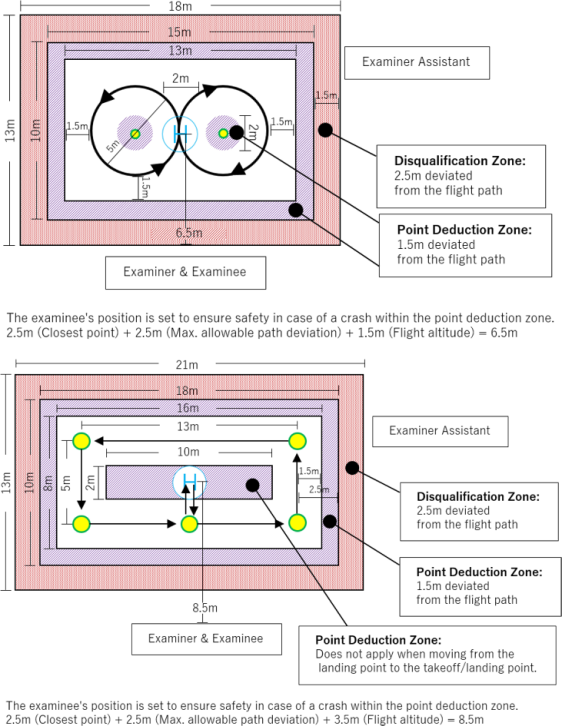
Figure 1: Layout and dimensions of the flight test field for the figure-eight and square flight tasks (redrawn from MLIT, 2022).
Exploring Virtual Reality for Drone Pilot Training 973
Experimental Task and Procedure This exploratory study introduced a VR-based simulator session without changing the overall flow of the school’s standard curriculum for the Japanese second-class remote pilot certification.
Trainees wore a VR headset and executed the certification tasks in a replicated test layout to confirm understanding, instructors viewed the trainee’s headset feed and could independently navigate the virtual scene to observe from alternate angles, providing real-time coaching. Flight-path data were logged for later review. On Days 2–3, trainees completed the ordinal live-flight training with real drones and then took the certification examination according to the national standard.
The VR session mirrored the MLIT practical test tasks and geometry (MLIT, 2023): Square flight (スクエア飛行): Take-off facing forward with horizontal position-hold functions ON; climb to ∼1.5 m and hover for 5 s; then fly straight-line legs along the examiner-indicated square course while keeping the nose aligned with the direction of travel; land after completing the route (time limit: 8 min).
Figure-eight flight (8の字飛行): Same initial conditions (position-hold ON; take-off, climb to ∼1.5 m, 5 s hover). Fly two consecutive figure-eight circuits with the nose kept in the direction of motion; the reference circle diameter is ∼5 m (time limit: 8 min).
Abnormal-condition flight (異常事態における飛行): With horizontal position-hold functions OFF, take-off, climb to ∼3.5 m, hover 5 s; fly straight in the examiner-indicated direction while maintaining nose-forward attitude, then translate laterally, and perform an emergency landing at the designated point via the shortest route (time limit: 6 min).
Consistent with the national specification, the practical exam employs a deduction-from-100 scoring method with pass/fail thresholds and clearly defined penalty/no-go zones; these same routes and heading constraints were observed during VR practice to align trainee behavior with certification criteria.
Data Analysis Two data sources were used. First, the practical exam scoring recorded by the school under the MLIT practical test rules for Japanese’s second-class certificate. The way points are deducted during the exam are “moderate”, which deducts 5 points (path deviation, flight not matching instructions, poor take-off/landing, insufficient monitoring, insufficient safety checks) and “minor”, which deducts 1 point (wobble, unsmooth control, nose-direction deviations).
For six VR participants, we obtained itemized deductions (moderate vs minor and subtypes) and the total points deducted. For an additional historical sample of 34 trainees (conventional training), only the total points deducted were available. Trainees/participants who made a major mistake during the test, receive a 100 points penalty, these were excluded, reducing
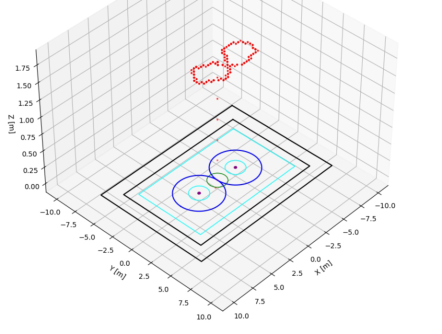
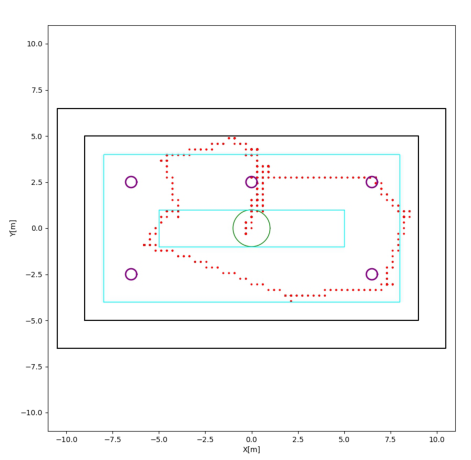
the historical sample to 31. Second, the VR training logs from the simulator during the instructor guided execution of the task (See Figures 2 and 3).
Figure 2: 3D reconstruction of a participant’s figure-eight flight.Figure 3: 2D reconstruction of a participant’s figure-square flight.
From logs, the following derived measures were computed per participant:
Mileage (m): cumulative path length, 6∥pt – pt1∥.
Altitude variation (m): variability of z (reported as SD and IQR).
Heading variation (deg): circular variability of yaw (circular SD).
Penalty-zone incursions (count/duration): episodes where the trajectory overlaid a test “deduction area.”
Exploring Virtual Reality for Drone Pilot Training 975
However, the main source of data is the total points deducted, since it is the only measure that was consistently available for both groups. The logs were treated as process training indicators, as the objective of the course during the first day is focused on task understanding rather than performance. Given the small sample of participants in the VR group (n = 6), the analysis is descriptive and exploratory. For both groups the median, IQR, and range (min-max) were reported. Between-group comparisons of total deductions were conducted using a permutation test on the median difference (30,000 iterations) and bootstrap 95% confidence intervals (CI) (10,000 resamples). A rank-based common-language effect size (CLES) was also calculated, representing the probability that a randomly selected VR participant would have fewer total deductions than a randomly selected historical trainee.
RESULTS
Table 1: Statistics of total deduction points by group.
Table available in the original PDF paper.
Group N Median IQR Min Max VR 6 16.5 7.5 14 26 Historical 31 19.0 13.0 2 54
(Note: Historical outliers with 100-point penalties were excluded a priori, reducing that sample to n = 31.)
Table 2: Comparison between VR and historical training groups.
Table available in the original PDF paper.
Test Result Median Difference (VR – Hist) –2.5 Permutation p-value 0.656 Bootstrap CI (95%) [–10, 4.0] CLES 0.5778
All six VR participants passed the certification exam. The VR group showed a lower median deduction than the historical group, but the bootstrap CI uncertainty is wide since the VR group is a small sample showing that the true median difference could be anywhere from VR being 10 points better to 4 points worse. The permutation p-value indicates that both groups have similar medians and the CLES indicates that there is a 58% chance a randomly chosen VR trainee performs better than a historical trainee.
DISCUSSION AND FUTURE WORK This exploratory study did not find that replacing the traditional simulator session with a VR simulator session negatively impacts the performance on Japan’s second-class drone certification exam. While the VR group’s median total deductions were lower than those of the historical group, and the CLES result was higher than 0.5, indicating that there is a possible advantage in using VR, the wide confidence interval in the bootstrap underscores that any benefit remains inconclusive. However, as the VR approach does not show
any disadvantage, it is worth trying more challenging tasks, performing more tests and extracting logs for further analysis as both the traditional screen- based setup and the VR setup use the same simulator, or even increasing time on the simulator (if this time exceeds the 40% stipulated by MLIT (MLIT, 2023), participants would not be able to get the certification). In addition, it would be worthwhile to incorporate the simulator beyond the initial stage of the course. In many programs, simulators are positioned mainly as risk-mitigation tools that are used to gain familiarity with the equipment and reduce the likelihood of accidents or loss during live training. However, the transfer of skills from simulation to live flight may vary by training stage (e.g., early familiarization, intermediate precision control, or advanced abnormal-condition handling). Analyzing simulator and VR practice skill transfer effectiveness according to the training stage, would be a valuable focus for future study.
The simulator logs (mileage, altitude/heading variability, and penalty- zone incursions) were treated as process indicators rather than predictors of exam outcomes because that session emphasized task understanding and included instructor-guided drills tailored to each participant. Consequently, correlations with final performance were not expected to be stable.
CONCLUSION
This exploratory study suggests that replacing the conventional screen- based simulator with a VR-based simulator for Japan’s second-class drone certification training does not negatively affect exam performance. Although the VR group showed slightly lower median deduction points, the results remain inconclusive due to the small sample size and wide uncertainty intervals. Nevertheless, the absence of adverse effects indicates that VR integration is feasible. Future research should investigate if VR provides measurable advantages for more complex or spatially demanding tasks. Also, evaluating its role in enhancing learning outcomes such as skill transfer and skill retention.
ACKNOWLEDGMENT
This paper is based on results obtained from a project, JPNP22002, commissioned by the New Energy and Industrial Technology Development Organization (NEDO).
REFERENCES
Ahn, H., Park, J. and Yoo, S. (2014). A study of the status of UAS certification system and airworthiness standards. Journal of the Korean Society for Aeronautical & Space Sciences, 42(10), pp. 893–901. Albeaino, G., Eiris, R., Gheisari, M. and Issa, R. R. A. (2022). Development of a VR-
based drone-mediated building inspection training environment, in: Computing in Civil Engineering 2021: Selected Papers from the ASCE International Conference on Computing in Civil Engineering 2021. Reston, VA: ASCE, pp. 1401–1408. Beninger, S. and Robson, K. (2025). Social, economic, and environmental implications of drones in marketing: A framework of safeguards for sustainable technology implementation. Journal of Business Research, 191, 115251.
Exploring Virtual Reality for Drone Pilot Training 977
Cardona-Reyes, H., Trujillo-Espinoza, C., Arévalo-Mercado, C. and Muñoz- Arteaga, J. (2021). Training of drone pilots through virtual reality environments under the gamification approach in a university context. Interaction Design and Architecture (s), 49, pp. 64–83. Dalamagkidis, K., Valavanis, K. P. and Piegl, L. A. (2008). A survey of unmanned
aircraft systems regulation: Status and future perspectives, in: Proceedings of the 16th Mediterranean Conference on Control and Automation. Piscataway, NJ: IEEE, pp. 717–723. Doroftei, D., De Cubber, G. and De Smet, H. (2022). Assessing human factors for drone operations in a simulation environment, in: Human Factors in Robots, Drones and Unmanned Systems, Volume 57, pp. 122–129. Kapustina, L., Izakova, N., Makovkina, E. and Khmelkov, M. (2021). The global
drone market: Main development trends. SHS Web of Conferences, 129, 11004. Khuwaja, K. S. A., Chowdhry, B. S., Khuwaja, K. F., Mihalca, V. O. and T, arc˘a, R. C.
(2018). Virtual reality-based visualization and training of a quadcopter by using RC remote control transmitter. IOP Conference Series: Materials Science and Engineering, 444(5), 052008. Lee, D., Hess, D. J. and Heldeweg, M. A. (2022). Safety and privacy regulations for unmanned aerial vehicles: A multiple comparative analysis. Technology in Society, 71, 102079. MLIT (Ministry of Land, Infrastructure, Transport and Tourism). (2022). : . Tokyo: MLIT. Available at: https://www.mlit.go.jp/common/001510312.pdf. MLIT (Ministry of Land, Infrastructure, Transport and Tourism). (2022). : . Tokyo: Civil Aviation Bureau. Available at: https://www.mlit.go.jp/common/001516517.pdf. Öz, E., Heikkilä, E. and Tiusanen, R. (2022). Development of an organisational
certification process for specific category drone operations. Drones, 6(10), 278. Ruiz-Medina, J. S., Maeng, S., Tu, N. and Itoh, M. (2025). Evaluating drone operator motor skills: A comparison between simulated and real environments, in: Proceedings of the 23rd International Symposium on Aviation Psychology. Corvallis, OR: Oregon State University, pp. 181–186. Sándor, Z. and Pusztai, M. (2021). Certification of unmanned aircraft systems –
from product safety to type certificate: A review about the operation of the EU safeguard processes. Acta Technica Jaurinensis, 15(1), pp. 36–46. Somerville, A., Lynar, T., Joiner, K. and Wild, G. (2024). Use of simulation for pretraining of drone pilots. Drones, 8(11), 640.
LISTED IN THE AHFE DIGITAL BOOKSTORE CATALOGUE
Explore the complete digital volume
Human Factors in Design, Engineering, and Computing
Read this individual research paper free through the original publisher, or explore the full digital proceedings book.
ISBN 978-1-964867-75-5
Explore this ISBN in the AHFE Bookstore ↗Listed in the July 2026 bookstore catalogue; search by ISBN to confirm current availability · Digital book purchase optional