Yulyana Rodríguez Bautista, Juan Fernando Castro Medina, Diego Andrés Quintero Ardila, Carol Natalia Rangel Santamaría, Sebastian Alberto Peláez Gómez (2022). Design of a VR-based training system for the evacuation of an engineering laboratory building. In: Intelligent Human Systems Integration (IHSI 2022): Integrating People and Intelligent Systems. AHFE Open Access, vol. 22. https://doi.org/10.54941/ahfe100955
This project designs a training system to perform an evacuation due to the presence of a possible structural fire using virtual reality. To develop the proposal, the software and hardware tools with which the experiment was carried out were initially selected, this selection was made taking into account the criteria of the ISO 25010 Standard and the AHP methodology was used based on the opinion of some experts in the area. The training system was applied to a sample size of 68 people. It was evidenced that the application of the concept of serious games integrated with virtual reality significantly improves the participants' learning by generating a higher level of immersion in the emergency. In addition, considering the average time that participants took to learn the evacuation system of the building with the developed application, a positive impact was obtained in areas such as: productivity, economy, culture, health and technology.
Natural disasters are unpredictable phenomena that can cause multiple damages, both material and human losses. In addition to these catastrophes, there are those caused by man, such as structural fires. The impact of these cannot be underestimated and people should be ready to face such adversities. There are different ways to carry out training for the evacuation of personnel in the presence of a disaster such as informative talks, learning videos, evacuation drills, among others. Despite the theoretical richness of these methods, they lack a practical component. Research has shown that traditional education on disaster prevention is not as effective as interactive methods, which if emphasized in improving people’s first-hand experience (Tsai et al., 2020).
Drills must ensure successful evacuation once a disaster occurs; arise to develop a healthy, reliable working environment, and an increase in the quality of life (Tepe, Kaleci and Tuzun, 2018). Despite those benefits that its application can bring, one of the main limitations is the big difference between the real world and training, because they omit many sensations and aspects that can make the learning limited (Lovreglio et al., 2018). Similarly, protocols can be costly, time consuming, and lead to production delays. Therefore, any methodology that can reduce the cost will be of great use to many people, organizations, and industries (Kaplan et al., 2020). For that reason, a new training alternative through Virtual Reality (VR) emerges, which generates a greater user experience by immersing them in a real environment, since stimuli are created through the senses to experience greater immersion.
This tool has been used in the field of medicine, as well as in the preparation of astronauts, soldiers and miners. In fact, the scenarios in which this training can be applied continue to increase, since it offers a great advantage over traditional training since it allows the total management of the environment in which the user is, giving experimental control allowing stakeholders to adjust and changes to analyze different situations (Lovreglio and Kinateder, 2020). Likewise, it can emulate scenarios that present a risk for staff, allowing them to face adverse situations, without running any danger to their security, that of third parties, material goods, among others (Manca, Brambilla and Colombo, 2013).
However, there is an important concept called Serious Games (SG) that complements the education provided through VR. According to Michael and Chen, this concept refers to "a game whose main objective is education over entertainment" (Belger et al., 2019). This tool is used today in successful educational processes since,
Intelligent Human Systems Integration (IHSI 2022): Integrating People and Intelligent Systems https://openaccess.cms-conferences.org/#/publications/book/978-1-7923-8988-7 it allows us to obtain data and information on the behavior of participants to analyze, make decisions and determine what factors affect their behavior (Almeida et al., 2017). In addition, the advantage of combining SG and VR is that training realism can significantly improve the learning of participants (Lovreglio et al., 2018).
Recently the Pontificia Universidad Javeriana Bogota inaugurated a new building of engineering laboratories on January 20, 2020. This building has 15 floors and an additional floor of technical control. This place has active (alarms, sprinklers, and fire extinguishers) and passive fire protection (structural designs and finishes). Given the opening, it is particularly useful designing a training system for safely evacuating students, professors, brigadiers, and university workers to learn how to evacuate the building in case of a fire. Thus, this building would be the first construction in the university to have a virtual training system for evacuation in case of a structural fire.
METHODOLOGY
The first stage of the project’s development consisted of the selection of the software and hardware tools that are used for the creation and implementation of the VR application. For the selection of the software some criteria provided by ISO 25010 were considered: Efficiency, Reliability, Usability and Portability. Moreover, the criteria selected for hardware analysis are as follows: Availability, Recognition, Immersion and Ease of use. After having applied the surveys to the experts, the AHP methodology was implemented for the selection of the tools to be used, HTC Vive Technology and Unity 3D were selected.
Afterwards, for the user to adapt to the interaction with VR, a learning scenario was designed. In this scenario, the participant learns how to use the commands and becomes familiar with the use of the viewfinder. This scenario consists of a small room where it is possible to move freely, go downstairs, observe some objects randomly arranged and be placed spatially in an environment with VR. The implementation of such learning scenario is highly relevant, as it allows users to adapt to movements and experience the feeling of participating in a VR simulation by identifying their symptoms. It also equalizes the users’ knowledge conditions for the actual application, thus avoiding bias in the performance times.
The location of the application scenario corresponded to some sections of the building. The floor selected to simulate the evacuation were chosen considering the maximum occupancy of people on them. The 14th floor, the last level of the building, was selected as a starting point since it represents the space with the greatest occupancy. This space is available for 281 people. Likewise, the 11th floor was chosen where there are spaces for students to develop their academic activities.
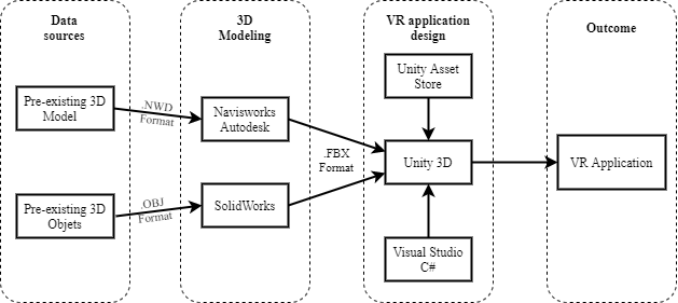
The 3D model of the building was delivered by the Faculty of Engineering in NWD format. Some internal building elements were imported from SolidWorks software. After that, these elements were converted to FBX format, which is compatible with Unity 3D. Items such as doors, plants and other accessories were obtained from different packages from the Unity Asset Store. The final adjustments to the model were completed directly in the software. Finally, to generate the user's
Intelligent Human Systems Integration (IHSI 2022): Integrating People and Intelligent Systems https://openaccess.cms-conferences.org/#/publications/book/978-1-7923-8988-7 movement, door opening, sound implementation, control of the commands, among other functions, the programming code used was Visual Studio and the language was C#. In Figure 1, you can see the process explained above:
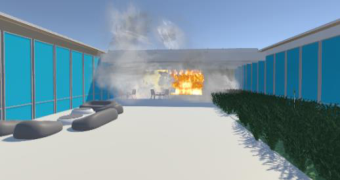
Figure 1. Development implemented to create the virtual environment The emergency occurs due to an explosion in the 14th-floor cafeteria area. Immediately afterward, fire is generated in nearby areas, in turn, the smoke is located along all the stairs between the 14th floor and the 11th floor of the building. For the visualization of both fire and smoke (Figure 2), a script was programmed to control its activation time. At the entrance to the 11th floor of the building, by the stairs of the south side, the fall of a structural object caused by the fire is simulated to hinder the descent down this route. The participant is forced to cross this floor, which is completely covered by smoke. It is important to note that once the explosion occurs, the fire alarm sounds. Finally, an electric heater that researchers manipulate stimulates the sensation of heat generated by the fire.Figure 2. Fire and Smoke Simulation
Currently, the engineering building has evacuation routes and their respective signals. For this reason, all signs are in the same places of the building in the virtual environment. Participants before starting the test do not receive any instructions on
Intelligent Human Systems Integration (IHSI 2022): Integrating People and Intelligent Systems https://openaccess.cms-conferences.org/#/publications/book/978-1-7923-8988-7 how to evacuate the building, as this may affect their behavior. That is to say, the participants only have the evacuation signs previously located in the virtual model of the building.
RESULTS
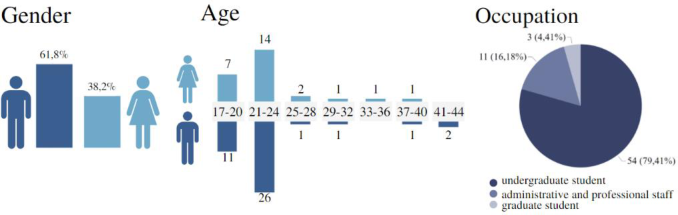
In order to have a considerable proportion of the population, the experiment was applied to 68 people, considering the statistically sample size. This number of people includes students, brigade members, teachers, and administrative staff of the Faculty of Engineering. Figure 3 shows the socio-demographic description: 61.8% of the participants belonged to the male gender and 38.2% to the female gender. Furthermore, 79.41% of the participants were undergraduate students, 16.18% belonged to the faculty's teaching and administrative staff, and the remainder were post-graduate students. The percentages obtained in the occupation variable are like the target population, since the aim was to make them similar to the data provided by the faculty.
Figure 3. Socio-demographic description
Within the sample, there were four brigades belonging to the teaching and administrative staff. Although two of them are external to the Faculty of Engineering, they are involved in Occupational Safety and Health issues (OSH) and provide the necessary support in any emergency. Figure 4 shows the integration of the users with the application and the corresponding VR equipment.
Intelligent Human Systems Integration (IHSI 2022): Integrating People and Intelligent Systems https://openaccess.cms-conferences.org/#/publications/book/978-1-7923-8988-7
Figure 4. Integration of users with the application Based on the information collected, a statistical analysis was carried out with the measured data and information obtained through the surveys. This study considered 36 variables classified as follows: 5 scalar, 19 nominal and 12 ordinals. It should be noted that prior to the analysis, a data cleaning and transformation was carried out for the correct reading and conclusion of the data. With a confidence of 95%, the average time of the emergency application is 4.04 minutes, which indicates that it contemplates the user's learning to know the emergency exits and the meeting point of the building. One of the results obtained shows that gender influenced the duration of the participants in the measured times, the respective averages show a longer duration of women in the simulation.
Figure available in the original PDF paper.
The evacuation application developed compared to traditional drills shows, with a significance level of 5%, that factors such as the realism of the evacuation, motivation, knowledge, and interest of the participants are different in comparison to the proposed methodology. For an evacuation drill, 97.1% of the participants preferred the VR training system over traditional methodologies, and the application obtained an average score of 9.63 points out of a possible 10. In addition, the results show a positive impact on factors such as: productivity, economy, culture, health, and technology. This is because the application can be carried out individually, the application time is flexible, it can be performed in a reduced space, and it is not necessary to evacuate the building or stop the activities that are being developed.
DISCUSSION
Based on the results obtained and the review of the existing literature, similarities were found with the project developed through the implementation of SG (Tsai et al., 2020). In this study, based on an assigned score, it is also concluded that there is a significant difference in the performance of men and women, and that the average score of men was better than that obtained by women. It was also observed that there is a positive influence on the level of users' interest in learning about disaster prevention. This behavior was repeated in the experiment conducted using HTC Vive in the simulation of a fire (Lin et al., 2018), in which more than 70% of the students believe that the use of a VR platform increases interest in learning and usefulness in training in emergency situations. In contrast to the present study, all the participants think that the simulation they experienced is important for the university and increases factors of interest, knowledge, motivation, and realism compared to traditional methodologies.
IMPACT In traditional drills, the entire building in question must generally be evacuated and vacated, and the time involved not only affects the productivity of the people involved
Intelligent Human Systems Integration (IHSI 2022): Integrating People and Intelligent Systems https://openaccess.cms-conferences.org/#/publications/book/978-1-7923-8988-7 but also all the activities and processes that must be halted because of the drill. With the designed application, only a room of at least 10 square meters, the VR equipment and at least one power source are needed. In this way, it is not necessary to stop the entire operation while the training of the personnel is being carried out, thus incurring lower costs and higher productivity. Finally, for proper training, it was found that with only one researcher in charge, it was possible to perform the simulation for each participant. Therefore, with this methodology, the costs of the personnel in charge of disaster prevention drills are also reduced.
The implementation of VR in evacuation drills, can also contribute to the well- being, safety, and health of people. This can be evidenced by the current contingency caused by SARS-CoV-2. To prevent contagion, one of the suggestions is to avoid crowds, which makes it impossible to conduct traditional face-to-face drills, thus demonstrating a notable advantage of the application of VR.
In addition, building a culture of prevention and emergency response is not a common theme, but it is vitally important. Perhaps, the probability of having to live through such a situation is minimal, however, being prepared or not to face such an adversity can make a difference in the severity of the consequences. Therefore, the application presented in this project is valuable, as it provides a new way to train and gradually generate that much-needed culture.
As is well known, technology is currently experiencing exponential growth worldwide. This, being a project based on the increase of emerging technologies, is part of the aforementioned boom. In addition, the results show that most of the people liked to participate in simulations carried out with new technologies, due to their content and attraction. This project opens the doors to technology and shows the great importance it currently has.
CONCLUSIONS AND RECOMMENDATIONS Being prepared for an emergency is essential to reduce the consequences generated by an unexpected disaster. Therefore, the objective of this project is to design a training system for the Pontificia Universidad Javeriana's community through virtual reality tools, which facilitate evacuation in the event of a structural fire at the new Engineering laboratory building. The simulation was developed as a serious game, with the purpose of generating a learning experience for the participants.
This project is a breakthrough in disaster prevention education with Industry 4.0 tools and techniques. As recommendations, it is important to continue the incursion of this type of experiments for other types of disasters, such as earthquakes, tsunamis, chemical disasters, among others. A challenge that future researchers can take into account is the inclusion of Non-Player Character (NPC) in the simulation with VR. The interaction of NPCs with the user can generate more parameters to be analyzed, since crowding, blockages at exits and delays in evacuation times can occur.
Another recommendation that a project of this type can consider the incursion of more functions related to the participant, for example, interaction with objects on the stage, bending down to reduce the effect of smoke, among others. Likewise, it is
Intelligent Human Systems Integration (IHSI 2022): Integrating People and Intelligent Systems https://openaccess.cms-conferences.org/#/publications/book/978-1-7923-8988-7 important to adapt the simulation to other hardware and software tools to make these projects more inclusive. Finally, considering the comments and suggestions of the users, it is recommended to program changes in the speed of movement of the user and better signage in the building. All this in order to have a greater reach and impact of the use of VR for evacuation drills.
REFERENCES
Almeida, J. E. et al. (2017) ‘Serious games for the human behaviour analysis in emergency evacuation scenarios’, Cluster Computing, 20(1), pp. 707–720. Belger, J. et al. (2019) ‘Immersive Virtual Reality for the Assessment and Training
of Spatial Memory: Feasibility in Individuals with Brain Injury’, 2019 International Conference on Virtual Rehabilitation (ICVR), Virtual Rehabilitation (ICVR), 2019 International Conference on, pp. 1–2. Kaplan, A. D. et al. (2020) ‘The Effects of Virtual Reality, Augmented Reality, and Mixed Reality as Training Enhancement Methods: A Meta-Analysis’, Human Factors. Lin, S.-C. et al. (2018) ‘Developing the Immersion Virtual Reality Platform Based on
Experiential Learning Cycle - Using Fire Disaster Prevention Education as an Example’, 2018 7th International Congress on Advanced Applied Informatics (IIAI-AAI), Advanced Applied Informatics (IIAI-AAI), 2018 7th International Congress on, IIAI-AAI, pp. 948–949. Lovreglio, R. et al. (2018) ‘Prototyping virtual reality serious games for building earthquake preparedness: The Auckland City Hospital case study’, Advanced Engineering Informatics, 38, pp. 670–682. Lovreglio, R. and Kinateder, M. (2020) ‘Augmented reality for pedestrian evacuation
research: Promises and limitations’, Safety Science, 128. Manca, D., Brambilla, S. and Colombo, S. (2013) ‘Bridging between Virtual Reality and accident simulation for training of process-industry operators’, Advances in Engineering Software, 55, pp. 1–9. Tepe, T., Kaleci, D. and Tuzun, H. (2018) ‘Integration of Virtual Reality Fire Drill
Application into Authentic Learning Environments’, World Journal on Educational Technology: Current Issues, 10(4), pp. 72–78. Tsai, M.-H. et al. (2020) ‘Exploring the effects of a serious game-based learning package for disaster prevention education: The case of Battle of Flooding Protection’, International Journal of Disaster Risk Reduction, 43.
Intelligent Human Systems Integration (IHSI 2022): Integrating People and Intelligent Systems https://openaccess.cms-conferences.org/#/publications/book/978-1-7923-8988-7
LISTED IN THE AHFE DIGITAL BOOKSTORE CATALOGUE
Explore the complete digital volume
Intelligent Human Systems Integration (IHSI 2022): Integrating People and Intelligent Systems
Read this individual research paper free through the original publisher, or explore the full digital proceedings book.
ISBN 978-1-7923-8988-7
Explore this ISBN in the AHFE Bookstore ↗Listed in the July 2026 bookstore catalogue; search by ISBN to confirm current availability · Digital book purchase optional