Marcel Baltzer, Marcel Usai, Frank Flemisch (2022). Balanced HSI for Energy – A System Dynamics Model for Energy Systems. In: Intelligent Human Systems Integration (IHSI 2022): Integrating People and Intelligent Systems. AHFE Open Access, vol. 22. https://doi.org/10.54941/ahfe1001059
New technologies offer new potentials to tackle everyday challenges, but this has only a chance to become true if technology is intelligently integrated with humans, organizations and environment. A good balance between different stakeholders and tension fields is one of the most challenging research questions of Human Systems Integration. Especially in the field of energy, where huge pulls from en-vironmental and societal demands into different directions meet technological pushes from new energy sources and methods. First, a short introduction to the electricity market in Europe is given. Afterwards, the relations between different systems are modelled into a system of systems, fo-cusing on the electricity offering and electricity demanding systems. Relevant sys-tem qualities are analysed. The paper continues developing the system dynamics model and brings the subsystems into relation with each other. It concludes by testing the system dynamics model with alternative approaches in the transfor-mation of the European energy system.
Intelligent Human Systems Integration (IHSI 2022): Integrating People and Intelligent Systems https://openaccess.cms-conferences.org/#/publications/book/978-1-7923-8988-7
INTRODUCTION
Not only new technology that offers new methods to tackle everyday challenges in complex human machine systems pushes innovation, but also requirements that were not sufficiently addressed in the past, like addressing climate change in the tension field of energy prices, grid stability, sector demand etc. The intelligent integration of technology in existing systems of humans, organization and the environment, and especially finding a good balance between human, technology and the systems surrounding human machine systems is one of the main research challenges of Human Systems Integration. Good examples where humans and technologies need to be integrated into well-balanced human machine systems is space flight, production, seafaring, automotive and energy systems.
Megatrends for the coming decades are the demographic development, scarcity of resources and climate change. The Paris Agreement under the United Nations Frame- work Convention on Climate Change effective of November 4th 2016 demands from all nations to keep the rise in mean global temperature below 2 degrees Celsius. The Intergovernmental Panel on Climate Change (IPCC) proposed in 2007 a path to achieve this by continuously reducing carbon emissions and to become “CO2 neutral” by 2080. Due to higher emissions than proposed, this path has been adopted in 2018 to make the world “CO2 neutral” by 2050.
One major factor to address acceptance and to fulfil the demands of the Paris treaty is transparency and an understanding of how different systems interact with each other. A main challenge for the next decades is how to address climate change in the design of socio technical systems like the energy market and in the traffic sector. This paper proposes a system dynamics model to show on the one hand, how different systems in the system of systems of the energy market interact with each other and on the other hand, how different scenarios can be simulated while transparently showing the setscrews in the energy system.
Although the methodology is not restricted to the European Union, the main data used for the simulations of the model is from the European Statistics Recovery Dashboard (EUROSTAT). The simulations of the model will show what consequences reductions in CO2 emissions will have on the electricity production market for the electricity offering side, as well as how human energy and transportation demands can be modelled with system dynamics on the electricity demanding side.
BALANCED HUMAN SYSTEMS INTEGRATION (BHSI) Human Systems Integration (HSI) is the science, craft and art of integrating humans, technology, organizations and environment into meaningful systems and system of
Intelligent Human Systems Integration (IHSI 2022): Integrating People and Intelligent Systems https://openaccess.cms-conferences.org/#/publications/book/978-1-7923-8988-7 systems. Within HSI, balance or balanced HSI is a specific Leitmotiv and a set of concepts, methods and tools to systematically bridge the tension fields in these complex cyber-socio-technical systems (e.g. Flemisch 2021). bHSI is inspired by system theory, system dynamics, combines system and design thinking with system acting, extends a couple of ideas from human-centred system design, and works fruitfully hand in hand with system engineering and project management. A typical sequence in bHSI is:
System analysis incl. identification of subsystems and interrelationships, tension fields, design space, use space and value space
System exploration e.g. with stakeholders
System realization, connecting to classical engineering methods
System test, including the assessment of technical, human, organizational and environmental factors
Fielding and support through the whole life cycle of the system or sub system Very often, this sequence is performed in iterative cycles, starting with models with a low level of detail and a potentially fuzzy understanding of problems and solutions, and condenses towards concrete solutions, implementations and their impact on the addressed socio-technical system, surrounding system and the environment.
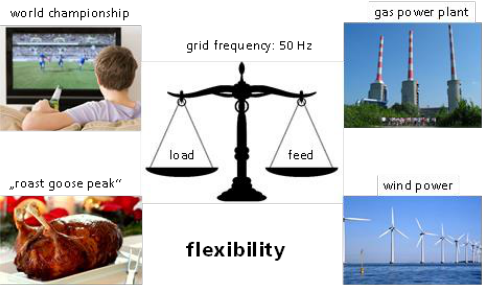
The question why bHSI can be used for energy is therefore to answer, that Energy is a balancing problem and a Human Systems Integration problem par excellence, as is summarized in the box (see Figure 1).
THE EUROPEAN ENERGY SYSTEM The European energy market divides into several roles: electricity producers, electricity suppliers, consumers, distribution grid operator and transmission grid operator. The grid operators have the responsibility to keep a strict balance of supply and demand in check for their designated zone to keep up the whole system in balance, i.e. in Europe at 50 Hz grid frequency. Aside from that, electrical energy might be traded freely and is done so, e.g. at the European Energy Exchange (EEX).
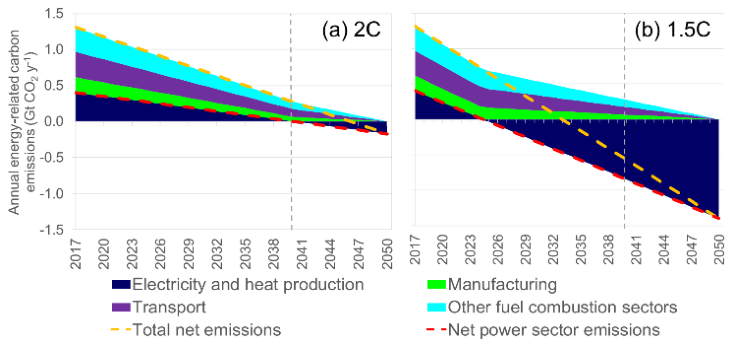
In order to meet the Paris Agreement and become CO2 -neutral by 2050, carbon emissions need to be reduced drastically, with the electricity and heat production sector even reaching negative emission levels to compensate for other sectors. Figure 2 shows an example scenario proposed by (Zappa et al., 2021).
Intelligent Human Systems Integration (IHSI 2022): Integrating People and Intelligent Systems https://openaccess.cms-conferences.org/#/publications/book/978-1-7923-8988-7
The energy system is highly dynamic
Several tension fields need to be dynamically balanced:
1. Supply and demand 2. First order system qualities, such as - Performance (power) - Costs (Monetary, Environmental) - Time - Quality (e.g. stability, variability) 3. Second order system qualities, such as - Flexibility, e.g. to respond to short term changes - Resilience, e.g. to resist disruptive events - Agility, e.g. to change to new demands imposed on it 4. Humans are involved in all stages of production, distribution, management and consuming. 5. Technology, humans, organizations and the environment are strongly interconnected
Figure 1. bHSI characteristics and tension fields of the energy systemFigure 2: Proposed decarbonisation trajectories to limit global warming to (a) 2°C or (b) 1.5°C with a 66% chance, respectively, by Zappa et al. (2021).
Intelligent Human Systems Integration (IHSI 2022): Integrating People and Intelligent Systems https://openaccess.cms-conferences.org/#/publications/book/978-1-7923-8988-7
The increase in renewable energy supplies, however, increases uncertainties introduced to the overall system, as they depend on partly uncontrollable external factors. This strengthens the role of storing technologies within the system (Child et al. 2019). The system stability and even dynamics, however, is not only dependent on technological progress but also human behaviour. With humans as a key element in the overall system, demand and supply can be modelled with more complex and flexible solutions (e.g. Vehicle-2-Grid).
SYSTEM DYNAMICS MODEL OF THE EUROPEAN ENERGY SYSTEM Many artefacts in modern time get the label of “system”, e.g. IT-systems, transport systems, planning systems etc. As Stafford Beer describes it: “The word system stands for connectivity. By that we mean every accumulation of parts that stand in relation with each other. What we define as a system is therefore a system because it comprises parts that stand in relation with each other and in a certain respect form a whole.” (Haberfellner, 2019 citing Beer, 1959).
When multiple systems are investigated, we talk about “system of systems” which is the case when addressing complex systems, such as the energy system. Electricity is produced in power plants and CO2 is emitted from fossil power plants: the electricity offering systems. Electricity is distributed via the grid: the distribution systems. It is demanded by different sectors like transportation, production etc.: the electricity demanding systems. The main demand in the latter system is due to human needs for products, services or transportation: socio-technical systems. All systems interact with each other and a change in one system leads to a change in another (see Figure 3, right). A possibility to model these interactions, and even more simulate and quantify these effects, is system dynamics. In the system “steam turbine power plant” (see Figure 3, left), which currently is mainly operated by burning solids (coal, peat, wood etc.), heat is created (𝑄𝑧𝑢̇), water evaporated to overheated steam (5 and 6) and a steam turbine is operated creating power (𝑃𝑇) and electric power (𝑃𝑒𝑙) via a generator. Finally the steam is condensed (𝑄𝑎𝑏̇) and the process restarts. The installed power of a certain power plant type multiplied by the full load hours determines the amount of electricity fed into the grid. The efficiency multiplied by this amount of electricity determines the primary energy demand in such a power plant. The specific CO2 emissions of the solids burned determines the overall CO2 emissions into the environment. The current complete system dynamics model incorporates nuclear power, gas power, hydropower, photovoltaic power, wind power and bio mass on the production side. The demand side is modelled for the sectors industry, services, households, agriculture, others and transport. The latter is further detailed into type of vehicle, driven distance per year etc.
Intelligent Human Systems Integration (IHSI 2022): Integrating People and Intelligent Systems https://openaccess.cms-conferences.org/#/publications/book/978-1-7923-8988-7
1
PT Pel T G
uses
Ü
2
5 6 Qzu Qab
hum
DE K P
emits gas
3 4
car
feeds in CO2
needs
PP T
Qzu
needs deman
1
solids
grid
5 6
PT
4
PP
2
3
Qab nuclear s
wind photovoltaics hyd
Figure 3: Simple system model. Left: Clausius Rankine process of a steam turbine power plant. Right: Simplified energy and electricity flow between electricity offering, electricity distribution and electricity demanding system.
Figure available in the original PDF paper.
SIMULATIONS The developed system dynamics model was used to simulate the effects of the different scenarios on the energy system in Europe:
Scenario 1: Current policies (Current). The scenario current policies uses data from various sources: Historic data of electricity production (EUROSTAT, 2020a), electricity consumption (EUROSTAT, 2020b), installed electricity capacities (EUROSTAT, 2020c, d, e), specific emissions (Federal ministry of environment Germany, 2016), forecast data of installed capacities, electricity production and consumption until 2050 (IEA, 2016, ISE, 2018). The demand sector was detailed into the sectors industry, households, services, agriculture and transport, where transport was further detailed by creating a subsystem “private transport” for which historic data was used (EUROSTAT, 2020e) to calculate growth rates.
Scenario 2: Transform energy sector to meet Paris agreement (Paris). For the second scenario, the same data basis was used as in Scenario 1 but with the goal to transform the electricity sector from fossil to renewable fuels. The method was on the one hand not only to replace investment in installed capacity from fossil to renewable, but also to account for lower full load hours in the renewable energy sector. To reach a zero CO2 emission state by 2050, around 23.25 GW/a of gas capacity would need to be replaced with around 36 GW/a renewable capacity and 3.6 GW/a of solid fuel capacity would need to be replaced with 5.58 GW/a of renewable capacity to offer
Intelligent Human Systems Integration (IHSI 2022): Integrating People and Intelligent Systems https://openaccess.cms-conferences.org/#/publications/book/978-1-7923-8988-7 the same electricity output as in scenario 1. Taking current technology into account, this would mean the construction of 23.000 wind power plants in Europe and quiescence of 3 coal power blocks and 8 gas power blocks.
Scenario 3: Current policies and transformation of the transportation sector to E-mobility (B+D2E). For the scenario 3 the same data basis was used as scenario 1 to simulate the effects of a transport transformation to E-mobility. The method was to adapt the invest rate from fossil fired vehicles into electric vehicles to meet a 0 % market share of fossil fired vehicles by 2050. To reach this, 21.7 million electric vehicles would have to be registered per year to meet the current demand of yearly driven vehicle kilometres. Since this represents the number of newly registered vehicles over-all, we already see that policies need to reduce the yearly driven vehicle kilometres and simply changing from fuel to battery powered transportation is not the end of the solutions.
Scenario 4: Paris and transformation of the transportation sector to E-mobility (B+D2E+Paris). In scenario 4, both power and transport sector were transformed with the methods of scenario 2 and 3 combined.
Scenario 5: Paris and transformation of the transportation sector to E-mobility and Vehicle-2-Grid (B+D2E+Paris+V2G). Scenario 5 extends Scenario 4 with the introduction of a new node to account for electric vehicles being able to store and supply electricity to support grid stability in a world with 100% electricity generation from renewable fuels. Based on data of current car usage in Europe (EC, 2012) which states that current vehicles in the private sector are in average parked in the private area for ~8.2 hours/day and at the work space for ~4.32 hours/day. Considering a further 10 kW output into the grid (e.g. Robledo et al. 2018) a certain electricity storage to account for over-production or under-production could be used if the respective charging and discharging-infrastructure would be available in the private and work parking area.
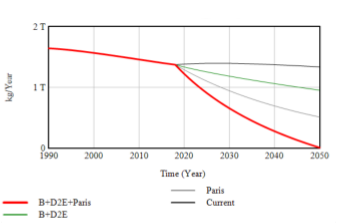
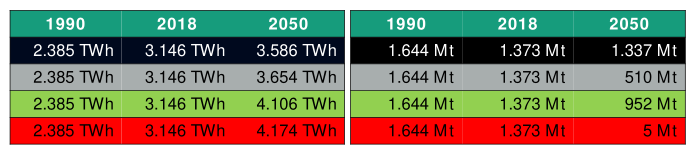
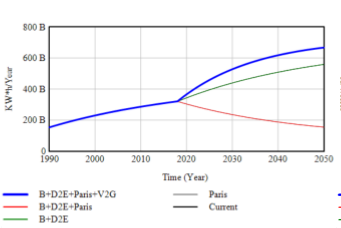
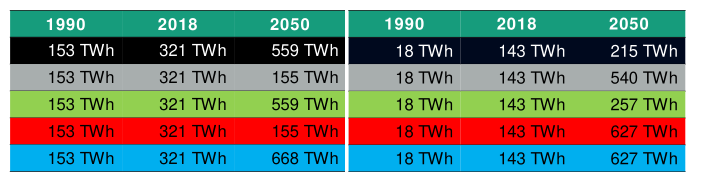
The values of the simulated electricity production and CO2 emissions of scenarios 1-4 are presented in Figure 4 and numbers for 1990, 2018 and 2050 in Table 1.
Figure 4: Left: overall electricity production. Right: Overall CO2 emissions for scenario 1 (black), scenario 2 (gray), scenario 3 (green) and scenario 4 (red).
Intelligent Human Systems Integration (IHSI 2022): Integrating People and Intelligent Systems https://openaccess.cms-conferences.org/#/publications/book/978-1-7923-8988-7
Table 1: Simulated values of electricity production (left) and CO2 emissions (right) for scenario 1 (black), scenario 2 (gray), scenario 3 (green) and scenario 4 (red).Figure 5: Left: flexibility offer. Right: flexibility demand for scenario 1 (black), scenario 2 (gray), scenario 3 (green), scenario 4 (red) and scenario 5 (blue).Table 2: Simulated values of flexibility offer (left) and demand (right) for scenario 1 (black), scenario 2 (gray), scenario 3 (green), scenario 4 (red) and scenario 5 (blue).
As we see, scenario 2 creates a dangerous situation of high flexibility demand due to
Intelligent Human Systems Integration (IHSI 2022): Integrating People and Intelligent Systems https://openaccess.cms-conferences.org/#/publications/book/978-1-7923-8988-7 the high share of electricity from renewable fuels and the same time reduced flexibility offer due to the reduction of gas power plants until 2050. The introduction of V2G technology would balance the tension field of grid stability and the need for a green transformation of the power generation and the private transportation sector, as we see in scenario 5.
SUMMARY AND OUTLOOK A system dynamics model of the European energy system was developed and based on data provided by the European Union five different scenarios were simulated. The proposed model differs from the various models already available in a way that it is a system dynamics model, which can also incorporate human behaviour. It provides a link between the human and the completely technical world of energy systems. The results show, that out of the five scenarios only a change in policies to meet the Paris Climate Agreement as well as a transformation to E-mobility provides enough decarbonisation to reach GHG neutrality by 2050. However, only the fifth scenario provides the flexibility of the grid required by the transformation. One of many possibilities to meet this flexibility is to use the batteries of electric vehicles as storage for electrical energy (Vehicle-2-Grid). It highlights the importance of meeting flexibility demands, which will be imposed on a rather inflexible system in the future. It also shows the impact of society’s decisions and its huge impact on the energy system. With future work, the role of the human in energy systems, including the embodiment of energy systems into the system of society, needs to be developed further to achieve results that technology cannot achieve on its own.
REFERENCES
Beer, S.: Cybernetics and Management; English University Press (1959). Child, M., Kemfert, C., Bogdanov, D., Breyer, C.: Flexible electricity generation, grid exchange and storage for the transition to a 100% renewable energy system in Europe. Renewable Energy. 139, (2019). European Commission (EC): Driving and parking patterns of European car drivers -
a mobility survey (2012). EUROSTAT: Production of electricity and derived heat by type of fuel (nrg_bal_peh). URL: https://ec.europa.eu/eurostat/data/database (2020a). EUROSTAT: Supply, transformation and consumption of electricity (nrg_cb_e).
URL: https://ec.europa.eu/eurostat/data/database (2020b). EUROSTAT: Electricity production capacities for combustible fuels by technology and operator (nrg_inf_epct). URL: https://ec.europa.eu/eurostat/data/database (2020c). EUROSTAT: Nuclear energy facilities (nrg_inf_nuc). URL:
https://ec.europa.eu/eurostat/data/database (2020d). EUROSTAT: Electricity production capacities for renewables and wastes (nrg_inf_epcrw). URL: https://ec.europa.eu/eurostat/data/database (2020e).
Intelligent Human Systems Integration (IHSI 2022): Integrating People and Intelligent Systems https://openaccess.cms-conferences.org/#/publications/book/978-1-7923-8988-7
EUROSTAT: Motor vehicle movements on national territory, by vehicles registration (road_tf_vehmov). URL: https://ec.europa.eu/eurostat/data/database (2020e). Federal ministry of environment Germany: CO2-Emissionsfaktoren für fossile
Brennstoffe, (2016). Flemisch, F.: Past, Present and Future of Human Systems Integration (Keynote). In: 4th International Conference on Intelligent Human Systems Integration: Integrating People and Intelligent Systems (2021). Haberfellner, R., de Weck, O., Fricke, E., Vössner, S.: Systems Engineering.
Fundamentals and Applications. Birkhäuser Verlag (2019). International Energy Agency (IEA): World Energy Outlook 2016, 2016. Fraunhofer ISE: Levelized Cost of Electricity Renewable Energy Technologies, (2018) Robledo, C.B.; Oldenbroek, V.; Abbruzzese, F.; van Wijk, A.J.M.: Integrating a
hydrogen fuel cell electric vehicle with vehicle-to-grid technology, photovoltaic power and a residential building, Applied Energy, 215 (2018). Zappa, W., Junginger, M., van den Broek, M.: Can liberalised electricity markets support decarbonised portfolios in line with the Paris Agreement? A case study of Central Western Europe. Energy Policy. 149, (2021).
Intelligent Human Systems Integration (IHSI 2022): Integrating People and Intelligent Systems https://openaccess.cms-conferences.org/#/publications/book/978-1-7923-8988-7
LISTED IN THE AHFE DIGITAL BOOKSTORE CATALOGUE
Explore the complete digital volume
Intelligent Human Systems Integration (IHSI 2022): Integrating People and Intelligent Systems
Read this individual research paper free through the original publisher, or explore the full digital proceedings book.
ISBN 978-1-7923-8988-7
Explore this ISBN in the AHFE Bookstore ↗Listed in the July 2026 bookstore catalogue; search by ISBN to confirm current availability · Digital book purchase optional