Frank Flemisch, Marcel Baltzer (2022). Are Rider-Horse or Centaurs intelligent Human Systems Integration? First Sketch of reversible and non-reversible human technology/machine/AI Symbiosis. In: Intelligent Human Systems Integration (IHSI 2022): Integrating People and Intelligent Systems. AHFE Open Access, vol. 22. https://doi.org/10.54941/ahfe1001039
Technological progress in form of machine intelligence increases the capabilities of machines to think and act autonomously on the world. This might only result in human and societal progress if these technical systems are intelligently integrated with humans, organizations and the environment, i.e. with intelligent Human Systems Integration.One key paradigm to enable this is human machine cooperation: The ability of agents to work together (e.g. Hoc & Lemoine 1997ff). An example for this is the relationship of a rider and a horse, which has been successfully translated to technical systems in form of shared and cooperative control (e.g. Flemisch et al. 2003ff), and as partially and highly automated, cooperatively interacting systems e.g. in the car domain (e.g. Stiller et al. 20019ff). Another paradigm is that of human machine symbiosis, in which two different species, here humans and machines, have a close and long term relationship, usually for the mutual benefit. This paradigm has been exploited e.g. for symbiotic driving schemes in the car domain (Abbink et al.2010ff). An extreme example of symbiosis that of a centaur, a creature from Greek mythology with a horse body and a human head. Applied to technology this metaphor is discussed for human-computer teams e.g. in chess competitions (e.g. Huffpost 2014) and in NATO for human-machine teaming (SCI 2020). Rider-horse and centaur stand for two different kinds of symbiotic relationships: A non-mandatory, reversible symbiosis like the rider and horse. Applied to humans and machines these are systems, where the humans can still do tasks without the support of the machines. A centaur is a non-reversable, mandatory symbiosis, where none of the symbionts can live and act without the other symbiont. The article will present that state of the art of cooperation, and of symbiotic human machine systems. It will structure and cluster symbiosis especially from a system and functions perspective, and make the differences visible with striking examples from the world of smart phones, automated cars and highly automated defense systems. Finally, the contribution will discuss what the desired kind of symbiotic relationship we as humans want and should strive for in intelligent human systems integration.
Intelligent Human Systems Integration (IHSI 2022): Integrating People and Intelligent Systems https://openaccess.cms-conferences.org/#/publications/book/978-1-7923-8988-7
Machine Cooperation ·Human Machine Symbiosis Human AI Symbiosis INTRODUCTION: HUMAN MACHINE CORPORATION AND SYMBIOSIS
Technological progress in form of machine intelligence increases the capabilities of machines to think and act autonomously. This will only result in human and societal progress if these technical systems are intelligently integrated with humans, organizations and the environment, i.e. with intelligent Human Systems Integration. One key paradigm to enable this integration is human machine cooperation: The ability of agents to work together (Hoc und Lemoine, 1998, Flemisch et al. 2019). An example for this cooperation is the relationship of a rider and a horse, which has been successfully translated to technical systems in form of shared and cooperative control (Flemisch et al. 2003), and as partially and highly automated, cooperatively interacting systems e.g. in the car domain (Stiller et al. 2018). A related paradigm is that of human machine symbiosis, in which two different species, here humans and machines, have a close and long-term relationship, usually for the mutual benefit. This paradigm has been theoretically formulated e.g. in (Licklider, 1960 and Gill, 1996), has been exploited e.g. for symbiotic driving schemes in the car domain (Abbink et al. 2010), and finds a revival e.g. in special sessions of IEEE-SMC (IEEE SMC, 2018). While horses and humans already form a symbiotic system, an extreme example of symbiosis is that of a centaur, a creature from Greek mythology with a horse body and a human head. Applied to technology this metaphor is discussed for human-computer teams e.g. in chess competitions (Cassidy, 2014) and in NATO for human-machine teaming (SCI, 2020).
Figure 1. Left and middle: Human Machine Cooperation based on the H-Metaphor Rider–Horse (Flemisch et al 2004 - 2019, Abbink et al. 2017). Right: Centaur from Greek mythology as a metaphor for human machine systems Rider-horse and centaur stand for two different kinds of symbiotic relationships: a) A non-mandatory, reversible symbiosis like the rider and horse. Applied to humans and machines these are systems, where the humans can still do tasks without the support of the machines.
Intelligent Human Systems Integration (IHSI 2022): Integrating People and Intelligent Systems https://openaccess.cms-conferences.org/#/publications/book/978-1-7923-8988-7 b) A mandatory, non-reversible symbiosis like the centaur where none of the symbionts can live and act without the other symbiont.
CLARIFICATION: WHAT IS HUMAN MACHINE COOPERATION, WHAT IS HUMAN MACHINE / HUMAN AI SYMBIOSIS?
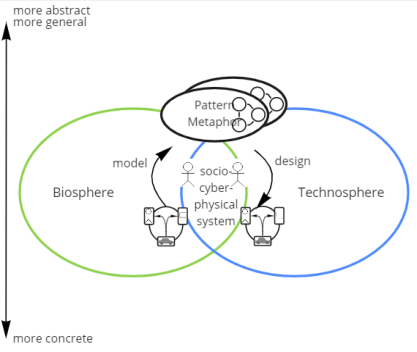
First of all, both concepts, human machine cooperation and human machine/AI symbiosis are metaphors which carry over meaning from one part of the world to another, here from the biosphere, where cooperation was described initially for humans, to the technosphere. More precisely, as humans are part of the biosphere, these metaphors are right at the connection point of bio- and technosphere (e.g. Flemisch et al. 2020). In Cognitive psychology recurring structures of our cognitive processes are referred to as Image Schemas (e.g. Johnson, 1987 and Lakoff, 1987). Image schemas are sourced in the biosphere, or more precisely the bodily interactions of humans with their environment. By this, metaphors can be build (e.g. BIG-SMALL, CONTAINER) that again can be used to design intuitive human- technology interaction (e.g. Hurtienne, 2009 and Baltzer, 2021). As metaphors, this transfer process is not precise as a pure copy would be, but lives from a minimum of plasticity. This is sometimes hard to bear for disciplines like mechanical engineering, for which precision is vital. On the other hand, plasticity opens up a degree of freedom, which can foster innovative solutions especially in early phases. Besides metaphors, both cooperation and symbiosis can be seen as meta-pattern, an collection of pattern, similar to architecture where a city is described as a meta-pattern formed by design patterns like streets, shopping malls, parks etc., as described by Alexander 1977 (Alexander et al. 1977). In the case of human-machine systems, they form patterns for system design, cooperation and interaction, e.g. (Flemisch et al. 2021 and Baltzer et al. 2019).
Intelligent Human Systems Integration (IHSI 2022): Integrating People and Intelligent Systems https://openaccess.cms-conferences.org/#/publications/book/978-1-7923-8988-7
Figure 2. Symbiosis as a meta-pattern, which can be metaphorically transferred from biosphere to technosphere (Flemisch et al. 2020)
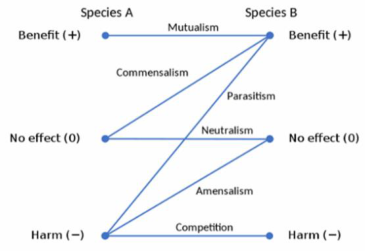
Analyzing the literature, it looks like human-machine cooperation is mainly applied to the direct interplay of humans and machines (Hoc and Lemoine, 1998 and Flemisch et al. 2014) and is more short term, while human machine symbiosis is used both short term and direct, e.g. (Teitelman, 1996 and Abbink, 2012), and long term and indirect (Licklider, 1960). Interestingly, most of the literature transferred only a positive meaning of symbiosis from biosphere to technosphere. In symbiotic relationships in the biosphere, where symbiosis (from Greek συμβίωσις, symbíōsis, “living together”) originated, symbiotic relationships can be both beneficial, have no effect or can have a harmful effect to either one of the partners. If we want to pursue human technology symbiosis further, we should especially develop mutualism as a symbiosis with benefits for both “species” human or machines, or as a minimum commensalism, with benefits at least for the humans involved. As symbiosis in the biosphere shows many examples where a mutualism gets out of balance and turns into amensalism or even a parasitism, from Greek παράσιτος parasitos, "one who eats at the table of another", we should keep out eyes open also regarding human machine symbiotic relationships, which could develop harmful for the human partner. Examples for this could be people falling in love with chatbots or voice recognition programs (Morais, 2013), the usage of smart phones where users are frequently exploited of their data, or addictions with video games which is exploited by software companies selling additional equipment or playtime (Watkins, 2021).
Intelligent Human Systems Integration (IHSI 2022): Integrating People and Intelligent Systems https://openaccess.cms-conferences.org/#/publications/book/978-1-7923-8988-7
Figure 3. Different categories of Symbiosis (Wikipedia, 2021)
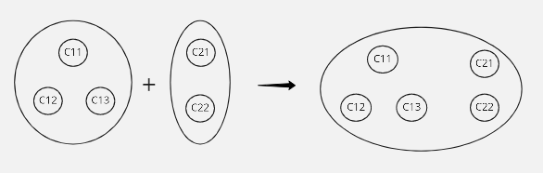
FIRST THOUGHTS TOWARDS A THEORETICAL ROLEMODEL OF REVERSIBLE, PARTIALLY AND NON-REVERSIBLE SYMBIOSIS Human Machine symbiosis is something that can be practically applied. As nothing is more practically as a good theory (Kurt Lewin), it makes sense to take a deeper look into some theoretical considerations of symbiosis, here based on system theory. (Wang, 2018) sketches symbiosis as a fusion of two systems with complexities or capabilities, where a fused system integrates the capabilities of both systems and becomes more capable (Wang, 2018). This concept is related but different to the concept of autopoesis αὐτός ποιεῖν, initially described for biological systems by (Varela et al. 1974), and transferred to social systems by (Luhmann, 1986, see also Seidl, 2004).
Figure 4. System Symbiosis as a system fusion by combination of complexities, simplified from
(Wang, 2018)
In biology, such a symbiosis would even form new breeds, e.g. a several single cell creatures uniting over time, dissolving their individual boundaries and forming a new, common system
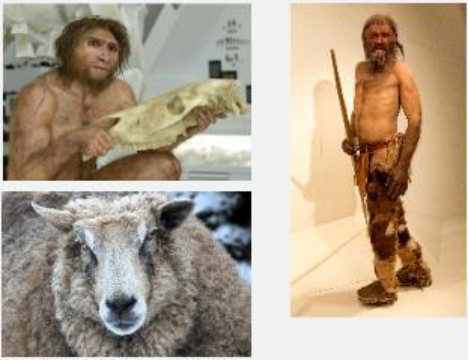
Intelligent Human Systems Integration (IHSI 2022): Integrating People and Intelligent Systems https://openaccess.cms-conferences.org/#/publications/book/978-1-7923-8988-7 boundary. Applying this to humans and tools, it becomes clear that this simple models needs refinements and modifications to explain what is happening. Fig. 6 shows early examples of homo heidelbergiensis, who already invented and used wooden spears, and used them to extend their capabilities beyond their own physical reach. For the animals hunted, killed and eaten, we would probably not yet talk about a symbiotic relationship, even if some parts of the animal systems are incorporated into the other system. For homo species and trees more and more symbiotic aspects show up, starting with a first commensalism (homo’s making use of trees by building spears) to later mutualism, where humans planted trees in order to reap wood e.g. for weapons like spears, bows and arrows. An interesting example of reversible and non-reversible symbiosis is that of humans and animals like sheep, where the animal profits on the one hand e.g. by having an extra protection from predators, and the human profits in form of fur or woolen clothes which protect him or her from colder temperatures. With the increasing use of clothes obviously homo’s own fur gradually disappeared, migrating this symbiosis from a reversible to an un-reversible symbiosis at least in most regions of this planet Earth.
Figure 5. Non-reversible human technology system symbiosis (Example Homo Heidelbergensis, Homo Sapiens “Ötzi”, wild sheep/ovis aries, clothes)
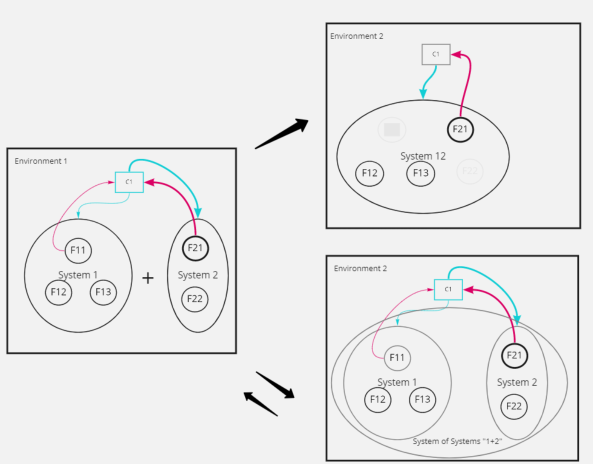
Figure 7 shows a more abstract representation of such a dynamic symbiotic relationship: On the left, we see two different systems (e.g. a human and a sheep), that both carry a capability, here described as a function towards a certain aspect in an environment, e.g. to isolate from cold temperatures. On the right, two different proceeding situations are described. The symbiosis could develop in a way that the function from system 2, F21, is completely replacing F11. In the new symbiotic system, there is still good protection from the cold, similar to what system 2 had before, but it becomes clear that the function to deal with C1 is only there once, and this symbiosis cannot be separated any more into two systems without at least one system loosing this ability completely. The lower part of Figure 6 shows a more
Intelligent Human Systems Integration (IHSI 2022): Integrating People and Intelligent Systems https://openaccess.cms-conferences.org/#/publications/book/978-1-7923-8988-7 reversible form of symbiosis: both original system borders are still intact, and even if F21 is mainly used to cope with C1, F11 is still there to support a system 1 if necessary. Besides the relationship of humans, fur-bearers and clothes, another example for this are human horse relationship, which is still reversible for both side, and the hypothetical Centaur relationship, where human (brain) and horse body are no longer separable, forming a non-reversible relationship.
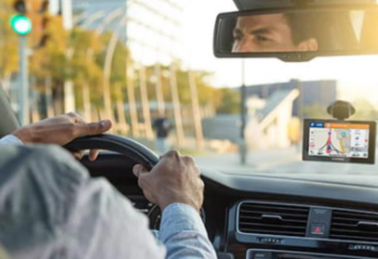
Figure 6. Non-reversible and (partially) reversible system symbiosisFigure 7. Left: Partially-reversible human technology system: Example Navigation System. Right: Partially-reversible human technology system: Symbiotic Driving System (Abbink, 2012)
Figure 7 left shows examples of symbiotic relationships in the domain of humans and machines: Navigation systems on the one hand bring a navigation capability superior to many
Intelligent Human Systems Integration (IHSI 2022): Integrating People and Intelligent Systems https://openaccess.cms-conferences.org/#/publications/book/978-1-7923-8988-7 people, on the other hand, an over-use of navigation systems can also degrade the capability of humans to navigate, e.g. (Parush et al. 2021). Some of this skill degradation could be harmless, e.g. once upon a time humans needed to know how to ride in order to move from one place to another, today riding is a sport because alternative transportation means are available that are easier to master. Other skill degradation might be harmful, e.g. when navigation systems are degraded or jammed by an enemy.
Figure 7 right shows an example of a symbiotic driving system, where e.g. the capability of staying on a street lane can be either supported with weaker or stronger forces. On the roads of 2021, these systems are quite rare, but in the foreseeable future, these systems will be used much more widely, opening up questions of skill degradation and reversible symbiosis.
CONCLUSIONS AND OUTLOOK It is clear that with clothes, we have accepted a non-reversible symbiotic relationship, which is difficult to reverse, especially outside of buildings and in colder climates. The example of clothes makes also clear that the type of symbiosis might also change, here from fur to plant fibers and artificial fibers, constituting new symbiotic, sometimes parasitic relationships e.g. for fashion addicts. With humans and technology, we are just realizing that we might already be in symbiotic relationships, and should carefully examine whether these relationships are more mutualist, more parasitic, or even competitive, e.g. in two military systems struggling for superiority. Reversibility and non-reversibility is not only a theoretically fascinating aspect of human-machine symbiosis, but in military systems a matter of life and death of humans, nations and societies. If we understand our name homo sapiens not as a fact, but as a program, human machine symbiosis could be a matter of conscious choice: What symbiotic relationships do we want to accept or reject, who do we want to be or not to be? Many questions are still open, but some glimpses of potential answers already exist. The rest is more than silence.
ACKNOWLEDGMENTS
The authors would like to acknowledge the support from the Deutsche Forschungsgemeinschaft (DFG) in the DFG Focus Program CoInCar (Cooperatively Interacting Vehicles), and the BAAInBw for their support on cooperative systems.
REFERENCES
Abbink, D.: Symbiotic Driving, VIDI Research Programme, Delft 2012; Baltzer, M. C. A., López, D., Flemisch, F.: Towards an interaction pattern language for human machine cooperation and cooperative movement. Cognition, Technology & Work. 21, 593–606 (2019). https://doi.org/10.1007/s10111-019-00561-8.
Intelligent Human Systems Integration (IHSI 2022): Integrating People and Intelligent Systems https://openaccess.cms-conferences.org/#/publications/book/978-1-7923-8988-7
Baltzer, M. C. A.: Interaktionsmuster der Kooperativen Bewegungsführung von Fahrzeugen, (2021). https://doi.org/10.2370/9783844080599. C. Alexander, S. Ishikawa, M. Silverstein, M. Jacobson, I. Fiksdahl-King, and S. Angel, A
pattern language: towns, buildings, construction. Oxford University Press, (1977) Cassidy, M.: Chentaur Chess Shows Power of Teaming Human and Machine, Huffpost 30.12.2014 Flemisch, F. O., Adams, C. A., Conway, S. R., Goodrich, K. H., Palmer, M. T., & Schutte,
P. C. (2003). The H-Metaphor as a guideline for vehicle automation and interaction. Flemisch, F. O., Pacaux-Lemoine, M. P., Vanderhaegen, F., Itoh, M., Saito, Y., Herzberger, N., Baltzer, M. (2020). Conflicts in Human-Machine Systems as an Intersection of Bio-and Technosphere: Cooperation and Interaction Patterns for Human and Machine Interference and Conflict Resolution. In 2020 IEEE International Conference on Human-Machine Systems (ICHMS) (pp. 1-6). IEEE Flemisch, F.; Abbink, D.; Itoh, M.; Pacaux-Lemoine, M.-P. & Wessel, G: Shared control is
the sharp end of cooperation: Framework of joint action, shared control and human machine cooperation", Ed. Flemisch, F.; Abbink, D., Pacaux-Lemoine, M.; Itoh, M.; Cognition, Technology & Work, Special Issue “Shared and cooperative control of safety critical systems”, (2019) Flemisch, F.; Bengler, K.; Bubb, H.; Winner, H.; Bruder, R.: Towards cooperative guidance and control of highly automated vehicles: H-Mode and Conduct-by-Wire; Ergonomics Special Issue Beyond Human-Centred Automation; Volume 57, Issue 3 2014; Online 24.2.2014 Flemisch, F.; Usai, M.; Herzberger, N.; Baltzer, M.; Lopez, D.; Pacaux-Lemoine, M.-P.:
Human-Machine Patterns for System Design, Cooperation and Interaction in Socio- Cyber-Physical Systems: Introduction and General overview; IEEE-SMC Int. Conference on Systems, Men and Cybernetics; (2021) Francisco J. Varela, Humberto R. Maturana, and R. Uribe: Autopoiesis: The organization of living systems, its characterization and a model. In: Biosystems. 5, 1974, S. 187– 196. doi:10.1016/0303-2647(74)90031-8 Gill, K. S. (1996). The foundations of human-centred systems. In Human machine
symbiosis (pp. 1-68). Springer, London. https://en.wikipedia.org/wiki/Symbiosis Hurtienne, J.: Image Schemas and Design for Intuitive Use - Exploring new Guidance for User Intrerface Design, (2009). IEEE-SMC 2018 Special session on Symbiotic Autonomous Systems Full Day Workshop
Fostering Technology, Ethics, Public Policy and Social Enablers, Miasaki, Japan, 2018 J. C. R. Licklider. Man-Computer Symbiosis, IRE Transactions on Human Factors in Electronics, volume HFE-1, pages 4-11, March (1960) J.-M. Hoc & M.-P. Lemoine (1998) Cognitive evaluation of human-human and human
machine cooperation modes in air traffic control. Int. J. Aviat. Psychol. 8:1–32 J.-M. Hoc & M.-P. Lemoine (1998) Cognitive evaluation of human-human and human machine cooperation modes in air traffic control. Int. J. Aviat. Psychol. 8:1–32 Johnson, M.: The Body in the Mind: The Bodily Basis of Meaning, Imagination, and
Reason. University of Chicago, Chicago & London (1987) Lakoff, G.: Women, fire and dangerous things. University of Chicago Press, Chicago & London (1987).
Intelligent Human Systems Integration (IHSI 2022): Integrating People and Intelligent Systems https://openaccess.cms-conferences.org/#/publications/book/978-1-7923-8988-7
Luhmann, N. (1986) "The Autopoiesis of Social Systems." Pp. 172-92 in Sociocybernetic Paradoxes: Observation, Control and Evolution of Self-Steering Systems, eds. F. Geyer and J. Van d. Zeuwen. London: Sage. Morais, B.: Can Humans Fall in Love with Bots? Annals of Technology; The New Yorker,
2013 Parush, A.; Ahuvia, S.; Erev, I.: COSIT'07: Proceedings of the 8th international conference on Spatial information theory; September 2007 Pages 238–254 SCI 2020, Personal Communication Seidl, D.: Luhmann's Theory of Autopoietic social systems; LMU Munich School of
MIT, 1966; https://dl.acm.org/doi/book/10.5555/889931 Wang, Y.: Invited keynote at IEEE FDC Workshop on Symbiotic Autonomous Systems (FDC WSAS'18) in IEEE SMC'18, Miyazaki, Japan, Oct. 6-10, (2018) Watkins, M.: Video Game Addiction Symptons and Treatment;
Intelligent Human Systems Integration (IHSI 2022): Integrating People and Intelligent Systems https://openaccess.cms-conferences.org/#/publications/book/978-1-7923-8988-7
LISTED IN THE AHFE DIGITAL BOOKSTORE CATALOGUE
Explore the complete digital volume
Intelligent Human Systems Integration (IHSI 2022): Integrating People and Intelligent Systems
Read this individual research paper free through the original publisher, or explore the full digital proceedings book.
ISBN 978-1-7923-8988-7
Explore this ISBN in the AHFE Bookstore ↗Listed in the July 2026 bookstore catalogue; search by ISBN to confirm current availability · Digital book purchase optional