Paul Weiser, Sebastian Pape, Daniel Rupp, Frank Flemisch (2025). From Paper to Pixels: Transferring Handwritten Note-Taking Into Virtual Reality. In: Human Interaction and Emerging Technologies (IHIET 2025). AHFE Open Access, vol. 197, pp. 193–203. https://doi.org/10.54941/ahfe1006712
While in the past, Virtual Reality and Augmented Reality needed hardware dedicated exclusively to one or the other, newer Virtual Reality headsets like the Meta Quest 3 combine both functionalities in one. This opens up possibilities to more easily implementable applications that use a combination of VR and AR, namely Augmented Virtuality, where a mostly virtual world is augmented with parts from the real one. We explore the possibilities that Augmented Virtuality can offer to enhance VR applications both from a theoretical perspective on the example of VR in driving automation and by offering a concrete prototype for note-taking in VR. This prototype, PaperVR, uses augmented virtuality concepts to enable handwriting on real paper inside a virtual environment. For that purpose, the front-facing cameras of a Meta Quest 3 were used, together with the MetaXR plugin, to create a tracked passthrough window, revealing the physical paper inside the virtual environment. As a point of comparison, a second prototype was developed which is intended to represent the current standard in handwritten VR note-taking, namely tablet writing. A user study was conducted, to compare both prototypes with each other and their equivalent writing methods outside of VR. It shows that paper writing is superior to tablet-based writing in VR for a synthetic task in our study. Additionally, in a practical note-taking task, it was possible to reach the same objective results inside VR as using physical writing outside a virtual environment, both regarding the number of correct answers and the answering speed per question.
Input techniques for Virtual Reality (VR) and Augmented Reality (AR) are a much-researched topic. The earliest VR devices, like the Sensorama (Heilig, 1962) were meant to improve the immersion in film. Soon, devices were developed with built-in tracking, like the Sword of Damocles by Sutherland (1968), together with new input modalities, like haptic gloves (e.g. DeFanti & Sandin, 1977). Today, there are general-use devices like the controllers
shipped with most VR headsets. However, certain use-cases still profit greatly from more specialized methods of input and interaction. There might be situations where users are located in a constrained place or where they need to be informed of some situation in the real world while inside the virtual environment. An example would be the use of VR behind the wheel of a vehicle, something that will be possible with improving vehicle automation.
For such situations, we propose the use of Augmented Virtuality (AV). This subfield of VR combines, much like AR, both the virtual and real world. However, the basic idea is flipped in AV, where the virtual world is augmented with real objects. AV is also related to the concept of Tangible Extended Reality (tXR). In tXR, the experience of a virtual object is enriched haptically with force feedback devices or with physical objects (e.g. Flemisch et al., 2020). In our example of VR in vehicles, AV can be used to show elements of the vehicle or its surroundings to the driver without them having to leave the virtual environment.
Another field that could benefit from the use of both AV and tXR is text input. In a normal desktop setup, this is usually realized with a keyboard or with pen and paper. However, with a head mounted display (HMD), the user cannot see the input device, nor their hands. For handwriting, the written text must also be detected and shown in VR. This can be done with specialized physical input devices, or in a purely virtual context, for example writing letters in the air. The latter enables input with potentially no devices other than the HMD. However, this not only requires sufficient space around the user, but it also contradicts the inherent two-dimensional nature of writing and provides no haptic feedback, making it feel unnatural (Bowers et al., 2021). With AV, we can directly show the physical input device – e.g. a keyboard (Grubert et al., 2018) – or the written text inside the virtual environment. We can also show the user’s hands to improve the precision when interacting (e.g. Nahon et al., 2015). To show these benefits, we developed a new prototype for note-taking in VR called PaperVR. Our implementation allows users to write naturally using pen-and-paper by showing a physical sheet of paper inside the virtual environment using the camera of the HMD. We will first present the concrete setup, as well as the results of a study that compares PaperVR to more common VR hand-writing input modalities. Afterward, we will use our prototype as a base point to discuss its use and the use of AV in special scenarios, with the example of VR in conditionally and highly automated vehicles.
RELATED WORK
Even in the early stages of the invention of virtual reality, there were many attempts to utilize tablet computers in VR. Billinghurst et al. (1997) used a tracked Wacom tablet, leveraging the 3D position and speech input to create 3D scenes. Surale et al. (2019) used a similar approach for solid 3D modeling, developing a complete design system with the tablet. Even for application control, handheld computers like the PalmPilot (Watsen et al., 1999) or an iPad (Hubenschmid et al., 2021) can be used in VR.
From Paper to Pixels: Transferring Handwritten Note-Taking Into Virtual Reality 195
Poupyrev et al. (1998) explored the idea of using a tablet for direct annotations in VR by using a tracked drawing tablet and a pressure-sensitive pen, switching between a hand and a pen visualization for writing. Using a pen-shaped computer mouse, called Flashpen, extends the drawing surface to every surface in the physical room (Romat et al., 2021). Kern et al. (2024) evaluated the usage of the Meta Quest Touch Pro controllers with the pre- packaged pen tips for mid-air versus on-surface writing for VR and AR applications, removing the requirement for special hardware. They conclude that a missing surface only affects writing style but not performance.
As Arora et al. (2017) and Bowers et al. (2021) tested, physical support surfaces aid in sketching applications as well. Pen-based sketching and object selection was found to be superior to controller-based approaches in different studies (Cannavò et al., 2021; Pham & Stuerzlinger, 2019). Thus, tablet- based solutions were also applied before for 2D and 3D sketching to facilitate the drawing on a 2D plane in a 3D space for augmented- or mixed-reality (Arora et al., 2018; Xin et al., 2008). A similar approach using VR gloves was presented by Jiang et al. (2021), allowing users to sketch with the index finger of their main hand on the palm of their off-hand to facilitate direct 3D drawing.
Utilizing augmented virtuality techniques, as defined by Milgram & Kishino (1994), allows the embedding of real objects in an otherwise completely virtual environment. Grubert et al. (2018) and McGill et al. (2015) e.g., examined the video-based embedding of a real keyboard into VR. For the embedding process itself, many techniques exist, e.g., depth- based selection (Rauter et al., 2019) or color-based selection (Villegas et al., 2020).
NOTE-TAKING IN VR: THE PAPERVR PROTOTYPE To demonstrate the possibilities that AV offers, we have implemented a prototype for a note-taking application in VR with the name PaperVR. The writing with our prototype is done with analogue pen and paper. A video of the paper is streamed to the VR environment, where it is shown in the same position as in the real world. For the video feed, the application uses front- facing cameras that many modern HMDs already come pre-installed with. They also take stereo view into account by using two adjacent cameras with roughly the same spacing as our eyes.
VR and AR are established enough that standards like OpenXR exist to improve the compatibility between devices. This is not yet the case for AV. Therefore, for AV, we will have to implement it with a specific hardware in mind.
For that purpose, we first tested multiple VR HMDs that additionally offer passthrough, i.e. AR, over front facing cameras. The passthrough resolution was tested for the Vive Pro, Vive Pro 2, and Vive Pro Eye, the Meta Quest Pro, Meta Quest 3 and the HTC Reverb G2. Of these HMDs, the only ones with a high enough resolution to reasonably read text were the Meta Quest Pro and 3, with marginal improvements by the Quest 3. As the Meta Quest 3 is lighter and has a higher screen resolution compared to the Pro variant,
we decided to implement PaperVR for the Meta Quest 3. To ensure a good performance and make the implementation of later parts easier, the virtual environment is running on the computer and is then streamed to the Quest 3 over the Meta Quest Link cable.
Note-taking is done in a variety of situations and positions, be it while sitting on a desk or walking through a manufacturing hall. For that reason, our prototype uses a physical, handheld board as the writing surface. The baseplate of the board is made out of medium density fiberboard (MDF). It is 36.5×23.4 centimeters large and weighs 442g without the tracking controller and 570g with it.
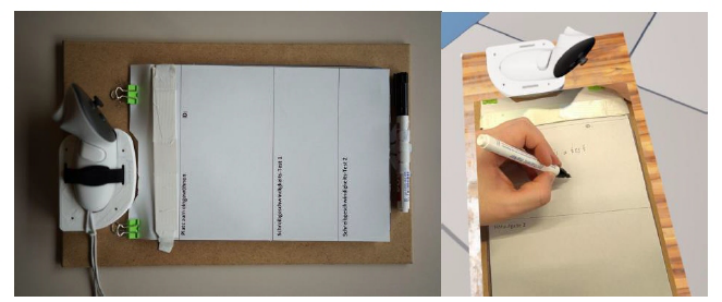
To track the physical board and place a virtual double at the same position, one of the Quest 3 controllers is used as a tracker. It is attached to the board with a 3D-printed holder. A top view of the board is shown in Figure 1 (left).
Figure 1: Left: A top view of the board for PaperVR. The paper is attached with two clips that are glued onto the board. The pen is connected with Velcro. Right: A look onto the PaperVR board from within VR. Note: The image had to be composited due to recording restrictions from MetaXR. It is, however, very similar to the real look.
On the software side, the prototype was implemented using the Unreal Engine (UE5). To use passthrough, which is necessary for our AV implementation, we used the MetaXR plugin (version 60.0). It extends OpenXR by meta-specific functions like access to the passthrough feed, but restricts the hardware to Meta Quest devices.
Inside the VR environment, a virtual double is placed in the position of the real board. A plane mesh on the virtual board that defines the area which should be passthrough is given to the MetaXR plugin. It creates an alpha mask which is used to define which part of the passthrough video feed should be shown in VR. Figure 1 (right) shows how the board looks inside VR. To track the pen, we would need to attach the other Quest 3 controller, as there is no external tracker available for it. This would add significant weight and make it awkward to use for writing. The pen is also already shown in VR while residing in the area of the passthrough window. For those reasons, we decided against tracking the pen itself. When it is not in use, the user can attach the pen to the board using Velcro to later find it again.
From Paper to Pixels: Transferring Handwritten Note-Taking Into Virtual Reality 197
Writing on a Tablet To compare PaperVR to what we deem the current standard for handwritten note-taking in VR, we additionally implemented a prototype where the user writes on a tablet. The implementation of our TabletVR prototype uses web technology that enable it to use virtually any tablet with an internet connection, improving on other implementations like Poupyrev et al. (1998) and Chen et al. (2019) by making it work vendor-independent. The website captures and streams all pen strokes on the tablet surface to Unreal, which are then shown in VR. For our study, an iPad Air 5 with an Apple Pencil Gen 2 is used. To enable a better comparison between PaperVR and TabletVR, the tablet is affixed to the same board that is used for PaperVR. Inside the virtual environment, the pen position is visualized with a virtual double as soon as it is tracked by the tablet. The pen itself is not tracked externally for the same reasons as for the PaperVR pen.
VALIDATION STUDY To test our concept of PaperVR, we performed a user-study comparing it against the usage of a tablet in VR to test its validity for writing tasks. We based this study on the note-taking task from Ehret et al. (2023), extending it with a writing speed test at the beginning of each condition. The study was conducted in German and implemented based on the study framework from Ehret et al. (2024).
The study consisted of a 2x2 within-subject design, where we tested the input device (Paper vs. Tablet) in two environments (VR vs. Desktop), resulting in four tested conditions. For the VR conditions, we used the PaperVR prototype and the TabletVR implementation. For the real- world conditions, we used a normal pen and paper and the same tablet computer respectively. All conditions and tasks within the conditions were counterbalanced using the latin-square method to eliminate ordering effects. In the beginning of each condition a short familiarization-phase with the input modality was included. As current VR systems are mostly used standing, we performed the VR tasks in a standing position, while the real world note-taking took place in a seated desk setting. While this reduces internal validity, directly comparing the results, it increases external validity for the actual usage of the results of this study. The used tasks consist of a short writing speed test and a note-taking task afterwards.
For the speed test, each participant was manually timed while copying two sentences which were displayed on a virtual or a real monitor. The sentences could be read in advance to only measure writing times. The two sentences per condition, so 8 in total, were taken at random from the Goldhahn et al. (2012) 10K Wikipedia set after filtering it to only include simple sentences with a length of 30–40 characters.
For the note-taking task each participant was listening to two virtual agents talking about their family relations, while taking notes using the respective technique. Afterwards, the participants were asked to answer 9 questions about the conversation. This was also repeated twice per condition, where the conversations 11–18 from Ermert et al. (2023) were used. To
aid participants in the note-taking task we suggested drawing a family tree structure to each participant in the beginning to keep note-taking techniques between participants similar.
In the study, N = 25 participants (16 male, 9 female) with an average age of 28.64 (SD 8.47) participated. For two additional participants technical problems occurred which led to the exclusion of their data. Based on their stated amount of previous VR usage, 16 were deemed inexperienced while 9 were well-versed with VR technology.
We used an alpha level of .05 for all statistical tests. For the writing speed tests, we measured the average WPM speeds given in Table 1. As all results were normally distributed we performed a repeated measures ANOVA, revealing a significant interaction effect (F(1,24) = 5.13, p = 0.032, η2 = 0.18). Evaluating the simple main effects, we could find that the Desktop conditions performed significantly faster for both Paper (t(49) = −4.93, p = <.001, d = −.65) and Tablet (t(49) = −7.25, p = <.001, d = −1.14). Examining the environments, we could find a significant difference in VR, where paper performed better than the tablet (t(49) = 4.63, p = <.001, d = .65), but no significant difference in the desktop conditions (t(49) = 1.3, p = .199, d = .17).
Table 1: Per condition results for all tests.
Table available in the original PDF paper.
PaperVR TabletVR PaperDesktop TabletDesktop Mean SD Mean SD Mean SD Mean SD
Writing Speed (WPM) 29.6 7.04 24.9 6.84 34.0 5.96 32.8 7.04 Response Time (sec) 6.1 3.74 6.7 4.68 6.4 5.23 6.2 4.54 Correct Answers (%) 84.4 16.59 79.3 17.97 89.1 9.69 84.7 15.32 SUS-Score 76.3 14.35 67.0 17.40 92.8 10.19 87.5 15.56 While we planned to also examine the writing error-rate, this proved difficult in practice as the handwriting was very hard to read for some participants. Thus, we refrain from interpreting error counts.
For the note-taking task, we evaluated the correct answers and the response times separately. We measured the response times shown in Table 1. We found that response times are not normally distributed as expected for a human-based latency measurement, thus they were compared using a Wilcoxon signed-rank test. The only significant difference could be found comparing the tablet condition for Desktop and VR usage (W = 42589.50, p < .01, d = 0.12), yielding no effect according to the Cohen’s d measure of effect.
Evaluating the percentage of correct answers, yields the results in Table 1, not showing any significant differences between the conditions.
After each condition, we asked participants to fill out the System Usability Scale (Brooke, 1996) to gain some insight into their preferences, resulting in the four scores listed in Table 1. While all of these scores are considered OK (Bangor, 2009), direct comparison of the four conditions showed, that the Desktop counterparts were deemed more usable for Paper (W = 16.5, p < .001, d = −1.33) and the Tablet (W = 27.0, p < .001, d = −1.24), both finding large effect sizes. Comparing techniques within each environment
From Paper to Pixels: Transferring Handwritten Note-Taking Into Virtual Reality 199
shows that paper notes are favored for both VR (t(24) = 3.97, p < .001, d = .58) and Desktop (W = 35.0, p < .05, d = .4), expressing medium and small effect sizes.
After each environment, participants were asked to fill out a NASA TLX Raw questionnaire (Hart & Staveland, 1988) to measure work load and the User Experience Questionnaire (UEQ) (Laugwitz et al., 2008) to evaluate user experience, allowing us to directly compare writing in VR and Desktop using the provided techniques.
Evaluating the overall TLX score results in (M = 42.7, SD = 13.27) for Desktop and (M = 46.7, SD = 17.38) for VR usage, which represents a relatively low workload, given the quite hard and laborious note-taking task. No significant difference could be found between VR and Desktop here (t(24) = −1.25, p = .223, d = −.26). The results of the UEQ are summarized in Table 2, yielding significant differences in all scales except the Attractiveness scale. Here the real world usage was deemed more clear, perspicuous, efficient and dependable, but less stimulating and novel.
Table 2: Results of the user experience questionnaire, together with significance.
Table available in the original PDF paper.
VR Desktop Significance Mean SD Mean SD Test Stat. p-Value Cohens’ d
Based on these results, comparing our PaperVR and TabletVR conditions, we can conclude that PaperVR performs as good or better in regard to writing speed, our synthetic note-taking task and subjective feel.
Comparing our VR versions with their desktop counterparts, our prototypes cannot reach the same writing speed, while reaching similar results in the note-taking task. The SUS-score for both writing techniques in VR is lower than for their Desktop counterparts, which is reflected similarly in the results of the UEQ. However, all prototypes reached acceptable results in their user-experience when compared to benchmarks like Bangor (2009) for the SUS and Schrepp et al. (2017) for the UEQ.
Based on these results we see PaperVR as a viable alternative to tablet- based handwriting in VR, while it still lacks behind the experience of real paper.
OTHER APPLICATIONS OF AUGMENTED VIRTUALITY: (MIGRATION OF) VEHICLE AUTOMATION As the usage and mainstream appeal of VR increases, it will be used in more and more areas. We propose the usage of AV to both improve on the possibilities and mitigate risks. We will do this with the example of vehicles,
specifically with high vehicle automation and the associated challenge of vehicle migration in mind.
The first to apply the idea of human-technology migration to the domain of road traffic were Flemisch et al. (2011). The basic idea is that the increase in vehicle automation over time necessitates a co-migration of the systems around it, including humans and human-machine interfaces (HMIs). The highest relevance for VR regarding vehicle automation lies in the HMI between driver and automation. As such, we will showcase first ideas of how VR, and as we propose AV, can positively influence the human-machine interaction in automated vehicles. Even today, there are already examples for VR and AR applications inside cars. Bamboo Apps (2022), for example, offer an AR app as part of the in-vehicle onboarding system teaching new car owners the functions that their car offers. This can already be seen as a tool to help drivers migrate between vehicles with different automation capabilities and HMIs.
The first conditionally automated vehicles that allow the driver to take their attention away from the road in certain conditions, are already approved for street use (Honda, 2021). However, the driver still needs to take control of the vehicle if the automation is not equipped for a situation. If they are using an HMD, a fast way to get them back into the driving role is to transition from VR to AR, something that is already possible with many HMDs like those tested and used for our PaperVR prototype. The main problem with an immediate switch is that it would overload the driver with a lot of information at once. A transition that is too late or early would also have negative side effects, e.g., too little time to react or a lower acceptance of the automation (Hecht et al., 2020). Both could be mitigated by a soft transition, where intermittently, AV is used to inform the driver of a possible driving situation. If the situation resolves itself, the driver is not thrown out of VR unnecessarily. If an intervention is indeed necessary, the driver is more prepared as they can first concentrate on the most important information before getting the big picture.
An even simpler application is the need to interact with some part of the vehicle, like the air conditioning, while being inside VR. AV could be used to show just the control panel. Our PaperVR prototype has already demonstrated that the camera and screen resolution are high enough for a user to not only interact with larger buttons, but also read medium to small sized text or symbols.
CONCLUSION
In this paper, we presented possibilities that AV offers to widen the scope of VR applications, first with the practical implementation of our PaperVR prototype, and then by presenting theoretical ideas in the domain of vehicle automation. Our PaperVR prototype has proven to be a viable alternative to VR handwriting applications using tablets and even reached similar results to writing in front of a monitor in a practical note-taking task.
Nonetheless, the implementation of AV applications still has some hurdles to overcome. In contrast to VR and AR, AV is not yet standardized in
From Paper to Pixels: Transferring Handwritten Note-Taking Into Virtual Reality 201
frameworks like OpenXR, so implementations mostly have to be hardware specific. Furthermore, while the resolution of current VR headsets and their integrated cameras is high enough from a practical perspective, as demonstrated by PaperVR, multiple users mentioned the low resolution during our study. However, newer HMDs like the Apple Vision Pro already improve on this compared to the Meta Quest 3. We also believe that with more hardware supporting AV, it will eventually be integrated into existing XR frameworks.
In conclusion, we believe that AV can be used to not only improve on current applications for VR, but also help introduce it to new application areas.
ACKNOWLEDGMENT
This paper was partly funded by the German DFG Project Migration of Road Vehicle Automation MiRoVA.
REFERENCES
Arora, R., Habib Kazi, R., Grossman, T., Fitzmaurice, G., & Singh, K. (2018).
SymbiosisSketch: Combining 2D & 3D Sketching for Designing Detailed 3D Objects in Situ. doi: 10.1145/3173574.3173759. Arora, R., Kazi, R. H., Anderson, F., Grossman, T., Singh, K., & Fitzmaurice, G.
(2017). Experimental Evaluation of Sketching on Surfaces in VR. doi: 10.1145/ 3025453.3025474. Bamboo Apps. (2022, January 1). A unique in-vehicle onboarding system. Powered by ML and AR. https://bambooapps.eu/projects/in-vehicle-onboarding-system Bangor, A. (2009). Determining What Individual SUS Scores Mean: Adding an
Adjective Rating Scale. 4(3), 10. Billinghurst, M., Baldis, S., Matheson, L., & Philips, M. (1997). 3D palette: A virtual reality content creation tool. doi: 10.1145/261135.261163. Bowers, B., Tuttle, A., Rukangu, A., Franzluebbers, A., Ball, C., & Johnsen, K.
(2021). Comparing Virtual Constraints and a Physical Stylus for Planar Writing and Drawing in Virtual Reality. doi: 10.1109/VRW52623.2021.00048. Brooke, J. (1996). SUS—A quick and dirty usability scale. In Usability Evaluation In Industry. CRC Press. Cannavò, A., Calandra, D., Kehoe, A., & Lamberti, F. (2021). Evaluating Consumer
Interaction Interfaces for 3D Sketching in Virtual Reality. doi: 10.1007/978-3- 030-73426-8_17. Chen, Y.-T., Hsu, C.-H., Chung, C.-H., Wang, Y.-S., & Babu, S. V. (2019). iVRNote: Design, Creation and Evaluation of an Interactive Note-Taking Interface for Study and Reflection in VR Learning Environments. doi: 10.1109/VR.2019.8798338. DeFanti, T., & Sandin, D. J. (1977). Sayre Glove Final Project Report. US NEA
R60-34-163 Final Project Report. Ehret, J., Bönsch, A., Fels, J., Schlittmeier, S. J., & Kuhlen, T. W. (2024).
StudyFramework: Comfortably Setting up and Conducting Factorial-Design Studies Using the Unreal Engine. doi: 10.1109/VRW62533.2024.00087. Ehret, J., Bönsch, A., Nossol, P., Ermert, C. A., Mohanathasan, C., Schlittmeier, S. J., Fels, J., & Kuhlen, T. W. (2023). Who’s next? Integrating Non-Verbal Turn-Taking Cues for Embodied Conversational Agents. doi: 10.1145/3570945.3607312.
Ermert, C. A., Schlittmeier, S. J., Mohanathasan, C., Ehret, J., Fels, J., & Kuhlen, T.
(2023). AuViST - An Audio-Visual Speech and Text Database for the Heard-Text- Recall Paradigm. doi: 10.18154/RWTH-2023-05543. Flemisch, F., Bielecki, K., Hernández, D. L., Meyer, R., Baier, R., Herzberger, N. D., & Wasser, J. (2020). Let’s Get in Touch Again: Tangible AI and Tangible XR for a More Tangible, Balanced Human Systems Integration. doi: 10.1007/978-3-030- 39512-4_153. Flemisch, F., Schieben, A., Heesen, M., Hesse, T., & Beller, J. (2011). Aus der Vergangenheit (und Natur) lernen, Zukunft gestalten: Migrations- und evolutionsfähige Gestaltung der Mensch-Maschine-Interaktion skizziert am Beispiel der kooperativen Führung hochautomatisierter Fahrzeuge. Forschritt- Berichte VDI, 172174. Goldhahn, D., Eckart, T., & Quasthoff, U. (2012). Building Large Monolingual
Dictionaries at the Leipzig Corpora Collection: From 100 to 200 Languages. Grubert, J., Witzani, L., Ofek, E., Pahud, M., Kranz, M., & Kristensson, P. O. (2018).
Effects of Hand Representations for Typing in Virtual Reality. doi: 10.48550/ arXiv.1802.00613. Hart, S. G., & Staveland, L. E. (1988). Development of NASA-TLX (Task Load Index): Results of Empirical and Theoretical Research. doi: 10.1016/S0166- 4115(08)62386-9. Hecht, T., Kratzert, S., & Bengler, K. (2020). The Effects of a Predictive HMI and
Different Transition Frequencies on Acceptance, Workload, Usability, and Gaze Behavior during Urban Automated Driving. doi: 10.3390/info11020073. Heilig, M. L. (1962). Sensorama simulator. US PAT. 3, 050, 870. Honda. (2021, January 1). Honda to Begin Sales of Legend with New Honda Sensing Elite. https://global.honda/en/newsroom/news/2021/4210304eng-legend.html Hubenschmid, S., Zagermann, J., Butscher, S., & Reiterer, H. (2021). STREAM:
Exploring the Combination of Spatially-Aware Tablets with Augmented Reality Head-Mounted Displays for Immersive Analytics. doi: 10.1145/ 3411764.3445298. Jiang, Y., Zhang, C., Fu, H., Cannavò, A., Lamberti, F., Lau, H. Y. K., & Wang, W. (2021). HandPainter—3D Sketching in VR with Hand-based Physical Proxy. doi: 10.1145/3411764.3445302. Kern, F., Tschanter, J., & Latoschik, M. E. (2024). Handwriting for Text Input
and the Impact of XR Displays, Surface Alignments, and Sentence Complexities. doi: 10.1109/TVCG.2024.3372124. Laugwitz, B., Held, T., & Schrepp, M. (2008). Construction and Evaluation of a User Experience Questionnaire. doi: 10.1007/978-3-540-89350-9_6. McGill, M., Boland, D., Murray-Smith, R., & Brewster, S. (2015). A Dose of Reality:
Overcoming Usability Challenges in VR Head-Mounted Displays. doi: 10.1145/ 2702123.2702382. Milgram, P., & Kishino, F. (1994). A taxonomy of mixed reality visual displays.
IEICE Transactions on Information and Systems, 77(12), 1321–1329. Nahon, D., Subileau, G., & Capel, B. (2015). “Never Blind VR” enhancing the virtual reality headset experience with augmented virtuality. doi: 10.1109/ VR.2015.7223438. Pham, D.-M., & Stuerzlinger, W. (2019). Is the Pen Mightier than the Controller? A
Comparison of Input Devices for Selection in Virtual and Augmented Reality. doi: 10.1145/3359996.3364264. Poupyrev, I., Tomokazu, N., & Weghorst, S. (1998). Virtual Notepad: Handwriting in immersive VR. doi: 10.1109/VRAIS.1998.658467.
From Paper to Pixels: Transferring Handwritten Note-Taking Into Virtual Reality 203
Rauter, M., Abseher, C., & Safar, M. (2019). Augmenting Virtual Reality with Near Real World Objects. doi: 10.1109/VR.2019.8797873. Romat, H., Fender, A., Meier, M., & Holz, C. (2021). Flashpen: A High-
Fidelity and High-Precision Multi-Surface Pen for Virtual Reality. doi: 10.1109/ VR50410.2021.00053. Schrepp, Martin, Jörg Thomaschewski, and Andreas Hinderks. “Construction of a bench-mark for the user experience questionnaire (UEQ)”. In: (2017). Surale, H. B., Gupta, A., Hancock, M., & Vogel, D. (2019). TabletInVR: Exploring
the Design Space for Using a Multi-Touch Tablet in Virtual Reality. doi: 10.1145/ 3290605.3300243. Sutherland, I. E. (1968). A head-mounted three dimensional display. doi: 10.1145/ 1476589.1476686. Villegas, A., Perez, P., Kachach, R., Pereira, F., & Gonzalez-Sosa, E. (2020). Realistic training in VR using physical manipulation. doi: 10.1109/ VRW50115.2020.00025. Watsen, K., Darken, R., & Capps, M. (1999). A handheld computer as an interaction
device to a virtual environment. Proceedings of the International Projection Technologies Workshop, 303–304. Xin, M., Sharlin, E., & Sousa, M. C. (2008). Napkin sketch: Handheld mixed reality 3D sketching. doi: 10.1145/1450579.1450627.
LISTED IN THE AHFE DIGITAL BOOKSTORE CATALOGUE
Explore the complete digital volume
Human Interaction and Emerging Technologies (IHIET 2025)
Read this individual research paper free through the original publisher, or explore the full digital proceedings book.
ISBN 978-1-964867-73-1
Explore this ISBN in the AHFE Bookstore ↗Listed in the July 2026 bookstore catalogue; search by ISBN to confirm current availability · Digital book purchase optional