Sarah Rudder, Michael Preutenborbeck, Paul Weiser (2025). Integrating Model-Based Systems Engineering and Stakeholder-Driven Design Exploration: A Virtual Reality Approach for Early-Stage System Development. In: Human Interaction and Emerging Technologies (IHIET 2025). AHFE Open Access, vol. 197, pp. 111–118. https://doi.org/10.54941/ahfe1006704
The integration of design, human factors engineering, and Systems Engineering (SE) is an important approach to improving the efficiency and consistency of technical development processes. In practice, these disciplines are often separated, creating challenges in the early alignment of system requirements and human factors. This study investigates the combination of Model-Based Systems Engineering (MBSE) with a Stakeholder-Driven Design Exploration to enable a closer integration of these disciplines. The development of a blind spot assistance system for vehicles is considered as a use case. Various design elements of the system are visualized as part of a virtual reality (VR) design framework. Design decisions influenced by participants are captured in an SE model representing the solution architecture of the assistant system. This enables immediate adaptation of system requirements and design elements, making the development process more iterative and recursive. The methodology described here will accelerate product development cycles, particularly in the early concept phase. By directly considering stakeholder feedback in the system model, potential weaknesses can be identified at an earlier stage and optimizations can be made in the concept phase. The study shows how the combination of MBSE with an interactive, stakeholder-driven approach in VR will increase development reliability to streamline entire engineering process.
Systems engineering (SE) is increasingly shaped by complex requirements, shorter innovation cycles, and growing expectations regarding usability, adaptability, and stakeholder alignment. As technological systems become more interconnected and embedded in sociotechnical contexts, the early phases of system development gain importance. At this stage, aligning
technical feasibility with human needs is particularly challenging due to the incomplete and evolving nature of user and system requirements (Preutenborbeck et al., 2024).
Model-Based Systems Engineering (MBSE) has established itself as an approach to manage complexity by modeling system architectures, behaviors, and constraints. It supports traceability, consistency, and the systematic integration of multidisciplinary perspectives across the entire development lifecycle. However, MBSE alone often struggles to accommodate the qualitative, iterative, and creative processes that characterize early-stage design, particularly when it comes to capturing the needs, preferences, and concerns of users and other stakeholders.
To address these limitations, stakeholder-driven design exploration has emerged as a complementary approach to MBSE in the domain of balanced Human Systems Integration (HSI). Rooted in participatory and co-creative design thinking processes, this method emphasizes the integration of stakeholders in the ideation and exploration of design alternatives (Spinuzzi, 2005; Carthy et al., 2021). While this approach improves the usability and acceptance of design outcomes, it still lacks the formal mechanisms needed to consistently document and propagate stakeholder input within system models for the later development process.
This research describes a first step towards integrating MBSE and stakeholder-driven design exploration. We argue that this combination not only improves the requirements analysis in early development phases, but also enables a more continuous and traceable transition from exploration to implementation in later system development stages. In doing so, we seek to contribute to the ongoing convergence of systems and Human Factors Engineering (HFE) in human systems integration - integrating ideas and concepts from design science.
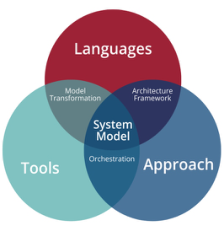
STATE OF THE ART SE has recently been transitioning from a document-based approach to a digital environment (Henderson & Salado, 2021). In this context, MBSE, a subset of digital engineering, has experienced a growing interest. Delligatti (2014) describes the three pillars of successful MBSE as a modeling language, approach, and tool, combined to construct a system model as shown in Fig. 1.
Figure 1: Pillars of MBSE.
Integrating Model-Based Systems Engineering 113
Human Systems Integration (HSI) combines perspectives from HFE and SE (Boy, 2020), but there are currently no established approaches for integrating HFE design considerations within an SE model yet. This research will use the Systems Modeling Language (SysML) v1.7, the most widely adopted industry standard (Hause & Kihlström, 2021) for the SE model. A case study will be performed to explore potential ways to accomplish the goal of integrating HSI into the model, assisting with communication and collaboration throughout development and design lifecycle phases.
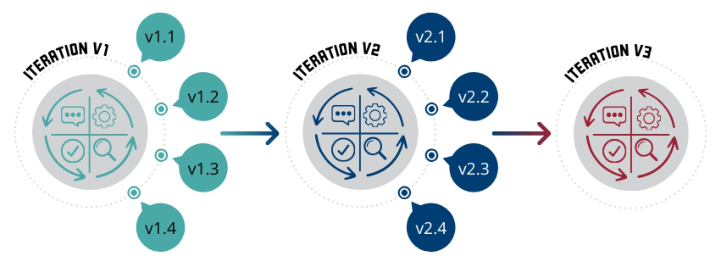
INTEGRATION OF DESIGN INSIGHTS TO SE-MODELS The system design approach is based on the methodology of Human Systems Exploration, supporting early-stage development by integrating stakeholders into iterative system design processes (Preutenborbeck et al., 2024). It systematically examines the use-space, design-space, and value-space of sociotechnical systems to generate and refine design concepts. This iterative feedback loop enables the identification of promising configurations and the early identification of usability issues. Fig. 2 represents the versioning of prototypes through iterative design.
Figure 2: The iterative process of system design.
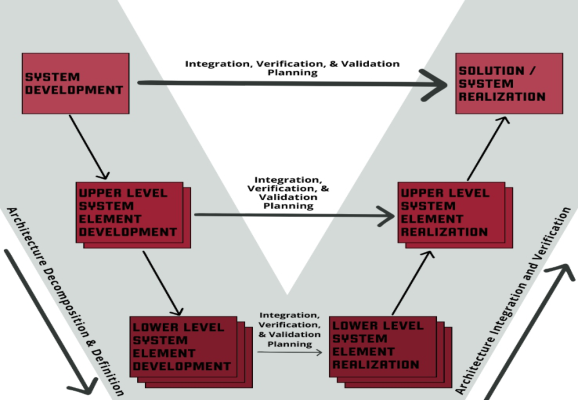
By integrating the stakeholder-driven design process within a model- based framework, user needs and feedback can be directly mapped into system architecture elements, fostering both creative exploration and technical consistency. Fig. 3 shows a rendering of the standard SE processes beginning with requirements and moving through development, design, implementation, integration, verification, and validation (Walden et al., 2023). The research application of an SE model for the blind- spot assistance system in vehicles will leverage this approach for prototype iterations.
Figure 3: Systems engineering processes.
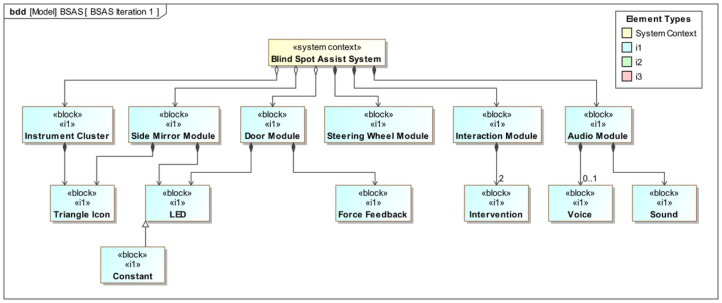
APPLICATION: BLIND-SPOT ASSISTANT SYSTEMS IN VEHICLES To validate the proposed approach of integrating stakeholder-driven design explorations and MBSE, these techniques were applied to the design of a blind-spot assistant system in vehicles. The structural architecture for the first design iteration was captured within an SE model to describe the blind-spot driver assist system components with SysML blocks. The diagrams shown in the remainder of this paper are specific views into the model and therefore not a comprehensive solution architecture.
Fig. 4 shows the system of interest (SoI), its context, and the comprising parts for the initial iteration. The aggregation relationship, represented by the hollow diamond, references modules that are external to the SoI context. The composition relationship, represented by the solid diamond, establishes the structural decomposition of the blind-spot assist system. Multiplicities are shown when the number of sub-parts differs from the default of one (1). This can also denote ranges of possible values (e.g., 0..1). The generalization relationship, represented by a hollow arrow, is used to distinguish components that are specialized types. For example, the Constant is a type of LED.
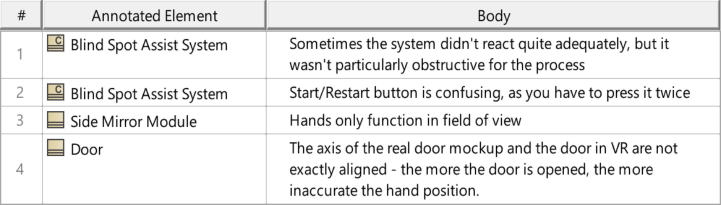
Fig. 5 shows comments elicited from initial prototype testing in the “Body” column, which are traced to the relevant system component in the “Annotated Element” column.
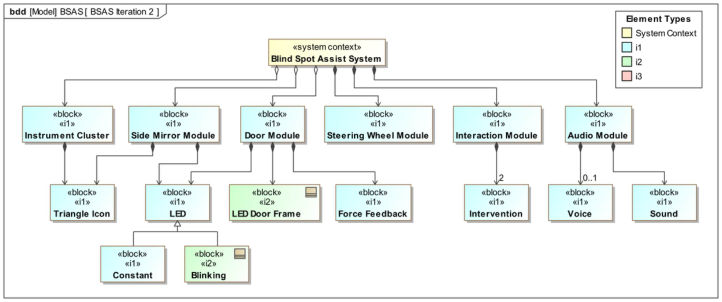
Traceability created between human considerations to the design increases transparency between disciplines and real-time collaboration based on real- time feedback. A user comment in the second iteration of the design process was that the LED warnings of the assistant system could blink to attract even more attention. In addition, a further position for an LED warning was suggested to be placed in the door frame. These observations prompted the incorporation of additional design elements as shown in Fig. 6.
Integrating Model-Based Systems Engineering 115
Figure 4: First iteration of the SysML model of the blind spot assistance system.Figure 5: User feedback traced to blind spot assist system components.Figure 6: SysML model of the blind spot assistance system after the second iteration.
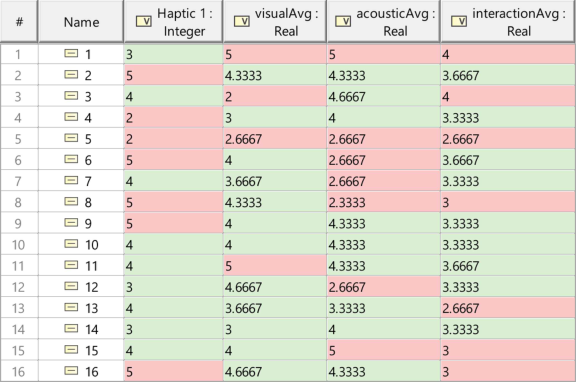
In addition to the qualitative feedback, users also provided quantitative assessments for the haptic, visual, acoustic, and interaction design elements of the assistant system. All ratings were based on a scale between one and five. For the visual and acoustic elements, five was the optimum, while for the interaction assessments, the optimum was three, with one and five meaning that the interaction happened too early or too late, respectively. The quantitative values were incorporated into the model as
SysML requirements. Fig. 7 shows established parameters that are within a single standard deviation of the mean for each variable.
Figure 7: Human factors requirements.
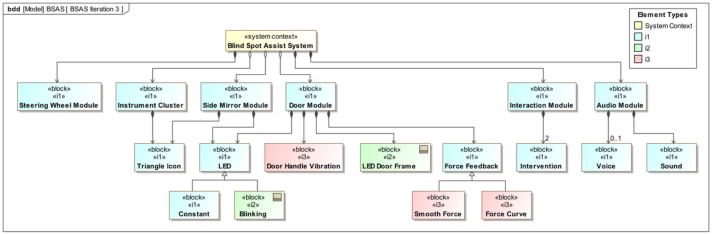
Based on user feedback from the second prototype, the additional design elements shown in Fig. 8 were implemented. The haptic interaction was enhanced, including a tactile feedback of the door handle and an adaptive force-feedback of the door when it is opened.
Figure 8: SysML model of the blind spot assistance system after the third iteration.
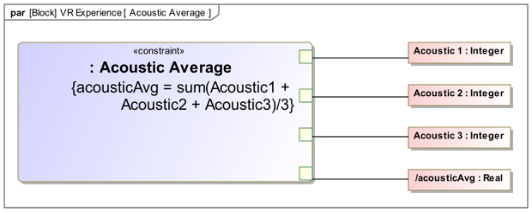
Maintaining a data repository in a virtual environment assists with collaboration between disciplines. By incorporating stakeholder needs early in the product development phase, communication is enhanced and can be traced to design elements. Fig. 9 shows an example of a SysML parametric diagram used to calculate the acoustic rating average for each group instance.
Fig. 10 demonstrates the verification of the average haptic, visual, acoustic, and interaction ratings in relation to the bounds mandated by project requirements in Fig. 7. Identifying stakeholder responses within one (1) standard deviation of the sample mean provides insight into which user comments should be prioritized when evaluating potential design modifications.
Based on the verification shown in Fig. 10, approximately 87.5% of participants submitted ranking values outside of the parameters for at least one variable. Linking user-provided feedback to requirements provides rationale for design modifications and ensures additional stakeholder needs are incorporated in subsequent iterations. Findings such as these will continue
Integrating Model-Based Systems Engineering 117
to improve prototyping with a balanced mindset as questions can be tailored to each individual based on previous responses. Future research will incorporate stakeholder feedback from design exploratory phases within a mature system model.
Figure 9: SysML parametric diagram for acoustic requirement verification.Figure 10: Verification of derived values for each instance.
CONCLUSION
This paper demonstrates how MBSE can be integrated with stakeholder driven explorative designing. The result of each design iteration was easily included in the SE model. Moreover, the model is well-suited to depict the evolution of the system over multiple iterations, together with the user feedback that prompted the changes. This provides an additional layer of traceability and transparency to the design process. Although this paper explores a single example for the incorporation of MBSE in explorative design, the results promise that future endeavors will cement this combination as a useful technique in the early development stages of new systems.
REFERENCES
Boy, G. A. (2020). Human-systems integration: From Virtual to Tangible. CRC Press. Carthy, S., Cormican, K., Sampaio, S., 2021. Knowing me knowing you: Understanding user involvement in the design process 181, p. 135. Delligatti, L. (2014). SysML distilled: A brief guide to the systems modeling language.
Addison-Wesley. Hause, M., & Kihlström, L. (2021). An Elaboration of Service Views within the UAF. INCOSE International Symposium, 31, 728–742. https://doi.org/10.1002/ j.2334–5837.2021.00865.x Henderson, K., & Salado, A. (2021). Value and benefits of model-based systems
engineering (MBSE): Evidence from the literature. Systems Engineering, 24(1), 51–66. https://doi.org/10.1002/sys.21566 Preutenborbeck, M., Wolf-Monheim, F. Carey, E. Canu, P, Herzberger, N., Usai, M., & Flemisch, F. (2024c). Stakeholder-driven Design and Exploration of Sociotechnical Systems using Virtual-Reality. In: Procedia CIRP 128, S. 274–279. doi: 10.1016/j.procir.2024.04.006. Spinuzzi, C. (2005): The Methodology of Participatory Design. In: Technical
Communication 52, S. 163–174. Walden, D. D., Shortell, T. M., Roeddler, G. J., Delicado, B. A., Mornas, O., Yew- Sing, Y., & Endler, D. (Eds.). (2023). INCOSE Systems Engineering Handbook a Guide for System Life Cycle Processes and Activities (Fifth). John Wiley & Sons Ltd.
LISTED IN THE AHFE DIGITAL BOOKSTORE CATALOGUE
Explore the complete digital volume
Human Interaction and Emerging Technologies (IHIET 2025)
Read this individual research paper free through the original publisher, or explore the full digital proceedings book.
ISBN 978-1-964867-73-1
Explore this ISBN in the AHFE Bookstore ↗Listed in the July 2026 bookstore catalogue; search by ISBN to confirm current availability · Digital book purchase optional