Virginie Rosa, Franck Handgraaf, Jean Sayeux, Brice Pereyre, Frédéric Cordier (2021). The Ergomedical Design: Integrating a Medical Approach into the Innovative Design Process. In: Advances in Human Aspects of Healthcare. AHFE Open Access, vol. 13. https://doi.org/10.54941/ahfe100509
1 Research and Development Society, S Port Controle, Bidart, 64, France ↗
2 Research and Development Society, S PORT CONTROLE, Bidart, 64, France b Laboratoire ESTIA Recherche, ESTIA, Bidart, 64, France c Service cervico-facial, Fondation Bagatelle, Talence, 33, France ↗
3 Centre médico-sportif, Centre Hospitalier Layne, Mont de Marsan, 40, France ↗
4 Service orthodontie, Centre Belcenia, Hendaye, 64, France ↗
Ergonomics, usability and user-centered design are terms that are well known among designers. Yet, products often seem to fail to meet the users' needs, resulting in a gap between expected and experienced usability. Prospective users of a new design in the area of everyday products offer innumerable opportunities for measurement and observation, in view of both the diversity in user populations and the freedom of where and how to use a product. In this research we wanted to show the impact of integrating a medical approach with an ergonomic approach to create a new sphere of innovation. This is what we called the Ergomedical design. This design process allows innovating protection concepts, but also in the wellness or human performance. All the examples are in the field of physical activity. We illustrate the integration of medical experts and their approach to innovation and design product with an innovative concept of earplug. Generally, it's explained that earplug protects of environment (pollution), water and maybe the cold (or wind). But the problem for users is not pollution, water or cold but the otitis and the exostisis. So with our medical team, we decide to change our approach and develop an earplug, which protects patients about otitis and exostisis. With this new design approach, a new concept of earplug was born. During the conception, the medical team has validated or not the different designs with medical arguments. The first test has been centered about the health used of the product on extreme condition. We have tested this product during many days and every tester has kept the earplug in his ear during 6 to 8 hours by days. Our medical manager has tested a non-irritability of this product. To finish we have tested this earplug during one year in order to prove the concept efficiency to prevent the otitis and the exostisis. Ergonomic tests have proved the comfort, the fit design and the good adaptability for the sport practice. The Ergomedical concept completes the ergonomic and user's centered approaches to design new product.
In product development, companies and designers focus on one main objective: design a good product. In our highly competitive industrial situation, a good product is merely characterized by the following criteria: long-lasting profitability. These criteria depend on the quality of the product, its price and the development cost and time and, finally, its development potential (Ulrich et al., 2004). The quality of the product often characterizes its robustness and the operating efficiency. Considering the efforts surrounded in its development, is the product correctly designed? And obviously, the quality of a product directly sends back to the customer needs and expectations. Unfortunately it too often happens that, when operated products do not correctly meet customer expectations. Product designers can provide substantial input to improve comfort when operating or using a product by integrating the human factor and by concentrating on the customer’s usage while designing new products. This vision led to the apparition in the product design process of disciplines such as Ergonomics, Industrial Design and User Centered Design. In this paper we transcribe the intervention of these processes, to which we integrate a medical vision. We called, this vision coupled with the ergonomic requirements, Ergomedical design.
The physicians occurring during the design process are specialists of their domains and do not know or not almost know the domain of the engineering. This particularity let us glimpse the difficulties occurring during the product design process in terms of understandings between the various actors and in terms of habit change (Merlo et al., 2004).
THE DESIGN PROCESS We first, thought interesting to present the various stages of an innovative product design process so that reader dispose of an overall view of the different stages and activities a designer goes through when thinking and developing a new product. Next we will introduce the “freedom degree” and “convergence-divergence” notions in order to show in which stages the designer are freer and so where Medicine and Ergonomics may intervene. This will lead us to the notions of design for X.
The Various Stages There are many methodologies in product design that have been formalized over the past fifty years. Howard, Culley and Dekonink made a non-exhaustive list of those processes (Howard et al., 2008). It appears that all models contain similar stages. Since it appears being a synthesis of most other models, we have chosen to use the five stages model of Suh, which is similar to a problem solving process (Suh, 1990). This model is presented on the following figure (see Figure 1).
11
Know and understand the needs of the customer/user Know and understand the needs of the customer/user
22
Define and formalize the problem to be solved, to satisfy needs Define and formalize the problem to be solved, to satisfy needs Look for the options solving the problem Look for the options solving the problem
33
Develop the best solution previously identified Develop the best solution previously identified
44
55
Verify the results obtained according to initial needs Verify the results obtained according to initial needs
Figure 1. Stages of the design process (Adapted from Suh, 1990)
Figure available in the original PDF paper.
First stage: Know and understand the needs of the customer/user The first stage of the design process consists in highlighting the different needs of the future user. It is one of the most delicate parts of the designer’s work, as it will considerably impact the rest of the project (Pialot et al., 2008). At first, it is important to describe an existing problematic situation. This situation can occur because of a lack of products answering the need or the wish of the customer, but it can also result from the existing products being unsuitable. Once the problem description has been done, another really important work the designer must do, is to clearly define the target users his future product will address. A bad definition of these two first elements can result in the development of a bad solution and thus to a failure of the design project.
This stage also enables to define the logistics needed for designing the product. Those needs can be expressed for example in terms of time, material and human resources. A planning of the process is also required by some agencies such as the Design Council (Design Council, 2007) or the French Agency of Value Analysis (AFAV, 1994).
Second stage: Define and formalize the problem to be solved, to satisfy needs Once the first stage is completed and the needs are thus highlighted, it is important to document the description of those needs. This document has to be formulated in a way accessible and understandable to every actor of the design process. This foundational document is composed of several functions representing the needs. It will then become a reference base during the entire project, and will be of great help during the decision phases.
This document, often defined as “requirements” or “specifications”, illustrates the different approaches and the multidisciplinary angles of product design (Sagot, 2005). Indeed, every designer is likely to have his own method of formalizing a design problem.
Third stage: Look for the options solving the problem Sometimes called “creative research” or “conceptual design”, this stage consists in exploring all the different fields of possible solutions that could bring a good answer to the needs or a part of the needs. By the end of this stage, the designers will obtain several concepts, more or less accomplished. They will then have to choose between those concepts, and decide which ones will be further developed.
Fourth stage: Develop the best solution previously identified Once the concepts are selected and accepted by all the actors of the design process, their development can commence. The aim of this stage is to transform the concepts into products that work in technical and industrial terms.
Fifth stage: Verify the results obtained according to initial needs Now we have a finished product, in general a detailed 3D model and some prototypes. What is left to be done is to compare the product newly obtained with the reference document (requirements or specifications) to determine if it responds to the initial needs and so can be validated. A good way to test the product is to perform some live experiments.
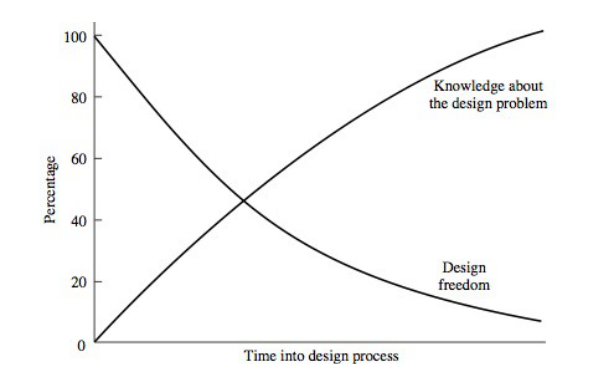
The “Freedom Degree” Notion In a design process, we can observe a curious phenomenon that is commonly called “freedom degree”. Ullman defines it with the following sentence: “The more you learn the less freedom you have to use what you know” (Ullman, 2003). In fact, in the beginning of the project, the problem is generally partly known and the designers will learn more and more about it as they go through the design phases. Despite this observation, it is at the start of the design process that more liberty of action is optimal. This creates the paradox presented in the Figure 2.
Figure 2. The design paradox (Ullman, 2003)
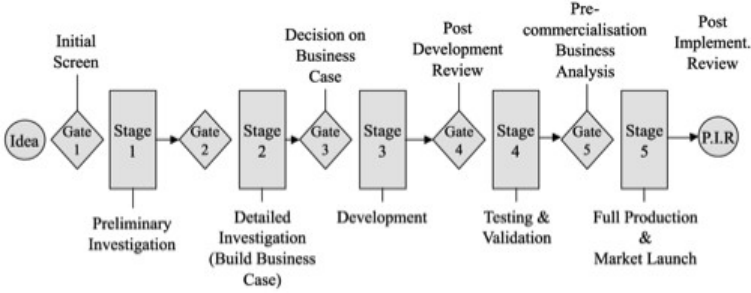
The “Convergence and Divergence” Notion During a product design project, as in a problem solving system, there are several research stages sequenced with decision-making stages. This observation is well described by the “Stage-Gate” model (Cooper, 1994) where each stage is checked by a gate.
Figure 3. A Stage-Gate model example (Cooper, 1994)
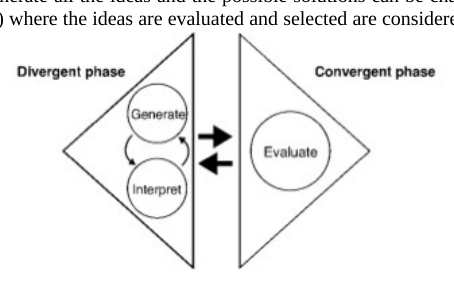
Van der Lugt introduced in his model a notion of divergence and convergence (Figure 4). According to his theory, the stages where designers generate all the ideas and the possible solutions can be characterized as “divergent”. On the opposite, the stages (gates) where the ideas are evaluated and selected are considered being “convergent”.
Figure 4. The Divergence-Convergence Model (Van der Lugt, 2001) Other existing models such as the double-diamond’s Design Council model (Design Council, 2007) integrate this notion of convergence and divergence. These are important notions that perfectly illustrate the importance of the decision phases in the design process.
The Notion of Design for X (DFX) The “Design for X” notion appeared in the 90’s with a simple objective: Define a way to guide the design processes towards a given discipline. It is a good way of evaluating the different concepts obtained after the third design phase (list of options identified for solving a problem), and it helps extracting recommendations according to each of the considered approaches. Among those different approaches, we can distinguish the Design for Manufacturing (Trybula, 1995), the Design for Assembly (Boothroyd et al., 1992) as well as the Design for Recycling (Beitz, 1993).
But the approaches that really interested us were the Design for Ergonomics (Weaver, 2000) or Design for Usability (Jordan, 2000). Both are based on the similarity of the design process and the ergonomic approach (Sagot, 1996). In fact a number of specific tasks of the design process can be performed by an ergonomist. In our Ergomedical approach, we aimed to go a step further by integrating this ergonomic approach as well as a medical approach into the product design process.
Figure 5 represents this multidisciplinary convergence, focus of our interest for the following parts of this article.
Figure 5. Multidisciplinary convergence of the Ergomedical approach
Figure available in the original PDF paper.
ERGOMICS AND MEDICAL INTERVENTIONS WITHIN THE DESIGN PROCESS In order to be as clear as possible, we have chosen to explain and illustrate our design process by means of an example our company developed in 2010: SORKYTM became SEALSTM.
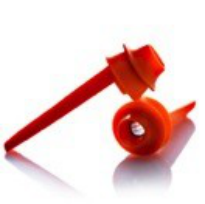
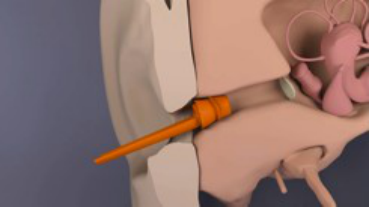
Product Presentation SEALSTM, presented in Figure 6, is a revolutionary earplug specifically addressing surfers but useful to water sports followers in general. It prevents from otitis and exostisis.
Figure 6. The earplug SEALSTM : CAD drawing (solidworks software) and picture The following list presents the general characteristics and gives a global vision of SEALSTM:
[Equation or mathematical symbol available in the original paper PDF] Composed of two non-toxic materials: A textile membrane without PTFE and biocompatible medical silicone. [Equation or mathematical symbol available in the original paper PDF] Designed for all the normal auditory canals from 12 years [Equation or mathematical symbol available in the original paper PDF] Design of an artificial eardrum protecting the external auditory canal while maintaining the capacities of
the internal ear (hearing and balance) [Equation or mathematical symbol available in the original paper PDF] External auditory canal protection which lets inhale the ear to assure a constant average temperature (no increase of the temperature as noted with classic earplugs) [Equation or mathematical symbol available in the original paper PDF] 6 to 8 hours per day wearing possibility without generating irritations [Equation or mathematical symbol available in the original paper PDF] First protection system tested and validated under medical supervision in terms of prevention (Risk of
otitis reduced to 1/3, risk of appearance of exostosis lowered almost 8 times and 3 times reduced risk of evolution of this pathology.
The following figure shows how SEALSTM can be well positioned and adapted to the ear:
Step 1 Step 2
Step 4 Step 3
Figure 7. Positioning SEALSTM
Product Design Process This part of the document will present major differences in the various design stages, as an Ergomedical approach was adopted throughout the project.
First stage: Know and understand the needs of the customer/user As indicated previously, this part is very important, as it will considerably impact the rest of the design process. This is where we highlighted the different the project would be answering to.
Generally, when following the classical mechanical engineer’s approach, the two main actions would have consisted in planning the project and analyzing existing earplugs. This classical approach would have led us to designing an earplug that protects users from environment (pollution), water and maybe cold (or wind). But the Ergomedical approach is based on health, human and user’s activity. So we also analyzed the needs for use and health. We like to think that with this approach, we were able to have a global scope of the problem.
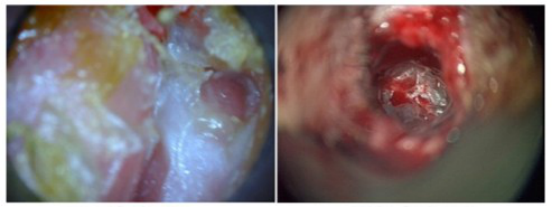
Firstly we observed that the problem for users is not the environment but the otitis, which is an inflammation of the ear, and the exostisis of the external auditory canal caused by this rude environment. The external auditory canal exostisis also called “surfer’s ear” is characterized by a new growth projecting from a bone surface (see Figure 8). It can cause episodes of deafness, ear infections or a lost of balance, which is really important when practicing sport.
With exostosis Without exostosis
Figure 8. An exostosis example
So with our medical team, we decide to develop an earplug that protects patients from otitis and exostisis. But, within the framework of our approach, we wanted to go further and understand why the environment causes the two pathologies.
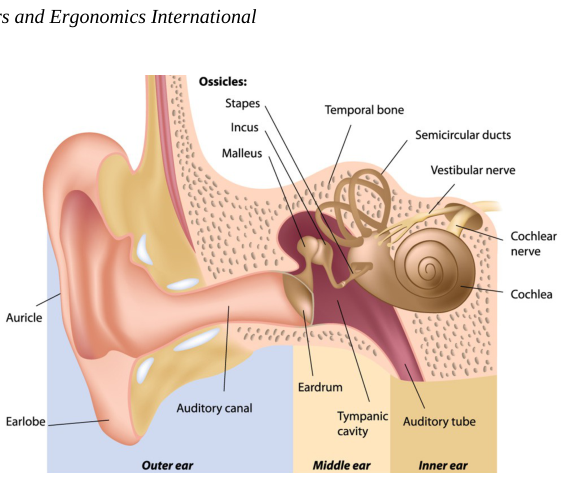
In fact, the external auditory canal, also called external acoustic meatus, is divided into two distinct parts (see Figure 9). The external part, which is composed of fibro-cartilaginous tissue, and the internal osseous part, covered with a fine cutaneous coat. It is this fine coat that doesn’t naturally fill any protection role and thus needs specific consideration. It has other functions and probably allows the external auditory canal to remain permeable (Makino et al., 1986) but it does not assure the protection of the periosteal bone. Without any specific protection the periosteal bone is directly exposed to the external aggressions such as cold water, cold wind or pollution. This causes the exostosis of the external auditory canal.
Figure 9. Anatomy of the ear
Still the external auditory canal is equipped with several mechanisms to maintain the balance of its bacterial flora. Among its mechanisms is the earwax. The earwax maintains the pH at the epithelium surface between 5 and 7,3. The modification of the pH from acid to basic may cause an external otitis. Furthermore the earwax contains cholesterol esters miscible with water. So a prolonged hydric contact can cause a bacterial contamination. The otitis may also appear because of two bacteria: the Staphylococcus Aureus and the Escherichia Coli. The ocean water contains these two bacteria.
It is interesting to notice that at this stage of the design process, as the designers have significantly more liberty of action than during the following steps, Medicine and Ergonomics can really be taken into consideration. This is true also for other disciplines (e.g. Industrial Design, Ecology, etc.) that could be integrated to the design process at this stage.
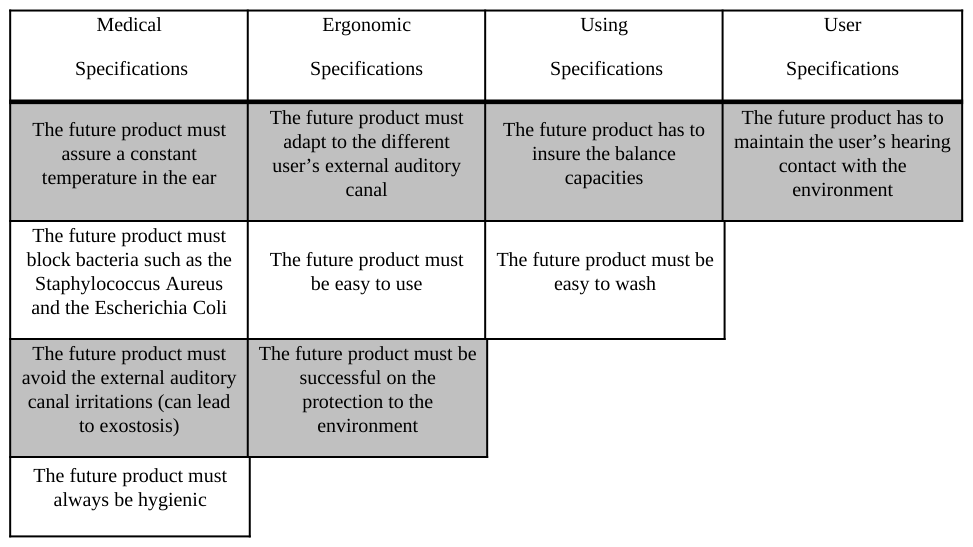
Second stage: Define and formalize the problem to be solved, to satisfy needs Because of collaboration with the medical team and their explanations on the apparition of the two considered pathologies as well as our activity observations and the anthropometrics data at this early stage, we were able to express specific requirements for SEALSTM. Thus adjusting the classical mechanical engineer process, we created a document that includes medical and ergonomic specifications as well as some using and user specifications (see Figure 10).
Figure 10. Building the Ergomedical design process requirements
Figure available in the original PDF paper.
It allowed us to have more precise specifications and so different functions. The following table (Table 1.) presents some of the functions coming from our requirements: Medical
Table 1. Some of the requirements functions
Third stage: Look for the options solving the problem In this creative research, all the different fields of solutions were explored. This stage is merely based on classical mechanical engineer’s work. Yet the Ergomedical approach still brings additional input. It is a rather complex stage that truly represents the paradox of Ergonomics (Daniellou et al., 1995). The Ergonomics is based on the analysis of the activity. But with a non-existing product how can we analyze the activity of the users? The solution is to imagine scenarios (use-cases) that the future product will have to respect.
Once the inventory of all the possible solutions has been established, you have to pick-out at least one of them. And, in order to develop the best solution, you first have to know which of the solutions is identified like the best. In order to assist you in selecting the best solution, the requirements and the formalization of the use that you have made before will be of great help.
Figure 11. Selecting the best solution
Figure available in the original PDF paper.
Compare the different solutions with the functions of the fourth specification’s themes is here really important. The doctor’s intervention is thus essential as he really helps the designer to answer to the following questions: [Equation or mathematical symbol available in the original paper PDF] Is the solution answering to the problem? [Equation or mathematical symbol available in the original paper PDF] What will make that the solution generates health problems?
But sometimes it is hard to know which concept is the best. There are always concepts that you prefer because of the sketch quality for example. One of the good techniques for selecting the best solution is to create a notation table based on the requirements and the scenarios. You thus can quote (value) the different characteristics of the concept. It enables to be impartial during the decision of the concept that will be developed.
This stage highlights the importance of the Ergomedical approach during the convergent phases (Figure 4) of the design process.
Fourth stage: Develop the best solution previously identified The next step is to develop the chosen concept. It is a classical “mechanical engineer” stage. But the Ergonomics and the Medicine are not useless as they came up with specific criteria to be checked-out during the development of the product. This enables to insure that medical and ergonomic specifications are respected.
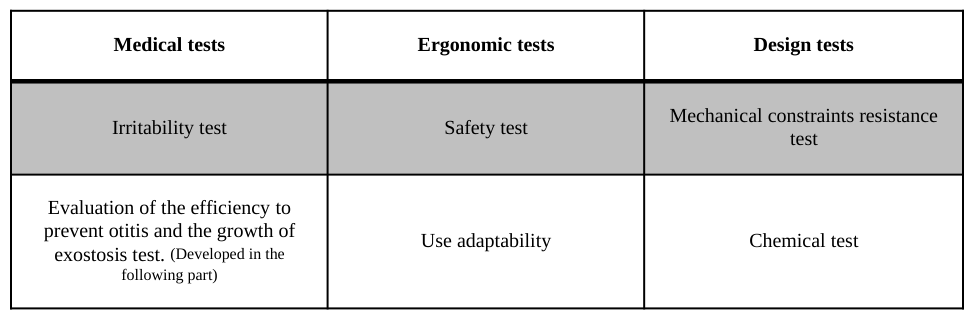
Fifth stage: Verify the results obtained according to initial needs The product is finally finished, and it is time to verify if the results obtained meet the initial needs. We can here observe another major interest in using the Ergomedical approach: It enables to run a wider range of tests in order prove that the product you are about to launch is good according to all of your initial needs. Concerning our earplug we have run some tests that can be classified in three different categories:
Table 2. Some run tests.
A first medical test with surfers on height days during 8 hours per day, in order to define the irritability of earplug using was performed. We found that our earplug concept do not cause irritations. In a second time, we have run the following test: Objective: The exposure to the cold water causes a stenosis of the external auditory canal called surfer’s ear. The growth of the bone causes infections and episodes of deafness due to water retention in the ear. The main objective was to evaluate the efficiency of the SEALSTM earplugs to prevent otitis and the growth of exostosis.
Methods: We conducted a 12-month prospective study of 41 surfers. 21 surfers wore earplugs (SEALSTM) during each session, and the other 20 surfers didn’t. The distribution of the earplugs was done randomly at the first consultation. Patients identified events of otitis and obstruction duct was also measured at the beginning and at the end of the study.
Results: The following list presents the different results obtained: [Equation or mathematical symbol available in the original paper PDF] Rate of reduction of the exostosis: In this study, we noticed 7.8 times less risk of exostosis with the SEALS and 2.8 times less evolution when the exostosis was already declared.
[Equation or mathematical symbol available in the original paper PDF] Rate of reduction of the otitis: surfers using the SEALSTM earplugs developed 3 times fewer otitis.
Conclusion: Wearing the SEALSTM protective earplugs when practicing water sports is an effective way to prevent from external otitis and obstruction, and the development of exostosis. It will then help surfers to avoid problems with their ears leading to surgery (Sayeux, 2012).
CONCLUSION
In this document we have tried to explain what an Ergomedical approach could look like. We have first explained the different steps of a classical product design process, and some of its key points such as the notion of “design freedom” or the “divergent-convergent” phases. We considered important for everyone to first dispose of a global vision of a classical design process to then be able to highlight the benefits of the Ergomedical approach. The document then insisted on the design for X and the multidisciplinary convergence of our design process with Ergonomics and Medicine.
Next we illustrated our Ergomedical design approach by developing an example: the SEALSTM earplug. The first step was to present the product so that the reader could have a wide view of our approach’s results. Then we have gone through the five design process phases and on each of them we presented the major differences between the classical and the Ergomedical approach. This appeared to us a simple, understandable way to explain the major differences between the two processes.
This is what we would like to share as conclusions: First we can see that the key differences between the Ergomedical approach and the original one are located in the beginning of the process (phases 1 and 2). As the designer is free to act during these stages, the medical aspects integrate rather smoothly.
Next the new approach really differs during all the decision phases (the “gates”), qualified as convergent. It makes the concept converge towards a user adapted and medically preventive product. Concerning the fifth phase, we can notice that the efficiency of the product was easier to prove thanks to medical supervision illustrating once more the benefits of such a design approach.
The final end product thus obtained convinced us in considering that it was a good decision to adopt this new Ergomedical design approach. So this approach proved its innovative and consumer’s reassuring contribution.
DISCUSSION
During this entire article, we have addressed product design on human centered issues. The benefits of multidisciplinary design approaches are no more to be proved. But we have tried to go a step further with our Ergomedical approach. We have included medical specifications in the first steps of the design process that enabled to converge towards a medically approved product.
In the case of the presented earplug project, there were real known diseases to prevent. So, we were able to try to design a product that will prevent those diseases. But what if the product had no pathology preventive vocation? If the product is intended for a non-medical use, will the human centered approach be the same? Is it still Ergomedicine or only Ergonomics?
These questions highlight the thoughts on the frontier between Ergonomics and Medicine. Trying to give a part of the answer to that question, we thought interesting to go back to the origins of the two terms concerned. The word “Ergonomics” comes from the Greek “ergon” meaning work, and “nomos” meaning laws or rules. Thus, the Ergonomics is the science of work that aims to adapt the work to the man (improvement of the working conditions). Nowadays, Ergonomics applies to all the aspects of the human activity. Three different types of Ergonomics exist, but the one that can be confronted to Medicine is the physical Ergonomics. Indeed physical Ergonomics sources knowledge from disciplines such as Anthropometry, Biomechanics, or Medicine. Furthermore, Ergonomics can be used in two different ways: to correct an existing product, or to design a new product. Our input naturally focuses on “Ergonomic Design”. The aim of this discipline is to design products well adapted to usage by men.
The word “Medicine” comes from the Latin “medicina” meaning art to cure, remedy, or potion. So Medicine is the science and the practice studying the organization of the human body (Anatomy), its normal functioning (Physiology), and to the discipline of restoring health by the treatment and the prevention of the pathologies.
Based on these definitions, and focusing on the design process the answer to the question of the frontier between Ergonomics and Medicine could be the following; from a product design perspective, Ergonomics will engender a product causing no physical trouble du to its use, whereas the Ergomedical approach will result in products, which will also not create any trouble du to its use, but moreover will prevent pathologies or diseases.
Another point that can be discussed is the legitimacy of the performed tests proving the medical efficiency of the product. Indeed when it comes to user centered design it is really important to take into account the real user behavior. In some cases we can observe a gap between theoretical and real use (Abi Akle et al., 2013) that can engender the opposite of the wanted effect. For example, our medical tests were performed under the control of specialists, so that testers used the earplugs the right way. But maybe, in regular everyday use conditions, as the user will not use the product properly, the earplug will cause irritations or the apparition of otitis and exostosis of the external auditory canal. This shows one of the limits of the Ergomedical approach. But the “medical” denomination also has some advantages regarding to the user behavior. Indeed, because of its medical aspect, people will use the SEALS differently than other market’s earplugs. They will probably use it more frequently and take a bit more care of it, so that it will be easier for SEALSTM to meet the user’s expectations.
To finish, we assume that taking into account all the details and specifications shown previously when designing new products, can take more time. Indeed integrating more people and disciplines into the product design process inexorably causes more parameters and problems to manage. It is especially true for the first stages of the design process (before project). But being so precise and demanding at the beginning of the process enables then to be faster for the following steps such as the proposition of concepts and the selection of the concept that will be developed. The proof is that we can observe a general time increase of those early stages in the industry within a design process that leads to be shorter (Yannou, 2001). So according more time to the first stages doesn’t necessarily mean taking more time to design the whole product. Plus in order to design better, designers really have to better define the needs and better represent these needs (Yannou, 2001). Integrating a medical approach into the innovative design process is then an effective way to improve the quality of company’s products.
ACKNOWLEDGEMENTS
We frankly thank the EQTM company (distributor of health and wellbeing sport accessories) for giving us the opportunity to conduct this research and to design the earplug SEALSTM. We also thank SolidWorks Corp (CAD software) for the partnership during the whole process.
REFERENCES
Abi Akle, A. Bertoluci, G. Minel, S. (2013), “From environmental assessment to usage centered eco-design: taking into account the real impact of container-content system for the liquid laundry detergent”, in: The proceedings of the 19th international Conference of Engineering Design (ICED), Seoul, Korea, Volume 5, pp.241-250. AFAV (1994), “Management et démarches de projet - Projet de guide d'intégration des démarches qualité dans la conception de
produits”, Association Française pour l'Analyse de la Valeur. Beitz, W. (1993), “Designing for ease of recycling. General approach and industrial application.”, in: The proceedings of the nineth international Conference of Engineering Design (ICED), The Hague, The Netherlands, pp.325-332. Boothroyd, G. Alting, L. (1992), “Design For Assembly and Disassembly”, in Keynote paper, Annals of the CIRP, Volume 41,
Issue 2, pp.625-636. Cooper, R.G. (1994), “Third generation new product processes”, in: Journal of Product Innovation Management, Elsevier Science Publishing Co., Volume 11. Issue 1 pp.3-14. Daniellou, F. Naël, M. (1995), “Ergonomie”, Technique de l’Ingénieur, Paris, France. Design Council (2007), “Eleven lessons: managing design in eleven global companies”, in: Desk research report. Issue Date 5
November 2007. Guerlesquin, G.(2012), “Articulation Ergonomie–Design–Conception Mecanique : Approche methodologique de la convergence multidisciplinaire” , Engineer Sciences, University of Technology of Belfort-Montbéliard, 163p.
Howard, T.J. Culley, S. J. and Dekoninck E. (2008), “Describing the creative design process by the integration of engineering design and cognitive psychology literature”, in: Design Studies, Volume 29, Issue 2, pp.160-180. Jordan, P.W. (2003), “Designing pleasurable products, an introduction to the new human factors”, Taylor & Francis, ISBN: 0-
415-29887-3. Makino, K. Amatsu, M. (1986), “Epithelial migration on the tympanic membrane and external canal”, in: Arch.
Otorhinolaryngol, Springer-Verlag, Volume 243, Issue 1, pp.39-42. Merlo, C. Legardeur, J. (2004), “Collaborative tools for innovation support in product design”, in: The proceedings of the 8th International Design Conference, Design 2004, pp.787-792. Pialot, O. Legardeur, J. (2008), “Management of New Ideas during Early Design Phases of Innovative Products in the Surf
Industry (P261)”, in: The Engineering of Sports 7, Volume 32, pp.587-596. Sagot, J.C. (1996), “Améliorer simultanément les moyens de production et les conditions de travail: l'ergonomie”, in: La Technique Moderne, Volume 6-7, pp.7-12. Sagot, J.C. Mahdjoub, M. Gomes, S. (2005), “Concevoir la fonction d’usage à travers l’ergonomie”, in: The proceedings of the
“ le design en question(s)” colloquium, Centre Pompidou, Paris, France. Sayeux, J. (2012) Intérêt de l’utilisation de protections otologiques de type bouchons d’oreille dans la prévention des otites externes, des épisodes d’obstructions et sur la croissance des exostoses chez le pratiquant de sports nautiques en eau froide, SFORL, Paris, France. Suh, N-P. (1990), “The Principles of Design”, Oxford University Press, Inc. ISBN: 0- 19-504345-6. Trybula, W.J. (1995), “Development of Design for Manufacture”, in: The proceedings of the IEEE1 CPMT Int'l Electronics
Manufacturing Technology Symposium. Ullman, D.G. (2003), “The Mechanical Design Process”, McGraw-Hill Higher Education. ISBN: 0-07-237338-5. Ultrich, K.T. Eppinger, S.D. “Product Design and Developement”, Second Edition, pp.14-24. Van Der Lugt, R. (2001), “Developing brain sketching, a graphic tool for generating ideas”, in: Idea Safari, 7th European Conference on Creativity and Innovation, University of Twente, The Netherland. Weaver, J. (2000), “Design for Ergonomics”, Powerpoint presentation, MPD575 DFX. Yannou, B. (2001), “Préconception de produits”, Mechanical, Industrial automation-Logistics Laboratory, Ecoles Centrale Paris.
LISTED IN THE AHFE DIGITAL BOOKSTORE CATALOGUE
Explore the complete digital volume
Advances in Human Aspects of Healthcare
Read this individual research paper free through the original publisher, or explore the full digital proceedings book.
ISBN 978-1-4951-2093-0
Explore this ISBN in the AHFE Bookstore ↗Listed in the July 2026 bookstore catalogue; search by ISBN to confirm current availability · Digital book purchase optional