Daijha Hilliard, Bhushan Lohar, John Wade, Kari Lippert, Saeed Latif (2025). Model-Based Architectural Patterns Concept for Home Security System Solutions. In: Human Factors in Software and Systems Engineering. AHFE Open Access, vol. 181, pp. 13–24. https://doi.org/10.54941/ahfe1006390
The home security system is a comprehensive guard against threats to the home and rental properties. The history of the home security system is extensive and has become revolutionary in transforming its abilities to better perform for the user. This system protects owners, residents, their valuables, and provides peace of mind. This vital tool can be enhanced by using a Model Based Systems Engineering (MBSE) technique, Model-Based Architectural Patterns (MBAP), to produce an elevated level of safety to users. The detailed abilities associated with MBAP development will provide an all-inclusive experience for users to have a personalized security system for their property. This paper discusses a concept that aims to highlight the compound ability of home security and its capacity to provide varieties of viable solutions with various levels of protection using MBAP method. The diverse levels of protection that will be outlined in these patterns will explore different types of intrusions and user interruptions that would require protection of the home through a security system. The concept in this paper also discusses already existing wireless communication protocols which allows for an analysis of the different connectivity types that can be used to demonstrate the choices and variations in the home security system. Additionally, the purpose of this research is to show how the use of advanced Model-Based Systems Engineering (MBSE) methods and tools with an architectural pattern library concept can enhance the determination, selection process and solution competence of the home security system. The user requirements, need satisfactions, human factors, and appropriate security levels can be developed using a template like a work-flow process. The work-flow process can accomplish the specific needs and wants of the system in relation to stakeholder desires. This process can display the accurate repetition needed to provide unique protection to each user. The idea is to demonstrate the pattern library development and provide a user template that will serve as an outline of the system. The pattern library will be evolved from requirements that outline the necessary abilities of the system. This paper demonstrates the concept of using advanced MSBE to enhance the home security system selection, requirements allocation and verification to serve as a basis for improving system performance by developing a Model-Based Patten Library (MBPL) from the MBAP’s created that provides unique solutions per user requirements and needs. The patterns will contain a multi-level decomposition of the system and be allocated to the applicable system elements that support various security system protocols like Z-wave.
The concept of home security system originally generated centuries ago. In the 1700’s the first related idea of the home security, known as the intrusion door alarm, was created, and implemented by an Englishman, Tildesley. This invention by Tildesley was the idea of connecting links or chimes together manually to the lock on a door. This elementary concept served as the foundation of the now detailed and complex home security system that provides protection from various types of danger (Hilgers, 2021). The growth of the home security system is interesting for several reasons. The American District Telegraph (ADT) developed the very first alarm system that had the ability to notify residents of any issues such as a burglary or fire, while also notifying local police and other forms of public safety such as firefighters and EMTs. This new development proved to be a groundbreaking creation that would lead the way for advances for the home security system (Atkins, 2022). Marie Van Brittan Brown, a nurse and entrepreneur, invented the first home security system with video in the mid-1960s. This innovative development also allowed for the resident to communicate with the person outside of the residence. Specifically, the system Brown created included four- peepholes, a sliding camera, television monitors and two-way microphones (Atkins, 2022). The combination of those items generated a Closed-Circuit Television System also commonly known as CCTV.
The home security system serves as a pipeline that funnels communication to various stakeholders. This communication is necessary to ensure the safety of the user. The Controller Area Network (CAN) is a similar form of communication that is used with vehicles. Specifically, CAN is a communication tool that is set in place to create flawless connections between Electronic Control Units (ECUs) that have the job of maintaining accurate communication to various outputs (Lodge et al., 2024). This communication between various networks and sensors can be beneficial to the home security system as well. There are issues that arise in the home security system that can interfere with protection for the user. Some of the issues include gaps in the home security from combining new and old components of the system, possibility of false alarms, interferences of power and potential for cyber- attacks on the system (Mustafa, 2024). False alarms can simply occur from the door not being properly closed which could trigger sensors. Camera sensitivity sparked from weather changes is another form of false alarms. Cyber-attacks can occur on the home security system from attackers tapping into the system unexpectedly (Mustafa, 2024). These problems can range in severity but are maintained and corrected in a short period of time. Along with home security systems, there are also smart homes that can protect the user from hazards with the use of various features such as smart locks that can be controlled anywhere by the user on a smartphone as well.
Problem and Proposed Solution Users currently purchase a home security system by way of subscription- based services such as Ring Home and ADT. With a selection process by way of information from websites outlining the systems with little knowledge
Model-Based Architectural Patterns Concept for Home Security System Solutions 15
on the system abilities and importance. These forms of selection can be both helpful and harmful. It is imperative that the user is well informed on all components needed for their specific residence as well as having a full understanding of how the home security benefits the user. In most cases stakeholder/user requirement and technical applications per users’ needs are overlooked and a generic solution system or device is provided. The proposed solution to the gaps listed above is to create model based architectural patterns and create a template based on stakeholder and user requirements that will prove to bring clarity and efficiency in providing viable solutions.
METHODOLODY Model Based Systems Engineering (MBSE)
A system is defined as a collection of connected parts that collaborate to achieve a goal. A complex engineered system is made up of many different components that are closely related which needs systems engineering to guide its growth. The MBSE principles are useful in this complex technology. MBSE is based on domain knowledge, this knowledge includes an understanding of principles, concepts, constraints, and best practices of the domain of the system (Zhang & Yang, 2024). MSBE is used to create models and other design components to produce solutions for the system. The model-based systems engineering process approach of managing problems and creating solutions for those problems is executed by effective communication and prompt system thinking (Zhang & Yang, 2024). The goal of approaching the problem in layers allows for a thorough look into the system and the systems needs for success being the output. Requirements are developed to outline the specific needs for the improvement of the system. These requirements serve as a blueprint of the stakeholders’ needs and desires for the system. There are benefits to using MBSE modelling that include greater efficiency of the system that originates from details gathered from previous projects, strong impact of requirement analysis and raised correspondences between stakeholders and engineers. The effective communication created within MBSE can bridge the gap in areas that are lacking within the system.
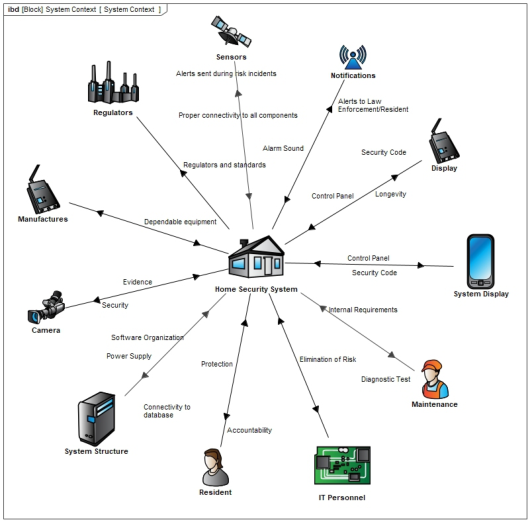
Figure 1 interprets an analysis of home security system inputs and outputs, “High-Level Home Security System Context Diagram”. The diagram includes imperative components to the home security system along with system details that are related to the functionality of each component. These performance details provide an enhanced understanding of the home security abilities.
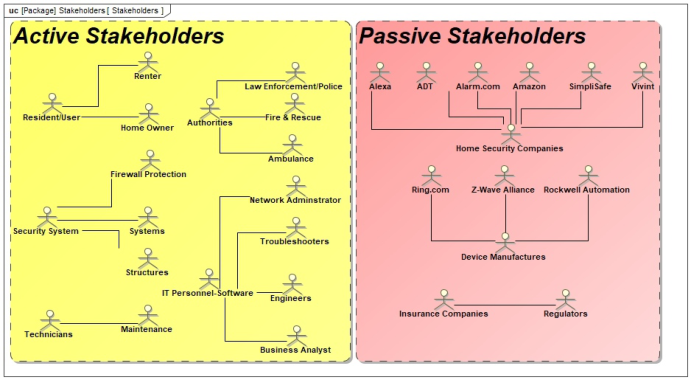
A stakeholder can be described as an individual or group that has an interest in the development of the organization or system. There are stakeholders who have more input on the system’s progress than others, but each holds a different importance to the system. Regarding the home security system there are both active and passive stakeholders, as shown in Figure 2 “MBSE SysML Use Case Model of Active & Passive Stakeholders of Home Security System”. The active stakeholders include the resident/user, authorities (law enforcement, ambulance, fire & rescue), IT personnel (engineers, network administrator, business analyst,
troubleshooters) and maintenance personnel. The passive stakeholders’ regulators, device manufactures, homeowners’ insurance company and home security companies.
Figure 1: High-level home security system context diagram.Figure 2: MBSE SysML use case model of active & passive stakeholders of home security system.
Model-Based Architectural Patterns Concept for Home Security System Solutions 17
MBSE and MBAP can be leveraged to develop a MBPL for home security system selection by providing a structured, model-driven approach to system design, evaluation, and decision-making. MBSE utilizes formal models to capture system requirements, behaviors, and constraints, ensuring consistency, traceability, and validation throughout the development lifecycle. MBAP extends this by offering reusable architectural patterns that encapsulate best practices, design principles, and standard solutions for common system configurations (Lohar et al., 2024). By integrating these methodologies, an MBPL can be created to serve as a repository of predefined security system models tailored to various home security needs, such as intrusion detection, video surveillance, access control, and smart integration. Each pattern in the MBPL would include specifications for system components, interactions, performance metrics, and compliance considerations, enabling users to select and configure a security system based on predefined templates rather than starting from nothing. This approach facilitates rapid system customization, improves design quality, reduces errors, and ensures alignment with industry standards (Lohar & Cloutier, 2022). Additionally, MBSE tools can support simulation and verification of selected security configurations, allowing homeowners or security professionals to assess system effectiveness before implementation.
SYSTEM DESIGN Pattern Library Analysis
The history associated with the Model Based Systems Engineering Pattern Library development process is extensive. The creation of a pattern library can outline a system and the system’s abilities in complex ways. The pattern library development ensures an overall decrease in time needed to outline and construct the needs of the system (Ahmad et al., 2023). The idea of patterns and using them in engineering architecture was established by Christopher Alexander over four decades ago, these ideas have translated into being practical in systems engineering for improved understanding of systems development (Lohar & Cloutier, 2024). The design and usage of pattern libraries are used to formulate an effective line of communication between all stakeholders involved in the development of the system being created (Ahmad et al., 2023). The line of communication is helpful in determining gaps and areas that require improvement that will lead to proper functioning of the system.
This development can also be analysed by performing a decomposition of the system. This occurs by collecting imperative information needed for the system and thoroughly breaking down necessary details that are essential to the system and specific abilities needed for the system to perform effectively (Lohar, 2022). MBSE takes a high-level view of systematic impacts and issues to build imperative components needed for each system of interest. SysML models are used to detail each pattern specifically while simultaneously developing subsystems and subassemblies needed in the logical architecture to enhance the pattern library being formed (Lohar & Cloutier, 2024). The Model-Based Architectural Patterns being constructed
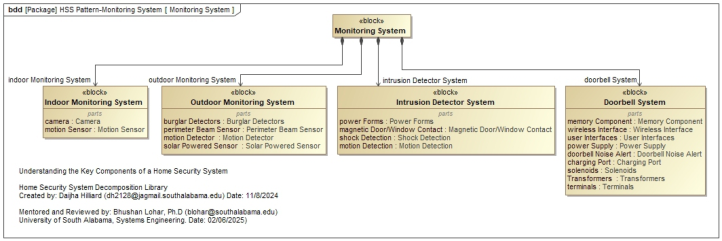
for this research will include various levels of details that will encompass the necessary components to ensure the stakeholder is satisfied and user is fully protected while using the home security system. Figure 3 outlines the necessary components of the monitoring system. This model was created by using CAMEO’s Block Definition Diagram (BDD). Each system displays a breakdown of subsystems that are related. This system is used to provide surveillance of the property, both interior and exterior. The devices used within this system are sustainable in reviewing unknowns and issues that may arise.
Figure 3: Monitoring system-pattern library.
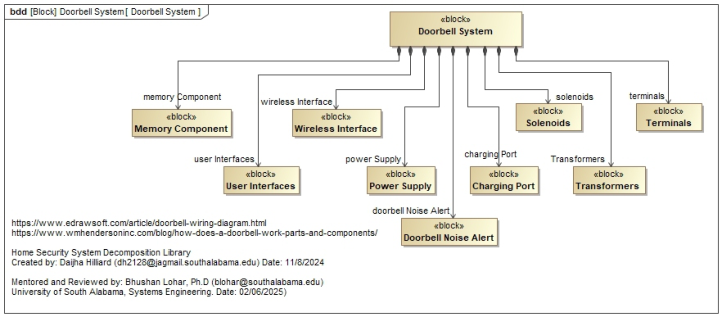
Figure 4 is another component of the Model-Based Architectural Patterns that illustrates a detailed review of the monitoring system subsystem known as the doorbell system. The doorbell system is used to survey the exterior of the home. The doorbell subsystem BDD specifically decomposes components within the block definition diagram that are requirements for accurate performance of the subsystem. The repetition of decomposing each system down further to lower levels allows for further detailed needed for the system to revealed and analysed.
Figure 4: Doorbell system-pattern library.
Model-Based Architectural Patterns Concept for Home Security System Solutions 19
Requirements Development The analysis and formulation of system requirements is critical to ensuring a successful system. Requirements for each system are divided into groups such as functional requirements and non-functional requirements which allow for the requirements to be detailed and split in areas that highlight system importance and system restrictions (Ahmad et al., 2023). This is necessary with identifying areas of weakness and strength of the system being created. Furthermore, requirements are useful to build a bridge of vital communication in the form of documentation, conversation and sustainability needed for the system. These requirements developed for the system serve as a map to answer various questions and concerns posed by stakeholders and developers (Ahmad et al., 2023). The table below, Table 2, are example requirements that have been formulated to identify the ability of the system that is being researched.
Table 1: Home security system requirements table.
Table available in the original PDF paper.
ID# System Requirement Requirement Category Performance 1 The system shall allow for stakeholder selection in system development. Performance 1.2 The system shall connect with the internal home system (software) to detect square footage security coverage needed for residence. Performance 1.3 The system shall send a notification via an application to a smart device upon the decision made for the specific system needed for the system. Performance 2 The system shall include a home security management system. Design 2.1 The system shall encompass the control panel for interface purposes. Control 3 The system shall use automation to create the necessary security system for the user. Design 3.1 The system shall include a surveillance system. Interface 4 The surveillance system shall include various camera types to provide protection. Interface 4. The system shall have the capability to monitor the entire home. Control 5 The system shall include connection sensors for system improvement. Performance 1 The system shall allow for stakeholder selection in system development.
The top-level systems, second-level subsystems, and subassemblies are the first in line of the patterns, and the selection of substitute components comes last. This strategy is driven by two primary goals. For the user to understand of collection of patterns as a pattern language, wherein the user can construct countless combinations, the first goal is to display each pattern
that is connected to the second level pattern. Second, the method offers user- friendly, standard solutions for every pattern in a way that allows users to adapt and change it without losing sight of the original goal of developing a new space system (Lohar & Cloutier, 2022). These are needed for the overall decomposition. The unification of the above outlined information, architectural pattern library development for the home security system, the development of user requirements, the decomposition of those requirements that will be translated into the allocation of patterns with be created and used to assist the user and stakeholder in the selection process of the most desirable system. These principles will create an initiative concept of the understanding and preference of the home security system.
Wireless Communication Protocols The evolution of the security system, specifically regarding to home protection, has been an ongoing transformation. The connectivity required for the home protection system is managed and facilitated by wireless communication protocols. There are a wide range of types of protocols that can be used throughout the system which include Bluetooth, cellular, Zigbee, Wi-Fi, LoRaWAN and Z-Wave (Henke, 2023). Bluetooth is a communication protocol that is used in conjunction with other protocols such as Wi-Fi or Cellular. This protocol uses lower amounts of power to transfer data and allows for wireless communication as well (Henke, 2023). Zigbee is another communication protocol used primarily in-home automation that is comparable to Bluetooth in its abilities to transmit information. The main difference in Zigbee protocols is they send data over networks in small pieces which is known as packet-based communication. This form of communication allows for an adequate shift in data (Henke, 2023). The Industrial, Scientific, and medical radio frequency band (ISM) is where Z-Wave operates. It broadcasts on frequencies of 868.42 MHz in Europe and 908.42 MHz in the US, which are intended for low-bandwidth data transfers in embedded gadgets like home automation control panels, security sensors, and alarms. Although there is an open-source version of the Z- Wave protocol stack called open z-wave, it does not currently enable security services (Z-Wave, 2024). Listed below is a detailed table of frequency bands standards Z-wave technology in for various parts of the world (Z-Wave, 2024).
Table 2: International Z-Wave frequency data.
Table available in the original PDF paper.
Frequency in MHz Used in 865.2 India 868.4 China, South Africa 868.4, 869.85 Armenia, Bahrain, CEPT Countries (Europe and other countries in region), Egypt, French Guiana, Georgia, Iraq, Jordan, Kazakhstan, Kuwait, Lebanon, Libya, Nigeria, Oman, Philippines, Qatar, Saudi Arabia, South Africa, Turkmenistan, UAE, United Kingdom, Uzbekistan, Yemen 869 Russia
Continued
Model-Based Architectural Patterns Concept for Home Security System Solutions 21
Table 2: Continued Frequency in MHz Used in
Table available in the original PDF paper.
908.4, 916 Argentina, the Bahamas, Barbados, Bermuda, Bolivia, British Virgin Islands, Canada, Cayman Islands, Colombia, Guatemala, Haiti, Honduras, Jamaica, Maldives, Mauritius, Mexico, Moldova, Morocco, Nicaragua, Panama, St Kitts & Nevis, Suriname, Trinidad & Tobago, Turks & Caicos Islands, Uruguay, USA 916 Israel 919.8, 921.4 Australia, Brazil, Chile, Dominican Republic, Ecuador, El Salvador, Indonesia, Malaysia, New Zealand, Paraguay, Peru, Uruguay, Venezuela, Vietnam
Along with Z-Wave technology, there are other network systems used within the home security system that provide increased levels of protection. The intrusion detection system or IDS is comparable in its ability to capture data and transmit information. IDS is used to gather data in preparation to avoid the ability of a network encroachment, more specifically IDS is used on the Internet of Things networks (IoT) to identify threats to the system and overall provide a higher level of security system (Al Hanif, 2024). In return, this security increases the security needed for the user as well. Additionally, it would be extremely beneficial to users and stakeholders for all communication protocols to be centrally located. A proposal for this concept is to create a pattern library to house and detail all of the communication protocols associated with the home security system. This pattern library will be useful with creating necessary understanding and knowledge needed in the selection process of the home security system that is best for each user.
DISCUSSION
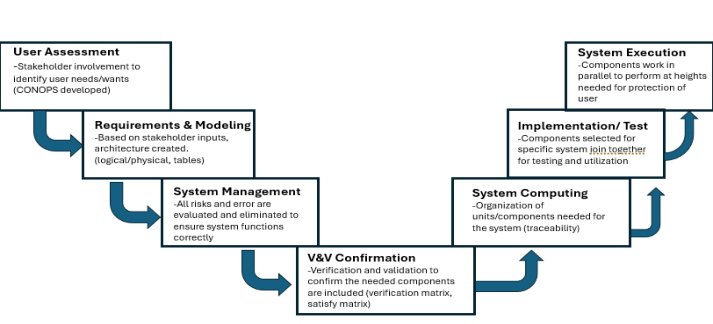
Home Security System Template The consolidation of the architectural pattern library, requirements development, decomposition and pattern allocation will be used in the template below. This template includes seven components that are necessary for the system functionality. Each component assesses an imperative step for the creation of the minimum viable product that best fits the necessary home security system for each specific user. This template takes the importance of the stakeholders input seriously. Figure 5 is a template devised to examine various steps needed to ensure the stakeholder remains informed on system changes and improvements and to honour the desires of stakeholders as well. This seven-step proposed process begins with a user assessment which allows for full stakeholder involvement in the creation of the system. Next, requirements, modelling and system management steps occur to visually display the desires of the stakeholder while taking the proper steps to manage system functionality. These steps are followed by verification and validation confirmation and system computing analysis, which are set in place to confirm the necessary components of the proposed home security system and organizational steps to ensure effective traceability of the system.
Lastly, implementation and testing phases occur which will lead to the system execution of the finalized required components of the system. This template is the proposed solution of the various issues that occur in the home security system. This seven-step process will take the necessary time to completely survey and understand what is needed for each scenario.
Figure 5: Home security system MBSE template.
The goal of improving the home security system is to ensure the stakeholders are satisfied and the resident is provided with the highest more of security from break-ins, damages to the home and overall safety. There is various communication protocols used in the home security system. The analysis of the home security system throughout this article highlights the importance of providing safety to the user as well as the usefulness of the model-based system engineering principles that can define the required components of productive and functional system. The architectural patterns created show the breakout of necessary components for the home security system. This will occur by using stakeholder input and automation. The template development being created will be useful to the customer, service provider, insurance provider and manufacturer. The proposed idea of using MBSE principles to further identify and enhance the needs of the home security system for each user while increasing the overall utilization and durability of the system. This proposed change in system will elevate immediate peace of mind for each user by providing critical protection specific to each user.
CONCLUSION
This paper introduces the concept of how practical and applicable combining the principles of model-based system engineering architectural patterns with the needs of the home security system to create an overall beneficial system for the user. The authors propose developing an MBSE architectural pattern library (Lohar & Cloutier, 2022) using the Vee model (Figure 5) that addresses the home security systems components selection process,
Model-Based Architectural Patterns Concept for Home Security System Solutions 23
phases, requirements, and systems engineering guidelines and practices used in developing complex systems. The future version of this approach will follow an end-to-end MBSE architectural pattern language (Lohar, 2022). With security system’s logical architecture and detailed design are completed on the left side of the Vee model, then at the bottom of the Vee, the “blocks” from logical architecture and requirements will be translated and allocated to the detailed logical design of various subsystems and components (Lohar et al., 2024). After the successful integration of the home security system elements on the left side of the Vee model, the requirements, functions, and behaviors will be verified, validated, and tested on the right side to generate a desired home security system architecture per user and stakeholder requirements and expectations. By systematically applying MBSE and MBAP to build an MBPL, the selection of home security systems becomes more efficient, scalable, and adaptable to evolving security threats and technological advancements.
Future work for this system design includes a further comprehensive assessment of the home security system. This assessment will be decomposed and demonstrated in numerous other SysML Block Definition Diagrams. Requirements writing will also be used in parallel to identify and detail the research needed for a valuable home security system. Additionally, future work for this concept includes the research of this paper will be continued and expanded by the authors of this paper. The continued research includes developing a full pattern library that will evaluate the concept proposed in this paper. The authors of this article plan to expound on this conceptual idea to further evolve this notion to improve the home security system by using model-based system engineering. The future findings of this concept will further assist in the user’s ability to understand and accurately select the best home security system.
REFERENCES
Ahmad, K., Abdelrazek, M., Arora, C., Bano, M., & Grundy, J. (2023). Requirements engineering for artificial intelligence systems: A systematic mapping study. Information and Software Technology, 158, 107176. Al Hanif A., Ilyas M. Effective Feature Engineering Framework for Securing
MQTT Protocol in IoT Environments. Sensors (Basel). 2024 Mar 10;24(6):1782. doi: 10.3390/s24061782. PMID: 38544044; PMCID: PMC10975182. Atkins, Harry. (2022). “Marie van Brittan Brown: Inventor of the Home Security System.” History Hit. www.historyhit.com/who-was-marie-van-brittan-brown/ Danbatta, S. J., & Varol, A. (2019). Comparison of Zigbee, Z-Wave, Wi-Fi, and
Bluetooth wireless technologies 540 used in home automation. In 2019 7th International Symposium on Digital Forensics and Security (ISDFS) (pp. 1–541 5). IEEE. Henke, C. (2023, March 23). A comprehensive guide to IoT protocols. IoT Glossary.
IoT Protocols and Standards: An Introductory Guide. Hilgers, L. (2021). A brief history of the invention of the Home Security Alarm. Smithsonian Magazine. https://www.smithsonianmag.com/innovation/ history-home-security-alarm-180977002/
Lodge, N.; Tambe, N.; Saqib, F. Addressing Vulnerabilities in CAN-FD: An Exploration and Security Enhancement Approach. IoT 2024, 5, 290–310. https:// doi.org/10.3390/iot5020015 Lohar, B. R. (2022). Development of New Space Systems Architecture in Sysml
Using Model-Based Pattern Language (Doctoral dissertation, University of South Alabama). Lohar, B., Wade, J., Adelabu, J., & Sree, N. (2024). A Concept Model to Analyze the Digitalization of Industrial Fire Protection Systems Decision-Making. ESSN: 2701-6277, 458–471. Lohar, B., & Cloutier, R. (2024, July). Model-Based Architectural Patterns for
Teaching Systems Engineering. In INCOSE International Symposium (Vol. 34, No. 1, pp. 1494–1504). Lohar, B., & Cloutier, R. J. (2022). Towards a model-based pattern language for new space-based systems. Preprints, 2022080177. https://doi.org/10.20944/ preprints202208.0177.v1 Mustafa, A. (2024a, October 4). 6 common security system problems and how to fix
them. Canadian Security Professionals. https://www.cspalarms.ca/blog/security- systems/6-common-security-system-problems-and-how-to-fix-them/ Z-Wave. (2024). In Wikipedia. https://en.wikipedia.org/wiki/Z-Wave
LISTED IN THE AHFE DIGITAL BOOKSTORE CATALOGUE
Explore the complete digital volume
Human Factors in Software and Systems Engineering
Read this individual research paper free through the original publisher, or explore the full digital proceedings book.
ISBN 978-1-964867-57-1
Explore this ISBN in the AHFE Bookstore ↗Listed in the July 2026 bookstore catalogue; search by ISBN to confirm current availability · Digital book purchase optional