Daijha Hilliard, Bhushan Lohar, Robert Cloutier, John Wade, Saeed Latif (2026). Integration of MBSE Elements and Automation with System Development Processes for Advanced Performance & Efficiency. In: Human Factors in Simulation, Software and Systems Engineering. AHFE Open Access, vol. 220, pp. 15–26. https://doi.org/10.54941/ahfe1007690
This research presents the culmination of a progressive study, detailing the results of integrating advanced Model Based Systems Engineering (MBSE) elements with system automation to enhance stakeholder selection processes. The importance of precise system selection remains paramount for optimal user safety and comprehension. By exploring the robust capabilities of Artificial Intelligence (AI), Machine Learning (ML), and automation tools, this study demonstrates significant improvements in developmental outputs over time. MBSE serves as a revolutionary methodology possessing complex capabilities that fundamentally elevate system performance and development. This methodology is successfully implemented through rigorous requirements writing, the formulation of architectural patterns, the establishment of comprehensive pattern libraries, and stringent verification processes. The strategic combination of these MBSE components, systems thinking, and automated intelligence functions in parallel to systematically improve selection processes for diverse users and stakeholders. Consequently, this final paper focuses on how these compounded systems engineering elements operate cohesively to guarantee that users select the most vital, beneficial systems tailored strictly to their preferences and operational needs. Furthermore, this study illustrates how the deployment of architectural patterns and pattern libraries seamlessly verifies requirements to output exceptionally performant architectures. Because modern architectures typically function as systems of systems requiring both high-level and low-level decomposition, this methodology efficiently promotes enhanced operational efficiency. While applicable across any diverse domain, this research specifically applies the refined framework to home security systems, definitively demonstrating the enhanced deliverables produced by merging MBSE, artificial intelligence, and advanced automation elements.
Engineers act as the primary drivers of innovation, continuously elevating the capabilities of Systems Engineering (SE) to improve current developmental Received March 5, 2026; Revised April 9, 2026; Accepted April 27, 2026; Available online July 20, 2026
processes. As a relatively modern discipline, SE was developed shortly after World War II as a pivotal step to manage the rapid advancements and growing complexities related to new, evolutionary system designs (Hossain et al., 2020). Over the past 80 years, systems engineers have exercised various methodological approaches that have proven highly beneficial in solving complex problems and providing practical solutions. Today, Model-Based Systems Engineering (MBSE) represents a paradigm shift, structuring system design in a manner that prioritizes communication, precision, and stability (Odukoya et al., 2021). The practice of MBSE creates a robust environment for engineers to clearly define and demonstrate the precise needs of the stakeholder.
In recent years, the International Council on Systems Engineering (INCOSE) has served as a central pipeline for the transition from traditional document- based engineering to modern MBSE principles, which are currently utilized to manage multifaceted complexities within system development (Saloranta, 2024). The standards and frameworks established by INCOSE are applied directly to MBSE practices to ensure model durability, feasibility, and rigorous requirement traceability. In parallel with requirements writing, architecture modeling is utilized to systematically verify and satisfy stakeholder needs.
The Systems Modeling Language (SysML) is a standardized modeling language utilized in MBSE to construct models that align with the architectural designs necessary for the verification of stakeholder requirements (Wolny et al., 2020). Within this framework, physical and logical architectures serve as essential modeling structures used to demonstrate the system hierarchy and core functionality (Schindel & Peterson, 2013). These architectures leverage specific architectural patterns to highlight detailed system characteristics and operational needs. When strategically combined, these patterns form a comprehensive pattern library. The primary purpose of the pattern library is to visually and structurally model the core functions of the system being assessed (Lohar & Cloutier, 2024). The patterns within this library are comparable to pieces of a complex puzzle; while each piece is shaped uniquely and represents a distinct component or subsystem, all elements are strictly required to accurately display the complete architectural picture.
Furthermore, automation serves as another key component driving advancements in technology and system development. Various forms of automation including Artificial Intelligence (AI), Robotic Process Automation (RPA), Application Programming Interfaces (APIs), Machine Learning (ML), and Deep Learning (DL) have generated solutions for previously insurmountable engineering challenges. The formal inception of AI occurred in 1956 at the Dartmouth Summer Research Project, led by John McCarthy and Marvin Minsky (Sheikh et al., 2023). This foundational initiative provided the catalyst needed to address complex technological inquiries that were once considered mysteries in the scientific realm. Concurrently, the Systems Modeling Language version 2 (SysML v2) represents a notable technological advancement directly utilized within MBSE. As a foundational update to the original SysML v1 standard, SysML v2 bridges integration gaps, executes language processing more efficiently, and provides streamlined, accessible
Integration of MBSE Elements and Automation With System Development 17 solutions for modeling highly complex systems (Grunenwald et al., 2025). Currently, the system selection process is highly complex, time-consuming, and prone to costly life-cycle disruptions. System design demands significant time investments ranging from 80 to 150 hours for small-scale projects to over 500 hours for large-scale architectures (Agarwal, 2024). Compounding these delays is human error, which accounts for 86% of systems engineering mistakes during the manual development of core architectural models, such as state machine, block definition, and activity diagrams (Alenazi et al., 2019). This extensive manual labor not only inflates costs but severely hinders productivity. Furthermore, translating textual stakeholder requirements into formal models frequently introduces ambiguity, resulting in inaccurate architectural outputs that fail to align with true user preferences (Siddique, 2022). To overcome these critical challenges, this research demonstrates the significant potential of integrating Model-Based Systems Engineering (MBSE) in parallel with advanced automation. By synergizing the structured framework of MBSE with rapidly evolving automation capabilities, the proposed methodology fundamentally optimizes, improves, and expedites the system selection and development processes across any operational domain.
LITERATURE REVIEW
SE serves as a highly effective methodology for driving continuous technological advancement. As a discipline, it offers a broad umbrella of capabilities designed to systematically enhance and optimize complex processes, with its performance-boosting methodologies continuing to evolve. More specifically, MBSE functions as a critical subset within this discipline, providing the high-level structural integrity required during the developmental phases of new products and processes. The MBSE framework encompasses rigorous requirements writing, detailed design properties, and robust verification and validation tools, all of which are essential for effectively decomposing and maturing a complex system (Shevchenko, 2020). As a transformative technique, MBSE significantly elevates the quality of engineering outputs while concurrently ensuring strict alignment with stakeholder satisfaction.
This research emphasizes the critical role of requirements diagrams in fostering technological progress. Within the MBSE ecosystem, requirements diagrams are utilized to establish explicit traceability across models while clearly defining the hierarchical rankings between systems and subsystems (Dandan et al., 2020). Furthermore, architecture modeling serves as the functional representation of these stakeholder-driven requirements. In system model development, logical and physical architectures represent the two primary structural illustrations. Logical architecture models are engineered to allocate system patterns and requirements in a highly effective, enduring manner, ensuring the core functional concepts remain understandable and applicable over extended periods. Conversely, physical architecture models depict the tangible, implementable components of a system, which are inherently subject to continuous updates, modifications, and improvements
as technology progresses and the system matures (Lohar & Cloutier, 2022). Ultimately, within the realm of model-based systems engineering, it is the synergistic relationship between robust architectural modeling and precise requirements writing that pioneer and sustains successful system development.
At its core, MBSE prioritizes three major components: people, products, and processes (Khandoker et al., 2022). The harmonization of these elements ensures that the foundational aspects of new system development remain both concise and sustainable throughout the project lifecycle. Industrial AI serves as a highly valuable asset in this research. This specialized subset of AI incorporates advanced applications such as ML, DL, and Natural Language Processing (NLP), which collectively automate problem resolution and analyze complex communication efforts. Within the framework of industrial AI, primary components such as infrastructure, data streams, algorithms, decision-making processes, and strategic objectives are rigorously prioritized and assessed (Peres et al., 2020). Specifically, machine learning functions by defining complex relationships among various system inputs, which are subsequently integrated and evaluated to accurately forecast system outputs (Sircar et al., 2021).
Furthermore, architectural patterns in systems engineering are systematically captured using modeling standards such as SysML v1 and SysML v2. Because SysML v2 represents the future of system modeling with its paramount technological advancements, it is particularly useful for this research domain. The inherent advantages of SysML v2 include meticulous language processing, enhanced consistency during complex system integration, and a seamless transition path from SysML v1, allowing engineers to leverage modern advancements for overall system optimization (Friedenthal, 2023). Ultimately, SysML v2 facilitates the creation of a significantly more robust workflow by natively supporting AI and ML automations. This synergistic integration transforms traditional problem-solving methodologies and drastically improves bidirectional communication with stakeholders, culminating in superior, high-fidelity developmental outputs (Polonyova et al., 2025).
METHODOLOGY
This research proposes a methodology to refine the stakeholder system selection process by seamlessly integrating MBSE components with advanced automation tools. Specifically, pattern languages, requirements diagrams, ML and AI operationalize this approach. MBSE is highly valuable for system enhancement, as rigorous requirement traceability actively eliminates design gaps and minimizes errors (Lohar et al., 2025). Utilizing these systems engineering framework mitigates common developmental issues, such as poor stakeholder-engineer communication and misaligned system outputs.
RESEARCH QUESTIONS R1: What tools and methods can be utilized to improve timeliness in systems
engineering architecture modeling outputs?
Integration of MBSE Elements and Automation With System Development 19 R2: What functionalities can be implemented to optimally enhance the
stakeholder’s system selection process?
To resolve these inquiries, this study proposes a four-step sequential framework, Analyze, Categorize, Calculate, and Determine; designed to yield accurate, timely, and practical results. This methodology fuses requirements writing, architectural modeling, and system automation to modernize system development, utilizing the home security domain as a practical proving ground. The research process is defined as follows.
Analyze: The first phase prioritizes stakeholder engagement and satisfaction. Users provide comprehensive, hierarchical operational needs, ranging from top-level functions to bottom-level sub-components. For a home security system, this involves specifying the residence type (e.g., apartment versus single-family home) and necessary security features (e.g., interior versus exterior cameras, environmental versus intrusion alarms).
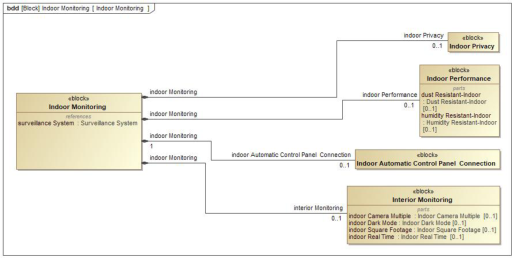
Figure 1: Indoor monitoring system pattern.
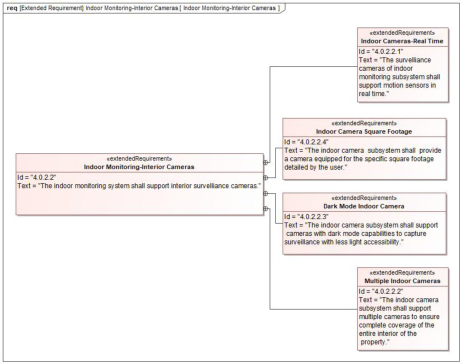
Categorize: The second phase translates the gathered stakeholder inputs into explicitly defined, verifiable requirements. Automation tools, such as RPA, are used to categorize these needs and decompose them into specific requirement tiers. Employing requirements and architectural patterns in parallel facilitates seamless system decomposition and development (Lohar, 2022). For example, home security requirements are decomposed as follows: Level 1 Requirement: The home security system shall support camera surveillance capabilities.
Level 2 Requirement: The monitoring subsystem shall support an indoor monitoring component.
Level 3 Requirement: The indoor monitoring system shall disable recording upon the selection of privacy mode.
These categorized requirements are then logically grouped into subsystems that align with the overall system architecture.
Figure 2: Indoor monitoring system requirements pattern.
Calculate: The third phase leverages system integration and AI-driven automation to formulate the system architecture. Requirements established in the categorization phase are processed by ML, deep learning, and SysML v2 to automatically generate diverse architectural models. Producing these models within minutes using tools like Cameo Systems Modeler drastically reduces design time. A key advantage of using SysML is the ability to link constructed patterns to demonstrate defined relationships, further verifying that stakeholder needs are actively being met (Lohar & Cloutier, 2024). Ultimately, these automatically generated architectural patterns are simultaneously verified against the categorical requirement diagrams to ensure holistic system accuracy.
The development of architectural patterns within home security systems deepens technical understanding while actively fostering stakeholder trust (Hilliard et al., 2025). This proposed research serves as a revolutionary aid, providing stakeholders with viable, customized options derived directly from their initial input. Central to this approach is the pattern library, a comprehensive repository of diagrammatic models. This library utilizes foundational system elements, known as blocks, which are compiled within a Block Definition Diagram (BDD) to explicitly define the system’s structural design. Functionally, the pattern library facilitates a robust decomposition environment, enabling engineers to analyze the system’s logical architecture seamlessly from early conceptual phases through final development (Lohar et al., 2024).
Determine: The fourth and final phase synthesizes the preceding three steps to deliver multiple verified system outputs, ensuring the stakeholder has a diverse array of viable options. By leveraging the automatically generated diagrams from the calculation phase, the methodology produces a comprehensive overview of potential system designs directly aligned with the user’s initial requirements. Presenting this grouped repository of modeled architectures empowers stakeholders with tangible, high-fidelity choices, allowing them to definitively select the optimal system tailored to their specific operational needs.
RESULTS
While adaptable to any industry domain, this proposed methodology is highly effective within the home security sector, which relies on critical subsystems and components to guarantee comprehensive user protection. As demonstrated throughout this research, integrating MBSE specifically architectural patterns and pattern libraries with advanced automation substantially improves the high-fidelity deliverables essential to the stakeholder’s system selection process.
Furthermore, architectural patterns play a pivotal role in maturing system designs. The strategic application of these pattern collections significantly increases developmental rigor across both simple and highly complex system creations and upgrades (Wu et al., 2020). Ultimately, these customizable patterns adapt to fulfil the unique security requirements of individual users. The following list defines the distinct system capabilities and components that can be seamlessly integrated to architect a customized, user-specific system: (1) Efficiency System - Level 1: Efficiency is necessary for ensuring the home
security system functions correctly. Technological advancements within system functions are required to perform the essential activities needed to consistently provide the user with protection. The combination of the home security system to home automation produces elevated levels of efficiency which provides additional protection to the user (Roombanker, 2024). (2) Home Security Protection- Level 2 (3) Monitor Merge- Level 2 (4) Encrypt Recordings- Level 2 (5) System Performance - Level 2 (6) Real Time System Updates- Level 2 (7) Self-Test Verification - Level 2 (8) Third-Party Communications - Level 2 (9) System Security Operations - Level 2 (10) System Advancements - Level 2 (11) Connectivity System - Level 1: Connectivity captures the internal heartbeat of the security system. Connectivity is required to navigate through the software system and hardware systems needed to provide accurate linkage for system functioning. This system is needed to improve communication abilities and system application abilities that provide consistent precision (Ahmed et al., 2024). (12) Wired System - Level 2 (13) Wireless System - Level 2 (14) Solar Power - Level 2 (15) Internal Power - Level 2 (16) Perimeter System - Level 1: Perimeter includes physical protection from
outside forces or individuals intruding the home. Smart automation and manual perimeter protection provides assurance of system abilities and the ultimate deliverable of protection for each user (Tun et al., 2018). (17) Store Perimeter - Level 2 (18) Power Reboot - Level 2
(19) Fence - Level 2 (20) Gate - Level 2 (21) Perimeter Components - Level 2 (22) Perimeter Connections - Level 2 (23) Surveillance System - Level 1: Surveillance covers the capturing of imagery needed to identify changes within the home or assist in determining who may be responsible for a system interruption or showcase how the interruption occurred. The cameras used in surveillance provide a constant visual of the home. Surveillance and detection work directly with one another to assess the system environment and provide premium protection (Taiwo et al., 2022). (24) CCTV - Level 2 (25) Indoor Monitoring - Level 2 (26) Outdoor Monitoring - Level 2 (27) Audio Monitoring - Level 2 (28) Surveillance Features - Level 2 (29) Surveillance Connection - Level 2 (30) Camera Complexity - Level 2 (31) Camera Types - Level 2 (32) Sensor System - Level 1: Sensors include the support needed to determine
possible threats or hazards to the system or user. The sensors provide an internal view of issues that may arise, which can possibly prevent intrusions or alert authorities in a timely manner. Sensors are used to process images and detects movements within the home security system as well (Pal et al., 2021). (33) Sensor Support - Level 2 (34) Developed Sensors - Level 2 (35) Wireless Sensors - Level 2 (36) Motion Sensors - Level 2 (37) Detection System - Level 1: Detection captures the system needs of both intrusion and environments. Detection works heavily with sensors to connect and determine changes in the system. Detection is imperative in the assessment of different types of attacks, while partnering with communication systems to identify the appropriate individuals (Touqeer et al., 2021). (38) Intrusion Detection System - Level 2 (39) Environmental Detection System - Level 2 (40) Fire Alarm System - Level 1: Fire Alarm is required to determine changes
in heat levels within home and providing accurate notification in the case where a fire emergency has been discovered. The integration of alarm security and fire alarm is imperative to ensuring constant physical coverage from harm (Malantinsky, 2023). (41) Fire Notification - Level 2 (42) Fire Power - Level 2 (43) Smoke Detection System - Level 2 (44) Sprinkler System - Level 2 (45) Fire Standards - Level 2
Integration of MBSE Elements and Automation With System Development 23 (46) Data Transfer System - Level 1: Data transfer is the basis of communication
in the home security. Data transfer is necessary in delivering messages and alerts to the user. The advancement in technology pushes the improvements on the methodology of how communication is transmitted and relayed (Mabasha et al., 2023). (47) Audio Notifications - Level 2 (48) Visual Notifications - Level 2 (49) Communication Subsystem - Level 2 (50) Power System - Level 1: Power is the primary system needed in home security to generate the overall abilities of the system. Power is needed to start up and shut down the overall system. There are various types of power systems, isolated power and interconnected power, that serve as the basis of how power is generated and distributed (Horowitz et al., 2022) (51) Power Connectivity System - Level 2 (52) Power Components - Level 2 (53) Automation System - Level 1: Automation is used to create ease for
the user. Automation is helpful in improving timeliness and accuracy. Automation also creates a pathway of additional assistance to the user, by working to fill gaps identified and providing readily available assistance for the user in various ways (Yar et al., 2021). (54) Software Automation - Level 2 (55) Smart Home Integration - Level 2 (56) Home Security Management System - Level 1: Maintenance is needed to ensure the system continues to perform at its highest level. Maintenance for the home security system can be completed monthly, quarterly, semi-annually and annually depending on the needs of the system. This continual maintenance produces system updates and alerts necessary for proper functioning of the system for the duration of its life span (Gabriele, 2025). (57) Comprehensive Power - Level 2 (58) Maintenance Notification - Level 2 (59) Central Control Panel - Level 2 (60) Authentication Components - Levels 2 (61) User Opinion - Level 2 (62) Balance - Level 2 (63) Maintenance Contacts - Level 2 (64) Audible-Visual - Level 2 (65) LED - Level 2 (66) Environmental Comfort Assembly - Level 2 (67) Temperature Control Assembly - Level 2
CONCLUSION
This research demonstrates that integrating MBSE with advanced automation fundamentally optimizes the stakeholder system selection process. By utilizing strict requirement traceability and robust modeling structures such as activity
diagrams, block definition diagrams (BDDs), and use cases, engineers can rigorously validate functional requirements derived directly from user inputs. Furthermore, applying AI and MBSE-driven testing seamlessly confirms architectural modifications, maximizing overall life-cycle precision.
Applied specifically to the home security domain, this study characterizes 11 foundational subsystems that can be strategically combined to formulate highly viable, customized security solutions. This synergistic approach drastically reduces system development timelines from thousands of hours to mere seconds. Consequently, engineers can rapidly present fully matured, error-minimized architectural models to stakeholders. This automated translation of requirements into a Minimum Viable Product (MVP) not only preserves essential engineering oversight but significantly boosts productivity, minimizes manual human error, and fosters mutual trust.
Ultimately, the foundational AC²D methodology, Analyze, Categorize, Calculate, and Determine; drives a revolutionary shift in system selection. By pairing sophisticated system decomposition and precise pattern libraries with automation, this research transitions the engineering paradigm from rigid uniformity to highly customized stakeholder experiences. This framework ensures robust V&V, simultaneously amplifying user satisfaction and modernizing the developer’s workflow within a highly proficient and adaptable engineering environment.
REFERENCES
Ahmed, S. F., Alam, M. S. B., Afrin, S., Rafa, S. J., Taher, S. B., Kabir, M., ... & Gandomi, A. H. (2024). Toward a secure 5G-enabled internet of things: A survey on requirements, privacy, security, challenges, and opportunities. IEEE Access, 12, 13125–13145. Agarwal, R. (2024, October 22). How to estimate creating a design system in hours:
6 powerful tips. DesignWhine. Alenazi, M., Niu, N., & Savolainen, J. (2019, September). SysML modeling mistakes and their impacts on requirements. In 2019 IEEE 27th International Requirements Engineering Conference Workshops (REW) (pp. 14–23). IEEE. Dandan, W., Hao, L., & JianWen, C. (2020, April). Modeling and simulation of top-
level design based on MBSE. In Journal of physics: conference series (Vol. 1486, No. 7, p. 072061). IOP Publishing. Friedenthal, S. (2023, February). Future Directions for MBSE with SysML v2. In MODELSWARD (pp. 5–9). Gabriele, R. (2025, August 5). Our comprehensive home security system maintenance
checklist. SafeHome.org. Grunenwald, C. P., Dybov, A., & Stark, R. (2025, April). Leveraging Sysml V2 to Enhance System Architecture Decision-Making Based on Process Information. In 2025 IEEE International systems Conference (SysCon) (pp. 1–8). IEEE. Hilliard, D., Lohar, B., Lippert, K., Wade, J. T., & Latif, S. (2025). Model-Based
Architectural Patterns Concept for Home Security System Solutions. Human Factors in Software and Systems Engineering, 181, 13. http://doi.org/10.54941/ ahfe1006390 Horowitz, S. H., Phadke, A. G., & Henville, C. F. (2022). Power system relaying.
John Wiley & Sons.
Integration of MBSE Elements and Automation With System Development 25 Hossain, N. U. I., Jaradat, R. M., Hamilton, M. A., Keating, C. B., & Goerger, S. R.
(2020). A historical perspective on development of systems engineering discipline: a review and analysis. Journal of Systems Science and Systems Engineering, 29(1), 1–35. Khandoker, A., Sint, S., Gessl, G., Zeman, K., Jungreitmayr, F., Wahl, H., ... & Kretschmer, R. (2022). Towards a logical framework for ideal MBSE tool selection based on discipline specific requirements. Journal of Systems and Software, 189, 111306. Lohar, B. R. (2022). Development of new space systems architecture in SysML
using model-based pattern language (Doctoral dissertation, University of South Alabama). https://doi.org/10.13140/RG.2.2.20226.70089 Lohar, B., & Cloutier, R. (2024, July). Model-Based Architectural Patterns for Teaching Systems Engineering. In INCOSE International Symposium (Vol. 34, No. 1, pp. 1494-1504). https://doi.org/10.1002/iis2.13221 Lohar, B., Wade, J. T., Adelabu. J. & Sree, N. (2024). A Concept Model to Analyze
the Digitalization of Industrial Fire Protection Systems Decision-Making. 6th Conference on Production Systems and Logistics. Honolulu, Hawaii. July 8–12, 2024. ESSN: 2701-6277, 458–471. https://doi.org/10.15488/17735 Lohar, B., Wade, J., Mange, A., Ali, M., Colquhoun, R., Larson, L. (2025). Applying Model-Based Requirement Patterns Library Concept to Astronaut Space Suit System for Deep-Space Travel and Mars Surface Exploration Missions. Human Factors in Software and Systems Engineering. AHFE (2025) International Conference. AHFE Open Access, vol 181. AHFE International, USA. http://doi. org/10.54941/ahfe1006389 Mabasha, S., Kamini, S. R., Babu, S. R., & SHAIK, A. H. (2023). Enhancing Home
Security through an Android-based Door Security System using IoT Technology. Malatinsky, A. (2023). Integration of alarm security systems. Przegląd Elektrotechniczny. Odukoya, K. A., Whitfield, R. I., Hay, L., Harrison, N., & Robb, M. (2021,
September). An architectural description for the application of MBSE in complex systems. In 2021 IEEE International Symposium on Systems Engineering (ISSE) (pp. 1–8). IEEE. Pal, S., Mukhopadhyay, S., & Suryadevara, N. (2021). Development and progress in sensors and technologies for human emotion recognition. Sensors, 21(16), 5554. Peres, R. S., Jia, X., Lee, J., Sun, K., Colombo, A. W., & Barata, J. (2020). Industrial
artificial intelligence in industry 4.0-systematic review, challenges and outlook. IEEE access, 8, 220121–220139. Polonyova, E., Bentkowski, P., & Rooks, S. (2025, April 15). Boost engineering efficiency with SysML V2. IBM developer. https://developer.ibm.com/blogs/ sysml-v2/ Roombanker. (2024, September 24). 10 benefits of home security systems and tips
on how to choose a proper one. https://www.roombanker.com/blog/10-benefits- of-home-security-systems/ Saloranta, S. (2024). From Documents to Models: Adopting MBSE Practices in Complex Embedded Systems and Leveraging Large Language Models. Schindel, W., & Peterson, T. (2013, June). Introduction to pattern-based systems
engineering (PBSE): Leveraging MBSE techniques. In INCOSE International Symposium (Vol. 23, No. 1, p. 1639). Sheikh, H., Prins, C., & Schrijvers, E. (2023). Artificial intelligence: definition and background. In Mission AI: The new system technology (pp. 15–41). Cham: Springer International Publishing.
Shevchenko, N. (2020, December 21). An Introduction to Model-Based Systems Engineering (MBSE). https://doi.org/10.58012/d464-qf49. Siddique, I. (2022). Systems engineering in complex systems: Challenges and strategies
for success. European Journal of Advances in Engineering and Technology, (9), 61–66. Sircar, A., Yadav, K., Rayavarapu, K., Bist, N., & Oza, H. (2021). Application of machine learning and artificial intelligence in oil and gas industry. Petroleum Research, 6(4), 379–391. Taiwo, O., Ezugwu, A. E., Oyelade, O. N., & Almutairi, M. S. (2022). Enhanced
intelligent smart home control and security system based on deep learning model. Wireless communications and mobile computing, 2022(1), 9307961. Touqeer, H., Zaman, S., Amin, R., Hussain, M., Al-Turjman, F., & Bilal, M. (2021).
Smart home security: Challenges, issues and solutions at different IoT layers. Journal of Supercomputing, 77(12). Tun, H., Lupin, S., Linn, H. H., & Lin, K. N. Z. (2018, January). Selection the perimeter protection equipment in security systems. In 2018 IEEE Conference of Russian Young Researchers in Electrical and Electronic Engineering (EIConRus) (pp. 1504–1508). IEEE. Wolny, S., Mazak, A., Carpella, C., Geist, V., & Wimmer, M. (2020). Thirteen years
of SysML: a systematic mapping study. Software and Systems Modeling, 19(1), 111–169. Wu, Q., Gouyon, D., Levrat, É., & Boudau, S. (2020). Use of patterns for know-how reuse in a model-based systems engineering framework. IEEE Systems Journal, 14(4), 4765–4776. Yar, H., Imran, A. S., Khan, Z. A., Sajjad, M., & Kastrati, Z. (2021). Towards smart
home automation using IoT-enabled edge-computing paradigm. Sensors, 21(14), 4932.
LISTED IN THE AHFE DIGITAL BOOKSTORE CATALOGUE
Explore the complete digital volume
Human Factors in Simulation, Software and Systems Engineering
Read this individual research paper free through the original publisher, or explore the full digital proceedings book.
ISBN 978-1-964867-96-0
Explore this ISBN in the AHFE Bookstore ↗Listed in the July 2026 bookstore catalogue; search by ISBN to confirm current availability · Digital book purchase optional