Manuela Vargas Gonzalez, Valerio Cibrario, Denise Tumiotto, Annalisa Bertoli, Cesare Fantuzzi (2026). Optimization of Motion Capture Technology for a Human Digital Twin with Reduced Sensor Setups. In: Human Factors in Simulation, Software and Systems Engineering. AHFE Open Access, vol. 220, pp. 100–111. https://doi.org/10.54941/ahfe1007698
In recent years, ergonomic research has gained increasing prominence, highlighting the importance of analysing and improving workstation design to better support human workers and enhance task performance. Motion Capture technologies are widely used for ergonomic assessment and Human Digital Twin development; however, their practical deployment in industrial environments is often limited by complex setups, high costs, and lengthy calibration procedures. This study proposes a joint-level optimization methodology to reduce MoCap sensor requirements keeping motion reconstruction accuracy and the reliability of ergonomic evaluations. The approach leverages the posture prediction capabilities of the Digital Human Modelling IPS IMMA platform and validated through both controlled benchmark experiments and a real industrial use case.
Following Industry 4.0 development, the European Commission introduced the Industry 5.0 paradigm to address emerging industrial and societal challenges (Golovianko et al., 2025). This new approach emphasizes close collaboration between humans and machines, fostering a deep integration of human capabilities and machine intelligence to improve overall efficiency (Adel, 2022). In contrast to the technology-driven focus of Industry 4.0, Industry 5.0 adopts a value-driven perspective, prioritizing human well- being, sustainability, and ethical considerations (Xu et al., 2021).
With the increasing focus on workers’ well-being, the systematic assessment of ergonomic risks has become essential for the evaluation and optimization of workstations. Established ergonomic assessment methods enable the structured evaluation of biomechanical loads by analysing body postures, exerted forces, manual material handling, and repetitive upper-limb activities (Schaub et al., 2012). The application of these frameworks allows organizations to identify high-risk tasks, prioritize corrective measures, and ultimately reduce musculoskeletal disorders incidence through improved workstation design, automation, task rotation, or the implementation of ergonomic assistive devices.
Optimization of Motion Capture Technology for a Human Digital Twin 101 Ergonomics has increasingly adopted quantitative methods to improve the analysis of human interaction with tasks and work environments. Among these, Motion Capture (MoCap) technologies enable the objective measurement of human movement, providing detailed information on posture and joint kinematics during work activities (Rybnikár et al., 2022). By capturing body motion with high spatial and temporal resolution, MoCap supports ergonomic risk assessment and biomechanical load evaluation, allowing the identification of non-neutral postures and potentially harmful movement patterns (Salisu et al., 2023). Compared to traditional observational methods, MoCap-based approaches offer greater accuracy and objectivity.
This study investigates a joint-level approach for optimizing MoCap configurations in Human Digital Twin (HDT) development. By leveraging the Digital Human Modelling (DHM) software IPS IMMA, we aim to reduce sensor requirements while maintaining accurate motion reconstruction and reliable ergonomic assessment.
METHODOLOGY
The objective of this study was to optimize MoCap sensor configurations for the development of a HDT, minimizing the number of active sensors while preserving motion accuracy and the reliability of ergonomic assessments. The methodology combines controlled benchmark experiments with real industrial use-case validation, leveraging posture prediction capabilities of a DHM platform IPS IMMA (fleXstructures, 2026).
MoCap and DHM Framework Motion data were acquired using the Xsens MoCap by Movella (Xsens, 2026), which consists of a set of 17 small, inertial and magnetic sensors that are combined with advanced algorithms and biomechanical models (Schepers et al., 2018). Xsens provides full-body kinematic data including segment positions, orientations, velocities, and accelerations. The captured motion was imported into the IPS IMMA environment, where a digital manikin was generated with anthropometric parameters matching the recorded subject.
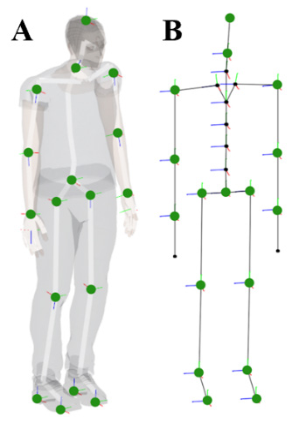
Although the skeleton models implemented in Xsens and IPS IMMA differ in some joint definitions and segment representations, they produce comparable kinematic results. A direct comparison between the two skeletal models (Figure 1) was performed to identify corresponding joints (shown in green). Hand segments were excluded from this comparison, as their spatial position is fully determined by the wrist joints. Similarly, spinal joints were not explicitly analysed because the back models differ substantially between the two systems, high precision in intervertebral joint angles was not required for the intended use cases, and ergonomic assessment methods typically model the trunk as a single segment. Nevertheless, IPS IMMA internally retains spinal joints within its posture prediction framework.
Figure 1: IPS IMMA (A) and Xsens (B) skeletons and corresponding joints in green.
Within IPS IMMA, it is possible to selectively activate and constrain specific control points (joints) and link them to the motion recorded with Xsens system. This flexibility enables systematic investigation of reduced joint configurations. In defining the tests, we considered the ability of IPS IMMA to predict the posture and evaluate some metrics based on the position and orientation of independent parameters: Segments and joints of the skeleton. For this reason, while eliminating some joints, we introduced additional constraints in the orientation level and stricter constraints at position level.
Given the lack of a direct one-to-one correspondence between individual Xsens sensors and skeletal joints in the digital human model, the analysis was conducted at the joint level rather than at the sensor hardware level. This joint-centric approach allows generalization of the findings across different sensor configurations and supports practical sensor reduction strategies for digital human twin applications.
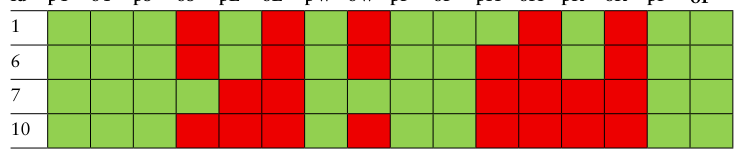
Sensor Reduction Strategy Each experimental configuration activated or deactivated specific joint control points and defined whether constraints were applied at the position level only or at both position and orientation levels (Table 1).
Symmetry considerations were applied such that bilateral joints (e.g., shoulders, elbows, knees) were always treated as pairs. Certain anatomical landmarks such as the top of the head and pelvis, were considered fundamental due to their biomechanical role in defining global posture, balance, and alignment.
Table 1: Summary of joint constraint configurations evaluated. T = Top of Head, N = Neck, S = Shoulders, E = Elbows, W = Wrists, P = Pelvis,
Table available in the original PDF paper.
H = Hips, K = Knees, F = Feet, O = Toes; p = position, o = orientation. In green active constraints, in red inactive ones.
Id pT oT pN oN pS oS pE oE pW oW pP oP pH oH pK oK pF oF pO oO
Benchmark Movement and Motion Accuracy Evaluation Metrics To ensure generalizability across common industrial postures, an internal MoCap dataset was recorded comprising ten benchmark movements representative of typical occupational tasks. Each benchmark movement was simulated using all the experimental configurations reported in Table 1.
A. Walking B. Bending down C. Bowing D. Arm circles E. Squats and bowing F. Kneeling G. Trunk flexion and extension H. Arm elevation I. Single-leg stance J. Walking while crouching For each simulation, the spatial deviation between the IPS IMMA digital manikin and the reference Xsens skeleton was computed. The evaluation focused exclusively on translational distance between corresponding joint positions, expressed in millimeters. Rotational discrepancies were not directly quantified but indirectly assessed through posture prediction behaviour.
Due to structural differences between the skeletal models, joint alignment offsets were manually corrected where necessary, and numerical adjustments were applied to ensure fair distance comparisons. An experimental configuration was considered acceptable if joint deviations remained within predefined tolerance thresholds and the simulated motion remained biomechanically feasible. Those configurations that caused instability, loss of ground contact, or unrealistic postures were excluded. A subset of configurations demonstrating acceptable accuracy and stability was retained for further ergonomic validation.
Model Validation The acceptable configurations were then validated using the REBA ergonomic evaluation method. REBA is an ergonomic assessment method, which stands for Rapid Entire Body Assessment; it is an ergonomic tool used to evaluate musculoskeletal disorder risks in manual and repetitive tasks (Hignett et al., 2000). It scores the posture of key body segments and combines these into a single risk level, allowing quick identification of high-risk tasks. REBA can be applied directly to human subjects or integrated with DHM for automated ergonomic assessment.
Configuration 01 (full joint constraint set) served as the reference condition. For each acceptable configuration, all REBA parameters were compared against the reference to identify deviations that could influence ergonomic risk classification. The analysis was first performed using internal MoCap recordings to assess the model’s performance under controlled conditions. To further test the model in a real industrial workstation.
Optimization of Motion Capture Technology for a Human Digital Twin 105 Industrial Use-Case
To evaluate real-world applicability, the proposed methodology was applied to MoCap data collected during an industrial activity at CHIMAR, a logistics company. The selected workstation was the windshield refinement process, which involves manual handling, wrapping, and packing of large automotive windshields and is characterized by asymmetric load handling, trunk flexion, and repetitive upper-limb movements. Reduced sensor configurations were evaluated against the full sensor setup in terms of motion reproduction fidelity and consistency of REBA ergonomic risk scores.
RESULTS AND DISCUSSION
Screening of the Experimental Configurations Using Benchmark Movements The initial benchmark evaluation highlighted the critical role of lower- limb and trunk-related constraints in ensuring biomechanically feasible simulations. Configurations in which constraints at the feet were removed systematically led to instability, including loss of ground contact and unrealistic lower-limb kinematics during tasks involving kneeling, bending, walking, and movements of the arms mainly in positions that are of difficult reachability. Similar issues were observed when the pelvis or the top of the head was unconstrained, resulting in poor global alignment and balance. These findings confirm the biomechanical importance of these joints in defining the global reference frame of the HDT.
In contrast, excluding the neck and toe joints did not compromise motion fidelity and, in several cases, improved simulation robustness by preventing over-constrained posture prediction. Therefore, these joints were considered non-essential and were excluded from subsequent analyses. In Table 2, the selected configurations with the relative constraints are shown.
Table 2: Selected configurations.
Id pT oT pS oS pE oE pW oW pP oP pH oH pK oK pF oF
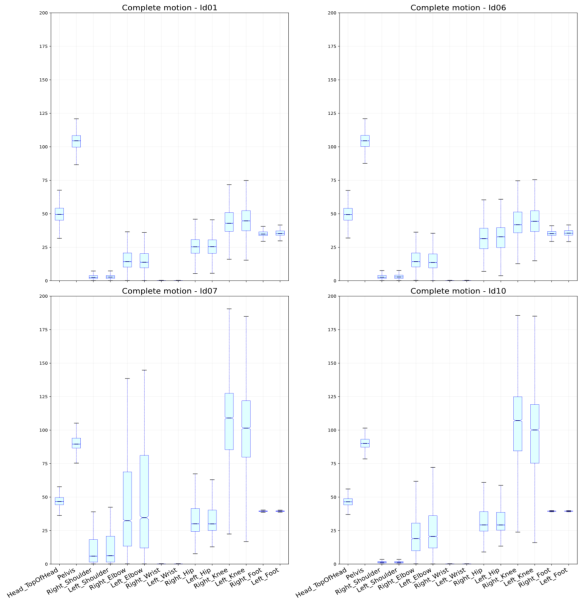
Motion Accuracy Evaluation Between IPS IMMA and Xsens For the retained configurations, translational deviations between the IPS IMMA manikin and the reference Xsens skeleton were analysed across all benchmark movements (Figure 2). Configurations 01 (full joint set) and 06 exhibited nearly identical error distributions across all joints, indicating that explicit hip constraints can be safely removed when the pelvis is constrained. This observation is further supported by configurations 07 and 10, in which
no significant changes were observed at the hip joints relative to the reference configuration. These results demonstrate that not all joints contribute equally to motion accuracy and that redundant constraints can be eliminated without degrading kinematic fidelity. In all cases, the IPS manikin accurately followed the Xsens motion while remaining within the prescribed tolerance limits.
Further joint reductions in configurations 07 and 10 led to increased variability at unconstrained joints, particularly at the elbows and knees, which were entirely predicted by the posture model. In configuration 07, orientation constraints were applied to joints adjacent to the elbows (shoulders and wrists), whereas in configuration 10 these joints were left free to rotate. Configuration 10 consistently showed improved elbow positioning compared to configuration 07, suggesting that reduced orientation constraints allow the posture prediction model to resolve joint kinematics more effectively. Similar to the previously observed effects of neck and toe constraints, excessive constraint density may negatively affect posture prediction. For the knees, however, both configurations exhibited comparable behaviour, indicating a lower sensitivity to adjacent joint orientation constraints.
Figure 2: Translational deviations for the complete motion. The distance (y-axis) is reported in millimeters.
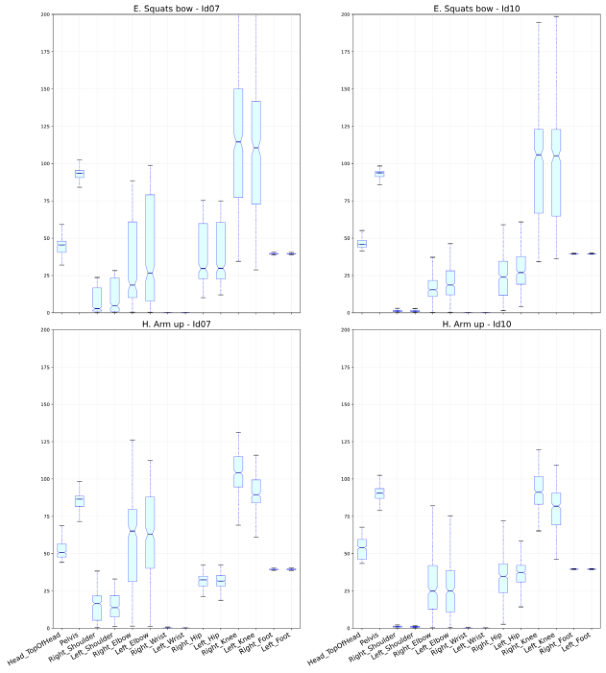
To further investigate the interaction between reduced joint constraints and posture prediction, benchmark movements were analysed separately for
Optimization of Motion Capture Technology for a Human Digital Twin 107 upper- and lower-body tasks. Figure 3 shows the translational deviations configurations 07 and 10.
For upper-body movements, configuration 10 demonstrated substantially improved elbow positioning compared to configuration 07. This indicates that relaxing orientation constraints at the shoulders and wrists allows the predictive model to generate more accurate and natural upper-limb postures. Conversely, knee deviations showed limited sensitivity to these changes, with similar trends observed in both configurations. This suggests that lower-limb posture prediction is primarily governed by constraints at the pelvis and feet.
These findings emphasize that increased constraint density does not necessarily improve motion accuracy and may, in some cases, interfere with the predictive model’s ability to generate biomechanically plausible postures.
Figure 3: Translational deviations for the for upper- and lower-body tasks for configurations 07 and 10. The distance (y-axis) is reported in millimeters.
Model Validation Ergonomic validation with the REBA method using the internal MoCap data demonstrated strong agreement between reduced joint configurations and the reference condition. Configuration 06 produced identical REBA risk levels across all benchmark movements, highlighting the same ergonomic criticalities as the full joint configuration.
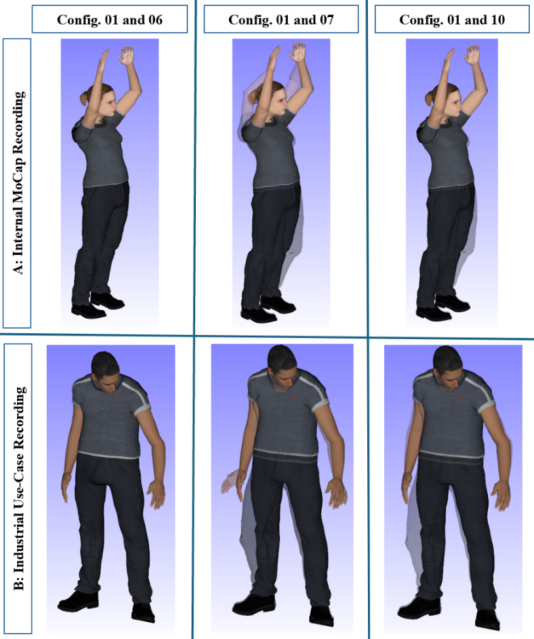
Compared to the reference configuration, configuration 07 exhibited noticeable deviations in knee and wrist flexion (Figure 4A, Config. 01 and 07), which negatively affected motion accuracy and typically increased the REBA ergonomic risk score by one level for the upper-limb criteria. The altered knee posture (Figure 4) is attributable to the IPS IMMA posture prediction model, which, in the absence of direct knee constraints, tends to introduce slight knee flexion to achieve a more ergonomically favourable posture; however, this adjustment did not affect the leg-related risk level. In contrast, increased wrist flexion arose from compensatory elbow repositioning required to accommodate constrained shoulder rotation, leading to a higher ergonomic risk classification. Conversely, configuration 10 showed only minor knee deviations for the same predictive reasons, while wrist posture remained closely aligned with the reference (Figure 4A, Config. 01 and 10), resulting in unchanged REBA risk levels and confirming that these kinematic differences were not ergonomically significant.
The industrial windshield refinement task at CHIMAR confirmed the benchmark findings under real-world conditions. Configuration 06 closely matched the reference motion, with negligible joint deviations and identical REBA scores across all criteria.
Figure 4: Comparison between confriguration 1 and selected confriguations (shaded) for the internal MoCap and industrial use case.
Optimization of Motion Capture Technology for a Human Digital Twin 109 Configuration 07 again exhibited deviations in wrist and knee postures (Figure 4B, Config. 01 and 07), leading to increased ergonomic risk for upper-limb criteria by one level. Configuration 10 maintained wrist kinematics consistent with the reference configuration and showed only minor knee deviations (Figure 4B, Config. 01 and 10), which did not affect the overall REBA risk level. These results demonstrate that the reduced joint configuration remains robust in a complex industrial task involving asymmetric loads and repetitive upper-limb activity.
Generalization of the Methodology Based on the preceding analyses, general guidelines can be defined for reducing the number of sensors without compromising the accuracy of the HDT or the reliability of ergonomic evaluations. Depending on the user’s priorities, two optimized joint configurations can be selected:
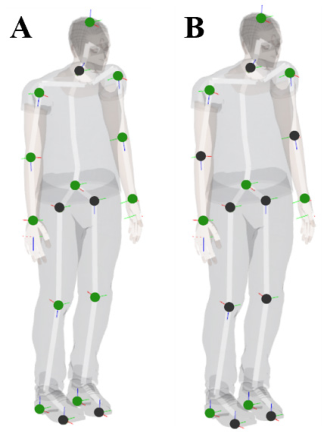
Setup 1: aimed at maximizing motion reconstruction accuracy, corresponds to configuration 06, which excludes the neck and hip joints while preserving full postural fidelity (Figure 5A). This setup consistently identifies the same ergonomic criticalities as the complete sensor configuration.
Setup 2: designed to minimize the number of sensors, corresponds to configuration 10, which further excludes the elbow and knee joints (Figure 5B). Although this configuration introduces minor discrepancies, most notably at the knees, it still enables accurate posture prediction and the ergonomic risk score is consistent with the full configuration (01).
Figure 5: Active join (in green) and excluded joints (in dark grey) of the IPS IMMA skeleton. Setup 1(A) and Setup 2(B).
FUTURE WORKS Future work may explore two main directions. First, the applicability of the proposed methodology could be examined across a wider range of industrial scenarios to further assess its robustness and potential for generalization beyond the use case considered. Second, the feasibility of extending the approach to a family of digital manikins with varying anthropometric characteristics could be investigated by leveraging the joint tolerance capabilities of IPS IMMA, enabling MoCap data to be adapted to different body dimensions.
CONCLUSION
This study presented a joint-level approach for optimizing MoCap configurations in HDT development, aiming to reduce sensor requirements while maintaining motion accuracy and reliable ergonomic assessment. By combining benchmark movements with an industrial use case and leveraging the posture prediction capabilities of IPS IMMA, the results demonstrate that accurate motion reconstruction does not require a full set of joint constraints.
The findings show that constraints at the pelvis, feet, and top of the head are essential to ensure postural stability, whereas other joints can be selectively removed without compromising kinematic fidelity or REBA-based ergonomic evaluation. In some cases, reducing constraints improved posture prediction by avoiding over-constrained kinematic solutions. Validation using Xsens data and an industrial task at CHIMAR confirmed the robustness of the approach under real-world conditions.
Among the tested configurations, the most reduced setup provided a favourable balance between minimal joint constraints and consistent ergonomic risk classification, supporting practical, cost-effective deployment of Human Digital Twins for industrial ergonomics.
ACKNOWLEDGMENT
This research was funded by MICS (Made in Italy—Circular and Sustainable) Extended Partnership and received funding from Next-Generation EU (Italian PNRR—M4 C2, Invest 1.3, PE00000004) CUP MICS D43C22003120001, project title “SOSTELOGICA—Ambienti di Lavoro SOSTEnibili ed Inclusivi per la LOGIstiCa del Settore dell’Abbigliamento e dell’Oggettistica”.
REFERENCES
Adel, A. (2022). Future of industry 5.0 in society: human-centric solutions, challenges and prospective research areas. Journal of Cloud Computing, 11(1), 40. fleXstructures GmbH. IPS IMMA: Intelligent Digital Human Modelling. Accessed
January 08, 2026, from https://flexstructures.com/products/ips-imma/. Golovianko, M., Terziyan, V., Branytskyi, V., & Malyk, D. (2023). Industry 4.0 vs.
Industry 5.0: Co-existence, transition, or a hybrid. Procedia Computer Science, 217, 102–113. Hignett, S., & McAtamney, L. (2000). Rapid entire body assessment (REBA). Applied ergonomics, 31(2), 201–205.
Optimization of Motion Capture Technology for a Human Digital Twin 111 Rybnikár, F., Kačerová, I., Hořejší, P., & Šimon, M. (2022). Ergonomics evaluation
using motion capture technology—literature review. Applied Sciences, 13(1), 162. Salisu, S., Ruhaiyem, N. I. R., Eisa, T. A. E., Nasser, M., Saeed, F., & Younis, H.
A. (2023). Motion capture technologies for ergonomics: A systematic literature review. Diagnostics, 13(15), 2593. Schaub, K., Kugler, M., Bierwirth, M., Sinn-Behrendt, A., Bruder, R. (2012).
Prevention of MSD by means of ergonomic risk assessment (tools) in all phases of the vehicle development process. Work, 41(SUPPL.1), 4409–4412. Schepers, M., Giuberti, M., & Bellusci, G. (2018). Xsens MVN: Consistent tracking of human motion using inertial sensing. Xsens Technol, 1(8), 1–8. Xsens. Motion capture and inertial sensor solutions. Accessed January 12, 2026,
from https://www.xsens.com/movella/. Xu, X., Lu, Y., Vogel-Heuser, B., & Wang, L. (2021). Industry 4.0 and Industry 5.0—Inception, conception and perception. Journal of manufacturing systems, 61, 530–535.
LISTED IN THE AHFE DIGITAL BOOKSTORE CATALOGUE
Explore the complete digital volume
Human Factors in Simulation, Software and Systems Engineering
Read this individual research paper free through the original publisher, or explore the full digital proceedings book.
ISBN 978-1-964867-96-0
Explore this ISBN in the AHFE Bookstore ↗Listed in the July 2026 bookstore catalogue; search by ISBN to confirm current availability · Digital book purchase optional