Manuela Vargas, Valerio Cibrario, Denise Tumiotto, Annalisa Bertoli, Cesare Fantuzzi (2026). Human-Centered optimization through Digital Twins, and Motion Capture Technologies of a manual activity in the logistics sector. In: Human Interaction and Emerging Technologies (IHIET-AI 2026): Artificial Intelligence and Future Applications. AHFE Open Access, vol. 201, pp. 22–31. https://doi.org/10.54941/ahfe1007157
Industry 4.0 has enabled significant technological advances for industrial applications, creating new business opportunities but often neglecting how operators interact with increasingly complex systems. In contrast, Industry 5.0 emphasizes a human-cantered approach, highlighting the role of operators and their interaction with automation in modern industrial environments. Despite technological progress, many industrial sectors, such as logistics, continue to rely on fully manual tasks. These workstations are frequently poorly optimized, ergonomically inadequate, and not inclusive of diverse operators. The repetitive and physically demanding nature of such tasks can lead to fatigue, stress, and increased risk of injury, negatively impacting both operator well-being and productivity.This paper proposes an innovative methodology to optimize manual operations in the logistics sector through advanced technologies and a human-centered design approach. The goal is to enhance inclusivity, reduce physical loads, and minimize injury risks associated with repetitive or hazardous activities. To this end, motion capture systems (MoCap) and digital human simulation software were employed to develop a digital twin of both operators and workstations. This virtual model enabled the analysis of the current situation and the simulation of multiple optimization scenarios. By using this risk-free environment, alternative automation solutions were evaluated, and the most effective configurations were identified based on performance, efficiency, and safety.A comprehensive ergonomic evaluation complemented the analysis, assessing key indicators to define the optimal task distribution between human operators and automated systems. This ensured minimized physical load on operators while maximizing operational efficiency. Virtual reality (VR) technology was integrated into the validation process, allowing operators to interact directly with proposed solutions in a virtual setting. The proposed methodology was applied to a real logistics process to validate its practicality and effectiveness. Preliminary results confirmed its potential in industrial applications, demonstrating improvements in ergonomics, inclusivity, and productivity. These findings are further detailed and discussed in the final version of the paper.Additionally, a dedicated study was conducted on the number of sensors required in MoCap acquisitions. The objective was to determine the minimum number of sensors necessary to accurately reproduce operator motion, while exploiting the posture prediction capabilities of a digital human simulation software IPS IMMA. This analysis is important due to the fact that reducing the number of sensors directly lowers acquisition time, system complexity, and implementation costs, thereby making the methodology more practical and scalable for industrial deployment. By identifying an optimal compromise between sensor quantity and motion fidelity, the study contributes to the efficient and sustainable use of advanced motion capture technologies in industrial contexts.Overall, this work highlights the importance of integrating ergonomic considerations and human factors into industrial automation strategies. By placing the operator at the center of system design, the study demonstrates how logistics operations can be optimized not only for efficiency but also for inclusivity, safety, and operator well-being. These findings provide practical insights for the transition toward Industry 5.0, where human–machine collaboration is essential for sustainable productivity and improved job satisfaction.
After a decade of Industry 4.0 development, the European Commission introduced Industry 5.0 to address new industrial and societal challenges (Golovianko et al., 2025). This new approach emphasizes collaboration between humans and machines, promoting deep integration between human skills and machine intelligence to enhance efficiency (Adel, 2022). Unlike the technology-driven Industry 4.0, Industry 5.0 is value-driven, focusing on human well-being, sustainability, and ethics (Xu et al., 2021). In this context, robots do not replace humans but support them by performing dangerous or repetitive tasks, allowing operators to focus on activities that require Received September 5, 2025; Revised November 28, 2025; Accepted December 12, 2025; Available online April 1, 2026
Human-Centered Optimization Through Digital Twins, and Motion Capture Technologies 23 creativity, empathy, and critical thinking. The goal is to create a synergistic relationship between humans and machines. The transition from Industry 4.0 to Industry 5.0 has intensified attention on operator well-being and workplace health, emphasizing human-centered design and ergonomics.
Despite high levels of automation, many assembly and production tasks remain manual due to human flexibility. However, such repetitive and awkward activities often cause musculoskeletal disorders and injuries that harm workers’ health (Rybnikár et al., 2022). Specifically, the present paper focuses on studying a real use case in the logistics sector. This sector, responsible for managing, moving, and storing goods within supply chains, aims to ensure efficient, cost-effective, and timely deliveries. However, many manual operations, such as handling heavy items and working in uncomfortable postures, pose significant health risks to operators (Loske et al., 2021).
Ergonomics is defined by the International Association of Ergonomics as a scientific discipline that studies the interaction between humans and system components with the goal of optimizing human well-being and overall system performance (IRIMIE et al., 2021). An ergonomic workstation offers several benefits, including reduced worker fatigue, prevention of musculoskeletal disorders, lower absenteeism, and enhanced worker performance (Mali et al., 2015). Motion capture (MoCap) systems are widely used to assess workstation ergonomics, as they allow the creation of Digital Twins (DTs), which are virtual replicas of physical systems used to simulate real-world scenarios (Rahmani et al., 2024).
This article presents a human-centered methodology for optimizing a manual logistics workstation. It is an extension of the work presented in a previous paper (Bertoli et al., 2025). A DT of a real use case (As-Is scenario) in logistics was developed using data collected from a MoCap system, enabling optimization based on the workstation’s actual configuration. In the previous work, the introduction of a serial manipulator robot was studied. This paper intends to evaluate the same scenario by integrating instead a Cartesian robot. A comparison between both scenarios is performed to determine the most optimal solution for workstation optimization.
METHODOLOGY
We present the main components of the analysis. A detailed description of the studied workstation is provided, along with the technologies and tools applied to achieve the optimized scenario. The resulting solution was then validated using a VR system.
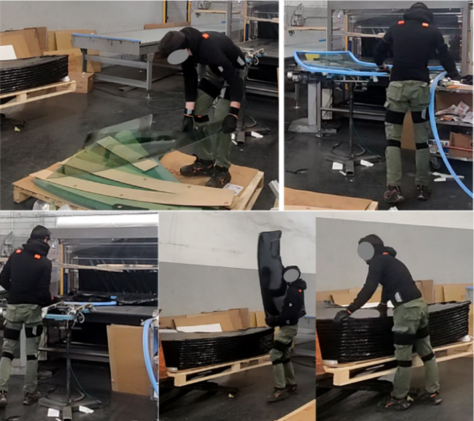
Use Case The studied workstation concerns car windshield refinement. Each windshield must be wrapped in protective foam and then secured with plastic using a packing machine.
The cycle involves handling large objects weighing between 17 kg and 21 kg. The process begins with the operator lifting a windshield from a pallet positioned at ground level and placing it onto a suction-cup structure, which holds it in place during the application of protective foam. Once the foam is applied, the windshield is inserted into a packing machine that secures it with plastic. For larger windshields, the operator must manually add extra plastic scraps, as the machine is not large enough to cover the entire surface. After packing, the operator lifts the packed windshield and places it onto a dispatch pallet. Figure 1 shows the sequence of the working task.
This task presents significant ergonomic risks due to the repeated handling of heavy objects and the workstation layout, which requires the operator to adopt awkward and physically demanding postures.
Figure 1: Windshield refinement workstation.
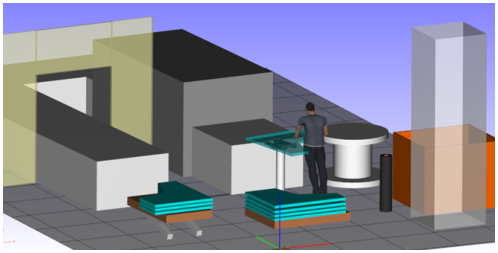
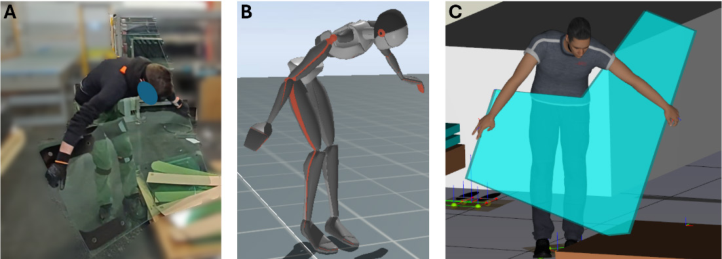
Motion Capture and Digital Twin of the As-Is Scenario The DT of the windshield refinement workstation was developed using the Xsens MoCap and IPS IMMA (Figure 2). One operator was equipped with 17 Xsens sensors to record task execution under real working conditions (Figure 3A). The collected MoCap data were imported into IPS IMMA to generate a human Digital Twin (Figure 3C), accurately reproducing the operator’s anthropometric features and movement patterns.
Ergonomic evaluation was performed using the EAWS Whole Body method integrated into IPS IMMA, and validated through a manual assessment conducted by a certified EAWS expert. The overall EAWS Whole Body score indicates a medium-high risk level, mainly resulting from lifting the windshields from the raw material pallet (Figure 3) and placement of them onto the dispatch pallet.
Figure 2: As-Is scenario of the Windshield refinement in IPS IMMA.
As the As-Is configuration and its ergonomic findings have already been extensively discussed in Bertoli et al., (2025), only a brief summary is provided here to contextualize the subsequent optimization phase.
Figure 3: Windshield lifting task in the 3 phases of the Digital Twin creation A) MoCap acquisition with Xsens system, B) Worker’s motion on Xsens MVN software, C) Digital Twin on IPS IMMA.
Implementation of the Optimized Solution To address the ergonomic risks identified in the As-Is scenario, an optimized workstation was developed where a robot assists the operator in physically demanding pick-and-place operations. The robot handles tasks such as retrieving windshields from the raw material pallet, positioning them on the suction-cup frame, and transferring the packed units to the dispatch pallet. The operator performs lighter activities including foam application and plastic wrapping, ensuring continuous workflow and improved task distribution.
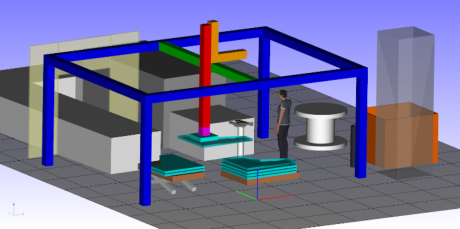
A previous study analyzed the first optimization setup using a serial manipulator (Bertoli et al., 2025). This paper focuses instead on a Cartesian robot implementation. The optimization was modeled and simulated using IPS IMMA and IPS Robotics (Figure 4), taking into account spatial constraints and real workstation geometry.
Robot positioning and motion planning were optimized to guarantee reachability and compliance with collaborative safety standards (ISO/TS 15066). Speed and Separation Monitoring (SSM) ensured safe interaction,
with robot speed limited to below 50% when operating near the human operator. Task synchronization between the robot and the operator was implemented to maintain workflow continuity and cycle time efficiency.
Figure 4: Optimized solution with the Cartesian robot using IPS IMMA and IPS Robotics.
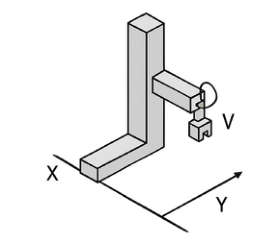
The Cartesian Coordinate Robot The Cartesian robot, also known as linear robot, is a conceptual model designed to perform structured pick-and-place operations along three orthogonal linear axes (X, Y, Z), with the addition of two rotative joints (V, W), see Figure 5. This type of architecture offers high precision and efficiency for tasks involving linear motion, such as horizontal transfers and vertical lifts.
The Cartesian robot was developed as an alternative to the serial manipulator (Bertoli et al., 2025) for the optimization of the windshield refinement real-case scenario to reduce unnecessary and complex motions and improve task execution speed. Its simplified kinematic structure allows for direct point-to-point movements without the need for complex joint coordination. The Cartesian robot is designed to ensure full reachability across the working area, with estimated joint velocities derived from comparable commercial gantry systems. The Cartesian robot is equipped with a suction cup gripping system capable of lifting loads of up to 25 kg, enough to handle all windshield models processed in this workstation.
Although it lacks the flexibility of a serial manipulator, the Cartesian configuration is well-suited for repetitive handling tasks and offers advantages in terms of predictability, safety, mechanical robustness and cost. The Cartesian robot is built and simulated using IPS Robotics.
Figure 5: Definition of a Cartesian robot.
Human-Centered Optimization Through Digital Twins, and Motion Capture Technologies 27 Validation of the Optimized Solution
The effectiveness of the optimized workstation integrating a Cartesian robot was evaluated in terms of ergonomic improvement, productivity performance, and task feasibility through Virtual Reality (VR) simulation.
Ergonomic assessment was conducted using the EAWS Whole Body method implemented in IPS IMMA, following the same procedure applied to the As-Is scenario (Bertoli et al., 2025). The motion of both the human operator and the Cartesian robot was simulated to quantify the ergonomic impact of task redistribution.
Performance was analyzed through four Key Performance Indicators (KPIs) defined at the beginning of the project.
1. Task Completion Time: The average time taken to complete a task when performed collaboratively by humans and robots versus humans alone. 2. Throughput Rate: The number of units produced or tasks completed within a specific timeframe in an HRC setup. 3. Utilization Rate: The total time of usage of the robot compared with the total amount of time for the task. 4. Cycle Time Reduction: The decrease in the time required to complete a cycle of tasks due to collaboration between humans and robots.
The optimized layout and task feasibility were validated through VR simulation, allowing to visualize and interact with the redesigned workstation. This validation made it possible to verify the robot’s reachability, workspace coverage, and alignment with the real layout, as well as to experience the new workflow and evaluate the division of tasks between the human and the robot.
A comparative analysis between the serial manipulator and the Cartesian robot configurations is performed to determine the most effective optimization strategy. The comparison considers all evaluation parameters, including ergonomic improvement, productivity performance based on the defined KPIs, and task feasibility assessed through VR simulation. This analysis aims to identify which robotic solution offers the best balance between efficiency, safety, and human–robot collaboration.
RESULTS AND DISCUSSION
The results involve the study of the ergonomics of the workstation, the validation of the model with the VR, and the verification of the KPIs. Afterward, a comparison analysis with the serial manipulator is performed (Bertoli et al., 2025).
Ergonomic Evaluation The main ergonomic risks of the workstation under investigation arise from the Manual Material Handling (MMH) section, due to the heavy lifting involved in repositioning the windshields from the raw material pallet and its placement to the dispatch pallet. As previously discussed, the optimization
seeks to improve worker well-being by delegating the repositioning tasks to the robot, enabling the operator to concentrate on lower-load activities.
The results of the EAWS Whole Body ergonomic evaluation applied to the simulation of the optimized solution using the Cartesian robot show a significant reduction in ergonomic risk, decreasing from a medium-high level to a low level. The solution notably improves the ergonomics of the workstation, thereby enhancing the operator’s well-being by reducing the likelihood of developing musculoskeletal disorders and decreasing overall worker fatigue.
Moreover, as the remaining manual tasks include a lower physical load, the workstation becomes more inclusive, allowing a broader range of workers, including women and older employees, to perform the tasks safely and effectively.
KPIs Validation The productivity performance is analysed by applying the KPIs described in the previous section to the simulation performed with IPS IMMA and IPS Robotics of the optimized workstation. The specific data for the As-Is scenario are detailed in Bertoli et al., (2025).
1. Task Completion Time: With the introduction of the Cartesian robot, the average time required to complete a full refinement cycle is 333 seconds, representing a 26% reduction compared with the original time of 448 seconds. 2. Throughput Rate: Owing to collaborative automation, the number of units processed per shift increases from 121 to 162, corresponding to a 35% improvement in productivity. 3. Utilization Rate: The Cartesian robot is actively working for 13% of the total cycle time. 4. Cycle Time Reduction: Compared with the original scenario, a total reduction of 115 seconds (equivalent to 26% of the original cycle time) is achieved.
The KPI analysis confirms that the integration of the Cartesian robot significantly enhances the workstation’s overall performance. The improvements in task completion time, throughput, and cycle efficiency demonstrate the system’s ability to increase productivity while maintaining safe and ergonomic working conditions. These results highlight the effectiveness of human-robot collaboration in achieving both operational and human-centered optimization objectives.
VR Validation During the VR validation, the users were able to familiarize themselves with the new workstation layout and assess its feasibility, allowing them to confirm that the robot could accurately reach all required target positions. Moreover, the users were also able to experience the new workflow and gain a better
Human-Centered Optimization Through Digital Twins, and Motion Capture Technologies 29 understanding of the human-robot collaboration activities, task distribution between the robot and the operator, as well as the timing and coordination required during interaction. This helped the users understand how to safely and efficiently carry out the tasks alongside the robot.
Comparative Analysis A comparative analysis between the results obtained in this study and those from the previous work on the serial manipulator was performed. Table 1 summarizes the overall performance parameters for both the serial manipulator and the Cartesian robot in terms of cycle time and productivity.
The Cartesian robot achieves a slightly shorter total cycle time (333 seconds) compared to the serial manipulator (341 seconds). Although the difference is modest (8 seconds), it results in a slightly greater cycle time reduction (26% vs. 24%) and enables the processing of four additional windshields per shift, 162 units versus 158. Consequently, the productivity gain associated with the Cartesian robot reaches 35%, outperforming the 31% observed for the serial manipulator. These results indicate that the Cartesian setup not only improves execution efficiency but also increases throughput under the current process conditions.
Both optimization solutions present a low ergonomic risk level for the worker, with only a minimal difference of 0.05 points between them. These results demonstrate that the Cartesian configuration provides greater efficiency and higher throughput without compromising worker safety or increasing ergonomic risk.
Although the performance improvements achieved with the Cartesian robot over the serial manipulator are relatively small, it is important to recognize that the simulation results are deterministic representations of the process rather than stochastic reflections of real production variability. In an actual industrial environment, even modest gains observed under ideal conditions translate into meaningful and measurable improvements on the production line. Therefore, the consistent advantages offered by the Cartesian robot, however limited in simulation, are expected to yield tangible benefits in real operational settings.
Table 1: Cycle time and productivity analysis for the serial manipulator and the Cartesian robot.
Table available in the original PDF paper.
Parameters Serial Manipulator Cartesian Robot Cycle time (s) 341 333
In addition to performance considerations, both the cost of the robot itself and its implementation were evaluated to determine whether the Cartesian robot represents the optimal solution for the windshield refinement workstation. The analysis showed that the combined acquisition
and implementation costs of the Cartesian robot are approximately 35% lower than those of the serial manipulator. From the maintenance perspective, Cartesian robots require less maintenance due to their simple, easily accessible linear axes. In contrast, serial robots have a more complex kinematic chain that makes diagnostics and repairs more demanding and expensive.
This finding reinforces the conclusion that the Cartesian robot is the most suitable choice for this application, not only in terms of workers’ well-being, efficiency, and throughput, but also regarding overall cost-effectiveness.
FUTURE WORKS Building on the demonstrated effectiveness of MoCap data for generating accurate Human Digital Twins, future work will focus on optimizing the motion capture setup itself. In industrial environments, equipping workers with a full set of sensors is often time consuming, and reducing this preparation time is essential to improving the practicality of the method. For this reason, a dedicated study will investigate the minimum number of sensors required to reliably reproduce operator movements while leveraging the posture prediction capabilities of the IPS IMMA digital human simulation software.
This analysis is particularly relevant because decreasing the number of sensors not only shortens acquisition time but also reduces system complexity and overall implementation costs. Identifying an optimal balance between sensor count and motion fidelity will support a more efficient and scalable integration of MoCap based Digital Twin methodologies in industrial settings. The outcomes of this study are expected to contribute to the broader adoption of advanced motion capture technologies in a sustainable and industry-oriented manner.
CONCLUSION
This work presented a human-centered methodology for optimizing a manual logistics workstation through the combined use of Motion Capture, Digital Twins, and human–robot collaboration. By integrating a Cartesian robot into the windshield refinement process, physically demanding manual material handling tasks were reassigned to the robot, reducing the operator’s exposure to high ergonomic risk. The EAWS Whole Body analysis confirmed a substantial improvement, lowering the risk level from medium-high in the As-Is scenario to a low level in the optimized configuration.
Productivity evaluation using predefined KPIs demonstrated notable performance gains. The introduction of the Cartesian robot reduced cycle time by 26%, increased throughput by 35%, and improved overall workflow efficiency. VR validation further confirmed the feasibility of the redesigned workstation, ensuring safe human–robot interactions and enabling users to experience the new task distribution and coordination requirements.
The comparative analysis with the previously studied serial manipulator revealed that both robotic solutions effectively reduced ergonomic risk; however, the Cartesian robot offered superior performance in terms of cycle
Human-Centered Optimization Through Digital Twins, and Motion Capture Technologies 31 time, throughput, and cost-effectiveness, with approximately 35% lower acquisition and implementation costs. These results indicate that the Cartesian configuration represents the most advantageous optimization strategy for the studied use case, providing a balanced improvement in worker well-being, operational efficiency, and economic sustainability.
Future work will investigate reducing the number of MoCap sensors required to generate accurate Human Digital Twins, aiming to facilitate data acquisition and enhance the scalability of the methodology for industrial deployment.
ACKNOWLEDGMENT
This research was funded by MICS (Made in Italy—Circular and Sustainable) Extended Partnership and received funding from Next-Generation EU (Italian PNRR—M4 C2, Invest 1.3, PE00000004) CUP MICS D43C22003120001, project title “SOSTELOGICA—Ambienti di Lavoro SOSTEnibili ed Inclusivi per la LOGIstiCa del Settore dell’Abbigliamento e dell’Oggettistica”.
REFERENCES
Adel, A. (2022). Future of industry 5.0 in society: human-centric solutions, challenges and prospective research areas. Journal of Cloud Computing, 11(1), 40. Bertoli, A., Nini, M., Cibrario, V., Vargas, M., Perona, P., Rossi, L., Benedetti, L.,
Nicolinti, A., & Fantuzzi, C. (2025). Leveraging Digital Twin Technology with a Human-Centered Approach to Automate a Workstation in the Logistics Sector of Made in Italy: CHIMAR Use Case. Machines, 13(4), 303. Golovianko, M., Terziyan, V., Branytskyi, V., & Malyk, D. (2023). Industry 4.0 vs.
Industry 5.0: Co-existence, transition, or a hybrid. Procedia Computer Science, 217, 102–113. IRIMIE, S. I., & IRIMIE, S. (2021). Ergonomy and the ergonomist. Historical and current references. Acta technica napocensis-Series: Applied mathematics, Mechanics, and Engineering, 64(1–S1). Loske, D., Klumpp, M., Keil, M., & Neukirchen, T. (2021). Logistics Work,
ergonomics and social sustainability: Empirical musculoskeletal system strain assessment in retail intralogistics. Logistics, 5(4), 89. Mali, S. C., & Vyavahare, R. T. (2015). An ergonomic evaluation of an industrial workstation: A review. International Journal of Current Engineering and Technology, 5(3), 1820–1826. Rahmani, R., Jesus, C., & Lopes, S. I. (2024). Implementations of Digital
Transformation and Digital Twins: Exploring the Factory of the Future. Processes, 12(4), 787. Rybnikár, F., Kačerová, I., Hořejší, P., & Šimon, M. (2022). Ergonomics evaluation using motion capture technology—literature review. Applied Sciences, 13(1), 162. Xu, X., Lu, Y., Vogel-Heuser, B., & Wang, L. (2021). Industry 4.0 and Industry
5.0—Inception, conception and perception. Journal of manufacturing systems, 61, 530–535.
LISTED IN THE AHFE DIGITAL BOOKSTORE CATALOGUE
Explore the complete digital volume
Human Interaction and Emerging Technologies (IHIET-AI 2026): Artificial Intelligence and Future Applications
Read this individual research paper free through the original publisher, or explore the full digital proceedings book.
ISBN 978-1-964867-77-9
Explore this ISBN in the AHFE Bookstore ↗Listed in the July 2026 bookstore catalogue; search by ISBN to confirm current availability · Digital book purchase optional