Akram Jemal Mohammed, Esmaeel Mohammed Esmaeel Mohammed Alteneiji, Eleni Mengistu Alemayehu, Hamdah Ali Yousef Ali Alqaydi, Nahom Abreham Hailu, Tsion Hagos Seyoum, Ahmed Seffah (2026). AI-Assisted XR Design and User Testing: Lessons from an Undergraduate Sustainability Project. In: Human Interaction and Emerging Technologies (IHIET-AI 2026): Artificial Intelligence and Future Applications. AHFE Open Access, vol. 201, pp. 136–146. https://doi.org/10.54941/ahfe1007168
This paper examines the practical application and challenges of emerging AI-powered UX design tools in prototyping and testing Extended Reality (XR) interactions within an undergraduate Human-Computer Interaction course at Zayed University, UAE. As AI-driven design tools rapidly transform the landscape of user experience design, understanding their capabilities, limitations, and implications for XR development becomes increasingly critical for both educators and practitioners. This study documents a semester-long project where interdisciplinary undergraduate students from multiple colleges collaborated to design XR experiences aimed at promoting sustainability awareness and engaging diverse citizen groups in environmental action.The six students/authors detail their development process across three iterative laboratory sessions, employing AI-powered tools including generative design assistants, automated prototyping platforms, and AI-enhanced testing frameworks. Each iteration involved progressively refining XR worlds that immersed users in scenarios demonstrating the environmental impact of everyday actions and motivating behavioral change toward sustainability. The project challenged students to balance creative vision with the affordances and constraints of AI-assisted design tools while maintaining focus on user-centred design principles.Four significant challenges emerged during the UX-centric development process taught and adopted in this class.First, AI tools had substantial limitations in understanding XR-specific requirements. Traditional WIMP-based interfaces, XR interactions rely on spatial relationships, embodied interactions, presence, and multi-sensory feedback. Many AI-generated solutions were suited for conventional screen-based interfaces, requiring significant manual adjustments to create immersive XR experiences.Second, integrating AI tools into an iterative workflow presented unexpected complexities. While AI promised faster prototyping, maintaining design consistency, managing version control, and transitioning between AI-generated and manually refined elements demanded careful planning. The efficiency gains promised by AI tools were sometimes offset by the learning curve and workflow adjustments necessary for effective implementation.Third, user testing using traditional tools such as SUS, heuristic evaluation, psychometric tests, and thinking aloud protocol raised methodological concerns. Students questioned whether AI-generated prototypes had sufficient fidelity and interaction depth to elicit meaningful feedback, particularly regarding presence, immersion, and emotional engagement. This highlighted the need to reconsider validation methods when using AI in XR design.Fourth, the project’s environmental focus posed unique challenges. AI struggled to translate complex sustainability data into persuasive and actionable XR narratives. While it could process technical data quickly, the resulting visualizations were often too simplified or generic to motivate real behavioural change. Creating immersive XR worlds that were scientifically accurate, emotionally engaging, and visually compelling required substantial manual work, reducing the efficiency benefits promised by AI prototyping tools. The challenge was not just in visualization, but in meaningfully contextualizing complex real-world data within immersive and persuasive environments.Finally, ethical considerations were also central to the project. Professor Seffah addresses critical ethical concerns surrounding AI-powered design and prototyping tools in education and professional contexts. These concerns include questions of intellectual ownership, the possible loss of fundamental design skills, biases in AI training data that shape problematic design patterns, and the risk of diminishing human-centred design principles when algorithmic efficiency replaces empathetic user understanding.
Extended Reality (XR) is a technology that alters a user’s perception of reality by creating immersive environments where users interact and gain experiences. It includes Augmented Reality (AR), Virtual Reality (VR), and Received November 17, 2025; Revised January 14, 2026; Accepted January 26, 2026; Available online April 1, 2026
AI-Assisted XR Design and User Testing: Lessons 137 Mixed Reality (MR) (Zainal et al., 2022). XR technologies are increasingly used to create interactive environments in which users can experience, explore, and rehearse complex situations that would otherwise be difficult to access in everyday life. Such immersive environments have been shown to support trial-and-error learning in risk-free settings and enable deeper conceptual understanding through embodied interaction. These immersive environments help in solving certain problems as they provide hands-on and risk-free simulations, thereby creating room for trial and error and practice (Valente et al., 2025).
Artificial Intelligence (AI) refers to the ability of computers and machines to exhibit human-like intelligence and perform tasks using it (Wheatley and Hervieux, 2024). It has become a core component of contemporary interactive systems. It enhances the educational experience by providing adaptive and data-driven intelligence to technologies (Engineering, 2019). AI technologies enable digital systems to adapt to users, automate parts of the design process, and analyse behavioural data at scale. Within education, AI is increasingly positioned as a “co-teacher” and “co-designer” offering personalized and generative support that can augment students’ skills and creativity. This shift reframes students not only as designers of interactive systems, but also as collaborators with AI throughout the design process. AI enhances user understanding by examining their cognitive state, engagement level, and potential issues and providing personalised solutions based on this information. At the intersection of these trends lies human-AI interaction in design practice: students are no longer only designing interfaces for users, but also collaborating with AI systems to generate, refine, and evaluate interactive experiences.
Interactive learning is effective in influencing attitudes and behaviours towards sustainability by allowing people to directly experience the problems associated with climate change and experiment with potential solutions to address the issue. Sustainability and climate action offer a compelling application area for XR-based learning. Research in environmental and sustainability education suggests that interactive, experiential learning is more effective than abstract instruction in influencing attitudes and behaviours. XR technologies provide this immersive experience through simulations that deepen understanding, such as environments profoundly affected by climate change resulting from unsustainable human activities (Ebinger, Buttke and Kreimeier, 2022). Immersive simulations can place learners inside scenarios of coastal flooding, habitat loss, or resource scarcity, making otherwise distant or data-driven issues personally meaningful and emotionally salient. Implementing immersive and interactive learning can lead to multiple essential educational outcomes in sustainability.
Firstly, it creates a deeper understanding of global sustainability challenges (Douvlou, 2025). Studies further indicate that such experiences can promote global thinking, empathy, and a stronger sense of agency regarding sustainability challenges. Secondly, it enhances engagement by improving learning outcomes. Studies show that students achieve higher levels of enjoyment, which in turn leads to a better understanding
of sustainability concepts, when learning in an immersive environment (Abdelwahab, Elhussainy and Abuzainab, 2025). For universities seeking to align their curricula with the United Nations Sustainable Development Goals (UN-SDGs), XR therefore represents a promising medium for engaging students and citizens with complex environmental systems.
Despite growing interest in both AI and XR in education, a notable gap exists in reported cases that examine how undergraduate students utilise AI-powered design tools when developing XR experiences. The students utilised AI-powered tools to develop their XR technologies, and it is essential to determine whether these tools enhanced the design of their XR technologies. Prior work has explored AI-based interventions to teach sustainability concepts, such as chatbots created by business students to answer questions about the SDGs, but these studies tend to focus on AI as a content delivery mechanism rather than as a design partner. However, there seems to be a lack of documented cases of AI-assisted XR design among undergraduates. Little is known about how novice designers integrate generative AI, automated prototyping platforms, and AI-assisted evaluation tools into the end-to-end UX process of conceiving, prototyping, and testing XR interactions. This gap needs to be addressed to gain a deeper understanding of AI-assisted XR design in the context of HCI education.
To address the gap, we report on a semester-long project conducted within an undergraduate Human-Computer Interaction course at Zayed University in the United Arab Emirates. Interdisciplinary teams of students were tasked with designing AI-assisted XR experiences that encourage citizens to reflect on the environmental impact of their everyday actions and adopt more sustainable behaviours. This paper aims to understand how students utilise AI during XR design and to explore their experiences with it. It also extracts lessons that emerge from this use for HCI educators. Specifically, this study investigates how undergraduate students utilise AI during XR design, examines their design and evaluation experiences in practice, and identifies lessons for HCI educators seeking to integrate AI assisted XR design into their courses, including challenges related to XR specific design requirements, iterative workflows, user testing fidelity, translating complex data into XR experiences, and emerging ethical considerations.
LITERATURE REVIEW
The application of AI tools within HCI education is a significant shift in how interactive system design education is approached. Recent literature has identified opportunities as well as challenges that arise with the incorporation of generative AI within design practice. Studies describe the application of generative AI within undergraduate-level HCI education design courses, identifying that it can be used as a design persona for developing project ideas, as well as a tool for reflecting learning of fundamental design principles (Kharrufa and Johnson, 2024). However, they also identify that students tend to over-rely on AI-generated content, neglecting critical evaluation, which indicates that teaching practices are required that can promote thoughtful use of the technology. While AI can be used to accelerate certain stages of
AI-Assisted XR Design and User Testing: Lessons 139 the design process, careful use is required to prevent shallow learning when teaching UX design and web development practice (York, 2023).
XR has proven to be a potent tool for sustainability learning, particularly for enhancing climate change awareness. It has been reported that immersive experiences with XR can transform abstract sustainability facts into affectively charged, motivational learning experiences for taking action. In a study, VR experiences that used body movement and message framing boosted learning success and self-assurance for climate action, as reported (Queiroz et al., 2023). The XR environment provides a chance for people to live through experiences such as rising sea levels on beaches and destruction of habitats, putting very distant problems into a personal perspective. In a recent assessment of one-year ecology courses, 360-degree VR photospheres facilitated cross-cultural teamwork, with improved ecological insights, revealing XR’s potential to inspire diverse population engagement with sustainability (Carmona-Galindo, Velado-Cano and Groat-Carmona, 2025). Other researchers reported that XR led to an increase in engagement, immersion, and learning experiences when studying difficult themes such as the environment (Newton and Annetta, 2024). Overall, these findings indicate that XR has tremendous potential for universities seeking alignment of educational programming with the UN SDGs.
The concept of human collaboration with AI has developed significantly. Today, people consider AI assistance not only as a tool but also as a partner with which they can work creatively. New models are being used to define the different roles of AI assistance in various tasks, such as how AI initiates tasks, how it processes information, and how autonomous it is. An overall design innovation research defines eight different roles of AI assistance in human collaboration with AI, emphasising that AI systems should be designed with adequate skills for different collaboration scenarios (Song, Zhu and Luo, 2024). This overall design innovation research clearly indicates that human collaboration with AI is dependent on factors such as how controllable AI is, how it can sense, and how trust is generated. Other researchers emphasize that most existing systems are still based on simple turn-taking assistance, which is not a dynamic collaboration process required for teamwork (Gomez et al., 2025). This is significant in the context of design education, where students need to learn not only how to use assistance from AI but also when to use AI assistance creatively. The debate over whether AI assistance is a quick, efficient partner that can be a hindrance to creativity while helping, or a true partner that can assist, is also still significant in the education of the HCI disciplines.
The teaching models used in teaching HCI are also undergoing a shift because of AI. The classical teaching models that rely on iterative design, user-centric design, and prototyping are now being compelled to employ AI throughout the design process. It has been revealed that teaching HCI in the AI era needs a strategic emphasis on AI literacy, critical assessment, and ethics. Teachers are adopting a flipped classroom approach where students are tasked with evaluating and enhancing AI-generated solutions, rather than developing solutions from scratch themselves, which not only enhances
engagement with design concepts but also harnesses the creative power of AI (Beale, 2025). However, there are concerns that students might lack foundational skills or depth in the skills they acquire because AI handles all the difficult tasks, depriving them of going through the valuable learning process. The aim of teachers is to develop tasks that leverage AI assistance in creativity and efficiency while ensuring robust goals that develop skills in interaction design, user research, and critical assessment. This includes helping students critically assess AI-generated outputs, identify biased or unsuitable data, and judge whether proposed designs align with HCI concepts and are appropriate for XR contexts.
Sustainability Project Overview and Milestones As part of the course, students worked in teams to design a high-fidelity XR (VR) prototype aimed at raising awareness about climate change and encouraging behavioural change. XR was chosen as our design interface because of its immersive nature and its ability to create emotional engagement with environmental issues. Through the VR, students aim to emphasise how human daily actions impact the environment and how design can motivate people to take more sustainable choices whenever possible. The project was organised into three laboratory assessments (labs) involving the five design thinking processes: Empathize, Define, Ideate, Prototype, and Test (Dam, 2025). The labs were based on a scenario that was AI-generated using a series of prompts from the professor and students. The story was discussed and refined in interactive mind mapping session, during the first week of the class. The scenario describes a shared immersive environment where AI, virtual reality, and physical interaction help participants understand climate change through collective action. It was used as a common narrative framework across the labs to guide design activities, reflection, and exploration of how immersive technologies can support climate awareness and community- based solutions. The labs are described as:
Lab-1: Empathize and Define. Students identified climate change as a wicked problem and defined a specific sustainability challenge to address. Activities included persona creation, journey mapping, and identifying digital touchpoints. During this stage, students used AI-supported tools, such as Scopus AI, to find relevant research and background information efficiently.
Lab-2: Ideate and Prototype. Students generated design ideas for their XR solution and developed a high-fidelity prototype using Figma. Ideation was supported by AI tools such as ChatGPT and Gemini to brainstorm concepts and refine ideas. Students also used online design resources, including UI pattern libraries, and applied HCI principles such as Norman’s design resources and Nielson’s usability heuristics during iterative prototyping. The design process of the prototype in Figma uses AI image generation tools to help develop visual design components.
Lab-3: In Lab Controlled Testing. Students conducted usability testing with classmates to evaluate their prototypes. Usability of the prototype was assessed using the Software Usability Scale (SUS) questionnaire and usability metrics to assess users’ interaction with the XR design and its ease of use.
RESEARCH METHODOLOGY This study uses a qualitative case study approach based on observations and experiences from an undergraduate HCI course. The research draws on a semester-long design project in which students created an AI-assisted XR (VR) prototype focused on sustainability. A qualitative approach was chosen to understand design processes, learning experiences, and the role of AI tools in HCI education.
Context and Participants The research was conducted in an HCI course offered by the College of Technological Innovation at Zayed University during the fall of 2025. The course focuses on applying HCI principles to design an efficient and user- centred solution for a given problem. A total of 18 students enrolled in the course participated in the study, forming a convenience sample. The data used in this study is based on coursework activities and reflections produced as part of normal class requirements. No personal identifying information about students is included in the study.
Role of AI Tools AI tools were used throughout the project to assist with research, ideation, and design, and they played a significant role in developing the XR prototype. Students leveraged AI tools to generate visual assets such as background images, avatars, and patterns. Tools such as Sora, Gemini, Artlist, Adobe, and Hailuo AI were used depending on task needs and availability.
Data Collection Data for this study were collected from students’ XR prototypes, observations made during lab sessions, and students’ experiences on their use of AI throughout the projects. These sources together form the basis for the insights and lessons discussed in this study.
RESULTS
This section presents the findings derived from the qualitative analysis of student design artefacts, observations during laboratory sessions, and reflective accounts being collected throughout the semester-long project. Four areas are identified that capture how AI-assisted tools influenced the XR design process and the learning experience.
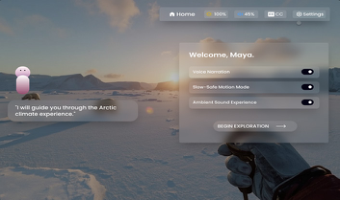
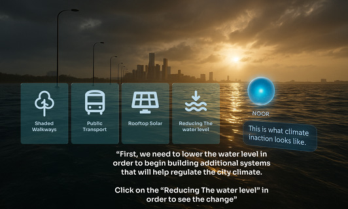
1- Speeding Up Ideation with AI. AI-assisted design tools significantly simplified the process of creating initial XR concepts, interaction scenarios, and sustainability ideas by students. At the early stage of the project, students were able to explore more ideas than would have been possible using traditional manual methods. This rapid process allows teams to iterate more often and move from conceptualisation to prototyping earlier. 2- Enhanced Clarity and Consistency in XR Prototyping. AI-supported prototyping tools helped create clearer interaction flows and more consistent design elements across iterations. For example, a consistent character was created using AI to maintain continuity across different XR scenes. According to students, usability inconsistencies related to layout structure, visual hierarchy, or interaction sequencing were less frequent. Automatically generated assets and pattern-based recommendations improved overall coherence within XR environments, especially in the case of early prototypes. 3- Better Communication of Sustainability Concepts. AI-powered tools enabled the transformation of intricate issues and notions of sustainability into visual and story elements of immersive XR; students used AI-generated imagery and textual suggestions to refine environmental storytelling and enhance message clarity. Although manual refinement was still required in all cases, AI did support the building of more compelling and accessible sustainability-focused XR scenarios.
Observed Challenges of AI-Assisted XR design Offset against these advantages, however, a number of challenges arose. An over-reliance on the suggestions generated by AI at times hampered creative exploration and reduced critical reflection. The depth of interaction generated within the AI outputs were often not specific to XR, and thus manual adaptation to meet immersion and presence requirements was necessary. Students also faced workflow challenges when trying to integrate the AI-generated content with XR development tools, which reduced some of the efficiency gains expected from AI assistance.
The following slides are taken from AI-assisted XR sustainability prototypes created by various lab groups. Each slide comes from a different student prototype and shows only selected parts as examples and does not equate to the whole project.
Together, these findings illustrate both the practical benefits and the structural challenges of integrating AI-powered tools into XR design workflows within HCI education.
DISCUSSION
This research aims to examine the utilisation of AI by undergraduate students in designing XR, evaluate their practical experiences, and identify lessons that could emerge for HCI educators seeking to integrate AI in XR design into their courses. The findings show that AI tools have helped students ideate quickly, starting from the first stage, supported baseline usability through improved consistency, and enhanced the multimodal presentation of information in XR designs. However, AI-assisted XR design also introduced new pedagogical and methodological challenges, such as hindering creativity and critical reflection.
The results indicate that students primarily used AI as a supportive design partner rather than an autonomous creator. AI tools were mainly used in early stages of the design process, including ideation, scenario generation, and visual asset creation. In later design stages, students utilized these tools to explore alternative sustainability concepts, generate initial interaction flows, and present abstract concepts in various modes within the design. Although the students utilized AI in all these various stages, they tried to not fully accept the AI’s ideas and outputs by iteratively refining and adapting them.
In practice, students experienced AI-assisted XR design as both enabling and limiting. Although AI improved the coherence of initial prototypes and
accelerated their progress, it also led students to sometimes overly rely on its suggestions and limited XR-specific guidance. Due to these reasons, HCI educators should implement specific pedagogical methods to successfully integrate AI-assisted XR design in their courses. Firstly, they should establish reflection checkpoints where students pause to assess design assumptions, ethical implications, and user experience goals before proceeding with their XR designs that were assisted by AI.
For example, this may include examining the data obtained from AI tools and evaluating whether it leads to biased or misleading design outcomes. From human-AI interaction perspective, students should be in an ongoing negotiation of control by carefully critiquing the outputs of AI tools. This balances the speed gains with mindful decisions in the design process, as the agency shifts dynamically between a human and an AI system. Secondly, HCI educators need to emphasise the quality of AI design outputs from the perspective of HCI concepts, iteration, and reflection in the AI-assisted XR design process by incorporating an assessment of AI use. This acknowledges the involvement of AI in the design process and assesses its learning outcomes. In summary, the findings suggest that AI-assisted XR design in HCI curricula offers substantial pedagogical opportunities but also demands careful implementation.
While this study has provided insights into AI-assisted XR design in undergraduate HCI course students, some limitations of the study should be acknowledged. Firstly, the study involved a limited number of student teams at one institution, one course, and one section. Due to this reason, the findings may not be statistically generalisable to other educational contexts and institutions. Secondly, the AI tools used by the students varied in capability and were a specific set of tools that were accessible to them. Thus, every insight in the findings may not apply to each AI tool. Also, since these tools evolve rapidly, the findings reflect the affordances and constraints of the tools available at the time of the study. The impact of AI-assisted design tools on students’ creativity is beyond the scope of this study. Further research is needed to explore these effects in more depth, particularly across diverse institutional contexts and evolving AI tool ecosystems.
CONCLUSION
In conclusion, students experienced AI-assisted XR design as both enabling and limiting, reinforcing the need for balanced human-AI collaboration in HCI education. From students’ perspective, AI tools helped them locate research papers and articles more efficiently during the problem definition stage. It supported brainstorming and strengthened the ideation process. Moreover, it enabled image generation, which improved the consistency of visual assets in XR prototyping.
However, several challenges were also observed. Over-reliance on AI-generated suggestions sometimes limited students’ creative exploration and reduced opportunities for critical thinking. Ethical concerns also emerged when using AI-generated content, as it could raise risks of unoriginal or closely replicated content and diminish students’ sense of authorship in the
AI-Assisted XR Design and User Testing: Lessons 145 design process. This could dilute students’ original ideas and make designs feel less authentic or overly similar to existing concepts. Additional concerns include questions of intellectual ownership, the possible loss of fundamental design skills, and biases in AI training data that may shape problematic design patterns. From HCI educators’ perspective, clear pedagogical strategies are needed for integrating AI-assisted XR design, such as reflection checkpoints and assessments of AI use to support meaningful learning outcomes. Overall, AI tools supported the development of more efficient and engaging sustainability-focused XR designs, but their use raised ethical considerations that require careful attention.
ACKNOWLEDGMENT
The authors would like to acknowledge Zayed University for creating such a conductive learning environment and providing necessary tools without which this research study would not have been possible. A special thanks goes to all students participating in our Human-Computer Interaction class for collaborating with the project and sharing your thoughts and concepts with such passion and interest in our class. A special acknowledgement goes to our professor, Ahmed Seffah, without whose guidance and assistance this project would not have gained such depth and effectiveness. The authors would also appreciate the designers of all AI and XR designing tools used in this project, which not only allowed learning but also experimentation in AI-assisted XR designing in sustainability education.
REFERENCES
Abdelwahab, S., Elhussainy, M. and Abuzainab, A. (2025) ‘Leveraging Interactive Platforms for Sustainable Built Environment education: A Case study for First- Year Students in Block Learning model,’ in Lecture notes in civil engineering, pp. 477–487. https://doi.org/10.1007/978-981-96-8769-5_34. Beale, R. (2025) Computer Science Education in the age of Generative AI. https://
arxiv.org/abs/2507.02183. Carmona-Galindo, V.D., Velado-Cano, M.A. and Groat-Carmona, A.M. (2025) ‘The ecology of climate Change: using virtual reality to share, experience, and cultivate local and global perspectives,’ Education Sciences, 15(3), p. 290. https:// doi.org/10.3390/educsci15030290. Dam, R.F. (2025) ‘The 5 stages in the design thinking process,’ The Interaction
Design Foundation, 14 December. https://www.interaction-design.org/literature/ article/5-stages-in-the-design-thinking-process?srsltid=AfmBOorpwuwpm10UQ 8QfFnRQCRQqnb-PzrJoHFuznn3mLXGm6DVhUMK8. Douvlou, E.D. (2025) ‘Immersive virtual reality as tool to promote sustainable development goals,’ in Sustainable development goals series, pp. 163–176. https:// doi.org/10.1007/978-3-031-76418-9_11. Ebinger, F., Buttke, L. and Kreimeier, J. (2022) ‘Augmented and virtual reality
technologies in education for sustainable development: An expert-based technology assessment,’ TATuP - Zeitschrift Für Technikfolgenabschätzung in Theorie Und Praxis, 31(1), pp. 28–34. https://doi.org/10.14512/tatup.31.1.28.
Engineering, I.A. for P. (2019) CIRP Encyclopedia of Production Engineering. https:// doi.org/10.1007/978-3-662-53120-4. Gomez, C. et al. (2025) ‘Human-AI collaboration is not very collaborative yet:
a taxonomy of interaction patterns in AI-assisted decision making from a systematic review,’ Frontiers in Computer Science, 6. https://doi.org/10.3389/ fcomp.2024.1521066. Kharrufa, A., & Johnson, I. G. (2024). “The potential and implications of generative AI on HCI education,” in Proceedings of the 6th Annual Symposium on HCI Education (EduCHI ‘24). https://doi.org/10.1145/3658619.3658627. Newton, M.H. and Annetta, L.A. (2024) ‘The influence of extended reality on
climate change education,’ Science & Education, 34(2), pp. 825–845. https://doi. org/10.1007/s11191-024-00518-y. Queiroz, A.C.M. et al. (2023) ‘The Efficacy of Virtual Reality in Climate Change Education Increases with Amount of Body Movement and Message Specificity,’ Sustainability, 15(7), p. 5814. https://doi.org/10.3390/su15075814. Song, B., Zhu, Q. and Luo, J. (2024) ‘Human-AI collaboration by design,’ Proceedings
of the Design Society, 4, pp. 2247–2256. https://doi.org/10.1017/pds.2024.227. Valente, L. et al. (2025) ‘Enhancing Sand-Table-Based incident command training with extended reality and interactive simulations: a use case in forest firefighting,’ IEEE Transactions on Learning Technologies, 18, pp. 273–288. https://doi. org/10.1109/tlt.2025.3545436. Wheatley, A. and Hervieux, S. (2024) ‘Artificial intelligence and libraries,’ in Elsevier
eBooks, pp. 286–290. https://doi.org/10.1016/b978-0-323-95689-5.00275-3. York, E. (2023). “Evaluating ChatGPT: Generative AI in UX design and web development pedagogy,” in Proceedings of the 41st ACM International Conference on Design of Communication (SIGDOC ‘23), pp. 197–201. https:// doi.org/10.1145/3615335.3623035. Zainal, N.H.M. et al. (2022) ‘Augmented reality (AR) and virtual reality (VR)
applications during COVID-19 pandemic among preclinical medical and dentistry Students: A Mini-Review,’ Malaysian Journal of Medicine and Health Sciences, 18(s14), pp. 131–143. https://doi.org/10.47836/mjmhs.18.s14.15.
LISTED IN THE AHFE DIGITAL BOOKSTORE CATALOGUE
Explore the complete digital volume
Human Interaction and Emerging Technologies (IHIET-AI 2026): Artificial Intelligence and Future Applications
Read this individual research paper free through the original publisher, or explore the full digital proceedings book.
ISBN 978-1-964867-77-9
Explore this ISBN in the AHFE Bookstore ↗Listed in the July 2026 bookstore catalogue; search by ISBN to confirm current availability · Digital book purchase optional