Virgínia Chalegre, Mariana Amora, Mario Sérgio Dias, Fernando Cavalcanti, Luciano Macedo, Yasmin Correia, Giulia Marianna, Gustavo Rodrigues (2026). Fiscolab: Co-Creation, Artificial Intelligence, and User-Centered Design in the Development of Educational Fiscal Solutions. In: Human Interaction and Emerging Technologies (IHIET-AI 2026): Artificial Intelligence and Future Applications. AHFE Open Access, vol. 201, pp. 107–118. https://doi.org/10.54941/ahfe1007165
Fiscolab is an experimental digital platform designed to democratize access to tax-related knowledge in Brazil through an inclusive, interactive, and user-centered learning environment. Developed in collaboration with academia and the public sector, the project emerged from the need to help individuals and organizations navigate a highly complex tax ecosystem — one that often creates barriers to entrepreneurship, economic participation, and social inclusion.Grounded in User-Centered Design (UCD) principles, the project followed iterative cycles of research, prototyping, and usability and accessibility validation. The multidisciplinary team — including designers, developers, accessibility specialists, and tax experts — conducted interviews, contextual inquiries, and co-design sessions with diverse user groups, including early-stage entrepreneurs, micro-business owners, accountants, students, and citizens with different digital and cognitive literacy levels. Four representative personas were generated to ensure that the solution would address multiple motivations, knowledge levels, and accessibility needs.User journeys captured the full learning experience, from onboarding and diagnostic quizzes to challenge-based learning, chatbot assistance, progress tracking, and certification. These journeys guided the creation of a clear and assistive interface that supports autonomy, comprehension, and usability. Accessibility was a foundational requirement, and the MVP followed national and international accessibility guidelines, ensuring compatibility with assistive technologies and keyboard navigation, semantic structure, intelligible content, and media alternatives. This inclusive approach acknowledges accessibility not as a compliance checklist but as a human right and an enabler of digital citizenship.Artificial Intelligence played a central role in two key dimensions:- Learning Experience – AI was integrated as a generative engine to create contextual challenges, validate responses, adapt difficulty levels, and provide real-time guidance. An intelligent chatbot supported users by clarifying tax concepts, explaining system feedback, and recommending personalized learning paths.- Design and Development Support – AI agents enhanced the creative and analytic process by assisting in information architecture refinement, drafting content, and validating interaction flows.The project adopted agile methodologies with weekly sprints, constant feedback sessions with government stakeholders, and real-world testing. This collaborative structure ensured that technological innovation remained aligned with policy objectives, accessibility best practices, and user needs — especially those affected by low digital inclusion or learning barriers.The outcome is a scalable, accessible, and intelligent learning platform that transforms bureaucratic and technically dense content into an empowering, engaging, and socially meaningful experience. Fiscolab demonstrates how the synergy between AI, accessibility, and user-centered design can strengthen civic education, reduce inequality in access to information, and support a more inclusive digital society.
The Brazilian tax system is recognized for its complexity and constant normative mutation, representing an obstacle for both citizens and entrepreneurs. The absence of accessible and contextualized educational resources contributes to inequalities in accessing fiscal information and business formalization (Oliveira et al., 2023). Given this scenario, the Fiscolab project was conceived with the objective of simplifying and democratizing learning about taxation through a user-centered approach supported by inclusive and artificial intelligence technologies. Founded on the principles of User-Centered Design (UCD) (Norman, 2013; ISO 9241-210:2019), the project adopts a logic of co-creation and continuous validation, ensuring that design and content decisions are guided by the
real needs and limitations of users. Fiscolab’s development also aligns with the digital public innovation agenda (OECD, 2022), which advocates for the use of AI and participatory methodologies as catalysts for inclusive and efficient policies.
METHODOLOGY
The development of Fiscolab was based on the integration of qualitative and iterative methods, following the Design Thinking cycle (Brown, 2009) and the User-Centered Design model described in ISO 9241-210:2019. The methodology involved four macro stages: Discovery and Contextual Research
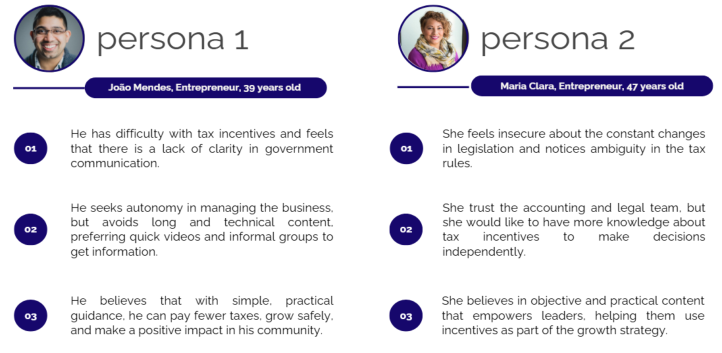
The discovery stage consisted of resuming and delimiting the central problem, in line with consolidated solution conception models, such as Design Thinking (Brown, 2008) and the Double Diamond model (Design Council, 2005), which emphasize divergent phases dedicated to a broad understanding of the context before proposing solutions. In this sense, the development of Fiscolab originated from the need identified by the State Secretariat of Finance of Pernambuco (SEFAZ-PE) to mitigate the recurrence of errors made by taxpayers during the processes of requesting and registering for tax incentive programs offered by the Secretariat. This issue is consistent with the studies by Nielsen (1993), who highlight the relevance of usability and error reduction in informational systems, as well as with the discussions by Bannister and Connolly (2014) on efficiency, clarity, and public value in governmental digital services. To expand the theoretical and technological repertoire, the team participated in training focused on Artificial Intelligence and Gamification. The literature recognizes the potential of Artificial Intelligence to support public management activities (Kankanhalli; Charalabidis, 2019) and identifies Gamification as an efficient strategy to promote engagement and learning in digital environments (Deterding et al., 2011). Also during the immersion process, activities were conducted aimed at understanding the user and the service ecosystem. This approach aligns with the qualitative methodologies presented by Creswell (2014) and the practices of applied design ethnography discussed by Salvador, Bell, and Anderson (1999). The techniques employed included: (i) construction of personas, based on the user-centered design approach; (ii) elaboration of empathy maps; and (iii) mapping of the user journey, aligned with the principles of Service Design. The use of these tools enabled the identification of taxpayers’ motivations, difficulties, and expectations, constituting a robust empirical basis for recognizing the obstacles present in the analyzed processes. Thus, the discovery stage consistently supported the subsequent stages of ideation and development of Fiscolab. Two personas created for this project are shown below:
Figure 1: Persona one, João Mendes. Persona two, Maria Clara. Source: original work.
Ideation and Co-Creation The ideation stage was developed after the consolidation of the results obtained in the contextual research phase, in accordance with the principles of Design Thinking, which guides the divergent generation of solutions based on evidence built during the discovery phase (Brown, 2008). To stimulate creativity and broaden the diversity of perspectives, widely recognized techniques in the design and innovation literature were applied. Among these techniques, brainwriting, such as the 635 method described by Paulus and Nijstad (2003), stood out as an efficient method for the individual and silent generation of ideas, contributing to the reduction of creative blocks and the expansion of the repertoire of alternatives. The application of this technique, together with the previously conducted immersion, resulted in the formulation of various possible solutions, including an intelligent platform aimed at simplifying tax issues, a free and gamified digital platform based on SEFAZ-PE’s fiscal informative documents, a platform composed of didactic classes with learning paths and certificate issuance, and an interactive platform structured in educational paths and equipped with a tax incentive eligibility simulator. This initial divergence process was essential for identifying multiple possible approaches, which were later discussed and refined until the final proposal was defined. In addition to the idea generation techniques, a systematic benchmarking survey was conducted, which allowed identifying relevant references for the comparative analysis of functionalities, scalability, and viability of different solutions available in the market. The analysis criteria included the use of gamification elements, the application of artificial intelligence resources, the offering of content focused on tax education, and other characteristics relevant to the scope of the project. This process contributed to the strategic alignment of the proposal and expanded the methodological repertoire available to the team. To organize and prioritize the identified functionalities, the MOSCOW method was applied, recognized in requirements engineering
for its effectiveness in classifying essential, desirable, and optional items (Alhenawi et al., 2024). This technique allowed for a structured prioritization of requirements, ensuring that the decisions made were consistent with the needs identified in the discovery phase. With the aim of deepening the understanding of the problem and validating the hypotheses formulated in the previous stages, semi-structured interviews were conducted with the client, who holds the position of director at the State Secretariat of Finance of Pernambuco and was one of the first institutional agents to identify the need to develop a solution for the analyzed problem. This technique, used in qualitative research, allows for an in-depth exploration of participants’ perceptions, practices, and expectations, maintaining flexibility and density in information gathering (Creswell, 2014). The interviews complemented the other techniques adopted, providing fundamental inputs for the refinement of functional and non-functional requirements that guided the subsequent stages of prototyping and platform development.
Prototyping and Usability and Accessibility Testing The prototyping stage was conducted progressively, starting with low- fidelity wireframes aimed at defining flows, information hierarchy, and structural organization, and evolving to high-fidelity compositions developed in Figma, in line with consolidated practices of interface design and information architecture (Cooper, 2014; Norman, 2013). The visual identity of the interfaces referenced the SEFAZ-PE e-Fisco platform to reinforce familiarity, institutional consistency, and perceptual continuity for users already accustomed to governmental digital services, in alignment with recommendations for visual coherence and pattern reuse in complex systems (Nielsen, 1994). The adoption of this fidelity gradation contributed to reducing rework and strengthening adherence to a user-centered design approach, as advocated by ISO 9241-210 (ISO, 2019). Artificial Intelligence played a central role in prototyping by supporting the generation of design hypotheses, the proposition of interaction flow variations, and the identification of improvement opportunities based on widely disseminated UI patterns in contemporary design systems (Cooper, 2014). Generative models were employed to assist in the evaluation of contrast, typographical hierarchy, and compositional balance, allowing for rapid adjustments aligned with visual perception criteria and the accessibility recommendations present in WCAG 2.2 (W3C, 2023). In addition, preliminary exploratory usability and accessibility tests were conducted, aimed at identifying initial navigation barriers, textual clarity, and legibility, following formative evaluation principles described by Nielsen and ISO 9241-11 (Nielsen, 1994; ISO, 2018). These tests functioned as screening for essential flow and interface adjustments, ensuring adherence to the general accessibility guidelines established by the W3C and reference authors in the area (Vanderheiden, 2008).
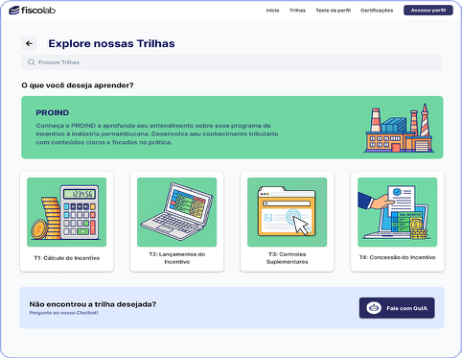
Figure 2: Screenshot of the learning paths prototype. (Source: original work - Fiscolab, 2025).
Implementation and Continuous Validation The implementation was organized into incremental cycles, adopting Scrum as the main reference, but in a version adapted to the project’s needs, without strictly following all the ceremonies and roles prescribed by the framework (Schwaber; Sutherland, 2017). In this arrangement, the work of the design and development teams was coordinated to favor continuous communication and joint prioritization of deliveries. While the design team refined high- fidelity prototypes and detailed interface components, the development team simultaneously implemented the functionalities based on these artifacts, using them as the main reference for technical and behavioral decisions (Knapp et al., 2016). This dynamic favored the convergence between design intent, technical requirements, and the platform’s pedagogical objectives, while also allowing for continuous incorporation of adjustments throughout development. Continuous validation involved recurring monitoring with stakeholders and users in real usage situations, with the objective of verifying the clarity, navigability, and adequacy of the content, in line with contextual research and field observation approaches (Holtzblatt; Beyer, 1998; Suchman, 1987). The collected evidence allowed for the identification of situational difficulties, confusion patterns, and signs of cognitive overload in more complex flows, engaging with the assumptions of Cognitive Load Theory regarding the limits of information processing by the user (Sweller, 1988). The integration of these findings guided the simplification of steps, the refinement of critical flows, and the strengthening of mechanisms for immediate feedback, simple navigation, and high legibility, in alignment with WCAG recommendations and internationally recognized usability and accessibility standards (W3C, 2023; ISO, 2019).
DEFINITION OF PLATFORM REQUIREMENTS Fiscolab was developed as a responsive educational platform with simplified navigation, appropriate semantic structure, and compatibility with assistive technologies. Gamification elements, adaptive quizzes, and immediate feedback mechanisms were implemented. The fiscal content was converted into clear and visually organized language, with emphasis on user autonomy and understanding. In the initial version specification stage, the functional requirements of the Fiscolab platform were detailed in accordance with the principles established by Sommerville (2019). According to the author, functional requirements constitute precise descriptions of the capabilities and behaviors that the system must exhibit in response to user demands. Through successive iterations of refinement, technical adjustments guided by feedback from public stakeholders, and continuous validation of the implementation, the final version of the functional requirements specification was consolidated. This process ensured adequate traceability between the originally identified needs and the components effectively implemented, in addition to guaranteeing coherence with the strategic objectives planned for the project. To address project constraints, the MoSCoW methodology was adopted, aiming to systematically prioritize the requirements. As demonstrated by Alhenawi et al. (2024), this approach allows requirements to be classified according to their strategic importance. The methodology segmented the requirements into four categories: Must Have (essential functionalities), Should Have (important functionalities), Could Have (desirable functionalities), and Won’t Have (postponed functionalities). This classification enabled the efficient allocation of resources and maintained clear communication with public stakeholders during the development of the Fiscolab platform.
Implementation and Integration of Artificial Intelligence AI was applied in three main dimensions:
1. Prototyping: AI enhanced prototyping by automating the generation of design hypotheses and the proposition of optimized interaction flows. It analyzed datasets of contemporary UI patterns to predictively identify improvement opportunities and ensure compliance with best usability practices. 2. Learning Experience: An AI-based generative engine creates personalized challenges, analyzes responses, adjusts the difficulty level, and provides contextual feedback. 3. Intelligent Chatbot: An intelligent chatbot acts as a tutor, explaining tax concepts, guiding the user, and suggesting learning paths.
AI Architecture for the Development of MVP Functionalities Fiscolab’s AI solution is based on the RAG architecture, a framework that combines the generative capacity of the language model (GPT-4o-mini) with
Fiscolab: Co-Creation, Artificial Intelligence, and User-Centered Design 113 an information retrieval system from the PDF documents contained in the application (Gao et al., 2023). This pipeline is composed of:
Extraction: Responsible for extracting the text contained in the PDFs. Chunking: Divides the extracted text from the PDFs into smaller chunks (pieces).
Embedding: Transforms the chunks into numerical vectors, storing them in a vector database.
Search: Uses semantic search in the vector database to find the chunks with the highest similarity to the user’s query.
Generation: Uses the user’s query and the chunks returned by the Search step to assemble a context that is sent to the language model integrated into the application.
Justification for the Choice of Architecture Combating Hallucination: A problem regarding Large Language Models (LLMs) is that they are trained with a vast range of public data. This enormous knowledge base ends up containing incorrect or biased data, which contributes to the occurrence of hallucinations in the responses generated by the model. Since Fiscolab deals with data related to tax legislation and is developed for a public entity, the reliability of the content generated by artificial intelligence is essential to the application. Thus, the RAG architecture forces the language model to respond using only the documentation provided by Sefaz-PE as context. This reduces the problem pertinent to the quality of the data that makes up the knowledge base being used.
Cost-effectiveness, Agility, and Viability for the MVP: As the project is an MVP, using RAG proved to be the ideal approach because it allowed testing and validating the platform’s central idea without the need for complex implementation or greater resource demands, as required by fine-tuning, for example. This also allowed developing the application with the necessary agility within the delimited duration of the project.
Use of Artificial Intelligence on the Platform on Learning Experience Challenge Generator
The challenge generator is the functionality of the application responsible for creating questions that are used for simulations and certification tests on the platform. Available only for administrator type users through the administrative panel, after adjusting parameters such as the subject of the challenge and difficulty level, the challenge generation triggers the RAG pipeline, creating a set of questions using exclusively the documentation contained in the application’s knowledge base.
Figure 3 – Screenshot of the Challenges Generator page. (Source: original work - Fiscolab, 2025).
Generation Process The process follows the approach of elaborating a prompt to be sent to the GPT-4o-mini model, following these steps:
Semantic Similarity Search: The string passed as the challenge subject is vectorized and compared with the chunks stored in the application’s vector database. The k most relevant documents are retrieved, considering a minimum similarity threshold of 0.7.
Document Context Creation: The retrieved documents are formatted into a structured context, including source, similarity, and content.
Instructions to the Language Model: Contains instructions on how the model should generate its response. This includes: the role the model should assume (tax legislation specialist and educational content creator), the behavior rules (defining the output format as a JSON and exclusive fidelity to the document context), and finally the rule for the output structure (specifying the keys and the type of content that should constitute the output JSON).
Request to the Language Model API: The request made to the GPT-4o- mini API contains the prompt, which is the junction of the document context with the instructions to the language model.
Validation and Persistence: The generated JSON is validated, and if correct, the challenges are persisted in the database, associated with the program and path specified by the administrator before generating the challenge.
GuIA - Intelligent Virtual Assistant GuIA, the name given to the chatbot contained in the application, is triggered by a floating button present on most platform screens. Pressing this button opens up a natural language conversation interface. The chatbot is responsible for acting as an assistant and tutor specialized in tax legislation, answering user’s questions using accessible language and exclusively the knowledge base contained in the application.
Generation Process The process follows an approach similar to the challenge generator, but with a different prompt. When a user asks a question, the system follows these steps:
Fiscolab: Co-Creation, Artificial Intelligence, and User-Centered Design 115 Semantic Search: The user’s question is vectorized and compared with the chunks stored in the vector database, returning the k most relevant documents, considering a minimum similarity threshold of 0.7.
Context Construction: The retrieved documents are formatted into a structured context, including source, similarity, and content.
Instructions to the Language Model: Includes guidelines such as responding exclusively based on the context provided, never using prior knowledge or external information, citing the sources whenever possible, and maintaining a professional and accessible tone.
Return to the User: The response is returned through the conversation interface, including the generated answer and the source used.
Accessibility and Inclusion in All Project Phases Accessibility was conceived as a structural principle of the project, guiding all conception, development, and validation phases of the MVP. In compliance with the Web Content Accessibility Guidelines - WCAG 2.2 (W3C, 2023), the design process adopted a preventive approach, ensuring that requirements for perceptibility, operability, comprehensibility, and robustness were incorporated from the initial construction of flows and interfaces. This perspective reinforces the understanding that accessibility should not be treated as a supplementary stage but as an intrinsic component of the quality and ethics of digital solutions. By assuming this commitment, the project aligns with the theoretical framework of Lazar, Goldstein, and Taylor (2015), according to which accessibility constitutes a fundamental human right and represents a vector for strengthening digital citizenship, especially in contexts of informational inequality. Procedures were implemented to ensure technical compliance and effective inclusion of the intended audiences, covering contrast analyses, typographical legibility verification, informational architecture inspection, compatibility with assistive technologies, clarity of labels, and predictability of navigation. The evaluations were conducted iteratively, combining usability heuristics, accessibility inspections, and reviews with fiscal domain specialists, allowing for continuous and evidence-based improvements. In the end, the integration of these criteria resulted in a more robust, inclusive, and adherent prototype to international best practices, contributing to expanding access to tax knowledge, reducing comprehension barriers, and promoting equity in the use of the educational platform.
DISCUSSION
The results obtained indicate that co-creation and continuous validation with real users were decisive for Fiscolab’s effectiveness, as they enabled the alignment of the proposed solutions with the specific needs, languages, and repertoires of the publics involved, in line with principles of user-centered design and digital accessibility (W3C, 2023). In this process, the use of Artificial Intelligence, articulated with inclusive design principles, enhanced meaningful learning by supporting the adaptation of content to different
cognitive profiles and interaction trajectories, in line with recent discussions on educational AI and personalization of learning experiences (Holmes et al., 2022). Within the scope of gamification, Fiscolab incorporated elements such as achievements and badges associated with the completion of challenges and certification in paths, approaching models widely discussed in the literature, such as the use of points, badges, and symbolic rewards to reinforce motivation and engagement in educational contexts (Deterding et al., 2011). The application of agile methodologies (Beck et al., 2001) and the involvement of public stakeholders guaranteed the alignment between technological innovation, gamified mechanics, and social objectives, demonstrating that the integration between AI, gamification, and user- centered design can contribute to the reduction of informational inequalities and strengthen fiscal citizenship by making complex content more accessible, motivating, and meaningful.
CONCLUSION
Fiscolab demonstrates the potential of uniting AI, accessibility, and user- centered design in educational solutions that promote inclusion and engagement. The project shows that public innovation can emerge from collaborative processes, where technology and empathy are equally valued.
The continuation of the project foresees the use of AI for user performance analysis and the expansion of the platform to new areas of fiscal education, including paths for audiences with disabilities and micro-entrepreneurs. The Fiscolab model reinforces that accessibility is not just a technical requirement but an ethical and social design principle essential for the construction of a more equitable and participatory digital society.
REFERENCES
Alhenawi, E. et al. Choosing a suitable requirement prioritization method: a survey.
arXiv preprint, arXiv:2402.13149, 2024. Bannister, F.; Connolly, R. ICT, public values and transformative government.
Government Information Quarterly, v. 31, n. 1, pp. 119–128, 2014. Beck, K. Extreme Programming Explained: Embrace Change. 2. ed. Boston: Addison-Wesley, 2000. Beck, K. et al. Manifesto for Agile Software Development. 2001. Available at: https://
agilemanifesto.org. Accessed on: 10 Nov. 2025. Brown, T. Change by Design: How Design Thinking Transforms Organizations and Inspires Innovation. New York: HarperCollins, 2009. Brown, T. Design thinking. Harvard Business Review, v. 86, n. 6, pp. 84–92, 2008. Cooper, A. et al. About Face: The Essentials of Interaction Design. 4. ed. Indianapolis:
Wiley, 2014. Creswell, J. W. Qualitative Inquiry and Research Design: Choosing Among Five Approaches. 3. ed. Thousand Oaks: SAGE, 2014. Design council. The Double Diamond Design Process Model. London: Design
Council, 2005.
Fiscolab: Co-Creation, Artificial Intelligence, and User-Centered Design 117 Deterding, S. et al. From game design elements to gamefulness: defining
“gamification”. In: Proceedings of the 15th International Academic MindTrek Conference. Tampere: ACM, 2011. pp. 9–15. Gao, Y. et al. Retrieval-Augmented Generation for Large Language Models: a survey.
arXiv preprint, arXiv:2312.10997, 2023. Holmes, W.; Bialik, M.; Fadel, C. Artificial Intelligence in Education: Promises and Implications for Teaching and Learning. Paris: UNESCO/OECD, 2022. Holtzblatt, K.; Beyer, H. Contextual Design: Defining Customer-Centered Systems.
San Francisco Morgan Kaufmann, 1998. ISO. ISO 9241-11: Ergonomics of Human-System Interaction – Part 11: Usability: Definitions and Concepts. Geneva: International Organization for Standardization, 2018. ISO. ISO 9241-210: Ergonomics of Human-System Interaction – Human-Centred
Design for Interactive Systems. Geneva: International Organization for Standardization, 2019. Kankanhalli, A.; Charalabidis, Y.; Mellouli, S. Artificial intelligence and public sector productivity. Government Information Quarterly, v. 36, n. 4, pp. 101–110, 2019. Knapp, J.; Zeratsky, J.; Kowitz, B. Sprint: How to Solve Big Problems and Test New
Ideas in Just Five Days. New York: Simon & Schuster, 2016. Lazar, J.; Goldstein, D. F.; Taylor, A. Ensuring Digital Accessibility Through Process and Policy. Oxford: Elsevier, 2015. Nielsen, J. 10 usability heuristics for user interface design. Fremont: Nielsen Norman
Group, 1994. Available at: https://www.nngroup.com/articles/ten-usability- heuristics/. Accessed on: 24 Nov. 2025. Nielsen, J. Usability Engineering. San Francisco: Morgan Kaufmann, 1993. Norman, D. A. The Design of Everyday Things: Revised and Expanded Edition. New York: Basic Books, 2013. OECD. The Digital Transformation of the Public Sector: Helping Governments
Respond to the Needs of the 21st Century. Paris: OECD Publishing, 2022. Oliveira, João Maria de; Araújo, Bruno Cesar Pino Oliveira de (org.). Eficiência produtiva: análise e proposições para aumentar a produtividade no Brasil. Brasília: Instituto de Pesquisa Econômica Aplicada (IPEA), 2023. p. 30–50. DOI: 10.38116/978-65-5635-061-5/capitulo2. Oliveira, João Maria de; Gomes, Victor; Cavalcante, Eric Jardim. Tributação e
produtividade: como a reforma tributária pode afetar o crescimento econômico? In: Silva filho, Edison Benedito da; Oliveira, João Maria de; Araújo, Bruno Cesar Pino Oliveira de (org.). Eficiência produtiva: análise e proposições para aumentar a produtividade no Brasil. Brasília: Instituto de Pesquisa Econômica Aplicada (Ipea), 2023. DOI: 10.38116/978-65-5635-061-5/capitulo2. Paulus, P. B.; Nijstad, B. A. Group Creativity: Innovation Through Collaboration.
New York: Oxford University Press, 2003. Salvador, T.; Bell, G.; Anderson, K. Design ethnography. Design Management Journal, v. 10, n. 4, pp. 35–41, 1999. Schwaber, K.; Sutherland, J. The Scrum Guide. 2017. Available at: https://scrumguides.
org. Accessed on: 24 nov. 2025.
Sommerville, I. Engenharia de Software. 10. ed. [S.l.]: Pearson, 2019. Suchman, L. Plans and Situated Actions: The Problem of Human-Machine Communication. Cambridge: Cambridge University Press, 1987. Sweller, J. Cognitive load during problem solving: effects on learning. Cognitive
Science, v. 12, n. 2, pp. 257–285, 1988. Vanderheiden, G. Ubiquitous accessibility, common technology core, and micro assistive technology. ACM Transactions on Accessible Computing, v. 1, n. 2, pp. 1–7, 2008. W3C. Web Content Accessibility Guidelines (WCAG) 2.2. W3C Recommendation,
2023. Available at: https://www.w3.org/TR/WCAG22/. Accessed on: 24 nov. 2025.
LISTED IN THE AHFE DIGITAL BOOKSTORE CATALOGUE
Explore the complete digital volume
Human Interaction and Emerging Technologies (IHIET-AI 2026): Artificial Intelligence and Future Applications
Read this individual research paper free through the original publisher, or explore the full digital proceedings book.
ISBN 978-1-964867-77-9
Explore this ISBN in the AHFE Bookstore ↗Listed in the July 2026 bookstore catalogue; search by ISBN to confirm current availability · Digital book purchase optional