Stef Koster, Jan Viebahn, Evangelos Niforatos (2026). Designing for human-AI teaming in power system control room decision support. In: Human Interaction and Emerging Technologies (IHIET-AI 2026): Artificial Intelligence and Future Applications. AHFE Open Access, vol. 201, pp. 269–280. https://doi.org/10.54941/ahfe1007180
The integration of renewable energy sources fundamentally alters the operating environment of transmission system operators (TSOs). While essential for achieving a sustainable and low-carbon energy system, their volatility leads to more frequent congestion events, narrower safety margins, and rising information demands for grid operators across multiple distributed systems. In this context, timely and effective decision-making becomes increasingly challenging. AI-based decision support tools (DSTs) have been deployed in TSO control rooms, for example, the GridOptions tool at TenneT TSO. However, these DSTs still offer only one-way assistance, providing context and recommendations without true human-AI collaboration. In contrast, adaptive decision-making and human cognitive needs require human-AI teaming, that is, bi-directional communication through synergetic interactions with ongoing refinements. This study takes a first step towards human-AI teaming for decision support in power-system control rooms. Following a Scenario-Based Design approach, utilizing the Joint Control Framework, we (i) perform a requirements analysis to identify how human-AI teaming requirements shift across different timeframes, (ii) design cognitive human-AI collaboration patterns specific for each timeframe, and (iii) formulate corresponding design guidelines for user interfaces for grid operators. Ultimately, this research seeks to contribute to the design of adaptive DSTs that enhance the resilience of grid control strategies via effective human–AI collaboration.
Control rooms are core places of the power system, providing to groups of human operators the necessary working environment to remotely monitor and operate the power system in real time. However, the integration of renewable energy sources (RES) has fundamentally altered the operating environment of transmission system operators (TSOs). This is not different for TenneT, a leading European TSO responsible for managing and developing the high- voltage electricity grid in the Netherlands and large parts of Germany. TenneT is tasked with ensuring secure, reliable, and sustainable power transmission across national and cross-border networks. Yet, the significant uncertainty and volatility related to RES leads to more frequent congestion events, narrower safety margins, and rising information demands across multiple distributed systems. As a consequence, timely and effective decision-making Received September 4, 2025; Revised November 28, 2025; Accepted December 11, 2025; Available online April 1, 2026
becomes increasingly challenging, resulting in a growing need for reliable decision-support tools to assist grid operators (Bessa et al., 2024).
One way to address this challenge is to upgrade the current supervision tooling toward Hypervision (Marot et al., 2022). The goal of Hypervision is to provide the right information at the right time to the right person while keeping track of user progress for each task. In a highly variable and demanding environment such as the grid control room, the goal is to support general forms of adaptive coping by designing for complexity (Hollnagel and Woods, 2005). More specifically, Hypervision aims to (i) unify data, tools, and user interfaces (UIs) into a single coherent operator environment, (ii) synthesise and contextualise to enhance situation awareness, (iii) recommend actions to support proactive and reactive decision-making, and (iv) provide bi-directional and collaborative interactions between the human grid operator and AI.
Especially (iv) is still lacking in current control room decision support tooling. For example, the GridOptions tool (Viebahn et al., 2024) represents one of the first AI-based decision-support tools deployed in a control room of a TSO. It recommends remedial actions to operators to prevent congestion in the intraday timeframe (i.e., within a 24-hour forecast horizon). The underlying approach is based on quality-diversity multi-objective optimisation. By providing evidence for and against possible options instead of fixed recommendations, the tool harnesses human expertise and mitigates both over- and under-reliance. However, regarding human-AI interaction the GridOptions tool currently only features the assistance mode of human-AI interaction (Leyli-Abadi et al., 2025). That is, the information flow remains one-dimensional with the AI offering information integration and action recommendations to the human but not the other way around.
In contrast, in a human-AI teaming Hypervision mode the operator is able to dialog consistently with the AI through various iterations and refinements, resulting in synergetic interactions and hybrid intelligence (Dellermann et al. 2019, Freire et al., 2022). Ultimately, this integration of human and AI capabilities is necessary to ensure adaptive decision-making appropriate to human affective and socio-cognitive needs (e.g., motivation and trust, Waefler et al., 2025). In this paper, we take a first step towards human-AI teaming for decision support in the power system control room.
METHOD
We perform a variation of Scenario-Based Design (SBD) in which the use of a future system is concretely described at an early point in the development process (Rosson and Carroll, 2002). Similar to other user-centered approaches, SBD changes the focus of design work from defining system operations (i.e., functional specification) to describing how people will use a system to accomplish work tasks and other activities. A user interaction scenario is a sketch of use. It is intended to vividly capture the essence of an interaction design. Scenarios of envisioned use can be successively detailed to discover and address finer-grained design issues. They serve as material for group brainstorming, to develop further alternatives, or to raise questions
Designing for Human-AI Teaming in Power System Control Room 271 about the assumptions behind the scenarios (Sahel et al., 2023). Scenarios can be used to analyze software requirements, as a partial specification of functionality, and to guide the design of user interface layouts and controls. They can be used to identify and plan evaluation tasks that will be performed by usability tests (Viebahn et al., 2025).
Here, we harness the SBD framework proposed by Rosson and Carroll (2002) which roughly consists of the three processes, namely, (i) Requirements Analysis, (ii) Novel Design, and (iii) Prototyping. During (i), the current situation is examined for problems and opportunities that might be addressed by available technologies. A key result of the requirement analysis is a set of problem scenarios that synthesize actors, themes, relationships, and artifacts discovered in the field work. During the design process, specific design proposals are developed which address the problem scenarios of the requirement analysis. For that purpose, we adopt the Joint Control Framework (JCF, Lundberg and Johansson, 2021) as outlined in the next paragraph. Finally, in prototyping, the design proposals are turned into specific UI proposals which enable subsequent formative usability evaluations (e.g., Viebahn et al., 2025).
Key results of the design process of the design process are specific design proposals that describe envisioned cognitive patterns of human-AI interaction. For that we employ the JCF (Lundberg and Johansson, 2021), which is particularly suitable to map joint control in systems with both humans and AI agents. The JCF describes the execution of activities as processes (e.g., sensing, deciding, and acting) when those are distributed over different cognitive levels (and possibly different agents) by putting (a sequence of) activities on a timeline. The abstraction hierarchy includes six cognitive levels which we can describe and exemplify with respect to power grid congestion management as follows (each level can be applied to both human agents and AI agents):
1. Physical. The location and status of the physical assets (e.g. lines, transformers, breakers) of the power grid. For the operator, observing the location and status of power grid elements, and giving directions for a specific switching action via telephone. 2. Implementation. A specific plan (i.e., sequence of actions), taking constraints into account (e.g., voltage or current limits when operating a specific breaker). For the operator, organizing the execution of a plan with the colleagues in the control room, in substations, or at other companies; limits on operator abilities to communicate with too many co-workers at the same time. 3. Generic. A plan for substation reconfiguration that can be reused by adjusting it to the congestion situation or to changing goals. 4. Values. Performance indicators, such as the degree of safety and efficiency that is achieved, as well as trade-offs such as prioritizing safety over efficiency. Considering the operator, their workload can be described at this level.
5. Goals. The goals that are generic to congestion management, such as safety goals and efficiency goals. The goals that the operators are currently concerned with in their work, such as having a backup plan for possible forthcoming issues in the grid, serving customers, and avoiding overloads by looking ahead. 6. Frames. Power grid situations, such as congestion, voltage violation, maintenance execution – and the situations as observed by the operator.
RESULTS
In this section, we present the results related to the three SBD processes.
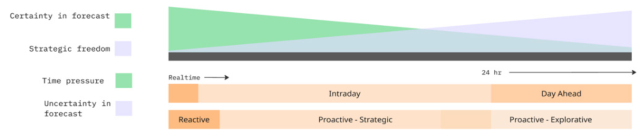
Figure 1: Inverse relationship of uncertainty and time pressure across operational timeframes.
Requirements Analysis: Balancing Uncertainty and Available Time In two sessions at TenneT’s control room, think-aloud methods were used to access the reasoning and decision-making of both senior and regional operators. They showed that decision making is strongly dependent on both available time and forecast uncertainty (“predictability”). Figure 1 illustrates the inverse relationship between forecast uncertainty and time pressure across operational timeframes. As real time approaches, uncertainty decreases but time pressure increases. In contrast, further away from real- time, the forecast uncertainty increases, whereas the time pressure decreases. This changing balance implies that a decision support tool needs to adapt to different timeframes, namely: (i) day-ahead for early exploration without commitment, (ii) intraday for robust strategy formation, and (iii) real-time for fast reactive strategy adoption. All three timeframes are relevant to future decision support, reflecting the structure of proactive congestion management and the continued need for reactive response to volatility.
Table 1 summarizes for each timeframe the goal and problem characteristics which subsequently can be used to inform the design of distinct human–AI interaction modes (see next section). In real-time congestion management, the aim is to resolve congestion as quickly as possible, specifying a single plan that can be adopted to restore a safe operational state. At this timeframe, congestion is clearly identified due to low forecast uncertainty, thus the operator can constrain the problem, and the AI offers fast optimisation. In the intraday timeframe, the goal is to produce a robust set of plans to cope with moderate forecast uncertainty. Operators and AI collaborate in creating a set of staggered plans (based on forecasts) that represent different trade- offs in terms of cost and risk. Day-ahead congestion management focuses on
Designing for Human-AI Teaming in Power System Control Room 273 identifying different congestion scenarios due to diverging weather forecast scenarios. Since uncertainty is high, it is premature to commit to a plan. Operator and AI collaborate in creating a family of plan sets to address different congestion scenarios.
Table 1: Characteristics of different timeframes and related modes of interaction.
Uncertainty level Low Medium High Problem characteristics Reactive Preventative Explorative
Tentative timeframe Realtime Intraday Day-ahead Challenge High speed congestion remediation Robust remediation under medium uncertainty Probabilistic problem identification, explorative remediation
Goal Specify single plan Specify a set of staggered plans
Specify plan families for divergent scenarios
Abstraction level focus Implementation /
Value/trade-offs Goal/frame plan
Tasks — Operator Constrain and guide, implement
Identify congestion patterns and trends
Prioritise, develop, plan evaluate, implement Tasks — AI Fast optimisation Conditional optimisation Probabilistic optimisation
Consequently, human–AI collaboration in congestion management cannot be treated as a single process. As situational characteristics shift, so too must the interaction mode. Designing for effective collaboration means addressing collaboration across the distinct timeframes.
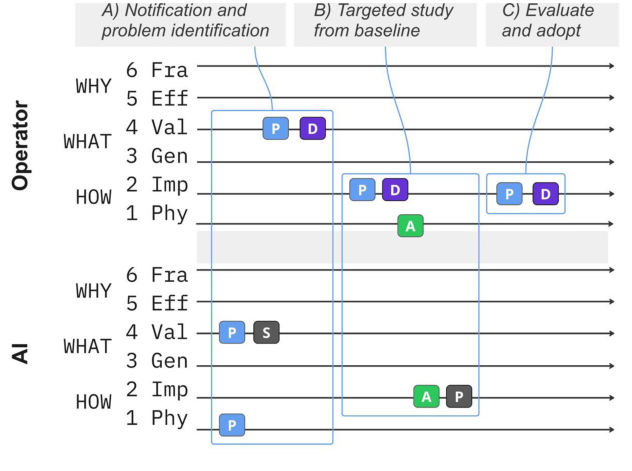
Design: Collaborative Human-AI Interaction Patterns Informed by Table 1, the JCF is used to design for each timeframe a collaborative human-AI interaction pattern. Figures 2–4 show the proposed cognitive interaction patterns as JCF score sheets. Interaction points can be either a perception point (P), a decision point (D), or an action point (A) for both the human operator and the AI. Purely AI-related points can also be a presentation (P-grey) or suggestion (S-grey). Interaction points are mapped in time (horizontal axis) and abstraction hierarchy (vertical axis). The caption below each figure provides further explanation of the points in the score sheet.
Section A - Notification and problem identification
1. AI[P][1-4] Perceives outage of element and severe violation of safety constraints 2. AI[Suggests][4] Conveys urgency to act based on violation 3. Operator[P][4] Perceives notification and identifies problem 4. Operator[D][4] Decides action is needed immediately Section B - Targeted study from baseline
1. Operator[P][2] Looks at existing remediation plans based on N−1 calculation 2. Operator[D][2] Decides on quick N−2 validation with most recent data 3. Operator[A][1] Specifies constraints for optimisation (t<5 min, focus on region X) 4. AI[A][1] Executes constrained N−2 optimisation 5. AI[Present][1] Shows results with trade-offs. Section C - Evaluate and adopt
1. Operator[P][4] Evaluates results and effectiveness of options 2. Operator[D][4] Chooses plan that remediates congestion for N−2
Figure 2 shows real-time remediation of an unplanned outage. Problem uncertainty is low and time pressure is high. The sequence runs from event detection to execution with little reinterpretation. The operator scopes the affected area and objectives, constrains the AI, and triggers a targeted optimisation that yields a single actionable plan. Rapid iterations may be possible depending on the situation, but the goal is immediate remediation. Activity sits relatively low in the abstraction hierarchy. Perception and action follow in quick succession based on operator intuition (Rasmussen, 1986), and decision time is minimized. The operator leads by constraining the optimisation so the AI can compute remediation strategies faster.
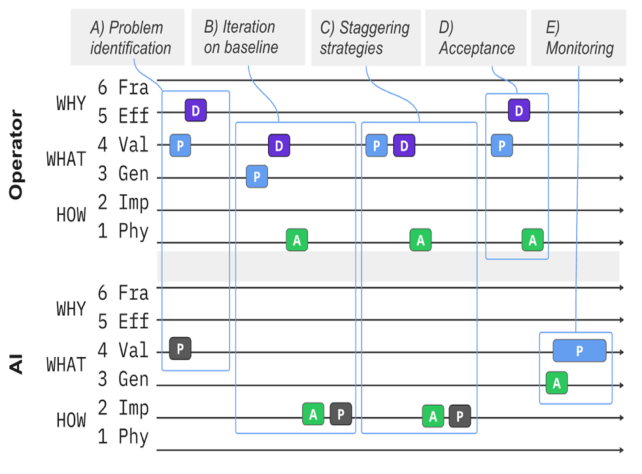
Figure 3: JCF score sheet for collaboration pattern 2: Staggered planning for robustness.
Section A - Problem Identification
1. AI[Presents][4] Shows congestion is expected and remediation required 2. Operator[P][4] Comprehends the expected congestion 3. Operator[D][5] Decides to develop a staggered congestion remediation plan to cope with moderate uncertainty Section B - Iteration loop from baseline
1. Operator [P][3] reviews the N−1 strategy plans; one substation configuration dominates across effective strategies 2. Operator [D][4] judges strategy effective as starting point, but wants to balance reduction of congestion and the complexity of the plan 3. Operator [A][1] Sets constraining substation configuration and requests new N-1 optimisation for second substation configuration 4. AI [A][2] runs constrained N−1 calculations 5. AI [Suggests][4] presents results and makes recommendation Section C - Iteration loop(s) for staggered strategies
1. Operator[P][4] Analyses results; highlighting residual congestion 2. Operator[D][4] Adopts the most effective strategy; targets optimisation to address residual congestion under medium uncertainty in the intraday timeframe 3. Operator [A][1] Fixes two substations; requests new N−1 optimisation to cover uncertainty 4. AI [A][2] runs constrained N−1 Calculations 5. AI [Presents][2] presents constrained optimisation results for 2 scenarios
Section D - Acceptance and adoption
1. Operator [P][4] reviews results, uncertainty covered by staggered actions 2. Operator [D][5] judges remedial actions effective; adopts set of staggered plans 3. Operator [A][1] Sets system to run subsequent optimisations on updated forecasts and to alert when plan limits are exceeded Section E - Monitoring
1. AI [A][3] System runs subsequent cyclic studies following the plan 2. AI [A][4] System monitors KPIs to notify operator when effectivity reduces Figure 3 shows iterative cycles to establish a robust congestion plan using staggered strategies. In this timeframe, some ambiguity remains, yet the situation is structured, and time is available to optimize and plan. This staggered approach addresses medium uncertainty, allowing different remedial actions to be adopted as conditions shift. The figure depicts an iterative loop: evaluating alternatives, adjusting constraints and objectives, and staggering plans. Reasoning is evaluative. Abstraction moves to value- level trade-offs such as cost and risk across candidate strategies. The AI proposes options and the operator steers optimisation toward a robust set of plans ready for adoption as conditions tighten.
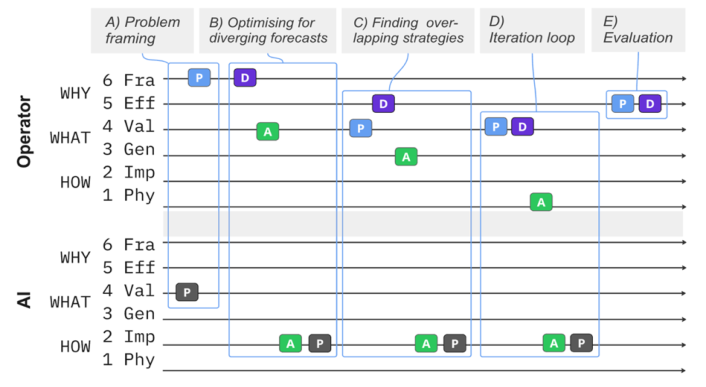
1. AI[Presents][4] Shows four different congestion forecasts; congestion is expected in all forecasts and remediation required 2. Operator[P][6] Notes weather-driven uncertainty: congestion across forecasts differs in severity and location
Designing for Human-AI Teaming in Power System Control Room 277 Section B - Strategizing diverging forecasts
1. Operator[D][6] Decides to develop scenario-based remediation plans to account for (weather-driven) uncertainty 2. Operator [A][4] Requests a N−1 optimisation studies for 2 relevant diverging forecasts, possibly constrained 3. AI [A][2] Runs 2 new N−1 optimisations based on selected forecasts 4. AI [Presents][2] presents constrained optimisation results for 2 scenarios Section C - Finding overlapping strategies for single robust plan
1. Operator[P][4] Reviews results, showing different solutions for each forecast 2. Operator[D][5] Operator seeks strategy that is effective for both scenarios 3. Operator[A][3] Instructs AI to test strategies from each against the other 4. AI [A][2] Runs constrained set of strategies to find outcome 5. AI [Presents][2] Presents study results Section D - Iteration loop for staggered strategies
1. Operator[P][4] Analyses results; strategies have overlapping impact 2. Operator[D][4] A robust plan that covers both scenarios can be adopted, but needs consecutive actions to be more effective: Staggering is required. 3. Operator [A][1] Constrains the configuration and request new N−1 optimisation 4. AI [A][2] Runs constrained N−1 Calculations 5. AI [Presents][2] Presents constrained optimisation results for 2 scenarios Section E - Evaluation
1. Operator[P][5] Analyses results; staggered plan is robust and effective 2. Operator[D][5] Due to the remaining time the operator decides to wait for implementation and monitor the effectivity of the plan over time
Figure 4 shows day-ahead exploration under high uncertainty, where forecasts diverge. The figure highlights a longer path up the Decision Ladder (Rasmussen, 1986). The operator frames the issue of diverging forecasts, compares them, probes what-if scenarios and thus identifies rough congestion causes and implications. Decision-making moves from observation and interpretation to goal formulation. For the operator, activity includes higher abstraction levels where frames, goals, and values are made explicit.
Table 1 also summarizes how the tasks and abstraction levels shift across interaction patterns. In real-time remediation, collaboration focuses on rapid convergence as the system helps target and execute quick, constrained actions. In the medium-term, collaboration becomes co-iterative as operators iterate on AI output, balancing multiple objectives. In the long-term, collaboration is sensemaking-oriented as the system supports exploring ambiguity.
Prototype: UI Design Challenges and Suggestions Based on the requirement analysis and the proposed collaborative human-AI interaction patterns, we identify the following challenges for a prototype of a congestion management UI: (i) Control over optimisation refers to enabling human input through the interface to refine AI-generated strategies, as well as requesting custom optimisations. (ii) Management of Iterations addresses the large quantity of optimisation reports that can be generated. (iii) Notification of Change encompasses the system’s capabilities to inform the operator of the evolving state of the grid. (iv) Continuity across timeframes refers to the fact that the specific needs of different timeframes need to be integrated in a unified UI.
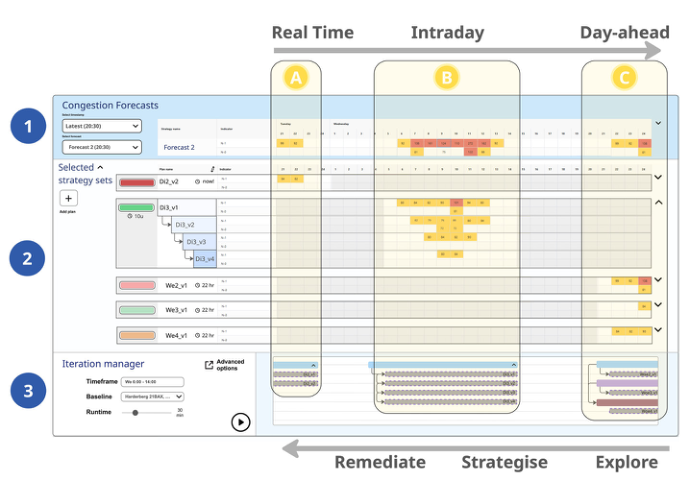
Figure 5 shows elements of an envisioned UI prototype, based on the GridOptions tool UI (Viebahn et al., 2024). The UI is organised around a live congestion timeline spanning from real time to 48 hours ahead. As time progresses, forecasts update and forecasted congestion events move to real- time operations. The UI is structured into three interlinked panels (indicated by the left blue circles): (1) Congestion Forecasts, (2) Selected Strategy Sets, (3) Iteration Manager.
The top panel (1) shows forecasted congestion for the real time (current) grid configuration. Red (yellow) colour indicates time periods with (nearly) congested grid elements. Three different congestion events are indicated on the top as A, B, and C. To the left, the panel offers the selection of a forecast creation timestamp and a specific forecast source via two drop-down menus.
The middle panel (2) shows distinct sets of strategies that the operator has pinned after showing effectivity. It is vertically aligned with the congestion timeline (1), aiming to show the direct impact of a strategy on the forecasted congestion. In this panel we find single strategies (2-A), as well as robust, layered plans (2-B) based on staggered optimisations, achieved through co-iteration. Pinned strategies can be unfolded to show every layer’s effectivity in a staggered plan, and minimized to avoid cognitive overload. In order to keep insight into the effectivity of every layer in minimized view, visual performance indicators have been added to the left.
Finally, the lower panel (3) keeps track of the different user-requested iterations. The user can specify a timeframe and request the baseline optimisation corresponding to that timeframe. On top of the baseline optimisation, the user can request new optimisations to create a set of plans that build on top of each other (either using baseline results or self-created starting points). On the right side, vertically aligned with specific forecasted congestion events in panel (1), we find a waterfall-style visualisation to track and manage iterations on baselines (blue bars) and their constrained iteration(s) (grey bars). Note that each of these is constrained to a specified timeframe, covering congestion events rather than the entire timeline (3-A, B and C). Also note that simultaneous optimisations can be run within the same timeframe in case that different scenarios might be explored or when a previous plan with accompanying strategy has become ineffective and obsolete (3-C).
Figure 5: Congestion remediation UI prototype based on GridOptions (Viebahn et al., 2024).
The dashboard enables the operator to identify emerging congestion by exploring possible remedial actions on diverging forecasts in the day- ahead timeframe (C) and then co-iterate on the most persistent scenario(s) in the intraday by staggering subsequent actions into a robust plans to cover uncertainty (B). Plans are tracked, compared and adopted in the intraday to prevent congestion from occurring in real time.
CONCLUSION
In this paper, we take a first step towards human-AI teaming for decision support in the power system control room. Employing SBD combined with the JCF, we (i) identify how human-AI teaming requirements shift across different timeframes, (ii) design cognitive human-AI collaboration patterns specific for each timeframe, and (iii) propose UI elements that enable human-AI collaboration across timeframes via iterative co-creation of strategies to deal with uncertainty.
ACKNOWLEDGMENT
AI4REALNET has received funding from European Union’s Horizon Europe Research and Innovation program under the Grant Agreement No 101119527. Views and opinions expressed are however those of the authors only and do not necessarily reflect those of the European Union. Neither the European Union nor the granting authority can be held responsible for them.
REFERENCES
Bessa R. J., F. Moaidi, J. Viana and J. R. Andrade, (2024). Uncertainty-Aware Procurement of Flexibilities for Electrical Grid Operational Planning. IEEE Transactions on Sustainable Energy, vol. 15, no. 2, 789–802. Dellermann, D., Ebel, P., Söllner, M., & Leimeister, J. M. (2019). Hybrid intelligence.
Business & Information Systems Engineering, 61(5), 637–643. Freire, S. K., Panicker, S. S., Ruiz-Arenas, S., Rusák, Z., & Niforatos, E. (2022).
A cognitive assistant for operators: AI-powered knowledge sharing on complex systems. IEEE Pervasive Computing, 22(1), 50–58. Hollnagel, E., Woods, D.D. (2005). “Joint Cognitive Systems. Foundations of Cognitive Systems Engineering”, Taylor & Francis Group. Leyli-Abadi, M. et al. (2025). “A Conceptual Framework for AI-based Decision
Systems in Critical Infrastructures”, 2025 IEEE International Conference on Systems, Man, and Cybernetics (SMC). Lundberg, J., Johansson, B.J.E. (2021). “A framework for describing interaction between human operators and autonomous, automated, and manual control systems”. Cognition, Technology & Work 23, 381–401. Marot, A., Kelly, A., Naglic, M., Barbesant, V., Cremer, J., Stefanov, A., and J.
Viebahn (2022). “Perspectives on future power system control centers for energy transition,” in Journal of Modern Power Systems and Clean Energy, vol. 10, no. 2, pp. 328–344. Rasmussen, J. (1986). Information processing and human–machine interaction: An approach to cognitive engineering. New York: North-Holland. ISBN 0444009876. Rosson, M.B., Carroll, J.M. (2002) “Scenario-based design”, in: The Human-
Computer Interaction Handbook: Fundamentals, Evolving Technologies and Emerging Applications, Lawrence Erlbaum Associates, J. Jacko & A. Sears (Eds.), pp. 1032–1050. Sahel, W., Mackay, W.E., Marot, A. (2023). Creating StoryLines: Participatory Design with Power Grid Operators. In: da Silva, H.P., Cipresso, P. (eds) Computer- Human Interaction Research and Applications. CHIRA 2023. Communications in Computer and Information Science, vol 1997. Springer, Cham. Viebahn, J., Ayedh, A., Lundberg, J., Bång, M., Keijzers, J. (2025). “User experience
evaluation of an AI-based decision-support tool for power grid congestion management”, in: Human Interaction and Emerging Technologies (IHIET 2025). AHFE (2025) International Conference. http://doi.org/10.54941/ahfe1006694 Viebahn, J., Kop, S., van Dijk, J., Budaya, H., Streefland, M., Barbieri, D., Champion, P. et al. (2024). “GridOptions Tool: Real-world day-ahead congestion management using topological remedial actions”, CIGRE Science & Engineering, vol. 35, pp. 1–15. Waefler, T., Hamouche, S., Eisenegger, A. (2025). The Supportive AI Framework:
From Recommending to Supporting. In: Schmorrow, D.D., Fidopiastis, C.M. (eds) Augmented Cognition. HCII 2025. Lecture Notes in Computer Science, vol. 15778. Springer, Cham.
LISTED IN THE AHFE DIGITAL BOOKSTORE CATALOGUE
Explore the complete digital volume
Human Interaction and Emerging Technologies (IHIET-AI 2026): Artificial Intelligence and Future Applications
Read this individual research paper free through the original publisher, or explore the full digital proceedings book.
ISBN 978-1-964867-77-9
Explore this ISBN in the AHFE Bookstore ↗Listed in the July 2026 bookstore catalogue; search by ISBN to confirm current availability · Digital book purchase optional