Sukesha Shekhar Ghosh, Swati Pal (2026). Interactive VR-Based Usability and Acceptance Testing for the Future of Age-Friendly Kitchen Design. In: Human Interaction and Emerging Technologies (IHIET-AI 2026): Artificial Intelligence and Future Applications. AHFE Open Access, vol. 201, pp. 147–154. https://doi.org/10.54941/ahfe1007169
As populations age globally, designing accessible and functional kitchens to support independent living becomes imperative. Designing user-friendly, safe, and ergonomically optimised kitchens is essential for maintaining autonomy and improving well-being among the ageing population. Contemporary one-size-fits-all design approaches often fail to meet major ageing-specific needs, and conducting rigorous scientific evaluations with full-scale prototypes poses significant financial burdens and logistical hurdles. Therefore, Interactive Virtual Reality (VR) serves as an effective tool for testing smart kitchen designs and identifying usability issues before incurring the costs of large-scale prototyping. This study assesses the effectiveness of immersive virtual reality (IVR) simulation as a tool for informed design decision-making in age-friendly kitchen spaces. In a controlled experimental study with 15 older adults (aged 65-85), we evaluate platform height manoeuvrability in kitchen designs through usability testing. The evaluation parameters include headset usability, safety and comfort, perceived usefulness, spatial accessibility, and technology acceptance. The study reports higher confidence in participants' design decisions, which indicates a better understanding of ergonomic considerations when using the IVR system. Finally, the findings suggest that IVR simulation can enable ageing adults to evaluate designs by actively participating in the creation of spaces that meet their functional needs. Presented ideas contribute to the future of accessible design methodologies and demonstrate the potential of IVR technology in supporting future initiatives for independent and healthy ageing.
The growth in the ageing population (65 years and above) worldwide is attributed to improved healthcare systems that enhance life expectancy, necessitating age-related design considerations for everyday living activities (Farage et al., 2012; Lundberg & Larsson, n.d.; Roelofsen, 2013; Xu et al., 2024). In the past decade, design studies for ageing have evolved and expanded into many interdisciplinary research areas, bridging gerontology, spatial design, behaviour research, ergonomics, human factors, and design research methodologies (Gregory, 2002; Hill et al., 2021; Merkel & Kucharski, 2019;
148 Ghosh and Pal Morris, 1994). While various design research collaborative approaches, such as participatory design, co-design, survey, interviews and user-testing, have advanced the ageing discourse, immersive virtual reality (IVR) emerges as a valuable tool for design evaluation and decision making, enabling designers and practitioners to test concepts prior to the manufacturing process (Abeele et al., 2021; Everard et al., 2025; Grübel, 2023; Pau et al., 2023; Schaumburg et al., 2025). Traditional practices in product, architectural, and interior design involve constructing physical mockups, downsized prototypes, and environments that require multiple iterative cycles. While they demand substantial time, human labour, materials, and financial resources, immersive virtual reality (IVR) offers an effective alternative for user evaluation that provides prerequisite experiential feedback, thereby enabling more effective design decision-making for interactable product and spatial design outcomes.
Although IVR technology was initially developed for the gaming and entertainment industry, its research applications have broadened to encompass architecture, interior design, healthcare, rehabilitation, training, education, automobile manufacturing, and interaction design (Abdelhameed, 2013; Ergün et al., 2019; Home2decor, 2025; Smith, 2019; Tieri et al., 2018; Zhang & Codinhoto, 2020). Previously, scholars have explored the potential of IVR applications within the healthcare domain, indicating improved diagnosis and rehabilitation in treating physical and cognitive impairments with age-related conditions such as stroke and dementia (Garcia et al., 2012; García-Betances et al., 2015; Tieri et al., 2018). Enhanced accessibility through improved manufacturing capabilities and customised hardware/software has accelerated IVR adoption (Kopeć et al., 2019). Additionally, research confirms favourable user acceptance and safety for using IVR amongst the ageing population (Huygelier et al., 2019; Ip et al., 2024). Therefore, in light of recent demographic trends, this study engages older adults to test the use of IVR to evaluate interactive kitchen surfaces that ease accessibility barriers in spatial design and interactive technologies.
METHOD
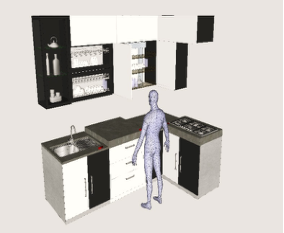
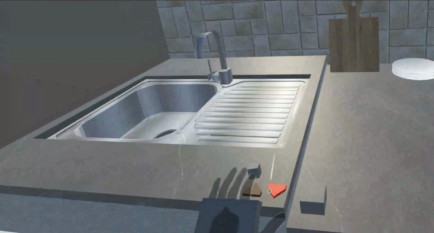
Scenario The study developed an IVR simulation system to investigate interactive kitchen platform designs optimised for the ageing population (see Fig. 1). The virtual environment displayed a compact kitchen area of 9 sq m with an L-shaped layout. The L-shaped platform was further segmented into four functional working zones based on established kitchen workflow principles: the washing area (sink), preparation counter, cooking area (stovetop/hob), and platform storage area. Each functional zone incorporated two buttons, one for up (red) and one for down (brown), to manipulate height, enabling real-time ergonomic testing across different workspace configurations. The system provided adjustable height at 0.05 meters (50mm) intervals across five standardised levels: 0.75m, 0.80m,
Interactive VR-Based Usability and Acceptance Testing 149 0.85m, 0.90m, and 0.95m, addressing the anthropometric diversity of the ageing adults. The scenario of this IVR simulation workshop consists of multiple steps:
1. Introduction and Study Objectives- discussing potential age-friendly design benefits 2. Briefing on IVR concepts and navigation principles 3. Guided exploration of available IVR interface solutions 4. Individualised IVR system calibration to accommodate both seated and standing interaction modes, as per their comfort and accessibility 5. Real-time height-adjustable platforms manipulation 6. Documentation of user preferences and spatial interaction patterns Software and Hardware
The workshop initiated by showcasing case studies for kitchen platform interactions, possibilities, and benefits for progressive ageing. The three- dimensional kitchen environment was created in SketchUp Pro 2022 and Blender 4.4, enabling the processing of functional mockups and iterations. Open-source software, Unity Hub 6.0, was used to incorporate quick interactions and test them simultaneously. The study used the Meta Quest 3 VR headset, which offered adjustable wearing techniques, visual comfort adjustments, hand gesture interaction, and a potential lightweight design. This device allowed users to interact with the kitchen platform using up and down buttons via a responsive hand-tap gesture (see Fig. 2).
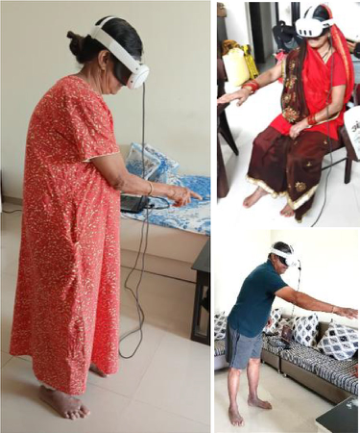
Figure 1: 3D model of the Kitchen design for ageing older adults.Figure 2: Ageing participants interacting with IVR simulation.
This study approached 15 healthy Indian older adults aged 65–85 years old (12 females and 3 males, mean=70.6, SD=4.5), using a random stratified sampling method to test the interactive kitchen design simulation in an immersive virtual reality system (See Fig. 3). The inclusion criteria consist of participants being healthy and active with no chronic ailment that could confine them to bed or a wheelchair, and they must be aware of kitchen activities, storage and organisations. All the IVR explorations were conducted in participants’ homes to ensure comfort and safety. Each participant could choose to sit or stand during the IVR interaction, as they had been informed of potential IVR side effects, such as headaches, balance issues, or nausea. Participants were exposed to the IVR headset for 50 seconds to 1 minute per testing session. Continuous support and physical assistance were provided to the participants throughout the experiment session. All participant were advised to communicate any discomfort during the session and were repetitively reminded of their right to pause or discontinue the experience at any time.
User evaluation employed Likert-scale (1–7) ratings and qualitative feedback to assess user performance across five key parameters: headset usability, safety and comfort, perceived usefulness, spatial accessibility, and technology acceptance. The study was conducted over seven consecutive days in May 2025. Ethical approval for the study was granted by the Institutional Review Board, IIT Bombay (Ethics approval no. ITB-IRB/2024/003).
RESULTS AND DISCUSSION
The findings document the evaluation of the effectiveness of using IVR technology in addressing Kitchen spatial evaluation and technology adoption, rather than the assessment of the proposed kitchen design solution. The insights were clustered into five outcomes as follows:
Figure 3: Participants interacting with the IVR kitchen design simulation.
1. Ageing and IVR Headset Usability – A commonly reported limitation in using IVR for ageing studies is the physical and ergonomic challenge, including headset weight and bulk, fogging issues, and sensitivity to glare (Kalantari et al., 2022; Schaumburg et al., 2025). By limiting the IVR exposure time to 1 minute, all participants in this study demonstrated effective interaction with the IVR headset, reflecting improved age- oriented usability standards. A significant observation was the quick learning and understanding of the IVR headset and hand gesture controls during the simulation. The participants stated that a realistic immersive environment enhanced their engagement by mirroring their personal kitchen spaces and helped establish behavioural patterns. 2. Safety and Comfort – In the current study, 92% of participants reported no discomfort, such as nausea, headache, heaviness, or neck issues, while using the VR headset. This aligns with recent literature showing that improvements in spatial clarity, self-paced navigation, and intuitive task flows in VR environments enable safe participation and minimise risks of cybersickness and ergonomic strain for older adults (Everard et al., 2025; Schaumburg et al., 2025). Younger-old participants (65–70 years) exhibited greater proactivity and adaptability to IVR technology. In contrast, 8% of participants reported anxiety while experiencing the immersive environment, perceiving it as real; notably, all anxious participants were aged 80 and above. 3. IVR Spatial Accessibility – The IVR simulation offered spatial layout assessment through both seated and standing interaction modes. Participants over 75 years predominantly chose seated interaction, whereas those under 75 years opted to stand, reporting improved reachability, ergonomic comfort, smooth manoeuvrability, and the ability to customise spatial organisation to their own preferences. 4. Perceived Usefulness – In this context, 95% of participants found the virtual reality visualisation experience valuable for evaluating kitchen layout and spatial designs. While studies in the interior design discourse have approached the virtual and walkthrough mediums for experiencing design concepts, interactive immersive experiences offer enhanced capability for personalising spatial elements tailored to individual needs (Muslu et al., 2025). The participant’s feedback strongly supported the implementation of immersive experiences in future age-inclusive design solutions, particularly for spatial furniture procurement (sofas, dining furniture, beds), where pre-purchase visualisation and interaction could inform financial decision-making. 5. Interactive Technology Adoption – Regarding technology adoption and usage, 95% of participants recommended further experimentation and exploration with this IVR technology for kitchen or other spatial design evaluation. Participants gave positive feedback for the intuitive, gesture- based design, which reduced their cognitive load engagement. The literature states that numerous IVR interventions are currently being developed targeting older adults, suggesting positive trends in technology acceptance and expressing eagerness to engage with future VR-based design solutions (Fu et al., 2022; Ip et al., 2024; Kopeć et al., 2019; Pau et al., 2023).
152 Ghosh and Pal Overall, participants responded positively to IVR as a design evaluation methodology and expressed intent to implement the observed design principles in their domestic kitchen spaces.
CONCLUSION AND FUTURE WORK This research is an important benchmark for developing the future of ageing- friendly spatial methodologies. This type of research in the Indian context with ageing adults is new and novel. The findings state that innovative IVR approaches enable the integration of interactive smart technologies, effectively addressing accessibility gaps and supporting independent ageing. Participant feedback indicated strong positive responses to IVR as a design evaluation tool, emphasising its value for enhancing realism, accessibility, and user-centred design in ageing studies. These findings reflect broader trends in both literature and practical applications, underscoring IVR’s potential to transform how older adults engage with and evaluate their built environments.
Future investigations will expand stakeholder participation through integrating comprehensive, inclusive, and barrier-free ageing principles. Additionally, by involving diverse stakeholder groups such as older wheelchair users, intergenerational participants, and design professionals, the subsequent phases will involve structured discussions and feedback sessions focused on customised age-friendly kitchen design solutions that support independent ageing within urban environments.
ACKNOWLEDGMENT
We thank the “Human Factors and Ergonomics in Design (HFED) Lab” and “Immersive Media Experience Design (IMXD) Lab” of the Industrial Design Centre, IIT Bombay, for their support with all resources and lab facilities. We express our gratitude to the interdisciplinary experts from IMxD for their valuable input on reviewing the iVR design, and to all the older adults for patiently participating in the simulation workshops. Ethical approval for the study was granted by the Institutional Review Board, IIT Bombay (Ethics approval no. ITB-IRB/2024/003).
REFERENCES
Abdelhameed, W. A. (2013). Virtual Reality Use in Architectural Design Studios: A Case of Studying Structure and Construction. Procedia Computer Science, 2013 International Conference on Virtual and Augmented Reality in Education, 25, 220–230. https://doi.org/10.1016/j.procs.2013.11.027 Abeele, V. V., Schraepen, B., Huygelier, H., Gillebert, C., Gerling, K., & Van Ee, R.
(2021). Immersive Virtual Reality for Older Adults: Empirically Grounded Design Guidelines. ACM Transactions on Accessible Computing, 14(3), 1–30. https:// doi.org/10.1145/3470743 Ergün, O., Akın, Ş., Dino, İ. G., & Surer, E. (2019). Architectural Design in Virtual Reality and Mixed Reality Environments: A Comparative Analysis. 2019 IEEE Conference on Virtual Reality and 3D User Interfaces (VR), 914–915. https://doi. org/10.1109/VR.2019.8798180
Interactive VR-Based Usability and Acceptance Testing 153 Everard, G., Vermette, M., Dumas-Longpré, E., Hoang, T., Robitaille, M., Sorrentino,
G., Edwards, M. G., Lejeune, T., & Batcho, C. S. (2025). Self-adaptive over progressive non-adaptive immersive virtual reality serious game to promote motor learning in older adults—A double blind randomized controlled trial. Neuroscience, 571, 7–18. https://doi.org/10.1016/j.neuroscience.2025.02.053 Farage, M. A., Miller, K. W., Ajayi, F., & Hutchins, D. (2012). Design Principles to Accommodate Older Adults. Global Journal of Health Science, 4(2), p2. https:// doi.org/10.5539/gjhs.v4n2p2 Fu, Y., Hu, Y., Sundstedt, V., & Forsell, Y. (2022). Conceptual Design of an Extended
Reality Exercise Game for the Elderly. Applied Sciences, 12(13), 6436. https://doi. org/10.3390/app12136436 Garcia, L., Kartolo, A., & Methot-Curtis, E. (2012). A Discussion of the Use of Virtual Reality in Dementia. In C. Eichenberg (Ed.), Virtual Reality in Psychological, Medical and Pedagogical Applications. InTech. https://doi.org/10.5772/46412 García-Betances, R. I., Arredondo Waldmeyer, M. T., Fico, G., & Cabrera-Umpiérrez,
M. F. (2015). A Succinct Overview of Virtual Reality Technology Use in Alzheimer’s Disease. Frontiers in Aging Neuroscience, 7. https://doi.org/10.3389/ fnagi.2015.00080 Gregory, J. (2002). Scandinavian Approaches to Participatory Design. TEMPUS Publication, 62–79. Grübel, J. (2023). The design, experiment, analyse, and reproduce principle for
experimentation in virtual reality. Frontiers in Virtual Reality, 4. https://doi. org/10.3389/frvir.2023.1069423 Hill, J. R., Brown, J. C., Campbell, N. L., & Holden, R. J. (2021). Usability-In- Place—Remote Usability Testing Methods for Homebound Older Adults: Rapid Literature Review. JMIR Formative Research, 5(11), e26181. https://doi. org/10.2196/26181 Home2decor. (2025, June 28). From Virtual to Reality: Top Interior Designers
in Pune for Kitchen Design. Home2decor. https://www.home2decor.in/post/ from-virtual-to-reality-a-kitchen-design-you-have-to-see Huygelier, H., Schraepen, B., Van Ee, R., Vanden Abeele, V., & Gillebert, C. R. (2019).
Acceptance of immersive head-mounted virtual reality in older adults. Scientific Reports, 9(1), 4519. https://doi.org/10.1038/s41598-019-41200-6 Ip, W. K., Soar, J., James, C., Wang, Z., & Fong, K. N. K. (2024). Innovative Virtual Reality (VR) Application for Preventing of Falls among Chinese Older Adults: A Usability and Acceptance Exploratory Study. Human Behavior and Emerging Technologies, 2024, 1–11. https://doi.org/10.1155/2024/5556767 Kalantari, S., Bill Xu, T., Mostafavi, A., Lee, A., Barankevich, R., Boot, W. R., & Czaja,
S. J. (2022). Using a Nature-Based Virtual Reality Environment for Improving Mood States and Cognitive Engagement in Older Adults: A Mixed-Method Feasibility Study. Innovation in Aging, 6(3), igac015. https://doi.org/10.1093/ geroni/igac015 Kopeć, W., Wichrowski, M., Kalinowski, K., Jaskulska, A., Skorupska, K., Cnotkowski, D., Tyszka, J., Popieluch, A., Voitenkova, A., Masłyk, R., Gago, P., Krzywicki, M., Kornacka, M., Biele, C., Kobyliński, P., Kowalski, J., Abramczuk, K., Zdrodowska, A., Pochwatko, G., … Marasek, K. (2019). VR with Older Adults: Participatory Design of a Virtual ATM Training Simulation. IFAC- PapersOnLine, 52(19), 277–281. https://doi.org/10.1016/j.ifacol.2019.12.110
154 Ghosh and Pal Lundberg, S., & Larsson, T. J. (n.d.). Inclusive Design instead of Assistive Technology
in Housing. Merkel, S., & Kucharski, A. (2019). Participatory Design in Gerontechnology: A Systematic Literature Review. The Gerontologist, 59(1), e16–e25. https://doi. org/10.1093/geront/gny034 Morris, J. M. (1994). User interface design for older adults. Interacting with
Computers, 6(4), 373–393. https://doi.org/10.1016/0953-5438(94)90009-4 Muslu, L., Karakuş, Z., Asï, E., Bayindir, R., & Özer, Z. (2025). Time travel of older people through virtual reality: A qualitative study. BMC Geriatrics, 25, 42. https://doi.org/10.1186/s12877-025-05699-x Pau, M., Cocco, E., Arippa, F., Casu, G., Porta, M., Menascu, S., Achiron, A., &
Kalron, A. (2023). An Immersive Virtual Kitchen Training System for People with Multiple Sclerosis: A Development and Validation Study. Journal of Clinical Medicine, 12(9), 3222. https://doi.org/10.3390/jcm12093222 Roelofsen, P. (2013). Healthy ageing—Design criteria for the indoor environment for vital elderly. Intelligent Buildings International, 6(1), 11–25. https://doi.org/10.10 80/17508975.2013.830589 Schaumburg, M., Imtiaz, A., Zhou, R., Bernard, M., Wolbers, T., & Segen, V.
(2025). Immersive virtual reality for older adults: Challenges and solutions in basic research and clinical applications. Ageing Research Reviews, 109, 102771. https://doi.org/10.1016/j.arr.2025.102771 Smith, A. W. (2019). User experience design for older adults: Experience architecture and methodology for users aged 60+. Proceedings of the 37th ACM International Conference on the Design of Communication, 1–9. https://doi. org/10.1145/3328020.3353952 Tieri, G., Morone, G., Paolucci, S., & Iosa, M. (2018). Virtual reality in cognitive
and motor rehabilitation: Facts, fiction and fallacies. Expert Review of Medical Devices, 15(2), 107–117. https://doi.org/10.1080/17434440.2018.1425613 Xu, Z., Bao, Y., Dong, H., Wu, Y., & Tang, G. (2024). Heart of the future home: A multidimensional model of inclusive kitchen for older people in the UK. Humanities and Social Sciences Communications, 11(1), 1–16. https://doi. org/10.1057/s41599-024-03508-1 Zhang, Y., & Codinhoto, R. (2020). Developing a visually impaired older people
Virtual Reality (VR) simulator to apply VR in the aged living design workflow. 2020 24th International Conference Information Visualisation (IV), 226–235. https://doi.org/10.1109/iv51561.2020.00045
LISTED IN THE AHFE DIGITAL BOOKSTORE CATALOGUE
Explore the complete digital volume
Human Interaction and Emerging Technologies (IHIET-AI 2026): Artificial Intelligence and Future Applications
Read this individual research paper free through the original publisher, or explore the full digital proceedings book.
ISBN 978-1-964867-77-9
Explore this ISBN in the AHFE Bookstore ↗Listed in the July 2026 bookstore catalogue; search by ISBN to confirm current availability · Digital book purchase optional