Florian Brillowski, Thomas Gries, Luisa Vervier, Thomas Schemmer, Philipp Brauner, Martina Ziefle (2022). User Centered Design and Evaluation of an Artificial Intelligence based Process Recommender System in Textile Engineering. In: Usability and User Experience. AHFE Open Access, vol. 39, pp. 201–212. https://doi.org/10.54941/ahfe1001709
Despite digitization and automation in everyday life and at the workplace, traditional craftsmanship continues to be primarily analogue and manual. This specifically applies to decision-making processes that are predominantly influenced by experience and intuition. As a result, established best-practice solutions are commonly used and promising alternatives are overlooked. AI-based decision support tools are a viable option to automate and objectify the decision-making process. Additionally, these tools can help stimulate decision makers to break with common best-practice solutions and consider novel, promising alternatives. However, using AI may lead to lower social acceptance among users, due to scepticism about effectiveness, workers’ fear of being eventually substituted, and missing comprehensibility of the suggestions due to the black box-models of many AI systems. Currently, there is a lack of grounded guideline for designing and implementing user-oriented AI-based decision support systems in traditional craftsmanship.This contribution investigates how a user-centred design of AI-based decision support influences user acceptance and usage intention. For this purpose, two AI-based process recommender systems for planning textile reinforced composite processes are designed with varying focus (user-centred and purely functional). Both applications are then benchmarked in a mixed-method user study with qualitative (think aloud) and quantitative (survey) parts and 17 domain experts. We used an Excel-based decision support system as a reference, since it realistically represents the currently prevailing planning support in manufacturing companies. In the user study we evaluate the planning efficiency, objectivity, and user orientation by measuring the duration of the planning process, the result quality, consistency, and reproducibility of the designed process chains and the usability of the system. Additionally, trust in automation, the performance expectation, as well as the intention to use are measured based on the acceptance models of Körber and Venkatesh et al. and are supplemented by additional items (e.g., comprehensibility). The results of the study suggest that an AI-based support system can increase the speed and objectivity of the decision-making process. However, it is also important to design the system in a user-centric way to ensure usability, trust, and acceptance. Further, we found that it is reasonable to leave the final decision-making authority with the decision maker, since our participants tended to less frequently question a completely automated result. Based on the results of our study, we derive actionable guidelines for the design of AI-based support systems in manufacturing.
The Digital Transformation has an enormous impact on the world in which we live, work, and innovate. It will reshape industrial production under the umbrella terms “Industry 4.0”, “Industrial IoT”, or “Industrial Internet”, for example, through smarter logistics, better process control and more intel- ligent process planning options (Kagermann, Wahlster and Helbig, 2013; Brauner et al., 2021).
Many companies have already implemented some concepts of the Indu- strial Internet-of-Things (Brous, Janssen and Herder, 2020). Yet, the early adopters are mainly larger companies with a highly automated production,
a well-developed digital infrastructure, and high research and development budgets. In contrast, small and medium-sized enterprises, as well companies from certain industries, such as the textile industry, still rely on traditional craftsmanship, resulting in most planning and production processes still being manual and analogue. These companies therefore do not tap the potential of a digitised production (Überbacher, Brozzi and Matt, 2020; Brillowski et al., 2021). This also applies to decision-making processes, which are predomi- nantly influenced by experience and intuition (Brillowski et al., 2021). As a result, established best-practice solutions are commonly used and promi- sing alternatives are often not considered. In this context, new, data-driven and Artificial Intelligence (AI)-based recommendation and decision support systems can make a valuable contribution to supporting decision-making, automating it, and objectifying it. Also, these tools can nudge decision makers to break with common, and often imperfect, solutions and consider novel, promising alternatives. However, the use of automation and AI may lead to lower social acceptance among users, due to limited trust, missing transpare- ncy and comprehensibility of the suggested solutions, or the workers’ fear of being eventually substituted by an AI (Edelman, 2019; Jacovi et al., 2021). Further, there is a lack of grounded guidelines for designing and implementing user-centered AI-based decision support systems in traditional craftsmanship.
This contribution investigates how user-centred AI-based decision support systems influence user acceptance and usage intention. For this purpose, two AI-based process recommender systems for planning textile reinforced composite processes are designed with different foci: One user-centred and one purely functional. Both applications are then benchmarked in a mixed- method user study with qualitative (think aloud) and quantitative (survey) parts and a sample of 17 domain experts. We used an Excel-based decision support system as a reference since it realistically represents the currently prevailing planning support in manufacturing companies.
In the user study we evaluate the planning efficiency, objectivity, and user orientation by measuring the duration of the planning process, the quality, consistency and reproducibility, and the perceived usability of the system. We also measured trust in automation, performance expectancy, comprehen- sibility and the usage intention based on the technology acceptance models of Körber and Venkatesh et al. (Venkatesh, Thong and Xu, 2012; Körber, 2019). Next, we review related work in context of automated technologies’ percei- ved trust, explainability, and acceptance in general and regarding the textile industry. Then, the study, the investigated applications as well as the results are described and discussed. Conclusively, we derive actionable guidelines for the design of an AI-based support system in manufacturing based on the study’s results.
RELATED WORK
Decision support systems (DSS) automate a computable part of decision processes (Gorry and Morton, 1971) and can be found in clinical decision making (Shibl, Lawley and Debuse, 2013) or industrial settings (Doltsinis
User Centered Design and Evaluation of an Artificial Intelligence 203
et al., 2020). Their fields of application are as diverse as their methodologi- cal approaches: In the past, expert systems or neural networks were used to a great extent, while today, recommender systems or deep neural networks are fashionable. DSS are used for planning processes within a company and to orchestrate collaboration across supply chains (Allaoui, Guo and Sarkis, 2019). They are also used in the textile industry for supply chain (Ngai et al., 2014) or order management (Ncube, Chikowore and Sibanda, 2018). Providing new tools for planning processes only serves a purpose if they are also used. Thus, a central challenge is the design of a trusted, reliable, fast, and effective interaction between DSS and human decision makers (Calero Valdez et al., 2015). Technology acceptance research aims to predict the later use of a product by measuring the usage intention beforehand and to identify antecedents that influence the (projected) later use (Davis, 1989; Venkatesh, Thong and Xu, 2012). Perceived usefulness and ease of use are cornersto- nes of acceptance of interactive systems. For DSSs, trust is also an essential prerequisite for higher operators’ acceptance and later use (Shibl, Lawley and Debuse, 2013). Further, with the advance of (deep) neural networks for auto- mation and decision support, the explainability is also becoming increasingly important (Amann et al., 2020).
The interaction between people and automated DSSs’ and the overall per- formance of the so called joint-cognitive system (human and system), is strongly determined by the users’ trust in the automation (Hoff and Bashir, 2015). Trust, however, is a thin line. If users trust an automated system too much and to an extend not warranted by the automations’ reliability, this yields errors and thus lower performance of the joint-cognitive system (“over- trust”). Conversely, a lack of trust yields disregard of automation and thus lower overall performance (“under trust”). Hence, trust needs to be carefully calibrated so that users’ trust in the automation is in line with its reliabi- lity (“trust calibration”) (Parasuraman and Riley, 1997). Further, over-trust relates to automation complacency, a bias that makes users blindly follow suggestions of a system without checking for errors or better solutions. Prior work suggests that higher (perceived) ease of use mitigates automation com- placency and automation bias (Goddard, Roudsari and Wyatt, 2012; Brauner et al., 2019). Thus, considering the principles of cognitive ergonomics and user-centered design (UCD) are crucial for effective and reliable automation and automated decision support.
METHODICAL PROCEDURE The user study aims at the identification of factors that have an impact on the acceptance of an AI-based support application and thus play a crucial role when implementing such an application. Therefore, an evaluation of three decision support applications for composite process chain planning are asses- sed regarding their usability of the system, planning efficiency, and planning objectivity.
Study Design To receive an in-depth evaluation and benchmark the three different applica- tions, a mixed-method approach was chosen. With the qualitative method of
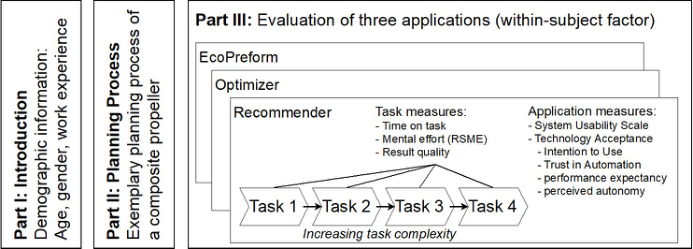
Figure 1: Design of the usability study to evaluate the three applications.
thinking aloud the participants thoughts were monitored for comprehending their action. The online-survey as a quantitative method contributed to ope- rationalise the acceptance-relevant factors. Figure 1 illustrates the methodical procedure and the investigated variables.
The study consisted of three parts. In the first part participants were intro- duced to the topic and demographic data were assessed. In a second part, an exemplary planning process of a composite propeller was provided to make the participants familiar with the upcoming evaluation tasks. The third part comprised the main applications (presented in random order) to be evalua- ted. For each, participants had to solve four tasks with increasing complexity. We measured the perceived difficulty after each task and the usability after all tasks were completed. We informed the participants that participation was voluntary and not rewarded and that they could quit the study at any time. In the following, we outline a detailed description of the evaluated application and the specific empirical measurements.
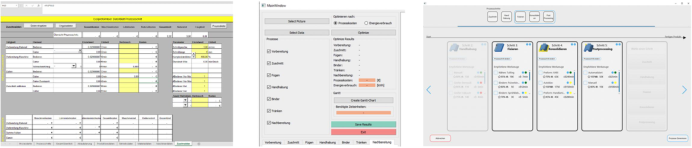
Evaluation of AI-Based Recommender Applications This study compares three different applications (“Optimisation App”, “Recommender App”, and “EcoPreform”) for planning and designing FRP process chains. As a baseline, we use EcoPreform as it reflects the prevalent use of Excel for planning tasks in industry. In contrast, both the Optimisation App and the Recommender App were developed to elaborate on how to use AI algorithms for planning and with a focus on user centered design (UCD). We describe all three applications in the following. Figure 2 illustrates the three different applications.
EcoPreform EcoPreform is a Microsoft Excel-based planning tool that provides software support for designing composite process chains and focusses on an econo- mic evaluation of these process chains (Grundmann, 2009). The planner is obliged to provide technology and scheduling information on his own in the tool’s spreadsheets. Nevertheless, the tool has a wide range of setting opti- ons for the economic evaluation of the process chains (e.g., depreciation of machines). There is no algorithm provided that supports the planner.
User Centered Design and Evaluation of an Artificial Intelligence 205
Figure 2: Three application of process chain planning evaluated in this study. EcoPre- form (left), Optimisation App (center), and Recommender App (right).
Optimisation App. The optimisation App is based on a mathematical optimisation model with which technologies (e.g., CNC cutting) are allocated to process steps and then scheduled in a process chain. The process chain is generated automa- tically. Finding the best possible chain is the focus of the application. The planer merely specifies the framework conditions and initiates the automa- ted optimisation process. The solving algorithm itself is the decision-making authority and the planner has limited means to overrule the suggestion.
Recommender App. The main goal of the Recommender App is to achieve a high degree of intui- tiveness in its interaction and the greatest possible comprehensibility during the decision-making process. For this purpose, an algorithm makes suggesti- ons for technology selection when designing the process chains. The quality of the suggestion is illustrated by visual indicators (comparable to a traffic light). In addition, to increase the transparency of the system, the key per- formance indicators relevant for the algorithm’s suggestion are displayed to the users. This enables planners to accept or reject suggested alternatives and guarantees that the decision-making authority remains with the planner. The design of the app followed user-centred and participatory design methods (Schemmer et al., 2020).
Study Measures Demographic Data In the first part the surveyed the participants’ age, gender, current field of work, their highest educational attainment, technical background in rela- tion to fibre composites, experience with the usage of decision-support-tools, experience with process automation as well as experience in technological planning of processes.
Usability In the main part, we randomly assigned the order of the applications to be evaluated to avoid fatigue or learning effects. For an assessment of each application’s usability, we used the System Usability Scale (SUS). For a more nuanced view on the systems’ usability, performance expectancy (PE) and usage intention (UI) as well as hedonic motivation (HM) according to the acceptance model of Venkatesh et al. [4] had to be rated. These items were
complemented by statements regarding the intuitivity, comprehensibility, fre- edom of design and positive sentiment during process chain design with each application. Moreover, trust (T) in automation was assessed on a scale by Körber (Körber, 2019). Mental effort was determined after each task on a 9- point Rating Scale of Mental Effort (RSME) by Paas (Paas, 1992) (“How much mental effort did you invest in the task?”). All other items had to be evaluated on a 6-point Likert-scale from no agreement at all to total agreement.
Planning Efficiency and Objectivity The planning efficiency was determined by the time needed for planning tasks. The study supervisor measured the times during the user study. Process chains designed by the participants were documented and qualitatively com- pared with each other to determine the planning objectivity. Criteria were technological feasibility and the consistency of the degrees of automation of the designed process chains. Furthermore, the reproducibility of the process chains was examined in terms of component quality, costs, and duration.
Sample Description In total, 17 people took part in the study including three women (18 %) and 14 male (82 %) participants. The average age was 28.2 (SD = 5.1) with a minimum age of 20 years and a maximum age of 41 years. The sample was well-educated with two (12 %) having obtained their PhD degree, seven of the participants (41 %) had a master’s degree, four (24 %) a bachelor’s degree, and four still (24 %) studying. The technical knowledge in relation to fibre composites was high (M = 4.47, SD = 1.28). However, experience with the usage of decision-support-tools was almost not existent (M = 1.71, SD = 0.92). Also, the experience with process automation (M = 2.82, SD = 1.70) and technological planning of processes was very low (M = 2.12, SD = 1.32).
Analysis For the various variables descriptive statistics are reported. Due to the small sample size non-parametric tests were used. Correlations are calculated by Spearman with the indication of correlation coefficient r and significance level of 5 % (p). Differences in means are analysed by Friedman-tests. Cohen’s measure was used to determine the effect size. The SUS score is calculated as the average of the ten items and scaled to 0 (minimum) to 100 (maximum) points. Meta studies suggest that SUS scores of less than 50 are inaccepta- ble, higher than 73 are good, and above 85 points are excellent (Kortum and Bangor, 2013).
RESULTS
This section presents the results of the user study, starting with the descriptive results of the general evaluation for each application. This is followed by the
User Centered Design and Evaluation of an Artificial Intelligence 207
Table 1. Means (M, min. = 1, max. = 6) and std. Deviation (SD) of evaluated variables.
report of differences between the applications’ evaluations and by the effe- ctiveness comparison. The section finishes with the identification of factors that relate to high social acceptance.
General Evaluation of Application Types When evaluating the app types, different ratings emerged. As Table 1 shows, the Recommender App received the best average rating across for each dimen- sion followed by the Optimisation App. Except for two values the ratings of the EcoPreform were below 3.5 and thus below the average of the scale. Only performance expectancy and trust were positively evaluated by the participants.
Comparision of the Applications & System Usability Scale (SUS) The difference in usage intention between the Recommender and the Opti- misation App (weak effect with r=.18) as well as EcoPreform (medium effect r=.30) was significant in each case (χ2(2)=15.89, p < .001, n = 17). Per- formance expectancy differed significantly between the Recommender App and Eco-Preform with an almost medium effect (χ2(2) =11.63, p=.003, n = 17, r=.26). Between Recommender App and EcoPreform the same could be detected in the variables trust (χ2(2) = 6.63, p=.036, n = 17, r = .19) and hedonic motivation (χ2(2) = 22.07, p < .002, n = 17).
Based on its SUS score of 91.4 points, the Recommender App achieved the highest user evaluation, followed by the Optimisation App (80.2), and EcoPreform (48.5). EcoPreform’s score is comparable to Microsoft Excel’s 56.5 points reported in literature (Bangor, Kortum and Miller, 2008). Overall, each participant perceived the usability of EcoPreform to be lower than or at most equal to the other two apps.
Planning Efficiency & Objectivity In the context of planning efficiency, the participants needed the least time using the Optimisation App to plan a process chain independently (01:36 min). With the Recommender App, the participants were on average 36 seconds slower (02:12 min), while planning with EcoPreform took an average of 09:41 min. The more time a task took, the more difficult it was perceived to be.
The process chains generated by the participants with EcoPreform or the Recommender App were all consistent in terms of automation levels and tech- nical feasibility. Reproducibility was also highest using the Recommender
Table 2. Comparison of the three evaluated applications.
Table available in the original PDF paper.
EcoPreform Recommender Optimizer
Planning efficiency Planning objectivity User orientation Acceptance Clarity Transparency Robustness Trust Performance Expectancy Hedonic Evaluation Intention to Use Legend: not fulfilled insufficient partially largely ful. fully fulfilled
App, 12 out of 17 participants create an identical process chain (quality, costs & duration), while only two identical process chain pairs were generated with EcoPreform and the Optimisation App. However, with the Optimisa- tion App, 9 out of 17 process chains were created that did not fulfil the required degree of automation and are thus inconsistent or technically not feasible. In these cases, the participants often provided correct input values, but (despite a clear task description) did not press the “optimise” button and did not check the result for correctness at the end (i.e., a typical “loss of activation error” (Norman, 2002)). Table 2 summarises the findings of the study.
Predicted Usage and Conditions of Use The Technology Acceptance Model postulates that usage intention is strongly linked to later product use and that the relations between the evaluations and intention to use therefore suggests which aspects are particularly relevant to increase later use (Venkatesh, Thong and Xu, 2012).
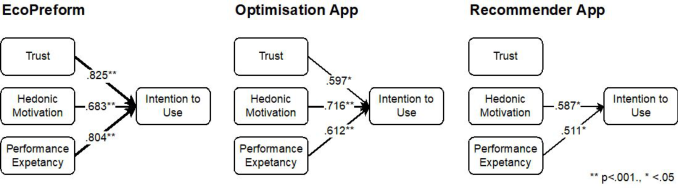
In our study, performance expectancy showed a positive correlation with intention to use for all app types. The strongest correlation could be detected within EcoPreform, followed by the Optimisation App, and Recommender App. Hedonic motivation showed the strongest relation to the intention to use within the Optimisation App, followed by EcoPreform, and then the Recommender App. Trust could only predict the intention to use for EcoPre- form and the Optimisation App. The Recommender App did not show any significant correlation. Figure 3 visualises the correlations with the intention to use for each application.
DISCUSSION & CONCLUSION We presented three different applications that differed in capabilities, appro- ach, and interaction design and an empirical evaluation of the applications with prototypical user. In summary, the evaluation showed that AI-based
User Centered Design and Evaluation of an Artificial Intelligence 209
Figure 3: Significant correlations between trust, hedonic motivation, performance expectancy on intention to use for the three evaluated process planning applications.
decision support systems can assist the planning of FRP process chains. Beyond the technical aspects (e.g., quality of the result), the non-technical aspects are equally important to value employees and provide optimal sup- port for their work. From the users’ perspective, the applications must be easy to learn and use, transparent by providing explanations for the suggestions, and respect how humans interact with interactive systems. In this regard, we found that the three applications differed tremendously.
Overall, the participants perceive the process chain design process with the user-centered Recommender App as faster, easier, and better than with the two alternatives. The Recommender App therefore fulfils the defined objectives best and received the highest evaluations from the participants. The Optimisation App also meets the objectives and performs better than the Recommender App in planning efficiency. However, the high degree of automation in planning a process chain may lead to users blindly trusting the application’s suggestions (i.e., over-trust (Parasuraman and Riley, 1997)), so that they do not critically examine the results. As an example, one partici- pant stated, “I don’t even have to think for myself, it’s just optimised”. As a result, this often leads to negligent and avoidable mistakes, e.g., participants forget to press “optimise” or to adjust parameters. Particularly critical in this context is the divergence between the participants’ perception and reality. Participants trust the Optimisation App very much, despite not being able to reconstruct the decision-making process. One participant commented that it was “Pleasant to have the decision taken away from me”. This observed high level of trust in the system is apparently favourable, but it also entails risks: A single erroneous suggestion may destroy this trust, as the cause of the error is not comprehensible and cannot be easily addressed due to the black-box character of the app (Hoff and Bashir, 2015).
While the Recommender App is evaluated best, all three applications have features that the participants value. Thus, we consider integrating these into a single application. EcoPreform’s versatile economic analysis could be inte- grated as an expert mode into the user-friendly Recommender App. Novices would have an easy start, while experts have more means to explore design alternatives. Also, the fast generation of alternatives of the Optimisation App could be embedded in the Recommender App: Following the process chain generation, the optimisation model could then generate alternative
process chains, optimised for different target variables (e.g., costs, quality, sustainability) and nudge planners to evaluate these as well.
For the design of future AI-based Decision Support Systems for planning FRP process chains we suggest considering the principles of good interaction design (Calero Valdez et al., 2015). First, we need to develop an understan- ding of the users’, their requirements regarding the planning tool, as well as the context of the work (Courage and Baxter, 2005). Second, all stakehol- ders and especially the later users should be involved continuously from the beginning of the development in the sense of an agile, iterative, and parti- cipatory design approach with frequent development and evaluation cycles. This ensures that the functionality of the software and its interface are ali- gned to the users which minimise interaction errors, slips, and unnecessary frustration. Acceptance research suggests that this approach results in higher perceived ease of use and usefulness and thus higher social acceptance as well as application of the planning tools.
ACKNOWLEDGEMENT
Funded by the Deutsche Forschungsgemeinschaft (DFG, German Research Foundation) under Germany’s Excellence Strategy – EXC-2023 Internet of Production – 390621612.
REFERENCES
Allaoui, H., Guo, Y. and Sarkis, J. (2019) ‘Decision support for collaboration planning in sustainable supply chains’, Journal of Cleaner Production, 229, pp. 761–774. doi: 10.1016/j.jclepro.2019.04.367. Amann, J. et al. (2020) ‘Explainability for artificial intelligence in healthcare: a
multidisciplinary perspective’, BMC Medical Informatics and Decision Making. BioMed Central, 20(1), pp. 1–9. doi: 10.1186/s12911-020-01332-6. Bangor, A., Kortum, P. T. and Miller, J. T. (2008) ‘An Empirical Evaluation of the System Usability Scale’, International Journal of Human-Computer Interaction, 24(6), pp. 574–594. doi: 10.1080/10447310802205776. Brauner, P. et al. (2021) ‘A Computer Science Perspective on Digital Transformation
in Production’, ACM Transactions on Internet of Things (TIOT), p. (in press). Brillowski, F. et al. (2021) ‘Know-How Transfer and Production Support Systems to Cultivate the Internet of Production Within the Textile Industry’, in International Conference on Intelligent Human Systems Integration (IHSI 2021), pp. 309–315. doi: 10.1007/978-3-030-68017-6_46. Brous, P., Janssen, M. and Herder, P. (2020) ‘The dual effects of the Internet of
Things (IoT): A systematic review of the benefits and risks of IoT adoption by organizations’, International Journal of Information Management, 51, p. 101952. doi: 10.1016/j.ijinfomgt.2019.05.008. Calero Valdez, A. et al. (2015) ‘Reducing Complexity with Simplicity - Usability Methods for Industry 4.0’, in 19th Triennial Congress of the International Ergonomics Association (IEA 2015). Melbourne, Australia. doi: 10.13140/RG.2.1.4253.6809. Courage, C. and Baxter, K. (2005) Understanding Your Users - A Practical Guide to User Requirements Methods, Tools & Techniques. San Francisco, CA, USA: Morgan Kaufmann Publishers.
User Centered Design and Evaluation of an Artificial Intelligence 211
Davis, F. D. (1989) ‘Perceived Usefulness, Perceived Ease of Use, and User Acceptance of Information Technology’, MIS Quarterly, 13(3), pp. 319–340. doi: 10.2307/249008. Doltsinis, S. et al. (2020) ‘A Decision Support System for rapid ramp-up of indu-
stry 4.0 enabled production systems’, Computers in Industry, 116, p. 103190. doi: 10.1016/j.compind.2020.103190. Edelman (2019) 2019 Artificial Intelligence Survey. Goddard, K., Roudsari, A. and Wyatt, J. C. (2012) ‘Automation Bias: A Systematic Review of Frequency, Effect Mediators, and Mitigators’, Journal of the American Medical Informatics Association, 19(1), pp. 121–127. doi: 10.1136/amiajnl- 2011-000089. Gorry, G. A. and Morton, M. S. S. (1971) ‘A Framework For Management Informa-
tion Systems’, Sloan Management Review, 13(1), pp. 50–70. doi: Article. Grundmann, T. C. (2009) Automatisiertes Preforming für schalenförmige komplexe Faserverbundbauteile. Aachen: Schaker Verlag. Hoff, K. A. and Bashir, M. (2015) ‘Trust in automation: Integrating empirical
evidence on factors that influence trust’, Human Factors, 57(3), pp. 407–434. doi: 10.1177/0018720814547570. Jacovi, A. et al. (2021) ‘Formalizing Trust in Artificial Intelligence’, in Proceedings of the 2021 ACM Conference on Fairness, Accountability, and Transparency. New York, NY, USA: ACM, pp. 624–635. doi: 10.1145/3442188.3445923. Kagermann, H., Wahlster, W. and Helbig, J. (2013) Recommendations for Imple-
menting the Strategic Initiative INDUSTRIE 4.0 – Final report of the Industrie 4.0 Working Group. Körber, M. (2019) ‘Theoretical Considerations and Development of a Questionnaire to Measure Trust in Automation’, in Proceedings of the 20th Congress of the Inter- national Ergonomics Association (IEA 2018). Volume 6. Transport ergonomics and hu-man factors (TEHF), aerospace human factors and ergonomics. Cham: Springer, pp. 13–30. doi: 10.1007/978-3-319-96074-6_2. Kortum, P. T. and Bangor, A. (2013) ‘Usability Ratings for Everyday Products Measu-
red With the System Usability Scale’, International Journal of Human-Computer Interaction, 29(2), pp. 67–76. doi: 10.1080/10447318.2012.681221. Ncube, L. K., Chikowore, T. R. and Sibanda, N. R. (2018) ‘Textile Weaving Order Planning Decision Support Tool Based on Fuzzy Logic’, IOSR Journal of Engineering, 8(3), pp. 2278–8719. Ngai, E. W. T. et al. (2014) ‘Decision support and intelligent systems in the textile and
apparel supply chain: An academic review of research articles’, Expert Systems with Applications, 41(1), pp. 81–91. doi: 10.1016/j.eswa.2013.07.013. Norman, D. A. (2002) The Design of Everyday Things. 1. New York: Basic Books. Paas, F. G. W. C. (1992) ‘Training Strategies for Attaining Transfer of Problem- Solving Skill in Statistics: A Cognitive-Load Approach’, Journal of Educational Psychology, 84(4), pp. 429–434. doi: 10.1037/0022-0663.84.4.429. Parasuraman, R.and Riley, V.(1997) ‘Humans and Automation: Use, Misuse, Disuse,
Abuse’, Human Factors: The Journal of the Human Factors and Ergonomics Society, 39(2), pp. 230–253. doi: 10.1518/001872097778543886. Schemmer, T. et al. (2020) ‘User-Centred Design of a Process-Recommender System for Fibre-Reinforced Polymer Production’, in Human Interface and the Management of Information, HCII 2020. Springer, Cham, pp. 111–127. doi: 10.1007/978-3-030-50017-7.
Shibl, R., Lawley, M. and Debuse, J. (2013) ‘Factors influencing decision support system acceptance’, Decision Support Systems, 54(2), pp. 953–961. doi: 10.1016/j.dss.2012.09.018. Überbacher, R., Brozzi, R. and Matt, D. T. (2020) ‘Innovation in craftsmanship family SMEs in times of digitalization’, Piccola Impresa / Small Business, 1, pp. 67–85. doi: 10.14596/pisb.345. Venkatesh, V., Thong, J. Y. L. and Xu, X. (2012) ‘Consumer Acceptance and Use of
Information Technology: Extending the Unified Theory of Acceptance and Use of Technology’, MIS Quarterly, 36(1), pp. 157–178.
LISTED IN THE AHFE DIGITAL BOOKSTORE CATALOGUE
Explore the complete digital volume
Usability and User Experience
Read this individual research paper free through the original publisher, or explore the full digital proceedings book.
ISBN 978-1-958651-15-5
Explore this ISBN in the AHFE Bookstore ↗Listed in the July 2026 bookstore catalogue; search by ISBN to confirm current availability · Digital book purchase optional