Philipp Brauner, Luisa Vervier, Martina Ziefle, Melina Sachtleben, Stefan Schlichter, Thomas Gries (2022). Clothing-as-a-service? – A research agenda towards a sustainable and socially accepted Circular Economy of Clothing. In: Human Factors for Apparel and Textile Engineering. AHFE Open Access, vol. 32, pp. 159–168. https://doi.org/10.54941/ahfe1001551
Circular Economy approaches are increasingly recognized as a solution also in the textile industry to foster a world-wide call to action in terms of sustainable production, sale, use, and recycling of materials and products. When supported by technical, economic, and political systems, such efforts help to integrate more efficient process-es and production lines as well as to maintain valuable materials and components for re-use and re-cycling, to target closed material cycles, develop or re-arrange production chains, and reframe consumption behaviors. In this paper we focus on clothing from a circular economy perspective. Textiles are the number two consumer goods market worldwide. Production, sale, use, and recycling of clothing must be better synchronized to increase sustainability. However, social factors and existing behaviors often affect these sustainable endeavors on different levels. Clothing is progressively regarded as a low-quality single-use-like object in a fast fashion world, discarded after only a few wears. Whilst it is also generally considered a personal item with individual attributions, not easily shared, or borrowed. Individual attributions of value and sensitivity, as well as technical barriers conflict with the requirements of longest possible use and subsequent reuse, and recycling. New concepts of ownership, sharing, pricing, and renting such as deposit trousers challenge the market and consumer sensibilities. In this article, we describe the opportunities and challenges of socially accepted circular economy approaches for clothing, conflicting technical, economic, and social forces that limit their viability, and outline strategies and an interdisciplinary research agenda to overcome these challenges.
One of the world’s greatest challenges is to reconcile social and economic prosperity and growth with a sustainable and careful use of natural resources. Circular economy approaches aim at the transformation from a linear to a circular economy by (re)using resources and recycling materials efficien- tly. The shift to sustainability is one of the most pressing challenges for our society today. One approach is shifting from linear to circular economies. In linear economies—which is still the dominant form of industrial production today—energy, raw materials, and other resources are lost, disposed, or inci- nerated at each production step. Also, the final product or most of its parts are often disposed after use (Tenhunen and Pöhler, 2020). Contrary, circu- lar economies minimize resource consumption, emissions, and waste along the supply chain by closing energy and material loops at each production step, which is achievable through durable design, repair, reuse, refurbishing, and—as last resort—recycling (Moreau et al., 2017; Morseletto, 2020).
It is increasingly acknowledged that a transition to a circular economy not only touch technology, economics, and ecology. The social acceptance of closed-loop production and its products must be in line with individual and societal needs (Kirchherr and Piscicelli, 2019; Hartley et al., 2020, Simons et al., 2021).
For clothing, implementing the concepts of repair, reuse, refurbish, or recycle is challenged by technical, economic, and social as well as societal aspects. For example, products must be sorted as purely as possible to faci- litate reprocessing (technical perspective). However, low unit costs of used materials limit the economic viability sorting and the absence of suitable incentives or reward systems hinder collecting clothing by type (economic perspective). The introduction of (mandatory?) return and refund systems may increase sorting rates but may fail due to low social acceptance: Cloth- ing is often perceived as personal and perceived value and sensitivity depends on the individual, the type of the clothing, and the context of use. Consequ- ently, establishing a sharing and circular economy for clothing is challenged by technical, economical, and social questions that must be balanced.
In this article, we research challenges from technical, economic, ecological, and social perspectives, and derive an integrated interdisciplinary research agenda.
STATUS QUO: ISOLATED PERSPECTIVES ON CIRCULAR ECONOMY OF TEXTILES The textile industry is one of the biggest consumer industries worldwide. The global fiber consumption is estimated to be around 145 million metric tons (Ellen MacArthur Foundation, 2017). The German textile industry alone has a turnover of 11 billion Euro as well as 5.5 billion Euro in the apparel sector (Statista 2021). While the industry is highly lucrative it also is among the most resource-intense and polluting. The textile chain is stretched around the globe with low transparency along the many different stops up to the end customer. Until now the textile chain is also mostly linear, beginning with the harvesting or manufacturing of raw materials and ending with the disposal
Clothing-as-a-Service? – A Research Agenda towards a Sustainable 161
of the product at the end of its life. Currently, only 1% of all textiles are recycled to new textiles (Ellen MacArthur Foundation, 2017).
Growing public interest has started to put pressure on brands and retai- lers to rethink this linear product life and draw new concepts for circular approaches. The complexity of textile products however cheap they may be in retails price is high. The many different components made of varying mate- rials prevent easy recycling by currently available methods. On the one hand, reuse, refurbish, and recycling of clothing is possible yet low and, on the other hand, some brands use influencer marketing to push consumers to ultra-fast fashion, which is rather counterproductive in terms of sustainability.
Yet, the potential of large-scale industrial reuse, refurbish, and recycling of clothing remains largely untapped. We need to integrate different equally important perspectives to design new and sustainable products and services for clothing that are technically feasible, economically viable, ecologically fair, and socially accepted. To develop socially accepted products and services, the goals, opportunities, and challenges of the involved stakeholders must be elaborated and holistically integrated.
The following section thus raises central questions from the individual per- spectives of textile engineering, economics, ecology, and social sciences and suggests a research agenda for their integration.
Textile Engineering Perspective: Products and processes From a technical perspective, the quality of textiles must be ensured, and maintenance, repair, and cleaning processes must be developed to set up a functioning rental system offering continuing high quality. Taking into con- sideration the trend towards more functionality we need to realize that the increasing hybrid setup of clothing results in a more and more complex con- figuration of clothing, regarding materials used and combination of different manufacturing technologies. Smart textiles will have an increasing market share, making clothing more individual and more designed for special occa- sions of use, i.e., sportswear with integrated health monitoring functions. Specialized clothing design with an increasing number of components will make reuse, repair, and recycling more difficult, but the vision of cloth- ing made from just one material will not meet the requirements of modern clothing designs of the future.
Just as today “design for recycling” increasingly represents a new additio- nal guideline in the design of products, the reuse of clothing and new cycles in clothing must of course also be considered in the design of new clothing. The choice of materials, which can increasingly also consist of recycled materials or endemic fibres, but also the use of energy-efficient and resource-saving processes must be adapted in their impact on a future cycle-oriented user model of clothing. New insights are needed here that technically redefine the impact of adapted processes and new materials.
Economic Perspective: Market Readiness and Stakeholder Integration From an economic perspective, new sustainable, and viable business models need to be developed and validated. This includes the evaluation of different
ownership models for personal clothing. Which models beyond personal ownership of clothing (ownership with return incentives (deposit), rentals, or leasing) are viable and offer ecological added value. While evidence sug- gests that extended use lowers the global warming potential of clothing (Levänen et al. 2021), there is a lack of experience and data regarding the economic impact and social acceptance of new ownership models.
The trend towards decreasing quality of textiles in terms of material and manufacturing quality due to so-called “fast fashion” is clearly at odds with new circular approaches. Depending on the type of clothing a cleaning cycle between the use circles is mandatory, but it needs to be clarified who will be responsible for this service and to what expenses caused. In addition, the logistics of new textile ownership models must be defined depending on cer- tain typification and categories and on the logistic in terms of shipping costs. Whilst the re-use business of second-hand textiles with retail shops is mainly driven by small enterprises with regional operating range the internet-based business models may open additional chances in reaching additional range of coverage. One key question in determining economical profit depends on the question to which existing business the new circularity concepts of clothing fits best, i.e., used textiles traders, recycling companies, or apparel brands. Would it be more likely new companies to be founded specifically for this purpose or rather adaptations of existing business models of existing textile companies?
Ecological Perspective: Environmentally Compatible Management of Waste The development of a sustainability-oriented circular economy has been increasingly recognized in our society as a necessity that admits of no alter- native. This is reflected by, for example, the European Green Deal (European Commission (2019), in the legal basis of the Law on Closed Cycle Mana- gement and Waste in Germany (“Kreislaufwirtschaftsgesetz”1) and similar laws in other countries, and in the changed awareness of large groups of soci- ety about sustainability. However, the circular economy approach does not automatically mean that products are more ecological than conventionally produced products but that the CE principles must be considered carefully (Braun et al 2021).
While an analysis by Wiedemann and colleagues suggests that current commercially operating textile recycling systems can reduce greenhouse gas emissions, energy demand, and freshwater consumption compared to virgin pure wool products (Wiedemann et al. 2022), it remains a challenge to make the textiles available for recycling pre-sorted. Increasingly, better data is now available for the ecological balance of textiles as well. Still, it can be noted that these figures mainly relate to new types of materials and processes. Alter- native business models, on the other hand, are only the subject of ecological assessments in individual cases and only with selected materials. For deposit 1The German Bundestag has adopted the Act Reorganising the Law on Closed Cycle Management and Waste with the consent of the Bundesrat on February 24th 2012. https://www.bmuv.de/en/law/circular- economy-and-safeguard-the-environmentally-compatible-management-of-waste
Clothing-as-a-Service? – A Research Agenda towards a Sustainable 163
systems or alternative forms of ownership of personal clothing, yet, there are in fact no studies available. In future, the ecological assessment of various business models must be taken into closer consideration in addition to the economic assessment.
Social Perspective: Social Values Between Identity and the Greater Good The social factors to be considered in circular economy approaches and green technologies can be subsumed under the roof of the technology acceptance concept. Technology acceptance refers to the positive acceptance or adoption of an idea, a fact, or a product in the sense of active willingness and not only in the sense of reactive acquiescence (Dethloff, 2004). Increasingly, society’s attitude towards technologies is shaped by cost-benefit considerations, risk perceptions, trust in technology, policy and industry, and control expectations (Arning et al., 2020; 2021 Engelmann et al., 2020). Finally, acceptance can be shaped by values, norms, and symbolic associations (Offermann et al., 2018; Linzenich et al., 2021).
When it comes to the case of textiles, acceptance issues it should be noted that textiles of all kinds have always been a part of cultural, social, societal, and individual life (Robinson, 1970) coining our identity, appea- rance, and protection (Kvavadze, et al., 2009; Brauner et al., 2017, Ziefle et al., 2014). Textiles represent value and worth (Hodson & Costello, 2007, Mc Neill & Mc Kay, 2016, de Saint-Exupéry, 1943), they enrich our per- sonality (Kamineri 2005) and even the specificity of social occasions are closely linked to the choice of textiles (Creed et al., 2002; Guy & Banim, 2000). Hence, certain pieces of clothing have a special emotional value, which also defines whether we would buy it new or used (e.g., a wedding dress). Others are considered very personal and intimate and thus won’t be shared or passed on (e.g., underwear) The social status of users also plays a role in the willingness to donate clothing (e.g., people are more wil- ling to donate to charity than for recycling companies). Also, cultural and societal practices might be relevant revealing different attributions towards clothing.
On the other hand, textiles have increasingly evolved to a disposable pro- duct, with only low quality and sustainability. The way in which clothing is produced meets the publics’ conscience and the trend for sustainability (Valor, 2007, Nakano, 2007). People and societies with a high level of environmental awareness might be more willing to contribute to a clothing circular eco- nomy than people who suspect corporate profit maximization behind these concepts. An increasing number of studies examine the social perceptions on acceptance and behavior intentions in reused, upcycled or recycled textiles and clothing (Armstrong et al., 2015; Diddi & Yan, 2019, Kim et al., 2021), by this tackling the acceptance trade-offs between perceptions and identity of textiles and the willingness of consumers to focus on circular economy approaches and the way textiles are produced and processed in line with new business opportunities (Janigo and Wu, 2019, Wagner & Heinzle, 2020, Simons et al., 2021).
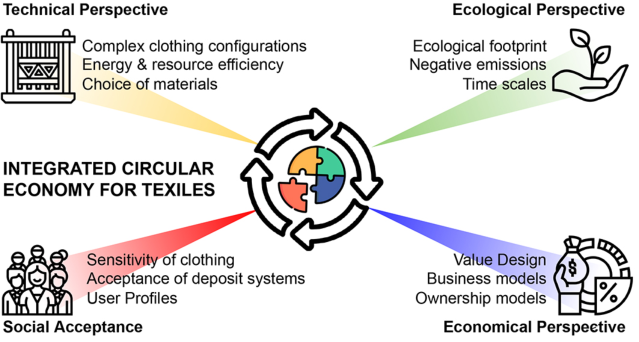
Figure 1: Integration of technical, economic, ecological, and social aspects for the realization of a circular economy in the textile sector.
INTERDISCIPLINARY RESEARCH AGENDA Even though there has been tremendous progress in the different areas, there is a lack of holistic concepts for a systematic and interdisciplinary integration of the perspective of users in the circular-based implementation and produ- ction process (Brauner et al., 2022). To achieve this, we need to understand the social perspective and individual motives and barriers towards sharing, reusing, rental, and recycling of clothing and the concept of clothing owner- ship in line with technical, ecological and economic aspects within one frame of reference (see Figure 1).
The implementation of the circular economy requires cooperation betw- een different sectors, disciplines, and approaches. Doubtless, a sustainable and successful circular economy has inherent social, societal, and political dimensions. Only if the needs and requirements of potential consumers are aligned with the demands of the market and the economy and supported by political strategies the idea of the circular economy will be successfully implemented and supported in the long term.
It is essential to integrate these different perspectives jointly and holisti- cally, so that stakeholder-specific solutions also harmonize with the other perspectives. Otherwise, we run the risk of developing insular solutions that conflict with the other perspectives. Consequently, the various resea- rch dimensions must be coordinated, integrated, and weighed against each other to yield novel ownership, rental and return models, products, and services that are technically possible, economically viable, and socially acce- pted. Based on the interdisciplinary integration of the different perspectives we derive the following paradigmatic research and development areas.
Circular Economy Research and Education: Academia and Advanced Training We need an integrative Circular Economy education, in academia, professio- nal training and the broader public. So far, the single disciplines focus mostly
Clothing-as-a-Service? – A Research Agenda towards a Sustainable 165
on their specialty. While this makes sense to understand to train the disci- plinary knowledge, still there is a need to tackle the demands of a holistic understanding of circular economy approaches. The complexity of Circular Economy requires inter-, trans- and multidisciplinary approaches, realized in new educational study courses (e.g., a Circular economy Master of Science). These programmes should direct to a transdisciplinary education, in which the methodologies and the perspectives are trained and linked to each other.
New Products and Services: User Driven Innovation and Public Participation New approaches to integrate users as a valuable source for new ideas and innovations (end-user driven innovation cycle) could help to launch a broa- der public awareness for circular economy, its value and realization. Public communities might represent a significant source for innovation and provide market insights before launching an innovative product. The identification of customers profiles allows to understand and consider individual and societal motives and barriers for reusing, refurbishing, and recycling of clothing and identification and quantification of individual differences. User driven inno- vation could thus help to find new ideas for products in an early stage of the innovation cycle, to create new product concepts and to optimize product generations. Also, new business model could be derived from users’ insights helping to identify distinct customer and product segments as well as new target-group specific products and services.
Transparency and Quality Management: An integrative Circular Economy Label for Textiles The ongoing fundamental technological shift, the changing societal, econo- mic, and legal circumstances in circular economy in line with the changing demands and desires of users require new ways of quality management and novel markets. For example, the joint efforts and transdisciplinary approa- ches could result in the development of an integrative “circular economy label for textiles”. Such a label however should not only consider single aspects (such as the ecological value or the technical aspects, Atkinson & Rosenthal, 2014), but should also consider the social factors related to a sustainable usage of circular economy textiles.
This requires integrating the user perspective in early stages of product development to achieve user-centered innovations on the one hand but also to enable the broader public to make an informed purchase decision for CCU products (Linzenich et al., 2018; Feucht, & Zander, 2018). In addition, the seal should have a multidisciplinary and independent awarding institution behind, driven from academia and supported by politics, rather than driven by companies. Instead of merely focusing on the merchantability of a product, the seal should be tailored to laypeople’s requirements, and should make the label awarding criteria and time frame transparent.
This integrative approach to jointly develop a circular economy label for textiles could launch a timely value engineering of textiles that is not only benefitting one single aspect but provides trusted information sources and an empirically validated foundation.
CONCLUSION AND OUTLOOK In this article we have outlined the necessity to implement a circular economy for clothing and to increase reuse, refurbish, and recycling of clothing signi- ficantly. We have also shown that the perspectives from textile engineering, economy, ecology, and social sciences must be integrated in one frame of refe- rence. This implies that the various challenges from the different stakeholders need to be balanced and conflicts of interests are resolved along the way. We believe that the successful development of a sustainable products and services for circular economy of clothing requires the interdisciplinary integration of the stakeholders’ perspectives and a joint agenda for research, education, and public communication.
ACKNOWLEDGEMENT
Funded by the Deutsche Forschungsgemeinschaft (DFG, German Research Foundation) under Germany’s Excellence Strategy – EXC-2023 Internet of Production – 390621612. Authors thank the valuable input of the Center of Circular Economy (CCE) at RWTH Aachen University, Germany.
REFERENCES
Arning, K., Offermann-van Heek, J., & Ziefle, M. (2021). What drives public acceptance of sustainable CO2-derived building materials? A conjoint-analysis of eco-benefits vs. health concerns. Renewable and Sustainable Energy Reviews, 144, 110873. Arning, K., Offermann-van Heek, J., Sternberg, A., Bardow, A., & Ziefle, M.
(2020). Risk-benefit perceptions and public acceptance of Carbon Capture and Utilization. Environmental Innovation and Societal Transitions, 35, 292–308. Arning, K., Zaunbrecher, B. S., Sternberg, A., Bardow, A., & Ziefle, M. (2018).
Blending Acceptance as Additional Evaluation Parameter into Carbon Capture and Utilization Life-Cycle Analyses. In SMARTGREENS (pp. 34-43). Atkinson, L., Rosenthal, S., 2014. Signaling the Green Sell: The Influence of Eco- Label Source, Argument Specificity, and Product Involvement on Consumer Trust. Journal of Advertising, 43(1), 33–45. Brauner, P., van Heek, J., & Ziefle, M. (2017). Age, gender, and technology attitude
as factors for acceptance of smart interactive textiles in home environments. Proc. 3rd international conference on information and communication technologies for ageing well and e-health, ICT4Agingwell. Braun, G., Som, C., Schmutz, M., & Hischier, R. (2021). Environmental Consequences of Closing the Textile Loop—Life Cycle Assessment of a Circular Polyester Jacket. Applied Sciences, 11(7), 2964. Brauner, P., Heek, J. V., Schaar, A. K., Ziefle, M., Hamdan, N. A. H., Ossmann,
L., et al. (2017). Towards accepted smart interactive textiles. In International Conference on HCI in Business, Government, and Organizations (pp. 279–298). Springer, Cham. Brauner, P., Vervier, L., Ziefle, M. , Sachtleben, M., Schlichter, S., Gries, T. (2022).
Clothing-as-a-Service? - A Research Agenda towards a Sustainable and Socially Accepted Circular Economy of Clothing. Human Factors for Apparel and Textile Engineering, Vol. 32, (in press).
Clothing-as-a-Service? – A Research Agenda towards a Sustainable 167
Catalani, A., & Chung, Y. (2005). Vintage or fashion clothes? An investigation inside the issues of collecting and marketing second-hand clothes. 8th International Conference on Arts and Cultural Management. Creed, W. D., Scully, M. A., & Austin, J. R. (2002). Clothes make the person?
The tailoring of legitimating accounts and the social construction of identity. Organization science, 13(5), 475–496. Chapanis, A. (1996). Human factors in systems engineering. Wiley Series in Systems Engineering and Management. Andrew Sage, Hoboken, NJ: Wiley. Dethloff, C. (2004). Akzeptanz und Nicht-Akzeptanz von technischen Diddi, S., & Yan, R. N. (2019). Consumer perceptions related to clothing repair
and community mending events: A circular economy perspective. Sustainability, 11(19), 5306. Engelmann, L., Arning, K., Linzenich, A., & Ziefle, M. (2020). Risk Assessment Regarding Perceived Toxicity and Acceptance of Carbon Dioxide-Based Fuel by Laypeople for Its Use in Road Traffic and Aviation. Frontiers in Energy Research, 291. Ellen MacArthur Foundation, 2017, A new textile industry: Redesigning fash-
ion’s future, https://ellenmacarthurfoundation.org/a-new-textiles-economy (last accessed 2022-02-25). European Commission (2019). The European Green Deal. Communication from the commission to the European Parliament, the European Council, the council, the European Economic and Social Committee and the committee of the regions. https://www.eea.europa.eu/policy-documents/com-2019-640-final Feucht, Y., Zander, K., 2018. Consumers’ preferences for carbon labels and the
underlying reasoning. A mixed methods approach in 6 European countries. Journal of Cleaner Production, 178, 740–748. Friedenthal, S. Moore, A. Steiner, R. (2008) A Practical Guide to SysML: The Systems Modeling Language, Morgan Kaufmann; Elsevier Science. Folds, Dennis. Gardner, Douglas and Deal, Steve. (2008). Building Up to the Human
Systems Integration Demonstration, INCOSE INSIGHT Volume 11 No. 2. Guy, A., & Banim, M. (2000). Personal collections: Women’s clothing use and identity. Journal of gender studies, 9(3), 313–327. Hartley, K., van Santen, R., and Kirchherr, J. (2020). Policies for Transitioning tow-
ards a Circular Economy: Expectations from the European union (EU). Resour. Conservation Recycling 155, 104634. doi:10.1016/j.resconrec.2019.104634 Hodson, G., & Costello, K. (2007). Interpersonal disgust, ideological orientations, and dehumanization as predictors of intergroup attitudes. Psychological science, 18(8), 691–698. Kim, I., Jung, H. J., & Lee, Y. (2021). Consumers’ Value and Risk Perceptions of
Circular Fashion: Comparison between Secondhand, Upcycled, and Recycled Clothing. Sustainability, 13(3), 1208. Kirchherr, J., and Piscicelli, L. (2019). Towards an Education for the Circular Economy (Ece): Five Teaching Principles and a Case Study. Resour.Conservation Recycling 150, 104406. doi:10.1016/j.resconrec.2019.104406 Kvavadze, E., Bar-Yosef, O., Belfer-Cohen, A., Boaretto, E., Jakeli, N., Matskevich,
Z., Meshveliani, T. (2009). 30,000-Year-Old Wild Flax Fibers, vol. 325, p. 1359. Science, New York. Janigo, K. A., & Wu, J. (2015). Collaborative redesign of used clothes as a sustainable fashion solution and potential business opportunity. Fashion Practice, 7(1), 75–97.
Levänen, J., Uusitalo, V., Härri, A., Kareinen, E., & Linnanen, L. (2021). Innovative recycling or extended use? Comparing the global warming potential of different ownership and end-of-life scenarios for textiles. Environmental Research Letters, 16(5), 054069 Linzenich, A., Arning, K., & Ziefle, M. (2021). Acceptance of energy technolo-
gies in context: Comparing laypeople’s risk perceptions across eight infrastructure technologies in Germany. Energy Policy, 152, 112071. Linzenich, A., Arning, K., & Ziefle, M. (2019). Identifying the” Do’s” and” Don’ts” for a Trust-Building CCU Product Label. In SMARTGREENS (pp. 58–69). Moreau, V., Sahakian, M., Van Griethuysen, P., and Vuille, F. (2017). Coming Full
circle: Why Social and Institutional Dimensions Matter for the Circular Economy. J. Ind. Ecol. 21, 497–506. doi:10.1111/jiec.12598 Morseletto, P. (2020). Targets for a Circular Economy. Resour. Conservation Recycling 153, 104553. doi:10.1016/j.resconrec.2019.104553. Nakano, Y. (2007). Perceptions towards clothes with recycled content and environ-
mental awareness: the development of end markets. In Ecotextiles (pp. 3–14). Woodhead Publishing. Norris, L. (2019). Waste, dirt and desire: Fashioning narratives of material regeneration. The Sociological Review, 67(4), 886–907. Offermann-van Heek, J., Arning, K., Sternberg, A., Bardow, A., & Ziefle, M. (2020).
Assessing public acceptance of the life cycle of CO2-based fuels: Does information make the difference? Energy Policy, 143, 111586. Offermann-van Heek, J., Arning, K., Linzenich, A., & Ziefle, M. (2018). Trust and distrust in carbon capture and utilization industry as relevant factors for the acceptance of carbon-based products. Frontiers in Energy Research, 6, 73. Offermann-van Heek, J., Brauner, P., & Ziefle, M. (2018). Let’s talk about TEX—
Understanding consumer preferences for smart interactive textile products using a conjoint analysis approach. Sensors, 18(9), 3152. Produktinnovationen. Lengerich, Germany: Pabst Science Publishers. Robinson, S. (1970). History of Dyed Textiles. MIT Press, Cambridge (1970) de Saint-Exupéry (1943), A. The Little Prince, Reynal & Hitchcock, 1943 Simons, L., Engelmann, L., Arning, K., & Ziefle, M. (2022). Two Sides of the Same Coin—Explaining the Acceptance of CO PLS-SEM 2. Front. Energy Res. 9:742109. doi: 10.3389/fenrg.2021.742109 Statista 2021 https://de.statista.com/statistik/daten/studie/255536/umfrage/umsatz
-der-europaeischen-textilindustrie-nach-laendern/ (last accessed 2022-02-25) Tenhunen, A., and Pöhler, H. (2020). A Circular Economy of Plastics: A Vision of Redesigning Plastics Value Chains. doi:10.32040/2020. 978–951-38-8824-4. Valor, C. (2007). The influence of information about labour abuses on consu-
mer choice of clothes: a grounded theory approach. Journal of Marketing Management, 23(7-8), 675–695. Wagner, M. M., & Heinzel, T. (2020). Human perceptions of recycled textiles and circular fashion: A systematic literature review. Sustainability, 12(24), 10599. Wiedemann, S. G., Biggs, L., Clarke, S. J., & Russell, S. J. (2022). Reducing the
Environmental Impacts of Garments through Industrially Scalable Closed-Loop Recycling: Life Cycle Assessment of a Recycled Wool Blend Sweater. Sustainability, 14(3), 1081. Ziefle, M., Brauner, P., Heidrich, F., Möllering, C., Lee, K., & Armbrüster, C. (2014).
Understanding requirements for textile input devices individually tailored interfa- ces within home environments. In International Conference on Universal Access in Human-Computer Interaction (pp. 587–598). Springer, Cham.
LISTED IN THE AHFE DIGITAL BOOKSTORE CATALOGUE
Explore the complete digital volume
Human Factors for Apparel and Textile Engineering
Read this individual research paper free through the original publisher, or explore the full digital proceedings book.
ISBN 978-1-958651-08-7
Explore this ISBN in the AHFE Bookstore ↗Listed in the July 2026 bookstore catalogue; search by ISBN to confirm current availability · Digital book purchase optional