Martina Motta, Delia Dumitrescu (2022). The role of teaching advanced technological knowledge to enhance experimental creativity in knit design. In: Human Factors for Apparel and Textile Engineering. AHFE Open Access, vol. 32, pp. 1–8. https://doi.org/10.54941/ahfe1001531
Digitalization is one of the main grounds for discussion in the textile manufacturing industry. As in other creative fields, digitalization in textile design has brought craftsmanship together with work using digital tools and mechanical processes to creatively embed advanced knowledge in structural design and this dualism is even stronger in the field of knitwear design. For years, knitting technologies have been considered far from creativity and entirely delegated to the expertise of technicians, and design education has often focused on fostering artistic expression by teaching highly creative manual/mechanical processes. In the ongoing shift towards digitalization and the challenges of Industry 4.0, research and education in knitting design must redefine the programming of industrial machines as a tool for designers to push their experimental creativity together with their technical knowledge. This article reports an investigation made by the authors in the two different contexts of the School of Design of Politecnico di Milano and of the Swedish School of Textile in Borås. Using the method of constructive alignment (Biggs, J. B. & Tang, C. S., 2011), the investigation set up a comparison of two practice-based methods for training designers in programming industrial knitting machines. The authors mapped the teaching, learning activities and expected learning outcomes specific for each course and analysed quintessential aspects that occur in the learning process in the transition from manual to digital tools. The research had the aim of understanding what kind of knowledge should be transferred, in which way and with which purpose, to make programming an integral and effective part of the learning process for knit designers. The data collected have been used to highlight similarities and differences between the two programmes, identify impactful items and open future research that could foster improvements with shared solutions.
In the past two decades, education in the fields of design, e.g. product design and architecture, have absorbed the training and knowledge of digital tools and mechanical processes used to support digital fabrication (e.g. additive and subtractive tools), largely replacing the role of manual craftsmanship. Hence for these creative fields, besides the comprehensive access to precision drawing, digital fabrication has introduced creativity in generating complex
processes, developing cross-disciplinary workflows and experimental ways of working with bottom-up processes from material to end object (Boeykens et al., 2006). In addition, the availability of open-source software and crafted mechanical tools present in the early stages of digitalization in artistic fields have supported the extended popularity of these methods and tools across various fields of design (Greenfield, 2017).
Like 3D printing, digitalized machines for structural textile design, e.g. weaving and knitting, now offer possibilities for fabricating and simulating materials and objects1. However, these technologies were developed starting from different premises; they were developed to support industrial users with advanced knowledge in structural textile design and required prior expert knowledge in yarns and fabric construction for programming and material fabrication. Although industrial machines have become more present in tex- tile education, there is still the challenge of how to educate a new generation of textile and fashion designers to successfully employ their artistic skills, communicate their knowledge across product value chains, and use advanced craftsmanship in the context of textile digitalization.
BACKGROUND KNOWLEDGE: A RENEWED SKILLS GAP Among the various branches of textile design and its applications, knitting is the area that has most experienced the dualism between craftsmanship and technological innovation. Long associated with manual work, the comple- xity of a knitted product has always required that designers have not just creativity, but specific technical knowledge and manual skills to constantly analyse materials and processes in order to create something new (Motta, 2018). Despite this, knitting technologies have frequently been considered to drive the work of designers far from the concept of creativity, and have sometimes been seen as a limit for the designer’s freedom to ideate. Because of this, the aesthetic and technical elements of knitting at most fashion com- panies and factories have been entrusted to two distinct roles, designer and technician, who often mutually complain about the respective lack of exper- tise (Eckert, 1999). In her research, Eckert identifies the ‘communication bottleneck’ between knit designers and technicians to be the major cause of inefficient workflows in the design and development of a commercial knit- ting industry. The problematic relationship between the two, as reported by Eckert, has also been observed and confirmed in more recent work (Sayer, Wilson & Challis, 2006; Taylor & Townsend, 2014; Taylor, 2016; Motta, 2019) that has outlined not just communication limits, but a ‘skills gap’ that generates friction and obstacles in the design process. This gap between pro- fessional cultures and practices is one of the main issues addressed by research in design education, which has been working for the last two decades to find a balance between cultural knowledge and the operational know-how of production (Buchanan, 2001; Friedman, 2003; Penati, 2000).
1Examples include the software for knitting machines developed by the Japanese company Shima Seiki and the German Stoll. https://www.shimaseiki.com/product/design/system/ and https://www.stoll.com/en/software/kinnovation-create-design/).
The Role of Teaching Advanced Technological Knowledge 3
Today, the progressive evolution of electronic industrial knitting machines, which are constantly changing due to updates in technology and software, is adding challenges to this dualism. Software and machinery are becoming increasingly complicated, delicate to manage, and highly expensive when pro- blems occur. While it has always been true that the realization and success of designers’ ideas depend on the attitude and skill of technicians (Taylor & Townsend, 2014), the more technologies are up-to-date, the more designers have to rely on the programmers’ support to control or even gain experience with these fundamental tools. This happens not just due to the complexity of the software, which ‘is such that the instruction is non-negotiable and based on the principle of there being a right and a wrong way of doing someth- ing’ (Taylor & Townsend, 2014, p. 164), but also due to designers’ limited access to industrial machinery and training on advanced technologies that — aimed to train technicians rather than encourage the creativity of desi- gners — is based on the rigid instructions delivered by machine builders (Taylor & Townsend, 2014). The technician’s experience becomes increa- singly critical ‘to achieve a design that is technically possible and meets the production criteria. The iterative process of fabric and garment development showcases the designer’s ability to work with a set of constraints to deliver a creative outcome and also the technician’s ability to push the technology’ (Twigger & Hill, 2019, p. 81). Potentially, the evolution of industrial knit- ting technologies (both machinery and software) could boost design and product development, pushing the boundaries for designers’ intervention; however, many authors report that technology is still not being used to its full potential by designers in industry (Evans-Mikellis, 2011; Yang, 2010; Underwood, 2009; Smith, 2013; Taylor, 2016) due to the difficulties encoun- tered, with consequent expansion of the domains of knowledge they need to control.
In 2006, Sayer et al. (2006, p. 43) suggested a need for ‘the role of designers [to] change’ and outlined the conceptual shift forced by new technologies in the way knitted garments are both designed and created (ibid, p. 39). Techno- logy developers have tried to make knitting software easier for designers, with a considerable focus on the practical advantages of computerized design and manufacturing (CAD/CAM). ‘We are now at a point in the development of advanced technological production where the combining of embodied, tacit knowledge and skills in all making disciplines are being reassessed and rei- ncorporated into the process of digital creation’ (Taylor & Townsend, 2014, p. 171). These are contemporary challenges in the paradigm shift towards Industry 4.0, where designers in any field act as active, collaborative media- tors between different areas of knowledge in the production system (Lotti & Trivellin, 2017). For industrial knitting, the constant exchange of expertise between designers and programmers leads back to a triangulation of skills: (1) the designer’s ability to have a general and methodological view of the project; (2) the specific technical knowledge about the knit product, from sti- tches to yarns and modelling, common to both the designer and programmer; and (3) advanced skills in the use of IT and technological tools typical of the programmer.
4 Motta and Dumitrescu
In this scenario, it is clear that researchers must ‘re-evaluate the curriculum for textile or fashion design courses’ (Sayer et al., 2006, p. 39) and que- stion the tools and methods in use for knitting design education. What is the purpose when we include digital tools alongside manual tools in knit design education? How can we balance technical and artistic skills in updated knit- ting training? What must be included in terms of skills and abilities to make the above-mentioned triangulation of skills effective? How can design stu- dents learn how to better communicate their designs and come into contact more easily with digital software and machinery that is not actually designed for them, but for technical experts and industrial processes?
While for decades design education focused on teaching highly creative processes, fostering conceptual and artistic expression through the use of experimental domestic manual machines, it is now the moment for manual practice to meet digitalization: fashion institutes need to prepare students to join an industry in the midst of the digital transformation and ready them- selves for an increasingly virtual future. For Taylor and Townsend (2014, p. 163) ‘the physical process of producing a knitted fabric using an industrial machine requires a completely new knowledge base’, and thus the ‘program- ming of industrial knitting machines is also a discipline which needs to be taught’ (ibid.). To the authors, the training and technical expertise makes designers able to take their own creative risks and experiment. ‘Applying programming skills alongside existing knowledge of garment modelling and knitting to create 3D sketches and prototypes, it is possible to formulate innovative designs that challenge the constraints and pressures of the knitw- ear industry’ (ibid., p. 169). Today, amid the above-mentioned shift towards digitalization, research and education in knit design must consider the pro- gramming of industrial machines as a discipline to be addressed in a new way. It must be redefined as a tool for designers to push their experimental creativity together with their technical knowledge about knit structures and machinery.
DESCRIPTION AND COMPARISON OF TWO TEACHING METHODS The authors have investigated this topic in two very different contexts, with experiments aimed at understanding which sort of knowledge should be tran- sferred, in which way and with which purpose, to make programming an integral and effective part of the learning process for knit designers. Two foundational courses in knitting technology, one in the School of Design at the Politecnico di Milano (Polimi) and one in the Swedish School of Textiles at the University of Borås (SST), were selected for analysis. Using the method of constructive alignment (Biggs, J. B. & Tang, C. S., 2011), the authors map- ped the teaching, learning activities and expected learning outcomes specific for each course and analysed quintessential aspects that occur in the learning process in the transition from manual to digital tools.
At the Politecnico di Milano, the Digital Modelling for Knitwear Course is part of the third year concentration in Knitwear Design that BA students can choose in their final year. Since the whole year works as a system with multiple modules, and the knowledge imparted and learning outcomes are
The Role of Teaching Advanced Technological Knowledge 5
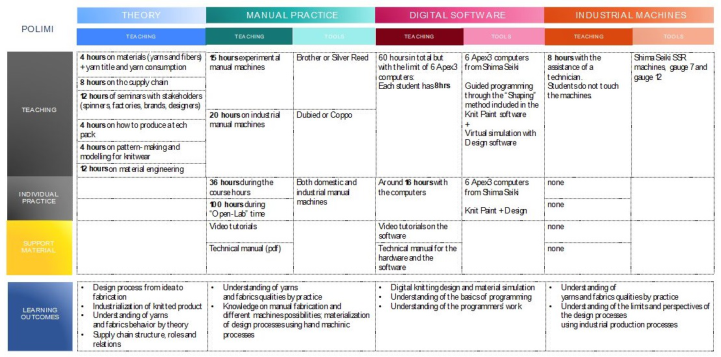
Figure 1: Outline of the Polimi programme.
all related to each other, they have all been considered as relevant for this analysis and are reported in Figure 1. The teaching of knitting technology is viewed as consequent to the theoretical foundation and practical exercises on manual knitting machines, which makes students able to translate what they know into digital form. Due to a lack of time and equipment, training on the main functions of the software is supported by video tutorials and a digital manual that have been specifically prepared to make students as independent as possible in programming with Apex3. With such support, the limited time spent in class is optimized for learning-by-doing activities where students test the translation of individual designs into a digital program first and then its production in a physical sample made with a power machine.
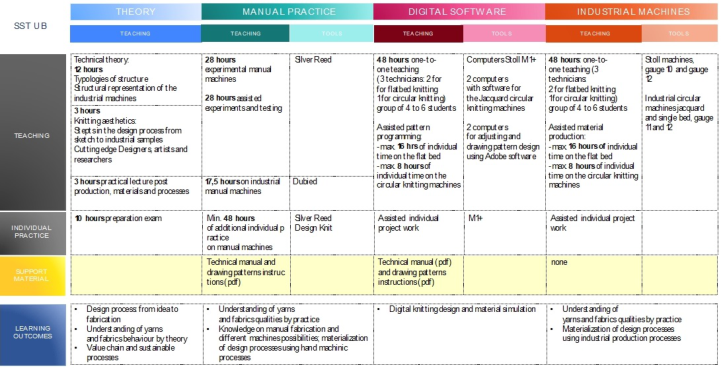
At the Swedish School of Textiles, the Advanced Course in Knitting Tech- nology is a foundational graduate-level course dedicated to MA and PhD students with no experience in knitting. The teaching activities and learning outcomes were initially developed to teach the basics of knitting techno- logy for both textile designers and engineers in an identical format. Thus, the teaching activities included only learning-by-doing teaching activities on the Dubied machines to experiment with basic structures and learn how to relate the machine work to their graphical notations. The learning outcome of this essential step was careful preparation for drawing and programming the pattern on the Stoll machines for the software precursory to M1+, which was based on pattern drawing using the same graphical notations as for the Dubied machines. Analysing the students’ design development process and resulting project work from a design perspective, we realized that most of the preparatory experimental design work on the Dubied machines was very limited, affected the expressive possibilities of the end project, and required unnecessary time and assistance in direct basic sketching on the industrial machines. However, training on these machines established a good founda- tion for students to learn the basic types of stitching that are useful when programming the industrial machines: stitch, no-stitch, tuck, transfer, and
6 Motta and Dumitrescu
Figure 2: Outline of the Swedish school of textiles programme.
wracking. To achieve better aesthetics, we also introduced the Silver Reed machine segment. This also allowed for a greater focus on the work with the fields of pattern and choice of different structures, which is a good foundation for the initial steps when programming the textiles on industrial machines. The students could therefore tackle knitting design work from a more expe- rimental and cutting-edge perspective without having such a strong focus on the constraints of industrial production during creation. Complemented by the learning outcomes on the Dubied machines, this action resulted in more appealing design results and a higher level of one-to-one exchange of knowledge with the supporting technical technicians when programming the patterns.
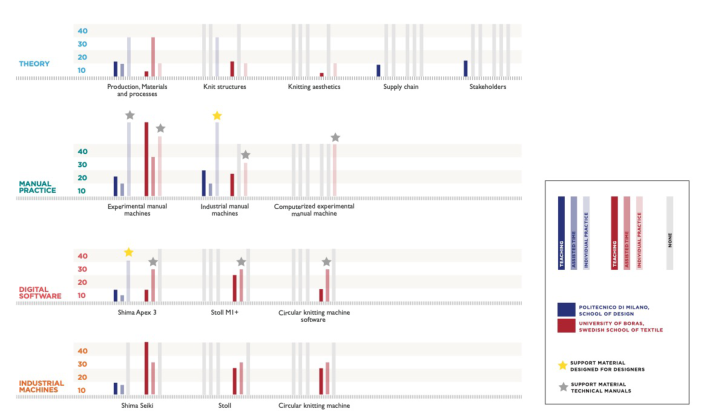
Figures 1 and 2 report the structure of the two programs and collect relevant data to highlight similarities and differences between the two pro- grammes and foster improvements with shared solutions. Figure 3 compares the data and opens discussion on the findings.
Findings from the comparison:
- In both cases, a lot of time is dedicated to individual practice or assi- sted time on manual machines. Manual domestic machines are conside- red essential tools for fostering designer creativity but they have to be integrated with digital technologies. - There is a great difference between Polimi and SST in the amount of time that each student can spend on computers and power knitting machines. The higher the number of students (around 50 per year at Polimi vs 4-6 students at SST), the greater the resources (experts and machinery). - The complexity of the current software and machinery, the wide vari- ety of machines with different functions, the potentially infinite ways of exploiting the software to pursue different results, make the mediation of an expert technician fundamental, especially during learning. This makes individual time the most effective for achieving results that are perceived as satisfactory by students in both programmes.
The Role of Teaching Advanced Technological Knowledge 7
Figure 3: Comparison scheme: the hours dedicated to teaching, assisted time, and individual practice are compared, together with the presence and relevance of different types of support material.
- Given the unlimited range of possibilities that the software and machi- nes offer for production, learning-by-doing is so far identified as the best method to train students, both at Polimi and in the SST. - Support materials make an important difference when managing a lot of students at tight times, since it allows them to be more independent and practice individually rather than requiring assistance from a technician.
There are also impactful items to be potentially shared/transferred:
- Practice and time spent experimenting with the computerized manual knitting machine (Design Knit for Silver Reed) – from SST to Polimi - Assisted time with technicians – from SST to Polimi - The software manual designed for designers – from Polimi to SST - Lessons on the supply chain and intervention of industry stakeholders – from Polimi to SST
CONCLUSION
The high cost of computers and machinery together with the non-availability of software licenses for installation on private computers are concrete limits for institutes of higher education, since it is difficult to find the necessary budget, space, and dedicated personnel to manage the equipment, and the difficulties grow along with the number of students. On the other hand, the wide range of skills, both cultural and technical, that design courses are meant to transfer, naturally leaves a short amount of time to teach and cover a broad subject such as software programming. The lack of time in curricula is the other main critical issue and a big challenge, since it requires researchers and teachers to make choices in terms of what to teach and with which purpose.
8 Motta and Dumitrescu
With these limits in mind, the purpose of teaching this subject is not to educate designers as programmers-technicians, but to help them understand and experience the related complexity, manage the dialogue with technicians, activate an initial ideal link with industrial practices, and understand how to scale the design process with particular attention to time and feasibility. It is a new way of being creative with awareness, following the path traced by the designer Ben McKernan, who familiarized himself with power-knitting mach- ines, first by working on manual machines, bringing old and new technology together. By translating craftsmanship into a highly technological machine, he created ‘something different but that remains universally knit’ (Sissons, 2018, p. 166). Design education in knitting also needs to adjust learning processes to today’s industrial challenges. As Industry 4.0 becomes the current model of organization in the fashion and textile field, with digitalization and cross- disciplinary techniques at its core, the knowledge of both physical material and the digital process of design and fabrication becomes an important tool for designers to navigate in complex workflows, strengthen their position in the product value chain, and contribute with their creativity to expanding the life cycle of textile products.
REFERENCES
Evans-Mikellis, S. (2011). Future forms: a methodological investigation for garment shape innovation in knitwear design. MA thesis. Auckland, NZ: Auckland University of Technology. Boeykens, S., Neuckermans, H., & Leuven, K. U. (2006). Improving Design Work-
flow in Architectural Design Applications. International Journal of Architectural Computing, 4(4), 1–19. Greenfield, A. (2017). Radical technologies: The design of everyday life. London- New York: Verso. Lotti, G., Trivellin, E. (2017). Una possibile strategia per il prodotto italiano. MD
Journal 4, 60–73. Peters, S., Drewes, D. (2019). Materials in Progress: Innovations for Designers and Architects. Basel, CH: Birkhäuser. Sayer, K., Wilson, J., & Challis, S. (2006). Seamless Knitwear—The Design Skills
Gap. The Design Journal, 9(2), 39–51. Sissons, J. (2018). Knitwear (2nd ed.). London, UK: Bloomsbury. Smith, A. (2013). Seamless knitwear: Singularities in design. Ph.D. thesis. Auckland, NZ: Auckland University. Twigger Holroyd, A., & Hill, H. (2019). Fashion Knitwear Design. The Crowood
Press Ltd. Taylor, J., & Townsend, K. (2014). Reprogramming the hand: Bridging the craft skills gap in 3D/digital fashion knitwear design. Craft Research, 5. Underwood, J. (2009). The design of 3D shape knitted preforms. Ph.D. thesis.
Melbourne, AUS: RMIT University. Yang, S. (2010). A creative journey developing an integrated, high-fashion knitwear development process using computerized, seamless v-bed knitting systems. Ph.D. thesis. Perth, AUS: Curtin University of Technology.
LISTED IN THE AHFE DIGITAL BOOKSTORE CATALOGUE
Explore the complete digital volume
Human Factors for Apparel and Textile Engineering
Read this individual research paper free through the original publisher, or explore the full digital proceedings book.
ISBN 978-1-958651-08-7
Explore this ISBN in the AHFE Bookstore ↗Listed in the July 2026 bookstore catalogue; search by ISBN to confirm current availability · Digital book purchase optional