Benedetta Cerulo, Flavia Papile, Martina Motta, Andrea Marinelli, Giovanni Maria Conti, Barbara Del Curto (2022). 3D knitting for upholstery: guidelines to design at the interface of sustainable fashion and furniture. In: Human Factors for Apparel and Textile Engineering. AHFE Open Access, vol. 32, pp. 129–137. https://doi.org/10.54941/ahfe1001547
Textile products, a synthesis of the complex relationship between physical and sensory characteristics, have always played a fundamental role in the culture of furniture design projects. Like many other production sectors, the furniture one in recent years has been called to meet the growing demand for conversion to sustainability both in terms of processes and raw materials, since most of the time disassembly is very difficult and the padding material is generally difficult to reuse, recycle, or recover when furniture pieces are dismissed. 3D knitting allows reducing the productive steps, consequently, i.e. reducing the supply chain. Moreover, it allows the development of local and on-demand production systems and, lends itself to the use of recycled materials. Finally, at the end of life of furniture pieces, the above-mentioned technology facilitates the recycling of yarns and drastically reduces the possibilities of exploitation of labor. In addition, the use of this process in furniture design has the potential to answer to the strong demand for circularity that the furniture sector is asking for. This research focuses on the relationship between innovative textile technological processes and furniture design (upholstered sofas and armchairs in particular). This study aims to investigate how the 3D knitting process, can contribute in terms of sustainable production in the furniture sector. The technological transfer has been studied either in literature and with direct dialogue with industrial 3D knitting experts. Through this research, it has been possible to demonstrate that the process is not limited to reducing production waste but also to bringing environmental, economic, and social benefits. In fact, 3D knitting allows companies to reduce the size of the product during transport, meeting the trend of flat packaging, allowing the replacement of polyurethane foams in upholstery with recycled and recyclable materials and ultimately leading to a different conception of the furniture product. 3D knitting brings the designer to conceive furniture in a completely new and different way, simple and easy to disassemble, factors that are fundamental principles of circularity design. To provide an output that was not only illustrative but also functional to the designer, in the second part of the research, some specific design guidelines for 3D knitted upholstery have been defined. The guidelines have been established through an overview of the basics of knitwear, the explanation of the machines and their operations, case studies and samples collection, and interactions with 3D knitting industries. Thanks to these guidelines it is possible to guide the designer in the early stages of the development of a 3D knitted product. A final case study on the guidelines application is also provided. This research has allowed to shed light on a process still little known in the world of product design, identifying the potential for the creation of circular products, especially in the furniture sector, and helping designers approach this technology.
The remarkable economic expansion in the last century has given rise to the phenomenon of consumerism which grows on a linear system of consumption and production. In the abovementioned system, products are mainly obtained from resources extraction and their journey ends in landfills, rivers, incine- rators (Ellen MacArthur Foundation, 2020). The furniture sector, for the reasons mentioned above, due to the impact of virgin materials used and the high amounts of municipal waste produced, is considered one of the sectors with the most significant impact (Barbaritano et al., 2019). At the same time, it constitutes an extremely profitable market in global trade and one of the sectors with the highest priority and opportunities to convert to the Circular Economy (EFIC, 2021).
Turning into circularity means reinterprets the “end of life” phase of pro- ducts as a way to give materials several chances to enter again in production systems as raw material (Bompan & Brambilla, 2016) and create long-term resilience, generating countless benefits for the environment, businesses, the economy, and society (Ellen MacArthur Foundation, 2020).
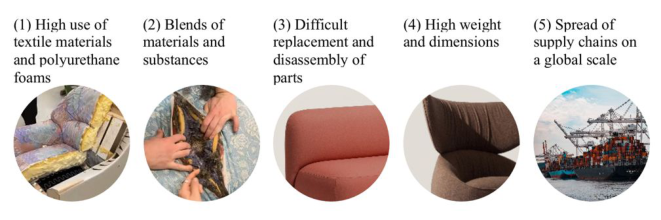
An analysis was carried out on the state of the art of furniture products, belonging to different market segments, focusing on the categories of uphol- stered seats (lounge chairs, sofas, armchairs). The main companies belonging to the different market categories were taken into account and an average of five products for each were examined. The analysis, of approximately 50 pro- ducts, was focused on: how many materials and which one constitutes them, in particular the paddings, how the product is conceived, if the cushions are removable or if the components are replaceable, and focusing also on pro- duct size when packed for sale. This analysis was compulsory to understand the existing design opportunities to implement the circularity of upholstery products (Figure 1).
The issues highlighted in existing design upholstery consist in: (1) high use of textile materials and of polyurethane foams, which have a significant impact on the environment during the disposal phase, since them are mainly used to energy recovery, because reuse and recycling are expensive and logi- stically complex (Letsrecycle, 2018); (2) blends of materials and substances in each piece of furniture make the recycling path difficult at the end of its life cycle; (3) difficult parts replacement and disassembly in products like armchairs, sofas, lounge chairs that are made up of components that can- not be disassembled or replaced individually (for example cushions covers that cannot be removed), demanding for the replacement of the entire pro- duct; (4) high weight and dimensions of upholstery usually brings to higher fuel consumption during transport and to a large use of packaging materials, generating high emissions into the atmosphere and generating waste; (5) and the spread of supply chains on a global scale with suppliers from different regions (Guolo, 2021).
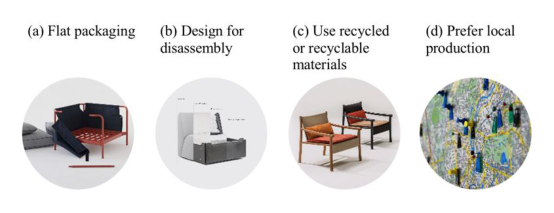
Those drivers emerging as possible intervention areas for sustainable design have been already implemented in certain upholstery products, deter- mining interesting trends in furniture design (Figure 2).
These trends are: (a) having flat packaging helps in reducing the product’s dimensions during transport and imposes the elimination of pre-assembled furniture, in order to optimize product stocking and at the same time reduce carbon emissions per unit (Imm Cologne, n.d.) in the transportation phase; (b) design for disassembly is one of the main strategies of circular design as it
3D Knitting for Upholstery: Guidelines to Design at the Interface 131
Figure 2: Identified trends in furniture design.
facilitates the replacement of individual parts of a product and the easy reuse of the materials that constitute it (Design School Kolding, 2018), (c) the use of recycled or recyclable materials avoids the extraction of virgin resources; (d) preferring a local production allows the involvement and development of local producers to significantly reduce the carbon footprint due to transports resulting from a chain too extensive (Imm Cologne, n.d.).
3D Knitting as a Sustainable Technology 3D knitting is part of the knitting process, that creates fabric through the interlacing of yarn in a series of concatenated loops (Spencer, 2001). Alth- ough this technology was introduced in 1995, only lately has been understood the great potential of this technology not only for application in the clothing sector but also in other fields such as automotive, sports, aerospace, health- care, smart textiles, and furniture (Shima Seiki, 2018). The three-dimensional knitting process corresponds to one of the most recent advances in the field of weft knitting (Kincade & Gibson, 2010). Starting from yarn, the coor- dinated movement of the needles - which work on the four needle beds of the machinery- creates a complete product, including possible pockets and decorative elements (Peterson & Ekwall, 2007). One of the peculiarities of the process is to make the production more sustainable in environmental terms because it does not generate production waste thanks to the possibility of creating 3D shapes without the need to resort to cut and sew proces- ses. Additionally, such computer control limits the number of prototypes needed to achieve the desired result and allows an on-demand production. 3D knitting is the only knitting technology that does not require additional processes to obtain the complete product, leading to a downsizing of the pro- duction chain and the possibility of reorganizing production locally (Nawaz & Nayak, 2015). Finally, the structure of knitted products makes it possi- ble and facilitates the recycling of yarns: using this technology yarns are not damaged, therefore it is possible to unravel the fabric to recover them easily and use them for creating a new product (Shima Seiki, 2021). On the social sustainability side, this technology eliminates the operations most subject to the exploitation of labor and at the same time involves a greater number of specialized figures (Peterson & Ekwall, 2007). In economic terms, this brings to a reduction of costs, due to saving of time as well as reduction of waste of materials and energy.
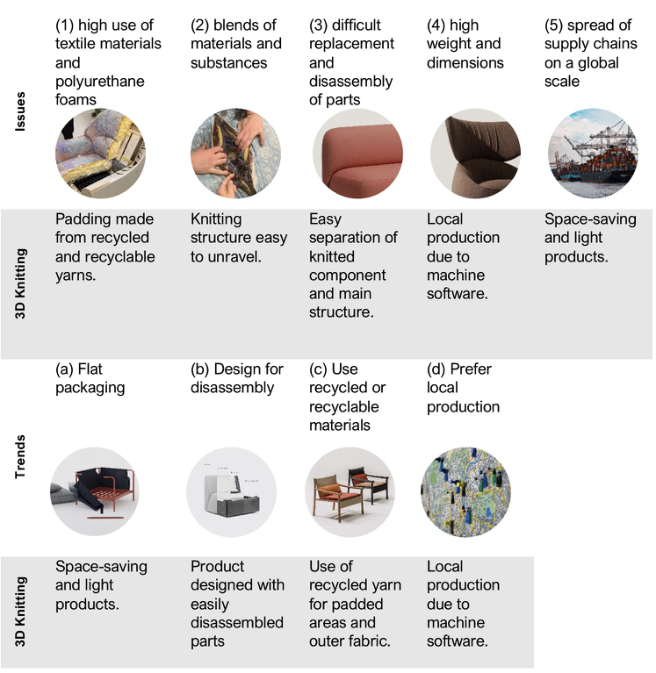
Contribution of 3D Knitting to Sustainable Production in the Upholstery Sector The use of this technology in the furniture industry currently presents a few examples. Interface with knitwear technicians and product designers who work with this technology has brought out how this is still little known in product design but how at the same time it is emerging thanks to the type of sustainable production it would generate, especially in the upholstery sector. 3D knitting favors the creation of products composed of a few components and at the same time made of a single material and provides the possibility of obtaining different techniques, which generate parts of the fabric with distinct aesthetic and functional properties, using the same machine and the same yarn. Referring to the issues and trends of the sector previously intercepted is possible to say where the technology of 3D knitting can intervene on: (I) the replacement of padding materials with recycled and recyclable yarn (see (3) and (b)); (II) the generation of easily disassembled products thanks to the nature of knitting structure (see (2), (3) and (b)); (III) the creation of space-saving and light products thanks to the efficiency of techniques that machines can produce (see (4) and (a)); (IV) potential improvement of local production and easy product replication thanks to machine software (see (5) and (d)); (V) supporting the trend of flat packaging, providing the possibility to create products with a reduced footprint that do not give up the desired properties (see (4) and (a)); (VI) implementing the usage of recycled yarn both for the creation of the fabric and for the padded areas (see (1), (2), (b) and (c)).
RESULTS: GUIDELINES FOR 3D KNITTING Once established the benefits of adopting 3D knitting in the production of upholstery, the technology guidelines have been defined to help the designer in the early stages of approaching the technology of 3D knitting.
Alongside a theoretical part, consisting of tables and information, a case study has been provided, which consists in the development of a 3D knitted lounge chair. Is necessary to keep in mind how designing for 3D knitting alw- ays needs feedback from specialized figures, like knitwear technicians. They, through their experience, are able to offer technical skills and translate them into better design solutions. ÂÂÂHowever, through these guidelines, it is possible to get oriented easily in the interaction with technology. Design steps identified are six and will be described in detail in the following paragraphs.
1. Product sketches The first step in designing a knitted product is to define the shape it will have. In this phase, the idea is presented and components of the product are defined.
2. Definition of shape/dimensions/requirements Generally, when one has to understand the actual feasibility of a product, it is necessary to understand first if the dimensions are in those of the machine (a common 3D knitting machine can produce with a range of 18 cm-254 cm) and think about how the machine works to create it. To do this is necessary to consider the machine needle beds and schematize the parts of the product
3D Knitting for Upholstery: Guidelines to Design at the Interface 133
Figure 3: 3D knitting opportunities related to issues and trends.
as if they were planes. Each needle bed works on one plane and depending on what should be the final result, they work separately or together. Once product shape and overall dimensions have been defined, requirements that the product must fulfill are identified.
3. Selection of techniques Once the requirements have been identified, it is possible to understand which techniques best meet the outlined needs. Techniques that 3D knitting machine is generally able to create are nine: Tubular knit, Three dimensional knit, Spacer structures, Padded structures, DOSs (Directional Oriented Stru- ctures), Multi gauge, Inlay, Jacquard, and Vanisè. Each technique is chosen following the design requirements.
4. Identification of compatible techniques Some parts of the 3D knitted product may require the combination of two or more techniques, in this case, it is necessary to verify that knitting machines can effectively produce and combine those of our interest.
5. Selection of parameters for each technique In the next step, parameters of the knitted product are established for each technique. These generally regard any texture of the fabric, type of stitches, type of yarn used, yarn count, and machine gauge.
Table 1. Knitting techniques.
Table available in the original PDF paper.
References
Techniques Description/ warnings
Compatible techniques
(Au, 2011); (Liu & Hu, 2015)
Tubular Knit Simple shapes; Choose sections and tubular size.
All the techniques except 3D structures and Spacers (Liu &Hu, 2015)
Three- dimensional Knit
Complex shapes; Software simulation is recommended.
All the techniques except Tubular knit.
Spacer Structure Simple shapes;
(Au, 2011); (Liu & Hu, 2015);
Variable thickness and properties;
3D structures, Inlay, Vanisè (Plating).
Padded Structure
Choose between inserts or yarns.
(Au, 2011)
All the techniques except Spacers.
All the techniques except Spacers. DOSs Horizontal insertion is the most simple to process; Tests are necessary to obtain desired results.
(Au, 2011)
All the techniques except Spacers.
Multi Gauge Both directions of the fabric; Gradual effect transition are recommended.
All the techniques but must be careful when combined with Spacers.
Inlay Images full of colors (up to 36;42). Used with precious and expensive materials; Slow and costly process; All the techniques except Spacers.
(Conti, 2013); (Parrillo Chapman, 2008)
Jacquard High definition images; Influences thickness of the fabric; Back fabric with floating yarns.
All the techniques. (Parrillo Chapman,
Vanisè (Plating) Design complexity and
2008); (Ray, 2011)
number of yarn reduced; Good quality of images on both sides.
6. Understanding feasibility (shape and size) Once these parameters have been selected, is possible to verify the feasibi- lity of the product, in terms of shape and size, based on what the machine can produce. Starting from that, the appropriate modifications to the product are made.
Guidelines Applications: 3D Knitted Lounge Chair The product designed to put into practice the guidelines explained is a lounge chair, consisting of a soft knitted component, wedged on a tubular alumi- num structure. The lounge chair was supposed: to be easily disassembled,
3D Knitting for Upholstery: Guidelines to Design at the Interface 135
Table 2. Knitting techniques parameters to monitor.
Table available in the original PDF paper.
Techniques Description/warnings Specificities References Stitches and textures (Motta, 2019); (El Mogahzy, 2009) Technical knowledge required to appropriately choose stitches From four main structures of weft knitwear (jersey, the rib knit, interlock, double jersey) is possible to get endless constructions and obtain different behaviors from knitted fabrics
Yarn (Material)
Choice of yarn material determines the behavior and sustainability of the final product.
(Conti, 2013); (Motta, 2019)
Not all yarns are suitable for 3D Knitting in the furniture field, the choice is often limited to man-made yarns (polyester is the most common). Yarn Count (Machine Gauge)
Machine gauge value relates to yarn count (Nm). Generally, it is advisable to work with a yarn count of the same value of machine gauge (e.g. yarn count Nm 3.000 for machine gauge 3) or use neighboring values.
To understand how thin or thick the fabric will be, varying the value of fineness of processing. The higher the number of needles used, the higher is machine gauge.
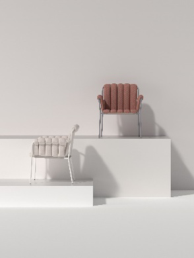
to facilitate the replacement of the knitted component, to generate the least possible space during the transport phase, to make use of recycled or easy to recycle materials. The knitted component was developed following the above guidelines. Requirements were: soft areas, reinforced areas/pockets for the attachment to the aluminum structure, reinforced areas to support the wei- ght of a person, areas with different colors. Once understood the techniques of our interest: tubular (to create the pockets for interlocking), padded (to create the soft areas), DOSs with insertion of the yarn horizontally (to create the reinforced areas), and inlay processing for areas with color variations, has been checked for compatibility. In the next step, the parameters for each of them were selected. To achieve the concept of sustainability, the knitted part was considered made of a single material, choosing recycled polyester yarns for both the outer parts of the knit and for the creation of padded areas. As a product that keeps contact with human skin, to obtain a soft touch effect, the knit structure selected was jersey knit. While this is a product that is put in tension on the aluminum structure, which therefore does not show ela- stic behavior, a high machine gauge has been selected, which consequently requires very thin yarns.
Figure 4: 3D knitted Lounge chair. (Image of the author).
DISCUSSION
The furniture sector, like many other production sectors, in the recent year, had to face the growing demand for circularity. This proposal has presented numerous benefits of 3D knitting technology, in environmental, social, and economic terms. A focus on the upholstered furniture sector has made it pos- sible to understand how the technology is suitable to solve the problems and trends that the sector meets and to contribute to its conversion to sustainabi- lity. Finally, to provide a functional output, 3D knitting guidelines have been defined and the case study, of a 3D knitted lounge chair, explained. Through this last part of the research has been possible to create a tool to help designers in the early stages of the development of a 3D knitted furniture product.
These guidelines give designers the possibility to understand the limitations and opportunities of technology, providing an overview of the obtainable techniques and identifying all the parameters that are possible to manage.
ACKNOWLEDGMENT
The authors express their gratitude to Shima Seiki for their help in under- standing the potentialities of 3D knitting. Additionally, the authors warmly thank the product designer Jonas Forsman and Darren Hill, Head of the Camira Knitting department, for sharing their background and experience with 3D Knitting and all the other professionals they interfaced with during this research.
REFERENCES
Au, K. F. (A c. Di). (2011). Advances in Knitting Technology. Woodhead Publishing Series in Textile. Barbaritano, M., Bravi, L., & Savelli, E. (2019). Sustainability and quality mana-
gement in the Italian luxury furniture sector: A circular economy perspective. Sustainability (Switzerland), 11(11). https://doi.org/10.3390/su11113089 Bompan, E., & Brambilla, I. (2016). Che cosa è l’economia circolare. Edizioni Ambiente. Conti, G. M. (2013). Design della Maglieria. Strumenti e Metodologie progettuali.
Lupetti.
3D Knitting for Upholstery: Guidelines to Design at the Interface 137
Design School Kolding. (2018). Design for Disassembly. https://sustainabledesigncar ds.dk/design-for-disassembly/ EFIC. (2021). Annual Report 2020. Ellen MacArthur Foundation. (2020). Financing the circular economy: Capturing the
opportunity. 102. https://www.ellenmacarthurfoundation.org/publications/fina ncing-the-circular-economy-capturing-the-opportunity%0Ahttps://www.ellenm acarthurfoundation.org/assets/downloads/Financing-the-circular-economy.pdf El Mogahzy, Y. E. (2009). Engineering Textiles. Woodhead Publishing in Textile.
https://doi.org/10.1080/00405009708658583 Evans-Miellis, S. (2012). New product development in knitted textiles. New Product Development in Textiles, 45–64. https://doi.org/10.1533/9780857095190.2.45 Guolo, A. (2021, July 6). I limiti del fast forniture impongono una svolta al suo
modello. https://design.pambianconews.com/i-limiti-del-fast-forniture-impongo nouna-svolta-al-suo-modello/ Imm Cologne. (n.d.). Sustainable furniture: The industry is becoming greener. Retrieved September 15, 2021, from https://www.imm-cologne.com/magazine/future- living/sustainable-furniture/ Kincade, D. H., & Gibson, F. Y. (2010). Merchandising of fashion products. Pearson. Letsrecycle. (2018, July 6). Polyurethane foam and the environment. https://www.le
tsrecycle.com/news/polyurethane-foam-and-the-environment/ Liu, Y., & Hu, H. (2015). Three-dimensional knitted textiles. In X. Chen (A c. Di), Advances in 3D textiles. Woodhead Publishing. Motta, M. (2019). DESIGNING KNIT DESIGNERS. Franco Angeli. Nawaz, N., & Nayak, R. (2015). Seamless garments. In Garment Manufacturing
Technology. Elsevier Ltd. https://doi.org/10.1016/B978-1-78242-232-7.00014-X Parrillo Chapman, L. (2008). Textile Design Engineering within the Product Shape.
North Carolina State University. Peterson, J., & Ekwall, D. (2007). Production and business methods in the integral knitting supply chain. Autex Research Journal. Ray, S.C. (Ed.). (2012). Fundamentals and Advances in Knitting Technology (1st ed.).
ability/#virtual Spencer, D. J. (2001). Knitting Technology: A comprehensive handbook and practical guide (Third edit). Woodhead Publishing.
LISTED IN THE AHFE DIGITAL BOOKSTORE CATALOGUE
Explore the complete digital volume
Human Factors for Apparel and Textile Engineering
Read this individual research paper free through the original publisher, or explore the full digital proceedings book.
ISBN 978-1-958651-08-7
Explore this ISBN in the AHFE Bookstore ↗Listed in the July 2026 bookstore catalogue; search by ISBN to confirm current availability · Digital book purchase optional