José Vicente (2022). Vernacular Products: An Example to Circular Design. In: Interdisciplinary Practice in Industrial Design. AHFE Open Access, vol. 48, pp. 142–148. https://doi.org/10.54941/ahfe1002026
CIAUD, Research Centre for Architecture, Urbanism and Design, Lisbon School of Architecture, Universidade de Lisboa, Rua Sá Nogueira, Polo Universitário do Alto da Ajuda, 1349-063 Lisboa, Portugal ↗
Throughout most mankind’s history our daily life artifacts have been designed, produced, and used with respect for social and environmental constrains and within the carrying capacity of ecosystems. Also, they have been created to fulfill tangible and specific needs (not desires) of individuals and communities to their daily tasks and have sustained a thorough process of evolution and adaptation to the cultural and environmental context and, so, have been perfected over time. It has been only with the technological and cultural changes implemented with the industrial revolution that several unbalances have been created in the relation between our material culture and the natural world. It stands to reason that there are lessons to be learned from those previous times, from their habits and, with a design perspective, from their products. This paper presents an analysis of vernacular objects identifying design features related to morphology, functionality, production, material, and use. This text presents as case study a set of vernacular objects from the rural life collection of the Portuguese National Museum of Ethnology. The analysis was made with support of literature, drawing and photography, and adapting some examples from previous studies of vernacular heritage and architecture. These products serve as example of the incorporation of circular product design strategies.
The production and consumption system is an element of great concern due to its unsustainable patterns and impact on the environment and society. Several design approaches have been developed throughout the last decades that tried to present solutions to the human impact on the environment (Moreno et al., 2016). One of the latest approaches is based on the model of circular eco- nomy (CE), that has its roots on the concepts of industrial ecology, cradle to cradle and biomimetics. In CE design is seen as one of its four bases, promo- ting the closing and slowing of resources loops (Ellen MacArthur Foundation, 2013). Previous works in the field of heritage and architecture (Correia et al., 2014; Fernandes et al., 2015; Heath, 2003) have help to define the concept of vernacular and found in it a significant potential to define principles and stra- tegies for sustainable design. In the product design area, introductory works
Vernacular Products: An Example to Circular Design 143
(Alves et al., 2013; Finizola et al., 2012; Wright, 2015) have already star- ted to rescue the vernacular approach from the oblivion the contemporary narrative of design history has rendered it and have connected it to a more sustainable approach. In addition, the ethnological study developed with the support of drawing, has the work of Fernando Galhano (Galhano, 1985) has opened the door for the use of drawing in a more analytical way.
The main goal of this work is to reaffirm the potential that vernacular product design has as an example for the display and establishment of design strategies, namely in the product design, that can promote the circularity and sustainability of our products and creating a more benign material culture (Walker, 2006).
The methodology designed to reach the main goals of this prospective rese- arch is divided in two main stages. In the theoretical one, a literature review was conducted, through the collection, selection, analysis, and critical synth- esis of relevant documentation in the areas of vernacular design, sustainable and circular design, and drawing (analytical and ethnological). Projects with similar approaches were also investigated, namely in the field of vernacular architecture. For the empirical phase, a set of vernacular furniture artifacts was selected to conduct a series of photographic records and analytical dra- wing sessions. Only two objects have drawings display in the paper due to page limitation constrains. These elements serve as data support for a deeper analysis of these objects.
CIRCULAR PRODUCT DESIGN Circular product design is framed by the concept of circular economy where the linear model of “take – make – dispose” evolves to a natural based con- text that intends to design out waste, build resilience through diversity, shift to renewable energy sources, think in systems and in cascades. Circular eco- nomy model highlights the importance of a system that stays as close as possible to direct reuse of objects, perpetuating the original use to create lar- ger cost savings, either in terms of materials, labour, energy, or capital (Ellen MacArthur Foundation, 2013).
Circular design presents a new step in the design approach to tackle envi- ronmental problems and is an evolution of DfX strategies and business models (Moreno et al., 2016). It also presents a new concept for product lifetime that “is the duration of the period that starts at the moment a pro- duct is released for use after manufacture and ends at the moment a product becomes obsolete beyond recovery at product level” (Hollander et al., 2017). So, besides extending the lifecycle loop, products should also have more than one cycle in each lifetime, therefore keeping resources and value. In circu- lar product design strategies, as systematized by Berg and Bakker (2015) it is clear the importance of guidelines oriented to long use, non-destructive disas- sembly, maintenance (reuse of products), remake (reuse of components) and recycling.
The change of mentality demanded by circular economy is not a total new and disruptive approach, but more a return to an economic model groun- ded on the fully efficient use of resources. Something that was practiced by communities were scarcity was a common place.
144 Vicente
VERNACULAR PRODUCT DESIGN The term vernacular design has been mostly used in architecture with a broad spectrum of meanings (Heath, 2003), but vernacular product design can also be associated with the responses of local communities to their daily-life and presents a rich cultural expression based on local ideas, materials, and tech- niques. Vernacular is a form of design that is influenced by the environment, the local community, and deals with the ordinary, the normal and the pra- gmatic tasks of rural life. Its evolution and stabilization led to the traditional. As stated by Wright (2015) the vernacular objects aren’t subject to national or international stylistic influences, their forms are uncluttered and unpreten- tious and are the result of an evolutive design process in which the place, the people and the local materials are the main constraints. This means vernacu- lar objects are shaped by the cultural setting and the human behavior, and, so, they emerge naturally from the local culture. The vernacular objects are rarely discarded because they have deep connection with cultural context, they present an answer to local needs, use the best materials and, in some cases, have a design that is tailored to the specific context of the household (Alves et al., 2013). Having a pragmatic approach the vernacular demon- strates a sound relation between need, purpose, function, form, material, and technique (Risatti, 2007). Vernacular design conveys the context of use, presents a direct relation to nature, and shows that beauty can come from contexts of scarcity, hardship, and necessity (Morrison, 2017).
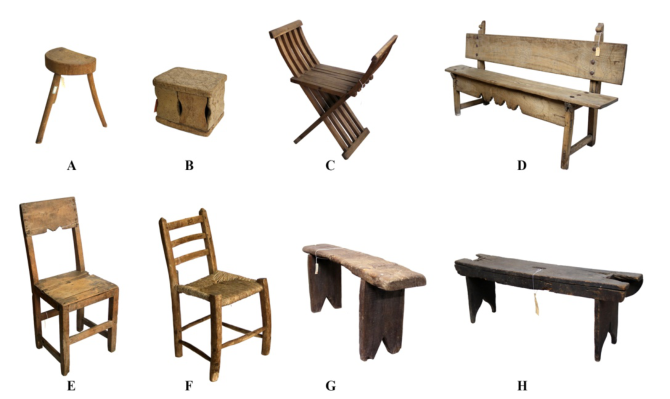
STUDIED OBJECTS A selection of 8 seating objects was made from the collection of the Portugu- ese National Museum of Ethnology (Figure 1). All artifacts were previously used for many years in Portuguese rural houses in the first half of the 20th
century or prior. Depending on the intended use they present different morph- ologies: simple seat, low seat, arm rests or back rests. All objects use local and natural materials that required very few steps of production, with the support of a small number of simple manufacturing techniques, they have little surface treatment and almost no decoration. The only decoration is made by carving; therefore, no extra material is added. It is customary for the best materials from the surroundings be kept by the family to produce objects to be used in the household (Alves et al., 2013). The 3 main materials used are wood (oak, chestnut, willow), cork and bulrush. The simplest object (G - long stool - TR MAD 113/96) presents only 3 pieces and the most complex (C - scissor stool - TR MAD 104/96), which is foldable, has 24 parts (nails and pegs not included). All objects present evidence of maintenance and, in some cases, several patches and repairs to extend their durability. These repair, although visible, do not contrast with the overall look of the objects.
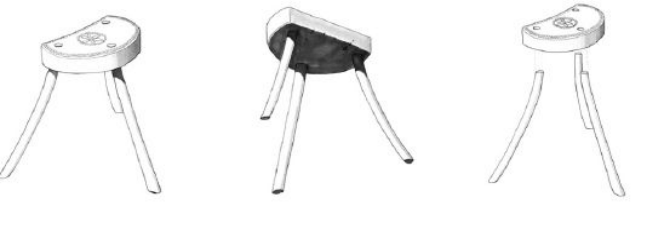
An excellent example of simplicity, efficient use of resources and small pro- duction steps is the “Tripeça” stool (A) (Figure 2). It is made of only 4 parts connected by pressure and glue; the legs are stripped tree branches, selected due to its width and curvature and, afterwards, their top is thinned out to fit the three holes previously made in the seat. This structural part is made of a single block of wood that was the waste of the thick planks used to build the
Vernacular Products: An Example to Circular Design 145
Figure 1: Set of 8 artifacts analyzed (Photos by the author with permission form the National Museum of Ethnology).Figure 2: Analytical drawings of A - Stool “Tripeça” (TR MAD 102/96).
wheels of ox carts. This reclamation rendered it the characteristic shape of a circle with a section chopped off (end line of the plank). No apparent surface treatment was used. Only two carving sets (center and edge) were made on the top surface. All the rest remain in a rough and textured state.
A similar approach was used in the long stool (G) where only 3 robust planks are joined with pressure, glue and 4 long nails. This apparently gro- tesque thickness of the boards had the purpose of allowing to use the stool as meat chopping board besides enabling its structural integrity for seating. Without the need for that secondary function the long stool (H) presents a more standard approach, using boards with less thickness but placing two vertical flaps throughout the length of the stool to provide structural inte- grity, but with the front board being smaller in height to promote a good relation with the user legs. In both long stools (G and H) the legs have the same width of the seat and present an inverted “V” shape cut in the bottom to improve stability. In stool H there is rectangular hole in the center of the seat to place the hand to pick up the object. No extra parts were added.
146 Vicente
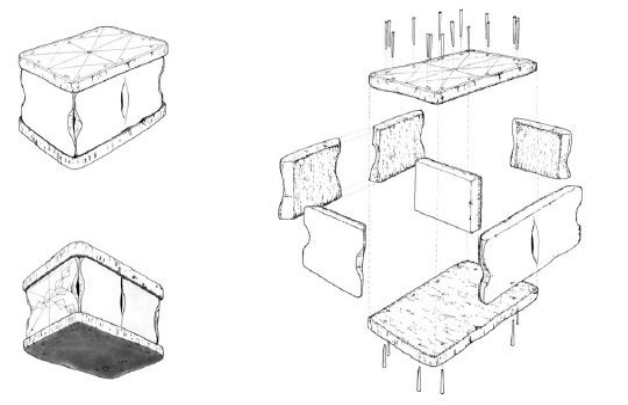
Figure 3: Analytical drawings of B - stool “Tropeço” (TR COR 70/8).
A paradigmatic example of a straightforward use of a local, renewable, and light material is the low stool “tropeço” (B) (Figure 3). It uses cork (bark from the Quercus Suber tree) with support of low-tech tools and very small amount of production steps. The stool is entirely made of genuine cork boards (no agglomerate), straighten with a simple moist and temperature treatment. Each board is them cut and put together using pegs reclaimed from spare wood. The simple exterior morphology (6 faces) is reinforced with an interior board and ensures an extraordinary load capacity for such a light-weight object, but still profiting from the material flexibility All the exterior side of the cork boards – more textured - are placed toward the interior of the stool, leaving the smoother side facing the exterior. Simple geometric patterns have been carved in two exterior faces.
The high back chair (E - TR MAD 149/96) presents a morphological stru- cture like the “alentejana” chair (F - TR MAD 137/96), with four legs and four horizontal crossbeams at mid-height of the legs and a rim supporting the seat. But the “alentejana” chair (F) uses a simpler approach to material transformation, since all the vertical and horizontal bars are made of tree branches that only have been smoothen out and, in the main vertical parts, have been roughly squared. Only four pegs are visible. The seat uses inter- laced bulrush. The high back chair (E) has the seat and back boards made from wood boards. This chair presents pegs in all joints and several nails in the boards.
The scissors chair (C - TR MAD 104/96) presents a totally different mor- phological structure due to its foldability. This type of “Savonarola” chair enabled easy transport and stow (Sousa & Bastos, 2004). Made with ten ver- tical bars, ten horizontal bars for the seat, two beams for the arm support, two beams for the floor and four metallic axis that connect the vertical and the seat bars.
Vernacular Products: An Example to Circular Design 147
The large bench with back (D – AP345) presents a different morphology where two vertical frames that serve as legs and backrest structure are connect by three long boards - back, seat and front flap – that are both functional and structural. The two main boards are connected to the beam by 12 large head nails. This object also presents simple carved decorations.
DISCUSSION AND CONCLUSION All objects presented here responded (a priori) to the five principles of circu- lar economy set by the Ellen MacArthur Foundation (2013) and are a good example of a biological closed and slow loop. They embed several eco-design, design for sustainability and circular design strategies as defined by Bre- zet and Hemel (1997), Vicente (2012) and Bocken et al. (2016), as are the selection of low-impact materials, design for low-consumption of resources, design for product optimization, design for production optimization, design for long-life and design for extending the product’s life (through maintena- nce, reliability, physical and emotional durability, and repair). They present a highly efficient use of resources and technologies (both the amount and type of production techniques) and a small to none surface treatment. This simplicity recovers an approach opposite to the contemporary object ideal that states that everything should have a smooth, shiny, and perfect surface, and when that surface is damaged the product loses attractiveness and is discarded. These examples proof that vernacular products are an excellent example for reframing a new identity for our material culture as defended by Walker (2006) and are a source of information to support a knowledge base for circular product development. The vernacular approach is also in line with the concept of slow design (Strauss & Fuad-Luke, 2008), where the attention to details, to the ordinary and to the local require the patience of empirical evolution. But these objects are durable, circular, and sustainable according to contemporary standards because there was a context of scarcity and poverty in which they were created and used. This context promoted a correct use of resources and provided an evolution of best practices regar- ding product design and maintenance. If a good use of resources was made in scarcity context, how can we, in an overabundant society, promote the same results? Further research on vernacular products can bring forth new strategies that associated with the correct business model can help bypass this problem.
ACKNOWLEDGMENT
This work is financed by national funds through FCT - Fundação para a Ciência e a Tecnologia, I.P., under the Strategic Project with the refere- nce UIDB/04008/2020; The author would like to thank the team form the National Museum of Ethnology – Dr. Paulo da Costa, Dra Ana Botas and Mr. João André.
148 Vicente
REFERENCES Alves, D., Paulo, L., Vicente, J., & Sousa, G. (2013). Vernacular living as a model for innovation and sustainability: The wood furniture of Minho region. in Correia, M., Carlos, G. & Rocha, S. (Eds.), Vernacular Heritage and Earthen Archite- cture: Contributions for Sustainable Development. London: CRC Press -Taylor and Francis Group. Berg, M. R. v. d., & Bakker, C. (2015). A product design framework for a circular eco-
nomy. PLATE Conference - Product Lifetimes and the Environment, Nottingham, UK. Bocken, N., Pauw, I. d., Bakker, C., & Grinten, B. v. d. (2016). Product design and business model strategies for a circular economy. Journal of Industrial and Production Engineering, 33(5), pp. 308–320. https://doi.org/10.1080/21681015.2016.1172124 Brezet, H., & Hemel, C. V. (1997). Ecodesign - a Promising Approach to Sustainable Production & Consumption. Paris: UNEP. Correia, M., Carlos, G., Mecca, S., Dipasquale, L., Guillaud, H., Vegas, F., Mileto,
C., Achenza, M., & Castro, A. (2014). Lessons learned and VerSus outcomes. In Correia, M., Dipasquale, L. & Mecca, S. (Eds.), VerSus: Heritage For Tomorrow - Vernacular Knowledge for Sustainable Architecture. Florence: Firenze University Press. Ellen MacArthur Foundation (2013). Towards the Circular Economy. Opportunities for the consumer goods sector. Cowes: Ellen MacArthur Foundation. Fernandes, J., Mateus, R., Bragança, L., & Silva, J. (2015). Portuguese vernacu-
lar architecture: the contribution of vernacular materials and design approaches for sustainable construction. Architectural Science Review, 58(4), pp. 324–336. https://doi.org/10.1080/00038628.2014.974019 Finizola, F., Coutinho, S., & Cavalcanti, V. (2012). Vernacular design: a discussion on its concept ICDHS 2012 | 8th Conference of the International Committee for Design History & Design Studies, São Paulo, Brazil. Galhano, F. (1985). Desenho Etnográfico de Fernando Galhano (Vol. 1 - Portu-
gal). Lisboa: Instituto Nacional de Investigação Científica. Centro de Estudos de Etnologia I.I.C.T.-M.E. Heath, K. W. (2003). Defining the Nature of Vernacular Material Culture, 35(2), pp. 48–54. http://www.jstor.org/stable/29764189 Hollander, M. d., Bakker, C., & Hultink, E. J. (2017). Product Design in a Circular
Economy. Development of a Typology of Key Concepts and Terms. Journal of Industrial Ecology, 21(3), pp. 517–525. Moreno, M., Rios, C. D. l., Rowe, Z., & Charnley, F. (2016). A Conceptual Framework for Circular Design. Sustainability, 8(9), pp. 937–952. https://doi.org/https://doi.org/10.3390/su8090937 Morrison, J. (2017). The Hard Life. Zurich: Lars Muller Publisher. Risatti, H. (2007). A Theory of Craft Function and Aesthetic Expression (1st ed.).
USA: University of North Carolina Press. Sousa, M., & Bastos, C. (2004). Mobiliário - normas de inventário. Lisboa: Instituto Português de Museus. Strauss, C. F., & Fuad-Luke, A. (2008). The Slow Design Principles: A new interro-
gative and reflexive tool for designresearch and practice. Changing the Change: Design, Visions, Proposals and Tools, Turin, Italy. Vicente, J. (2012). Contributos para uma metodologia de design sustentável aplicada à indústria do mobiliário. O Caso Português. Universidade Técnica de Lisboa. PhD Thesis. Walker, S. (2006). Sustainable by Design - Explorations in Theory and Practice
(1st ed.). London: Earthscan. Wright, L. (2015, 17–19 June). Vernacular as the dialect of the uncommon PLATE Conference - Product Lifetimes and the Environment, Nottingham, UK.
LISTED IN THE AHFE DIGITAL BOOKSTORE CATALOGUE
Explore the complete digital volume
Interdisciplinary Practice in Industrial Design
Read this individual research paper free through the original publisher, or explore the full digital proceedings book.
ISBN 978-1-958651-24-7
Explore this ISBN in the AHFE Bookstore ↗Listed in the July 2026 bookstore catalogue; search by ISBN to confirm current availability · Digital book purchase optional