Cristina Salvador, José Vicente, João Paulo Martins (2022). Ergonomics in Children's Furniture -Emotional Attachment. In: Advances in Ergonomics In Design, Usability & Special Populations: Part II. AHFE Open Access, vol. 19. https://doi.org/10.54941/ahfe1001284
When designing a product, frequently the focus stands on function and utility issues, however searching what kind of features can promote a bigger emotional attachment to objects is an important step for a design project. With the creation of more suitable and sustainable children's furniture as an overall objective, namely a chair that can follow child's growth from 6 months up to 7 years old, we aim to produce an object for children to bond, because affection can be the most important number in this equation. This is a mix of interview-based study with quasi-experimental drawing sessions in order to illustrate children's feelings and expectations towards the Tripp Trapp® chair, which is more than 40 years in the market, designed by Peter Opsvik and produced by Stokke® - our main case study. It gives us clues to understand what the chair of their dreams would be like and what they feel sitting on an existing chair. We identified problems concerning comfort and communication with this chair, which has very large acceptance between parents worldwide but doesn't seem so appealing to children.
When it comes to designing a product, human factors and ergonomic studies frequently focus on function and utility issues. Besides anthropometric data, physiological research and all the functional aspects of human activity, to search what kind of features can make a bigger emotional attachment to a certain object is an important step for an optimized design project (Jordan, 1998). Leading an investigation aimed to design children's domestic furniture, focusing in the child's well-being and the surrounding environment, it seemed necessary to explore issues related with the child's emotional and sensitive satisfaction when using a product.
We have as an overall objective, the creation of more suitable furniture for children, leading to extended product life cycles and contributing to sustainable development. Namely, through the design of a chair which can follow child's growth from 6 months up to 7 years old and guarantees physical and visual comfort, without being overpriced nor “disposable”. Bigger life cycles aren't just about the product's material resistance and long lasting performance, they're also about creating an object for children to bond because affection can be the most important number in this equation. Product attachment is a precondition for the sustainability of products, pleasantness is an affect and designing pleasurable products can create a bond between product and user (Borjesson, 2008). Besides sensual experience, context (social and cultural backgrounds, which are prone to change) also influences pleasure, so Ergonomics In Design, Usability & Special Populations II durable attachment is difficult to achieve (Jordan, 2000). But when it comes to meaning, if verbal and visual communication are combined, cultural differences can disappear (Pöppel, 2007).
This paper reports a study based on the expression of feelings and expectations towards a specific piece of children's furniture, an evolutive chair with more than 40 years on the market - Tripp Trapp® is a chair suitable for children from birth to adulthood (with a system of extra elements), created by the norwegian designer Peter Opsvik and produced by Alesund based company Stokke® (Stokke, 2013).
The child's spontaneous and imaginative universe expresses itself by reactions, but also by spoken words and graphic expression. A mix of interview-based study with quasi-experimental drawing sessions in order to illustrate their emotional response to a specific evolutive chair, can give us clues to understand what their dream chair would be like – near perfection - and what they feel sitting on an existing chair – reality. Shapes, colours and tactile characteristics will be the main ingredients in their aspirational recipes for the perfect chair.
CASE STUDY - TRIPP TRAPP® CHAIR One of Peter Opsvik's first works as an independent designer is Tripp Trapp® chair, launched in 1972 by the norwegian company Stokke®. He faced a problem by not finding in the market, a chair suitable for the age and size of his 2 year-old son, as he wanted to make him part of familiar gathering over meals (Opsvik, 2009). Then he designed an evolutive chair which can easily follow child's growth by changing the position of two plywood boards as seat or footrest.
Opsvik has an extensive work based on his theories about human posture (Opsvik, 2013). His views on human's need for movement and constant variation are passionately put to practice in an impressive number of chair designs. His devotion on studying human evolution and interaction make human factors essential in his design process. He has done a lot of research in human nature, setting himself into an observer role, trying to understand human beings in its essence – a nomad one. Much interested in sitting, Opsvik also studies our body's evolution and its constant need for motion. Well adapted furniture is essential, for it's a kind of third skin we have, being clothes our second skin and architecture our fourth.
But Opsvik doesn't just try to follow human growth, he thinks the key to comfort is not to support people in static positions, but to support them in different positions, so that they can move and change position (Opsvik, 2009, p. 37). For Opsvik “...the best posture is always the next one.”, so there's not an ideal posture like we are trained to follow in anthropometric data books. Any (so called) perfect posture will be uncomfortable after a while. Variety is positive and monotony is always negative. Sedentary situations are harmful to people's health both physical and mental.
Tripp Trapp® chair is our main case study given the fact that it is a worldwide best seller, with more than 3 million pieces sold by the end of the 20th century and with 90% share of the market in Norway (Ryan, 2000), where it is seen as more than just a chair, as so many people have grown up with it. Its presence is accepted just as easily as a door or window in any home.
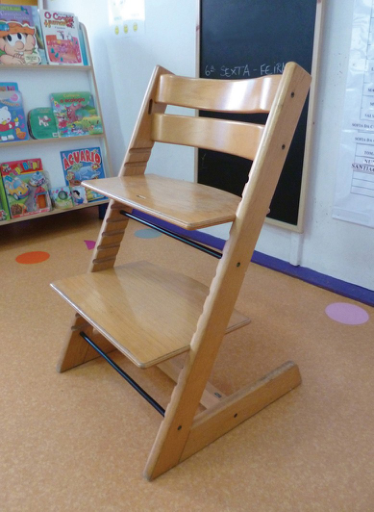
The chair has a very clean and simple appearance based on a diagonal line structured profile in solid wood, available in many different colours. Its contemporary look and functional/minimalist design has made it a timeless classic (Figure 1).
Ergonomics In Design, Usability & Special Populations II
Figure 1. Tripp Trapp® chair from Stokke®, used in this study (Barreiro, Portugal, 2014).
Is this the chair children want or are there other features they look for, when sitting on a chair? These are the questions we aimed to answer with our study.
CHILD'S EMOTIONAL RESPONSE Considering human factors and ergonomics as a fundamental scientific discipline in design processes, since Jastrzebowski's (1799-1882) pioneer contributions to a new way of helping the optimization of products and systems, we may accept that “...the paramount objective of HFE (Human Factors and Ergonomics) is to understand interactions between people and everything that surrounds us and based on such knowledge to optimize the human well-being and overall system performance.” (Karwowski, 2012, p. 5). According to HFES (Human Factors and Ergonomics Society), the function of ergonomics on the technical group product design is to develop useful, usable, safe and desirable products, applying the methods and principles of human factors, consumer research, and industrial design to ensure the product's success in the marketplace.
Affective Ergonomics is listed as one of the domains of Human Factors (Karwowski, 2012) and has also been designated as Hedonomics (Helander, 2002), relating to the study of pleasure on interaction with artifacts and tasks and on these matters lies the scope of our research. From a psychological point of view, Theodor Lipps' (1851-1914) early theories on empathy or esthetic sympathy, link emotional bonding with an object with a projection of oneself in it. Being a non cognitive process, this aesthetic experience is an “objectified self-enjoyment” (Lipps, 2012, p. 127). Possession of material goods enables the subject to “incorporate” the meanings that are signified to them by a given object (Fromm, 2005, p. 40). Emotional bonding with objects also through a process of identification may be one of the keys for more suitable and sustainable materiality. As Chapman states, “waste” is the result of broken (emotional) relationships (Chapman, 2005). As Tripp Trapp®'s creator Peter Opsvik thinks, objects should grow old nicely, accumulating and expressing life stories over the years (Ryan, 2000), becoming part of our lives.
The fact of small children being the target of this study brings specific issues we have to consider, when conducting Ergonomics In Design, Usability & Special Populations II this kind of research. Piaget (1896-1980) described the child's cognitive development between ages 2-7 as a pre operational stage as children learn representational skills and become more proficient in many areas as communicating, sharing and becoming more independent. However they can't see reality by others' eyes and they can't understand the consequences of their behaviour (Lueder and Rice, 2008). They are very imaginative and believe in magic. There are differences between 3 and 4-5 year-olds as a lot of capabilities develop in that stage, namely the recognition of primary colours, a much bigger language development, focusing on other children instead of adults and bigger physical and emotional autonomy. Shyness and fear give place to curiosity in this stage.
A REAL CHAIR The methodology we chose to apply includes observation, interview and drawing sessions in an empirical, mainly qualitative and quasi-experimental based research. The study was conducted in a private preschool with 56 children with ages 3-5 years old, distributed by 4 mixed classes (pre-existing groups) with boys and girls of all ages in our range. The school is located in Barreiro, a riverside town, southeast from Lisbon, in Portugal.
Although our focus is on domestic furniture, we chose a school setting given the nature of our study, which includes drawing sessions with the need of their usual and favorite drawing materials and the possibility to attain information from several children in a limited period of time and space. We wanted to use their enthusiasm for drawing in order to motivate them to express themselves, fighting their natural shyness.
Each child was subjected to a brief questioning namely about his/her name, age, if the presented chair was intended for children or grown up people, if he/she liked the chair's appearance, if he/she felt comfortable about the footrest, seat and back support and if he/she felt the need for cushions in the seat, after sitting on the chair for a few minutes. Children were then asked to imagine a chair they would like to have at home and illustrate it with their own drawing materials, choosing shapes, textures and colors. All of them were followed in their task, being asked about what they were drawing and what their chair would be like. They were also asked to draw themselves in the chair so we could see how they would like to use it.
We took a Tripp Trapp® chair model dated 2001, in natural beechwood color, so that we wouldn't influence them on color options. Although this is a system with extra elements like the Baby Set™ and Cushion for ages from 6 months to 2 years old (Figure 2), none of them were taken, as for this age gap (3-5 years-old) they are unnecessary. The children haven't been worn of our visits, so the surprise factor caused excitement. After a brief presentation, and instructions on what they would do, we proceeded with the interviews.
Ergonomics In Design, Usability & Special Populations II
Figure 2. Tripp Trapp® chairs – first from the left with Baby Set™ and Cushion (Lisbon, Portugal, 2014).
Figure available in the original PDF paper.
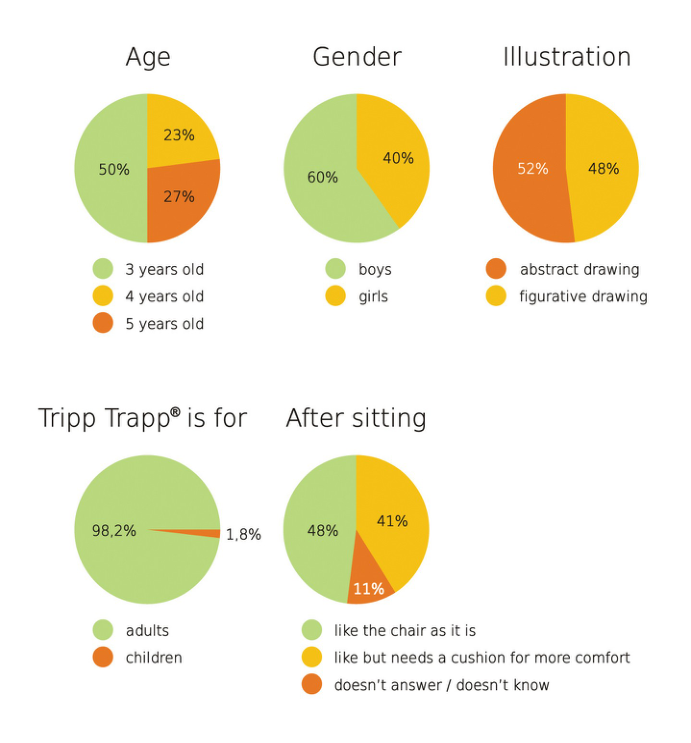
As we may see in Figure 3, 50% of the children were quite young, 3 years old, being the other half shared by 4 and 5 year-olds. As for gender, 60% were boys but that difference wasn't much noticed, as girls were evenly divided by the 4 mixed classrooms. When asked about Tripp Trapp®'s appearance on whether this was a chair for adults or children, the answer was almost unanimous – for adults. It's a chair to follow up children until adulthood but children were unable to identify themselves as targets.
Figure 3. Graphics based on the interviews' results.
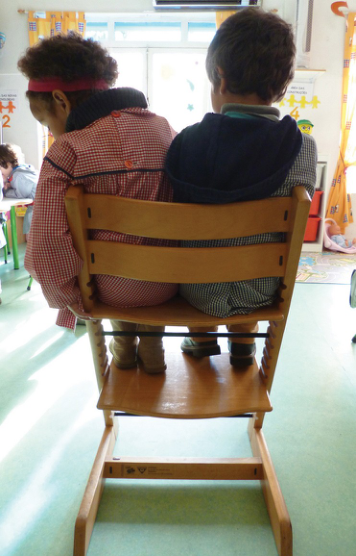
After sitting, children were asked if they liked the chair, about comfort, about feeling good on their legs and feet and about back and seat support. As 11% didn't answer or didn't know, the rest mostly liked the chair, but 41% felt the need for more comfort, considering the seat board quite hard. An additional cushion would be fine for them. In fact, the seat and footrest plywood boards are plain pieces without any smoothing curves or shock absorbers. Ergonomically, for adults or for children, it's rather hard for a seat and quite uncomfortable after a few minutes of sitting. According to Stokke®, until the child is 2 years old, comfort and security are provided with the Cushion and Baby Set™ elements, but for 3 year-old children and up, the chair is used without any accessory. We could observe the cotton Cushion which fits the Baby Set™ works more like a cover, as it doesn't absorb much shock. Nevertheless, the children's overall first reaction to Tripp Trapp® was positive and all wanted to make the trial, Ergonomics In Design, Usability & Special Populations II sometimes being more difficult to get them out of the chair than to put them in (Figure 4).
Figure 4. Children sitting on a Tripp Trapp® chair (Barreiro, Portugal, 2014).
We also could identify, when children started to illustrate their perfect chairs, that they could be almost evenly divided between abstract and figurative drawing. Some were interested in represent real objects and some still didn't know how to draw identifiable things, so they were trying to express those imaginary shapes through lines of color. This seems to be also a reflection of the amount of 3 year-olds who don't yet manage to express manually like older children do, as they indeed produced the majority of abstract drawings.
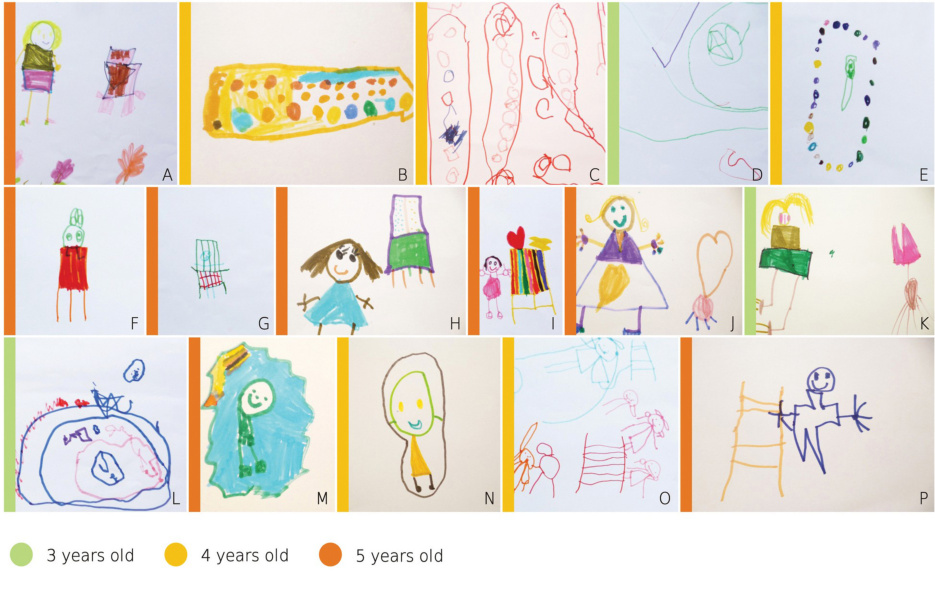
AN ASPIRATIONAL CHAIR During their drawing sessions, children were being asked to explain what they were trying to express, specially when it comes to abstract drawing. They were imagining chairs with specific smells, colors and shapes. There were children drawing brown and pink chairs that smelled like chocolate (Figure 5 / A) and very colorful round chairs that looked like toys (Figure 5 / B-C).
Some of the children who made abstract drawings were trying to express the kind of feelings they would like to have sitting on a chair. A 3 year-old girl stated her chair would feel and look like a round piece of grass, very soft and fresh and drew a big oval shape with green felt pen (Figure 5 / D). Another interesting drawing was made by a 4 year-old boy who drew himself and a lot of colorful balls around him levitating (Figure 5 / E). The chair would be like an invisible net supported by those little balls and he wouldn't feel gravity. Colorful, smooth and light.
There were ideas for chairs with wings that floated away, rocking chairs, wheel chairs and princess' thrones, not much recognizable in the drawings but stated in the interviews, while illustrating. As far as patterns go, there were a Ergonomics In Design, Usability & Special Populations II lot of stripes and squares mainly by boys (Figure 5, / F-G) and other shapes represented as polka dots, hearts, butterflies and flowers mainly by girls (Figure 5 / H-K). There were chairs that looked like pools or bathtubs, colored with blue felt pens and color pencils (Figure 5 / L-M). They drew chairs like cocoons around them – it seems they needed to feel more protected and safe in the chair (Figure 5 / N). The perfect chair should feel like a warm embrace.
Figure 5. Some of the results from the drawing sessions.
The Tripp Trapp® chair has a strongly defined diagonal line as a profile and seems to have steps by positioning the two plywood plain boards (seat and footrest). So some of the children pictured it almost as a ladder, representing their chair as the front view of a staircase, looking like Tripp Trapp®, they thought (Figure 5 / O-P). Only a 5 year- old boy and a 4 year-old girl tried to draw it as their perfect chair. The rest of the children pictured something completely different.
CONCLUSIONS
In this study we intended to know more about children's response to a specific evolutive chair and what would be the features they look for, while sitting. Besides literary analysis on these subjects, we applied methods of observational research, interviews and quasi-experimental drawing sessions with 56 children (boys and girls) aged 3-5 years old divided in 4 pre-existing groups (classrooms). Results show that children's first reaction to Tripp Trapp® was mostly positive but there are two levels where it seemed to fail later on:
Ergonomics In Design, Usability & Special Populations II
- Comfort of the seat, as almost half of the children felt the need for a cushion;
- Communication about its target, as children almost unanimously didn´t think this was a piece of children's furniture.
If someone can't identify himself with an object, he will not be able to bond and create an emotional attachment to it (Mugge, 2007). Curiosity can be an explanation for the overall good reaction and for the anxiety about the trial. As imagination is quite active in children aged 3-5 years old, almost all of the children drew chairs completely different from Tripp Trapp®. Summing up, it seems they didn't identify with the real chair, almost half of them had comfort problems with it and almost all would like to change it into a different chair. They looked mainly for sensations such as warm embraces, comfort and lightness, feeling safe and protected and much more variety and fantasy. Although this chair has very large acceptance among parents worldwide, it doesn't seem so appealing to children and the specific issues identified in it deserve attention. It seems necessary to create solutions that along with worldwide acceptance, also gather empathy from all age targets.
REFERENCES
Borjesson, K. (2009), Affective Sustainability. Is this what timelessness really means? in:Undisciplined! Design Research Society Conference 2008. Sheffield, UK, 16-19 July 2008. Chapman, J. (2005), “Emotionally Durable Design – Objects, Experiences & Empathy”. London: Earthscan. Eisenberg, N. and Strayer, J. (1987), Empathy and its Developments. Cambridge: Cambridge University Press. Helander, M. G. (2002), Hedonomics – Affective Human Factors Design. in: Proceedings of the Human Factors and Ergonomics
Society Annual Meeting. Volume 46 No. 12. Jordan, P. W. (1998), Human factors for pleasure in product use. APPLIED ERGONOMICS, Volume 29, No. 1, pp. 25-33. Jordan, P.W. (2000), Designing Pleasurable Products. London: Taylor & Francis. Karwowski, W. (2012), “The discipline of Human Factors and Ergonomics”. in: Handbook of Human Factors and Ergonomics.
Salvendy, Gavriel (Ed.). Hoboken, NJ: Wiley. Lueder, R. and Rice, V. (2008), Ergonomics for Children – designing products and spaces for toddlers to teens. New York:Taylor and Francis. Mugge, R. (2007), Product Attachment. PhD thesis. Delft University of Technology. Opsvik, P. (2009), Rethinking Sitting, New York: W.W. Norton. Opsvik, P. (2013), Sitting Philosophy. Peter Opsvik's Website: http://www.opsvik.no/reflections/sitting-philosophy Piaget, J. (1929), The Child's conception of the world. London: Routledge. Pöppel, E. (2007), A Toolbox for Thinking – an essay. COGNITIVE SEMIOTICS, Fall 2007, pp. 8-24. Reynolds, D. and Reason, M. (Ed.) (2012), Kinesthetic Empathy in Creative and Cultural Practices. Bristol: Intellect. p. 127. Ryan, N. (2000), Norwegian Design: The Work of Furniture Designer Peter Opsvik. The National College of Art and Design's
Ergonomics In Design, Usability & Special Populations II
LISTED IN THE AHFE DIGITAL BOOKSTORE CATALOGUE
Explore the complete digital volume
Advances in Ergonomics In Design, Usability & Special Populations: Part II
Read this individual research paper free through the original publisher, or explore the full digital proceedings book.
ISBN 978-1-4951-2107-4
Explore this ISBN in the AHFE Bookstore ↗Listed in the July 2026 bookstore catalogue; search by ISBN to confirm current availability · Digital book purchase optional