Vieira Leandro, Balbinotti Giles (2022). Ergonomic and Financial Benefits Reached Through the Application of a Kaizen Culture: Theoretical and Practical Study in An Automotive Industry. In: Advances in Ergonomics In Design, Usability & Special Populations: Part II. AHFE Open Access, vol. 19. https://doi.org/10.54941/ahfe1001228
After the advent of the 2nd World War increased international competitiveness in the automotive industries, began to think about saving and lower production costs. For this purpose many ways were created to reduce costs and waste of raw materials and reduce activities that do not add value to manufacturing processes. In the early XVIII century comes the manufacturing system, which process were rigid with little concern for the health and safety of employees and the conditions of the work environment. After the advent of the production system called Lean Manufacturing, began a new way of thinking, with a lean process and without waste and reducing costs, without neglecting the welfare of the operator and improving conditions of their work environment. Some studies show that the companies that there is a culture Kaizen continuous improvement and reduction of activities that do not add value to the results of product quality and tax of absenteeism are better than those obtained in companies that do not exist this same culture. A reflection will be applied in this paper on the application of ergonomics in a lean production system of an automobile industry using Kaizen methodology based on the (Continuous Improvement) and how to deploy this methodology in culture in a manufacturing environment, will also be shown performance gains the conditions of the job, in addition to the financial gains that the organization can get. The research will be conducted by collecting data "in loco" and interviews with operators, technicians and managers.
Lean production is the third revolution of the automobile in order to produce vehicles. As said Womack, Jones and Roos (1990), lean production represents a new paradigm in terms of production system capable of providing high levels of productivity and quality. It is based on waste elimination that occur during the production process. After emergence of the system of Henry Ford , the volume per vehicle has risen sharply to 2 million units a year the Model T, but the departure of virtually all producers craft market did drop the variety of products from thousands to tens of offers.
Lean production began in Japan, as he comments Womack et ALL (1990), it originated with the Japanese engineer Eiji Toyoda, he left for a three-month study by the Ford Rouge plant in Detroit, after studying carefully the system of factory production, the largest and most efficient manufacturing complex in the world, after much analysis and studies he came to a conclusion that mass production would never work in Japan "In this early experiment was born what Toyota came to call Toyota Production System, and finally lean production". Came with the system of analysis methodologies and improvement of works, among which we highlight the Kaizen, a tool for continuous improvement system that covers all the needs of those involved in a production process.
According mentioned Iudícibus (1995), "has been an undeniable success in the managerial sphere, the concepts and techniques of strategic cost management". In this context Accounting "necessarily" need to give attention to "advances in the companies in the area of total quality in the search for competitiveness and greater efficiency in business." Despite some resistance to the new concepts, techniques and methods, such as the Life-Cycle Costing, Target Costing, Activity Based Costing, among others, under various assumptions, the leading companies are adopting such procedures because "improve the quality of financial indicators, giving conditions to reduce unnecessary costs (non-value), increasing profits".
Ergonomics, coupled with the quality movement, stands as a basis for the proposed continuous improvement of production processes. However, different quality, which is a market requirement (ISO Standards), Ergonomics has in Brazil required by law, the Norm 17, the Ministry of Labour and Employment. It is understood his legal requirement by the simple fact of working conditions endangering the physical and mental integrity of workers. But interestingly, in general, the improvements in ergonomics bring effectively benefits for production processes. This is in terms of improvements in various aspects of the process such as: Productivity, quality of production, reduced errors, employee morale, among others, and that, in all cases, can be translated into financial results.
Importantly, in a production process, losses, failures in the management of health, the environment occur - environment, occupational safety. In addition to financial losses, efficiency and productivity, which are not always evident in management reports. In this sense, the methodology of ergonomics makes the faults and their apparent losses. Was incorporated in this proposal, a concept from economics: the value, which is defined as a form of benchmarking and utility costs.
In this context, this article aims to present the financial benefits through Kaizen methodology applied to ergonomic aspects.
PERFORMANCE FINANCIAL AND METHODOLOGY KAIZEN Ergonomics was a great evolution in the systems of mass production and lean because of the race for quality and productivity. According to IEA (2007), ergonomics is a scientific discipline that studies the interactions of men with other elements of the system, making application of theory, principles and design methods with the aim of improv- ing human well-being and overall system performance.
Another important aspect is ergonomics as Balbinotti (2003) is that it seeks not only to prevent workers in jobs stressful and/or dangerous, but seeks to put them in the best possible working conditions to avoid accidental injury or fatigue excessive and improve performance.
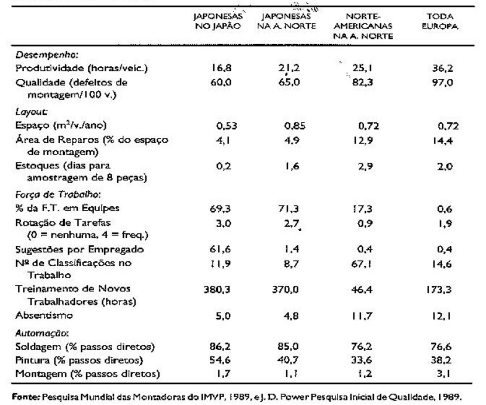
The relationship of ergonomics in lean production can be observed in Figure 1 that the rate of absenteeism of Japanese companies is lower than the European and North American, it is arguable that there was action for this reduction. Within this line as Womack et al (1990) summarizes several indicators as well as yield and quality of the current performance, the assembly activity of the large producers. It's amazing the difference between the average performance of Japanese and Americans and Europeans, the size of areas needed repair, the percentage of workers in teams, suggestions, and the amount of training given to new workers in the assembly.
Figure 1: Characteristics of Japanese automakers, North American and Europe – 1989 (From: The Machine That Changed the
World.)
Two important comparisons between the systems and lean mass is what the authors said Womack, et al (1990), in the old mass-production factories, managers were hiding information about the condition of the factory, because they have such knowledge to the key its power. In a lean factory as Takaoka, all information - daily production targets, cars built to date, equipment breakdowns, personnel shortages, overtime requirements that are displayed in frames andon (electronic boards bright) visible in all seasons the factory.
No doubt it is important to analyze the lean system has resulted in a great company it is important to adopt an er- gonomic program, they complement each other. According Balbinotti, (2003), the dissatisfaction of people at work, often neglected or unknown, arising from a mismatch between the content of an ergonomic work to men.
The methodology and the bases of a lean production systems, according to Martins et al (2006), the term kaizen is formed from KAI, which means changing, and ZEN, which stands for the better. Kaizen has expanded to an organi- zational philosophy and behavior, a culture focused on continuous improvement focusing on eliminating waste in all systems in an organization and involves application of two elements in the improvement, understood as a change for the better and continuity understood as acts as a permanent change. Thus, there should be a single day without some improvement in the company.
The Kaizen philosophy is the key to success of organizations to ensure competitiveness, as defined Masaki Imai (1994), "Kaizen, the Key to Success", ie continuous improvement in their personal, domestic, social and profes- sional. When applied to work or say, the improvement that involves everyone. KAIZEN, business strategy involves everyone in an organization working to make improvements with low or no investment. with KAIZEN, an involved leadership guides people to improve the ability to meet expectations continuously high quality and delivery time.
Another important aspect that says Martins et al (2006), kaizen management philosophy can be applied in specific parts of the targeted organization, such as Kaizen project: to develop new concepts for new products, Kaizen plan- ning: developing a planning system for both production to finance or marketing, manufacturing and Kaizen: devel- oping actions that aim to eliminate waste in the factory-floor and improve the comfort and safety.
According to Matthew (2007) Kaizen aims to develop curiosity and creativity of people and direct them to the process of adding value to customers. Kaizen is not an attempt to light a fire under people, Kaizen turns the light on inside people. Know that the bottom Kaizen is about people. People who are not businesses innovate. You must change attitudes for Kaizen to work, which requires a great commitment and a long time, and much study.
In the methodology of kaizen can not forget the concept value-added productivity, and informs Balbinotti (2003), in a company that seeks to produce more and better with less, always increase the effectiveness (purpose) and effi- ciency (means) should be concerned as quality planning (setting new standards) and the maintenance of quality (en- suring compliance with the standards) with the quality improvement (continuous improvement). This means that increasing quality and reducing costs increases the value, through the concept of total quality, which means satisfac- tion for all.
The organizations work with people that influence productivity and can increase the value of the organization, ac- cording Balbinotti (2003), people influencing productivity, productivity change, productivity depends on the perfor- mance of people. The performance by changing the productivity of people, puts us in direct contact with the er- gonomic issue is evident and the contribution of ergonomics in this context, since the ergonomics seeking better working conditions, so that work can be developed without the reduction of health of workers and therefore with lower rates of absenteeism and turnover, and this contributes to reduced productivity.
The vision of the organization is to increase financial productivity through Kaizen methodology is possible with the applicability of the job , turning a profitable ergonomic program for the organization, as the editorial comments of Applied Ergonomics , addressing the cost effectiveness of ergonomic Stanton and Baber (2003 ), mention that one of the classic studies of cost effectiveness of ergonomics , occurred in the 70s , came from the brake light device placed in the center and top of the bumper cars ( McKnight and Shinar , 1992 ; Akerboom , et al , 1993). This type of place- ment brake light offers cognitive advantages over conventional brake lights. Later studies showed that costs were small ($ 10 per car) and much higher benefits (estimated at around U.S. $ 900 million annual savings) than had been anticipated . The authors regret that not all interventions are so clear justification.
Many organizations do not deploy an ergonomic software within organizations for not observing financial vatangem, as MacLeod (2003) argues about the difficulty of estimating the financial benefits of ergonomic interventions. Any considerations around broad issues of effectiveness and ergonomics in particular mentions that ergonomics is not technology per se, it will enable the expected benefits. For this, MacLeod develops the concept of "fitness-for-pur- pose", in which the usefulness of a system is the degree to which this achieves the objectives of usability, reliability, and performance. MacLeod does not have a financial worksheet to the ergonomics, arguing that the costs of er- gonomic interventions are usually insignificant compared to the total cost of operations.
Beevis (2003) reissue his 1970 article, updating the issues, and points out difficulties in identifying the benefits that may occur because of some of these benefits are invisible. He suggests that in organizations where managers are in- different to the problem, you may need a model of "business case" providing for the economic viability of the pro- posed intervention, to convince them of the need to invest. What is different from the organization "venture into the dark" with the costs of the intervention, for, after the fact, to prove that the ergonomic intervention was feasible.
As noted, there are important contributions and ergonomists have a useful basis to build a business case for er- gonomics interventions knowledge. Visas cases suggest that the costs of involvement and ergonomic intervention tend to be a small fraction of the total budget. The intervention costs fi Guram about 1% to 12% (Hendrick, 2003), which are located in payback periods with 6 to 18 months (OXENBURGH, 2004). What is a very optimistic picture for Ergonomics.
As shown in the literature, there is a wide range from difficulty in developing a business case model, more elaborate, other qualitative approaches to spreadsheet. Anyway, all contributions help to confirm that interventions Ergonomics offer considerable benefits to the organization in question, including quantifiable financial results.
METHODOLOGY
The research presented was applied in an auto factory in Paraná, Brazil, the company works with the lean production system based on Toyota production system, the system is being used for almost 10 years. Ergonomics is part of this system to obtain results, and since the implementation of the company achieved many improvements in working conditions, as will be presented in the discussion of results. The foundations of this system are: 5 'S: the application of the 5's of Japanese origin (Seiri, Seiton, Seiso, Seiketsu and Shitsuke) Apply the 5's will re- duce waste, and jobs organized will reduce the offsets, improving safety, improving motivation of teams with a pleasant working environment, with the 5'S is possible to improve equipment performance.
Dexterity : is learning the operation of the workplace through training. The field of Dexterity allows the repeatability of gestures, which reduces the dispersion of implementation and the risks of non-quality, skill favors optimizing op- erations, improving the fluidity of movement. The relationship with the dexterity of ergonomics is the teaching of correct postures through training applied to employees.
Standardization: Standardization is the default operation being the best method of producing at the moment but there is no reason why there is no pattern change. Implementing the standard in the workplace there is the Standard Oper- ating Sheet. The ergonomics is linked to standardization through the development of operational procedures that take into account the know-how and experience.
Ergonomics : the production system, ergonomics is the basis, along with standardization, dexterity and 5's. They are all interlinked so that you have a good working condition for the developer. The goal of ergonomics in this produc- tion system is to ensure the adequacy of the operator (human capabilities) and the jobs or job offers. Improve perfor- mance while preserving the Health Delete musculoskeletal disorders (TMS) related to work and improve the condi- tions under Labor.
Kaizen : This is the subsystem that has a greater connection with the ergonomics, as with continuous improvement or Kaizen ergonomics tends to evolve in the enterprise, making it an improvement in jobs and in most cases to improve the working conditions of developer, who on the increase employee satisfaction and company productivity, obtaining higher results. The subsystem Kaizen is a method based on the cycle SDCA (Standardize, Do, Check and Act) detailing for better understanding, S (Standard) means establishing the best standard for the operation time, D (Do) application form operations effective, C (Check) to observe the operations, find problems, improve posture, improve processes, A (Action) found after the improvements should act.
This is the subsystem that has a greater connection with the ergonomics, as with continuous improvement or Kaizen ergonomics tends to evolve the company, making it an improvement in jobs and in most cases to improve the work- ing conditions of the employee, who forth to increase employee satisfaction and company productivity, achieving better results. The subsystem Kaizen is a method based on the cycle SDCA (Standardize, Do, Check and Act) detail- ing for the best understanding, the S (Standard) means establishing the best standard for the time of operation, D (Do) application form operations effective, C (Check) to observe the operations, find problems, improve posture, im- prove processes, A (Action) found the following improvements should act. There is an important relationship be- tween the PDCA cycle (Plan, Do, Check and Act) and SDCA cycle, SDCA cycle, the method is applied in a stable process for small changes and is PDCA cycle is applied during a improve and / or change. According Balbinotti (2003), Kaizen means of production, reduces the physical effort at the time, through the installation of mechanical assistance, for example, ensuring the proper gesture and poise, as well as the correct use of tools, through plans and also skills development for managers, aimed at leadership in the animation teams.
The methodology is based on the organization conduct a study of 1 day and a half in a particular area , should create a working group with staff specialists in various areas of the organization as quality , performance , manufacturing labor , manufacturing supervisor engineer , logistics , the pilot should be the area manager who will coordinate all work besides this working group should conduct a pre -observation with the group and identify items that add value to the product and do not add value by performing a table listing this item after the whole group should perform ob- servation in work stations with different characteristic alternately that lasts around 4 hours using a table as the exam- ple 1 , and identify waste into raw materials , steps , employee downtime , gestures not simultaneous , waste of space , saving moves in line border with parts and mainly enhancements movements critical positions.
Exemple 1 : Table used observation of activities, value-added and non value-added
The Working Group shall conduct a closure compilation of data on each item observed an action plan with defined term will be held, as can be seen in Table 1, in 2013 were conducted in 4 areas and desmontra the results of this methodology.
Quality Control: For quality control, or better, quality management, relies on some tools to deal with quality or er- gonomic problems, a method is the Qc-story (method of problem solving), the 7 quality tools (Pareto Diagram, Cause and effect diagrams, histograms, check sheets, scatter charts and control charts). Ergonomics has a relation- ship that through these tools is necessary to address problems with ergonomics.
Performance Management of Resources: serves to avoid problems with equipment, being necessary to perform pre- ventive maintenance. The TPM is aimed at reducing and avoiding any loss of production-related equipment that could break. Ergonomics can follow this performance with the means to identify critical points for a man to avoid accidents.
Guidelines for the Management: is a management system that allows you to Target all efforts and resources on one goal to success for the company. Based on strategic planning, identifying the organization's targets, according to Fal- coni (1997), is a subsystem of TQM (Total Quality Management) and facing competition not only includes the im- provement of existing products and processes, but mainly the innovation represented by new technologies.
The lean production system is based on Japanese tools to reach excellence in everyday life, aims to ensure the qual- ity demanded by customers, reduce costs, produce the required products and be responsible and respect the man.
RESULTS
This survey was conducted in an automobile, which has about 6.000 employees and 3.000 employees of partners. To analyze the company's results, we applied a form to identify the knowledge level of the lean production system and what the relationship with the ergonomics program implemented in the company. The form with 12 questions, 3 of 9 closed and opened to identify the views of officials in the relationship between ergonomic factors and work conditions and production system of the organization. This form was administered to 10 employees, that is Manufacture 4, Human Resources 2, Quality Control 1, Logistics 1, Performance 1 and 1 Communications Department.
Most of the survey was answered by the area of production, and even be the largest public company and where the lean system is more powerful. It was observed that there is a difference between the concept of lean production system and system of mass production among company employees, of the 10 employees of eight research think the company is using lean production and two mass production. The Graphic 1 the results in graphic form (closed questions) and feedback sequence divided by area.
6
5
5
4
4
3
3
2
2
1
1
0 0
Kaizen Dexterity 5'S Standardization Poka Yoke Qc Story Graphic 1 Question about the degree of importance of the tools that support ergonomics.
We can see through the Graphic 1 that the kaizen, Dextery, and 5's are really the most striking evidence for the relationship with the ergonomics. The following are the main comments from employees.
Another important aspect of the research is what would be the challenge of the organization to implement an ergonomic program, and 100% of respondents reported they would be the ROI - Return on investment in the planning phase should carry out the planning of activities and jobs, hires professionals and calculate what the financial return to the organization through this investment.
Taking into account the financial gain, was addressed in research on financial gains which the organization can get when deploying Kaizen implemented a program to improve working conditions, with 5 being most important and 1 minor, as noted in the chart below.
Graphic 2: Level gains importance with methodology applying Kaizen
The important point in the graph above was elimination of accidents and reducing absenteeism are major indicators that the organization may apply the Kaizen methodology in ergonomics, and reducing accidents and absenteeism, the organization will have financial gains, the main factor is not paying salary benefits to employees outside the company without productivity, and health care organization shall provide that.
Just below there are viewpoints of employees related to the subject, which is adding to the result of this article.
Viewpoint of Human Resources: In the better ergonomic design of the workplace (ergonomics in design), or better, are suited to the employee (ergonomics series, correction of problems), the likelihood of having products with best quality is higher, in order to decrease the physical and psychological operator allowing better perform the activity of the job. With regard to what has been predictable as, for example, occupational diseases, more specifically on musculoskeletal disorders, guidelines and actions to ergonomics are essential for improving QWL (quality of work life) and also for reducing the impact on cost for companies facing legal problems.
Viewpoint of the area of Manufacture: The system currently used in all car companies to achieve a high degree of competitiveness and performance, seeking a greater return of profits to the detriment of work in production jobs, to reduce losses and increase productivity with lower labor and possible mainly targeting the most important factor is that the proper treatment of people. Absenteeism has a direct impact with ergonomics, if the operator begins to miss work that can be put in where it performs the operations are no conditions that compromise their posture, causing muscle fatigue and subsequent absence from work.
Viewpoint of the area of Performance Financial: I understand that the lean production system recommends a suitable job for execution of its activity, in addition to 5'S must be ergonomically aligned. When deploying the ergonomics the company will be providing a better quality of life to the contributor (fatigue) will avoid people to depart / prob- lems related to lack of ergonomics at work, avoid future labor actions, with a more favorable job may occur im- provement or even elimination of a quality problem, among others.
It can be seen from the viewpoints of the employees that the company's ergonomic program, has affected several ar- eas of the company, raising awareness about the health of employees. Another important point that all areas have a preventive target to work on, avoiding the risk of accidents in the workplace. A negative point is the research divi- sion of knowledge production system that the company currently works.
DISCUSSION AND CONCLUSION Approach of the case it was found that the company is concerned about the continuous improvement of working conditions for operators, as presented indicators of Human Resources and Quality, listed below:
The company's ergonomic program, the jobs are divided into two types of critical posts and the posts are less critical than with the low level of risk for accidents and muscle problems. The most critical positions where there are medium and/or high likelihood of the employee having trouble muscle. According Balbinotti (2003), ergonomics seeks not only to prevent workers in jobs stressful and/or dangerous, but seeks to put them in the best possible work- ing conditions to avoid accidental injury or excessive fatigue and improve income.
3
2,84 2,54 2,45
3
2,12
2
2
1
G R E A T
1
-
2010 2011 2012 2013
Graphic 3 Index Absenteeism
Absenteeism is the absence of employees in the workplace. It is noticeable that from 2013 the level dropped drasti- cally, with reduction - 74%, many activities were organized to reach this number low. It is important to note in Graphic 2 that the level of absenteeism of Japanese firms that had a lean production system is related to this indica- tor of the company studied.
5
3,94
4
4
3
3
2
2
1,6 1,42 1,12
G R E A T
1
1
-
2010 2011 2012 2013
Graphic 4 Index Accident
The company's accident rate is calculated as the proportion of accidents for the hours worked by employees. The company has reduction more than - 300 % the improvement. This indicator includes all types of accidents with and without leave the company. All efforts to improve the ergonomics and conditions of employment are to prevent and avoid the level of accidents, and the company's goal is equal to zero.
Graphic 5 Critical Workstation(%)
This Graphic demonstrates the company's concern to reduce critical workstation, this positions are the main work stations that cause removal restriction of work, each of which is restricted away or an operator more than the organization must contract to supply the activity of this employee. It is noticeable reduction of 28% of the critical positions of the company, the company's ergonomic program responsible for this improvement.
2,66 2,7 2,6 2,47 2,5
2,4
2,26 2,26
2,3
G R E A T 2,2 2,1 2,0
2010 2011 2012 2013
Graphic 6 Performance Production
The Graphic 6 shows the level of performance of the company to produce more at lower cost and less resource as possible. The company have reduction – 16%. This indicator is important for productivity in relation to competitiveness, productivity is mainly defined as the ratio between output and factors of production used, competitiveness involves obtaining greater competitive advantage, or be the best at what it produces. When working on Ergonomics and working conditions of employees to search for productivity is achieved, it is noticeable that in recent years the company aims to improve working conditions and consequently increase the productivity of employees.
It is the indicator that measures the percentage of cars that can carry all the way from the assembly line without the need to be taken off line to perform rework. As said Womack, et all (1990). Lean producers, in turn, openly aspire to perfection, always declining costs, absence of defective items, no stock and a myriad of new products. Another aspect seen in Figure 1 of the authors' analysis is the quality level of the industries that lean production system has, always striving for perfection and when comparing with the result is visible to the search company in terms of perfection in product quality.
According to research presented, it is possible to observe that today there is a high level of concern about the quality of working life in business, because people are not worried about their own health, only when problems arise and this will be bad for both company and the employee because the employee will have to move away due to health problem, and the company will lose one of its employees, which in turn will have to hire another employee and training him, thereby generating cost more to the company.
As presented in Table 1 it is apparent that with implementation of Kaizen methodology, besides gains physical space and raw materials, it is possible to improve the process with movements, steps and gestures of amplitude difficult, it was possible to reduce the critical jobs to post light, and the organization may have financial gains, as will be reducing levels of accidents and absenteeism levels, reducing these indicators the organization does not have staff away, therefore you do not need to hire temporary staff to replace absent, plus costs medical assistance. You can check through this research that applying the Kaizen methodology in the organization, on behalf of ergonomics and consequently reduces waste organization, bringing financial gains primarily with gains in labor costs and with retired.
Just as some studies have already proposed the same argument in this article, other issues could be improved and enhanced with the topics discussed, aiming at the real situations of the working environment.
REFERENCES
Automotive industry documentation, 2013. Curitiba, Brazil. Balbinotti Giles. 2003, A Ergonomia como Princípio e Prática nas Empresas, 1º Edição. Curitiba: Editor Gênesis. Beevis, D.; Slade, I. M.. Ergonomics-costs and benefi ts. Appl. Ergon. 1, 1970, p. 79-84. Campos, V. Falconi 1997, Gerenciamento pelas Diretrizes, Belo Horizonte: Fundação Christiano Ottoni. Hendrick, Hal W.. Measuring the Economic Benefi ts of Ergonomics Error Analysis, Inc., USA, 1997 IEA – International Ergonomics Association, Retrieved May 02, 2007, from: http://www.iea.cc . Imai, Masaaki. Kaizen, A estratégia para o sucesso competitivo. São Paulo: Editora Imam, 1994. Iudicibus, Sérgio de. A gestão estratégica de custos e a sua interface com a contabilidade gerencial e a teoria da contabilidade: uma análise sucinta. Conferencias nos anais do IV CONGRESSO INTERNACIONAL DE CUSTOS e II CONGRESSO BRASILEIRO DE GESTÃO ESTRATÉGICA DE CUSTOS. São Paulo, SP, 1995. Macleod, Iain S.. Real-world effectiveness of Ergonomic methods, p. 465-477, v. 34, Issue 5, September, 2003, Applied
Ergonomics Elsevier Ltd. Martins, Petrônio G. E Laugeni, Fernando Piero. 2006, Administração da Produção. São Paulo: Editora Saraiva.
Proceedings of the 5th International Conference on Applied Human Factors and Ergonomics AHFE 2014, Kraków, Poland 19- 23 July 2014 Edited by T. Ahram, W. Karwowski and T. Marek
Matthew E. May. 2007, Toyota A formula da Inovação. Rio de Janeiro: Editora Campus. Mcknight, A.J.; Shinar, D.. Brake reaction time to center high-mounted stop lamps on vans and trucks Human Factors 34, p.205-213, 1992. NR 17 Ergonomia. Normas Regulamentadoras do Ministério do Trabalho e Emprego. Oxenburgh, Maurice S.. “Cost Benefi t Analysis of Ergonomics Programs.” 150 AIHA JOURNAL (58)
February, 1997. Stantion, Neville A.; BABER, Christopher. On the cost-effectiveness of ergonomics, p. 407-411, v. 34, Issue 5, September, 2003, Applied Ergonomics Elsevier Ltd. Womack, J. P. e Jones, D. T. A. 1990, A Maquina que Mudou o Mundo, Rio de Janeiro: Editora Campus. Womack, J. P. e Jones, D. T. A. 2004, Mentalidade Enxuta nas Empresas. Rio de Janeiro: Editora Campus.
LISTED IN THE AHFE DIGITAL BOOKSTORE CATALOGUE
Explore the complete digital volume
Advances in Ergonomics In Design, Usability & Special Populations: Part II
Read this individual research paper free through the original publisher, or explore the full digital proceedings book.
ISBN 978-1-4951-2107-4
Explore this ISBN in the AHFE Bookstore ↗Listed in the July 2026 bookstore catalogue; search by ISBN to confirm current availability · Digital book purchase optional