Cristina Salvador, Tuong Quyen Vu (2023). Ergonomics in Classroom Furniture for Primary School Children in Vietnam. In: Ergonomics In Design. AHFE Open Access, vol. 77, pp. 458–465. https://doi.org/10.54941/ahfe1003404
This paper reports a study in the context of a product design research about classroom furniture in Vietnam and is based on the review of literature. The objective of the research project is to help improve Vietnamese children's well-being, developing a proposal of classroom furniture more adapted to primary school children, using local materials and production processes, reducing carbon footprint and contributing to sustainability. In this Southeast Asian country, children spend a long time at school, daily, performing a lot of different activities and are still experiencing non-suitable classroom furniture, leading to wrong posture, posing safety risks and possibly harming their present and future health. Sustainability also seems to be overlooked, as the application of materials with less environmental impact is not a priority. The study helped on the contextualization and definition of the problem, providing information about the status quo in Vietnamese primary schools' furniture and pointed directions on this research project, towards more sustainable choices on materials, such as bamboo and its production processes. Adaptation to the Child is an aim in both health and environmental levels. Children's well-being at school depends on the interaction and comfort with their surroundings, including adapted and sustainable classroom furniture, which can support a healthier learning experience.
On Western societies, in the last 100 years, there has been a concern on adapting classroom furniture to the Child (Müller & Schneider, 2011). Ergonomic studies and anthropometric data helped designers and produ- cers evolve on that path. In Southeast Asia, specifically in Vietnam, children spend a long time at school daily and are still experiencing non-suitable classroom furniture, despite the Government’s efforts to enhance economical development and fight illiteracy (Quyen et al., 2023).
This research project intends to provide flexible and suitable solutions for classroom furniture, taking into account ergonomic adaptability to Vietna- mese primary school children (aged 6-10), specially in under-developed areas. Long-term exposure to inappropriate classroom furniture may affect their physical development in the future. The main overall objective is to create
Ergonomics in Classroom Furniture for Primary School Children 459
a more adapted learning space for primary school children, contributing to their well-being and motivation. One of our goals is also to provide more sustainable solutions with less carbon footprint, as Sustainability plays an important role in this research project.
This paper reports a study based on the review of literature, searching for information on child development in Vietnam and classroom furniture in Vietnamese public primary schools, addressing questions regarding sustai- nability in classroom furniture: searching for local, durable materials and simplified production processes, not overlooking environmental impact.
CHILDREN AND SCHOOL IN VIETNAM After 1975, Vietnam focused on industrial development, so after many deca- des of war and poverty, there has been a rising economic growth. According to Giay, the average height of Vietnamese adults measured in 1938 was: Male - 160 cm; Female - 151 cm. For nearly 50 years (1938-1985), the height of young Vietnamese people experienced a decrease. Vietnam had to endure great poverty and famine during the last years of World War II, with a record of 1 million deaths (Huff, 2019). This caused an arm-length redu- ction of 1.1–1.7 cm, height reduction of 3.4–5 cm, and weight reduction of 4.7–6.9 kg. Also causing around 3 percent literacy reduction, lower house- hold incomes and 4.9%–7.2% reduction in school participation among the survivors’ children, impacting social mobility and raising inequality (Guven et al., 2021). Nutrition transition along with the economical development of the last decades enhanced differences in children’s weight between rural and urban communities, with health risks (Van Leirop et al., 2008). Studies also pointed to premature introduction of complementary feeding instead of exclusive breast-feeding to play a role in poorer nutritional status, wea- ker immune system and retarding children’s growth in Vietnam (Hop et al., 2000). Primary school in Vietnam is a 5-year programme and compulsory subjects will be taught up to 4 hours a day. On average, a 1st grade student has a sch- edule from 07:30 or 08:30 a.m. to 04:25 p.m., Monday to Friday and for 4th and 5th graders, also on Saturday mornings (MOET, 2023). Children need to perform a lot of different activities in the same space with the same furniture: they study, eat and sleep after lunch on their desks/tables. In the beginning of the 21st century, the gaps between school facilities and equipment in urban and poorer rural areas were evident (Aikman & Pridmore, 2001). In rural areas with fewer children, the class is often multigraded, which means there are age and dimension gaps between children in the same class and they are using the same furniture and equipment, which cannot be adapted.
Classroom Furniture Classroom furniture design should encourage the activeness and mobility of users and be suitable for their psychological, cognitive, physical and social factors (Domljan et al., 2010). Stamenkoviˇc (2018) addresses the conseque- nces of prolonged sitting, which are related to the musculoskeletal system - unsuitable posture, weak muscles, shoulder pain, stiff neck, headache, back
460 Salvador and Vu
and arm pain, lower back pain, shoulder, coccyx and leg pain, dizziness, fatigue (Kaya et al., 2019).
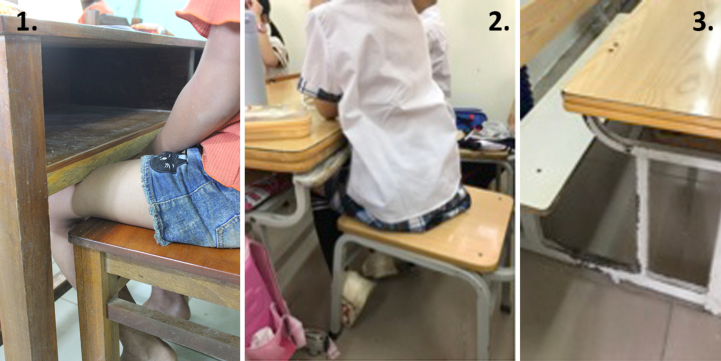
Children’s anthropometric data may not have been considered in the current classroom furniture design, because previous studies in public Vie- tnamese schools (Quyen et al., 2023) concluded classroom tables and chairs are often too high, wrongfully positioned and attached to each other, leaving feet hanging and not providing enough leg space. The existing desk shelves restrict leg space even more. Children lean down on the tables and do not use backrests.
Mismatches like these may force students to sit in unsuitable or restri- ctive positions (Shan et al., 2017). Also tables are unsuitable for sleep, too high and too small for children, leading to safety risks as possible fall and injury.
The use of vegetable source materials, such as wood, can be beneficial in Design and Architecture as the contact with nature in general, brings advantages to human health (Salvador, 2019a), including in the classroom environment, helping reduce students’ stress levels. It has been observed that solid wood is still used in old classroom furniture in some areas in Vie- tnam. Trees in general need a lot of time to grow and deforestation is an issue, thus the solid wood furniture was quite heavy and difficult to move. MDF coated with plastic (melamine - a thermoset polymer) is replacing solid wood tabletops. Metallic structures (painted steel/iron) have become cur- rent in classroom furniture. In this tropical climate, with a lot of humidity, pathologies of the material are evident, with oxidation and corrosion (see Figure 1).
An ergonomic analysis of classroom furniture on this research should also address other factors beyond possible health and safety risks provided by dimension, form and function issues. Sustainability is also key on the subject of classroom furniture development, namely on the choice of materials - its environmental impact and its durability.
Figure 1: A Luoi public school, Vietnam. 2 and 3: Viet Hung public school, Vietnam.
Ergonomics in Classroom Furniture for Primary School Children 461
SUSTAINABILITY - MATERIALS AND PROCESSES Sustainability is gaining relevance as an environmental and social challenge (EU Science Hub, 2023), becoming a long term goal for contemporary soci- ety. Sustainable development is a path to achieve that goal. In general, it implies wealth creation and, at the same time, life quality improvement, whilst protecting the environment. It is defined by economists as the non-loss of wealth from one generation to the next, in quantity and quality. It requires a long-term perspective, in which it is possible to create suitable living con- ditions, preserving environmental resources with efficiency criteria, within a global ecological system. This aim must be a shared responsibility, requi- ring effective partnerships and collaborations between industry, governments, environmental organizations and academia (Hale & Lachowicz, 1998).
In the last decades we could observe an unprecedented population explo- sion, also due to life-quality improvements, advances of science and techno- logy. This leads to a greater demand for manufactured goods. Research on alternative materials, which do not cause great environmental impacts and are reusable, is necessary. Product life cycle assessment (LCA) is a way to help users and manufacturers assess the environmental impact of the mate- rials they choose. The LCA analyses the effects on the environment by use of resources (inputs) and emissions created by a given process (outputs). The cycle is divided in 5 steps: Pre-production - Raw material; Processing; Tran- sport - Logistics; Use; Waste, Recycling, Reusing (Salvador, 2019b). On the production of sustainable objects, namely furniture, besides the choice of raw material, simplified manufacturing processes using less resources and reducing emissions are quite important (Papanek, 1995).
The aim of this research is also to identify local, suitable, environmentally friendly materials with relatively low cost. With tropical forest ecosystems of high diversity (Van Khuc et al., 2018), Vietnamese forests have endured a transition from net deforestation to net reforestation since the 1990s. In the beginning of the 21st century, Vietnam still had a big tree cover loss. Forest regrowth in Vietnam was not due to a single policy but to a combination of economic/political policies for forest and land scarcity, economic growth and market integration (Meyfroidt & Lambin, 2008).
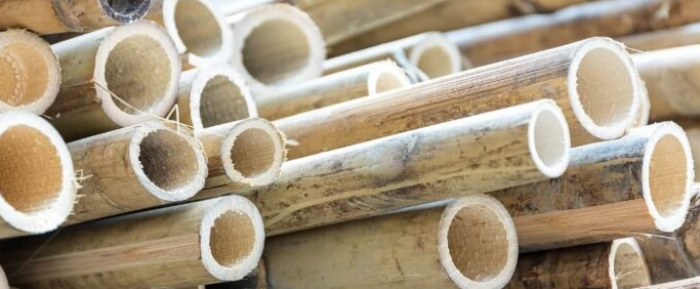
Bamboo Bamboo is one of the most abundant vegetable source materials in Vietnam, along with rattan - a strong, flexible, lightweight and durable vine. Bam- boo is a plant traditionally grown across continents and used in different cultures, described 1500 years ago by Kaizhi as “not grass nor wood, and not strong nor tender” (see Figure 2). There are more than 1600 woody and herbaceous species worldwide (Vorontsova et al. 2016) and the ideal envi- ronment for natural growth is a tropical climate with high temperature and humidity (Thuy et al. 2021). In addition to its fast growth, bamboo does not need much watering and pesticides, therefore, fewer resources are used, less environmental impact is made and production costs are lower, compared to other vegetable source materials, making it an environmentally friendly material used in Design and Architecture (Nguyen, 2018).
462 Salvador and Vu
Figure 2: Lung bamboo (Bambusa longissima) from Nghe An province, Vietnam.
According to the Vietnamese General Office of Forestry, there are 14.6 million hectares of forest, including 10.3 million hectares of natural forest and 4.3 million hectares of replanted forest. The bamboo growing area is 1.46 million hectares of bamboo. Provinces of Nghe An (51%) and Thanh Hoa (44%) hold the largest bamboo forest areas in the North Central Coast Region, with 95% of the total region’s bamboo forest area (Phuong & Xuan, 2020). Lung bamboo (Bambusa longissima) is the main bamboo species used in handicraft, collected from natural forests in Nghe An province and luong bamboo (Dendrocalamus barbatus) is the main resource for bamboo-based panels production in Thanh Hoa province. The cost of bamboo in the last province is half that of Anji province, in China. Bamboo harvest is worth the investment because every part of the plant may be economically viable. Bamboo shoots have high nutritional value, fresh bamboo leaves are used as cake wrapping materials and dry bamboo leaves are used as organic fertilizer. Bamboo stems are used as construction, furniture and handicrafts’ materials and bamboo roots are used as fuel (THBamboo, 2023).
In recent years, the combination of new technology and traditional tech- niques has been an inspiring development for both craftsmen and customers, which apply the practical qualities of bamboo to the challenges of sustaina- bility (Li et al., 2022). Bamboo can be stronger compared to timber but it is hollow, sometimes with small diameters, biodegradable, flammable in untre- ated conditions and with variable physical and mechanical properties (Shukla et al., 2022). Some factors that make it more environmentally friendly, also play a role in its strength and durability. The development of bamboo-based composite materials is a response to those challenges. After harvesting, the stems are sawed and can be flattened, cut, bended or split into strips. After radial plitting, these strips can be used for the manufacture of laminated pie- ces as scrimber boards or stocks, with cold or hot pressing (Huang et al., 2019). The process requires synthetic resins, which can be thermoset as mela- mine, but there are studies about the LCA of bamboo products in Vietnam stating the carbon footprint and eco-costs of bamboo-based panels for con- struction are much lower than non-renewable source materials, including
Ergonomics in Classroom Furniture for Primary School Children 463
plastics and metals (Phuong & Xuan, 2020). So the use of bamboo-based products has positive environmental impacts in climate change mitigation, compared to other materials. Nonetheless, the reduction of emissions of these production processes could be made with more energy efficiency, reduction of carbon emissions during transport and reduction of application of synth- etic resins. For construction and furniture processing, there is a traditional treatment, where bamboo can be heated to bend it to the desired shape, later soaked in muddy water to reduce sugar content and prevent insect infestation (Evans, 2015). Finally, bamboo can be smoke-dried, forming a carbonised layer on its surface to ensure strength and durability. Rattan fibre-tied joints and bamboo nails could also be applicable low-tech solutions, preventing the use of synthetic resin or glue and metallic or plastic elements.
CONCLUSION
The adaptation of classroom furniture to primary school children in Vietnam is an aim in both health and environmental levels on this research project. Decades ago, this country was considered one of the poorest in the world. The famine Vietnamese people endured, left scars on child development, impa- cting the body dimensions of following generations. Classroom furniture in use reveals clear mismatches with children’s dimensions and doesn’t reflect concerns on sustainability and environmental impact. This study addressed local renewable source materials, namely bamboo, which is highly present in several Vietnamese provinces. Searching for a structural material for the classroom furniture project, it was concluded bamboo is a strong possibi- lity with sustainable harvesting, traditional processing methods and reduced environmental impact, when comparing bamboo-based laminated boards to metals and plastics - materials used on the existing equipment in Vietnam. Children’s well-being and learning experience at school on adapted furniture depends on the interaction and comfort with their surroundings, but also with a sustainable environment.
ACKNOWLEDGEMENT
Without the support of the University of Lisbon, Lisbon’s School of Archite- cture, CIAUD - Research Centre in Architecture, Urbanism and Design, Por- tugal, this study wouldn’t be possible. This work is financed by national funds through FCT - Fundação para a Ciência e Tecnologia, I.P., under the Strategic Project with the references UIDB/04008/2020 and UIDP/04008/2020.
REFERENCES
Aikman, S., Pridmore P. (2001). Multigrade schooling in ‘remote’ areas of Vietnam. International Journal of Educational Development 21. Elsevier Science. pp. 521-536. Domljan, D. et al. (2010). Pupils’ working postures in primary school classrooms.
Periodicum Biologorum Vol. 112 No 1. March 2010, pp. 39–45.
464 Salvador and Vu
Evans, G. (2015). Bamboo modern: Indochine cafe by Vo Trong Nghia in Vietnam.
Architectural Review. Dec. 2, 2015. Website: https://www.architectural-review.c om/awards/ar-emerging/bamboo-modern-indochine-cafe-by-vo-trong-nghia-in- vietnam EU Science Hub (April 28, 2023). Green Transitions. Shaping the green transitions for a sustainable and fair Europe. Website: https://joint-research-centre.ec.europ a.eu/jrc-science-and-knowledge-activities/green-transitions_en Guven C. et al. (2021). Long-term effects of malnutrition on early-life famine
survivors and their offspring: New evidence from the Great Vietnam Famine 1944–45, Health Economics, John Wiley & Sons, Ltd., vol. 30(7), pp. 1600–1627, July. Hale, M., Lachowicz, M. 1998. The environment, employment and sustainable development, Londres: Routledge. Hop, L. et al. (2000). Premature Complementary Feeding Is Associated with Poorer
Growth of Vietnamese Children, The Journal of Nutrition, Volume 130, Issue 11, November 2000, Pages 2683–2690. Huang, Y., et al. (2019). Development of bamboo scrimber: a literature review.
Journal of Wood Science, 65(1) Dec. 2019. Huff, G. (2019). Causes and Consequences of the Great Vietnam Famine, 1944–5.
Economic History Review, 2019, vol. 72 issue 1. pp 286–316. Kaya, N. et al. (2019). MISMATCH BETWEEN CLASSROOM FURNITURE AND STUDENT BODY DIMENSIONS: CASE OF IZMIR. Ergonomi, 2(3) Dec2019, pp 167–177. Lin, Z. et al. (2022). Bamboo heat treatments and their effects on bamboo properties.
Construction and Building Materials, Vol. 331, May 2022. Elsevier. Meyfroidt, P, Lambin E. (2008). The causes of the reforestation in Vietnam. Land Use Policy, Vol 25, Issue 2, April 2008. Elsevier. pp. 182–197. MOET (April 27, 2023). Primary education. Ministry of Education and Training.
Vietnam. Website: https://en.moet.gov.vn/education-and-training/Pages/Primary- education.aspx Müller, T., Schneider, R. (2011). Das Klassenzimmer - von Ende des 19. Jahrhunderts bis heute. Tübingen: Wasmuth Verlag. Nguyen, T. (2018). Bamboo - the eco-friendly material – one of the material soluti-
ons of the sustainable interior design in Viet Nam. ESCI 2018. MATEC Web of Conferences 193. EDP Sciences. Papanek, V. 1995. The Green Imperative: Ecology and Ethics in Design and Architecture, Londres, Thames & Hudson. Phuong, T., Xuan, V. (2020). Life Cycle Assessment for Key Bamboo Products in Viet
Nam. Beijing: INBAR. MOET (April 27, 2023). Primary education. Ministry of Education and Training. Vietnam. Website: https://en.moet.gov.vn/education-and -training/Pages/Primary-education.aspx Quyen T. et al. (2023). Comfort in School Furniture for Vietnamese Children, RTD 2022, The 1st International Conference: Resilience by Technology and Design, University of Economics Ho Chi Minh City. UEH: Ho Chi Minh, Vietnam. pp. 56–69. Salvador, C. (2019a). Human Interaction, Emotion and Sustainability: Designing
Wooden Children’s Furniture. In: Rebelo F., Soares M. (eds.) Advances in Ergo- nomics in Design. AHFE 2017. Advances in Intelligent Systems and Computing, vol. 777. Cham: Springer. pp. 599–606.
Ergonomics in Classroom Furniture for Primary School Children 465
Salvador, C. (2019b). Mobiliário doméstico infantil – estudo da sua adequação à criança e à sustentabilidade. Tese de Doutoramento. Repositório de Teses de Doutoramento da Universidade de Lisboa. Shan, L. et al. (2017). Anthropometric evaluation and recommendation for primary
schools classroom furniture design in Perlis 3rd Electronic and Green Materials International Conference (EGM 2017). AIP Conference Proceedings, 1885 (1). AIP Publishing. Shukla, S. et al. (2022). Studies on laminated and scrimber composites produced from thermally modified D. strictus bamboo bonded with melamine-based adhesive. Industrial Crops and Products, Vol. 188, Part A, November 2022. Elsevier. THBamboo (April, 28 2023). VIETNAM BAMBOO PROCESSING DEVELO-
PMENT. THBamboo Blog. Website: https://thbamboo.com.vn/vietnam-bamboo -processing-development-342511 Thuy, V. et al. (2021). Status of bamboos in Binh Duong province, Vietnam: Distribution, species diversity, conservation and utilization. Trees, Forests and People, Vol 6, Dec2012. Elsevier. Van Leirop, A. et al. (2008). Regional clustering of anthropometric dimensions of
primary school children in rural and suburban Vietnam. Asia Pacific Journal of Clinical Nutrition. Dec2008, Vol. 17, issue 4, pp. 603–607. Van Khuc, Q. et al. (2018). Drivers of deforestation and forest degradation in Vietnam: An exploratory analysis at the national level. Forest Policy and Economics, Vol. 90, May2018. Elsevier, pp. 128–141. Vorontsova, M. et al. (2016). World Checklist of Bamboos and Rattans. INBAR
technical Report. no 37, Dec. 2016. Kew: INBAR.
LISTED IN THE AHFE DIGITAL BOOKSTORE CATALOGUE
Explore the complete digital volume
Ergonomics In Design
Read this individual research paper free through the original publisher, or explore the full digital proceedings book.
ISBN 978-1-958651-53-7
Explore this ISBN in the AHFE Bookstore ↗Listed in the July 2026 bookstore catalogue; search by ISBN to confirm current availability · Digital book purchase optional