Shuo-Fang Liu, Jiahao Cai (2023). 'The feasibility of Salutogenic Theory in product design. In: Ergonomics In Design. AHFE Open Access, vol. 77, pp. 843–850. https://doi.org/10.54941/ahfe1003445
With the four industrial revolutions, human social behavior and needs have grown and changed at a high rate. Design also continues to differentiate and evolve with human needs. In terms of product ergonomics, it can be divided into two important research directions: human mental perception of products and the physiological impact of products on people. However, current systems and basic concepts of product design methods lack the role and impact of cognitive processing on human perception and emotion.This paper we are discussing the area of mental cognition of products. From the perspective of cognitive ergonomics, it involves human mental processes such as perception, memory, reasoning, and motor response. For the elements of cognitive human factors engineering. In 1988, Norman proposed three design levels corresponding to cognitive psychology in product de-sign, including instinctive design level, behavioral design level, and reflective design level. The instinctive design level is very much associated with the image of the product itself, the behavioral design level corresponds to the functional use and interaction of the product, and the reflective design level corresponds to the spiritual and psychological needs of human be-ings(Norman, 1988). Human perception has influence on human psychology, and the relationship between psychological perception and health is highly relevant.In 1993, Antonovsky proposed the 6C theory and Salutogenic theory, arguing that human perception has a strong correlation with health, where health is identified as the ability of an individual to adapt physically and mental-ly and self-manage in the face of event stress, maintain dynamic calm and restore personal balance. 6C theory includes complexity, conflict, confusion, sense of coherence (SOC), civility, and coercion. The 6C's describe the different behavioral choices we can make to promote health in the face of stressors in our social system of existence and health. The interaction and use of the product can correspond to the six items of the 6C's theory, whether or not the cognition of the product and the difficulty of using the system create complexity, and complexity can create conflict, and the cognitive behavior of the designer and the cognitive behavior of the user may not always be consistent. The core of Salutogenic is the sense of coherence, and the sense of coherence (SOC) divides the world into three levels at the cognitive level: comprehensible, manageable, and meaningful. By comparing and analyzing the papers, Salutogenic and Norman's psycho-cognitive frameworks are highly relevant. The purpose of this paper is to explore whether people's perceptions of products can contribute to their health. The validity of the questionnaire items was verified by deforming Salutogenic's 29-item SOC Life Questionnaire from assessing individuals' perceptions of different elements of the product, conducting a questionnaire survey, and finally collecting data for testing. The feasibility of applying health promotion theory to product design was assessed to create the concept of healthful product design and the evaluation form of healthful product design.
With the progress and development of production, people’s needs and beh- aviors are highly developed and changed. At the same time, design is also constantly differentiated and developed. In terms of product ergonomics and human health, it is divided into two important research directions: the psychological impact of people on products and the physiological impact of products on people. However, current systematic and fundamental concepts of product design methods lack the role and impact of cognitive processes on human perception and emotion.
Method
In this paper, a literature review is conducted to review and summarize the relevant issues and integrate the relevance.
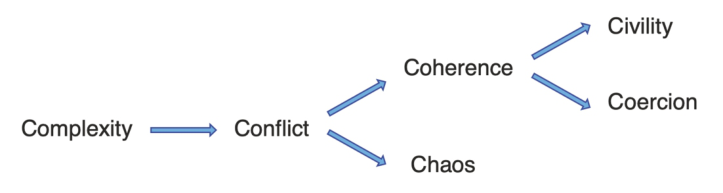
6C&Salutogenic Theory In 1993 Antonovsky proposed the 6 C’s theory at the Social Science and Medicine Symposium, where the 6 C’s refer to complexity, conflict, chaos, coherence, coercion and civility, looking at the structure of health from the social science field, where the concept of health refers to the notion of maintaining a dynamic balance in society. The 6Cs are structured by the com- plexity of the system, the occurrence of contradictions that lead to stress, the resolution of chaos and coherence, and the two approaches to coherence, the central point of which is coherence (as shown in Figure 1).
Figure 1: 6C theory (Aaron Antonovsky, 1993a).
COMPLEXITY In modern society, our health operates within a highly complex and ever- changing material-social super-system. Complexity refers to the level of organisation of the system, which sets up problems and provides the potential for sub-systems and super-systems to interact in order to maintain a dynamic state of stability(Aaron Antonovsky, 1993a). The complexity of systems deri- ves from biological evolution as well as the evolution of civilisations, and it is the evolution of culture that not only changes our environment, but also gives humans the complex ability to realise this change, to find ways to understand ourselves and our environment (Aaron Antonovsky, 1993c).
CONFLICT The greater the complexity of the system, the greater the likelihood of conflict, where conflict can be seen as an intrinsic human tension, a ten- sion between people, a tension between an individual and the supersystem to which he belongs, and a tension between these supersystems (Aaron Antonovsky, 1993a).
We can understand conflict from an informational perspective in that humans have sensory organs that receive large amounts of external stimuli, which we take in, disclose, pay attention to, pass on to our perceptual organisation, interpret, and form memories or make decisions (Hawkins & Mothersbaugh, 2010). It is assumed that the more complex the information an individual receives, the greater the likelihood that the information will become noise. The greater the complexity of information in an individual’s
The Feasibility of Salutogenic Theory in Product Design 845
internal processing system, the more difficult it is to integrate the information and the higher the likelihood of confusion in the output. On the other hand, the greater the complexity, the greater the potential for choice, flexibility and adaptive change(Aaron Antonovsky, 1993a).
CHAOS Stress is generated by conflict, and the health effects of stressors, regardless of their proximity, are endless.
Scholars distinguish between two forms of coping with conflict, chaos, which brings about collapse, arbitrariness and confusion, and a sense of coherence (SOC), which is the stressor of coping towards health.
We understand chaos from an informational perspective: all information is noise, noise that hurts and even kills people, and we accept that noise outputs chaotic behaviour. It takes the form of the breakdown of rules, consciousness and responsibility at the family level, the disappearance of structures, and a life full of random, unpredictable and meaningless violence. Admittedly, the choice of chaotic ‘solutions’ has the potential to resolve conflicts, but also to cause harm (Aaron Antonovsky, 1993a).
COHERENCE Another solution, sense of coherence (SOC), refers to the movement of people facing conflict in a highly complex social system that creates confusion and anxiety, but copes with the sources of stress and moves towards a healthy continuum. Sense of coherence is explained in terms of information theory and refers to the core of complex human cognitive processing systems that successfully process information and assemble output signals.
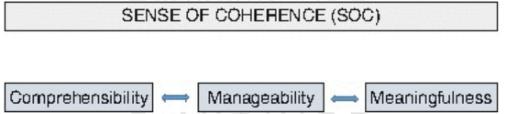
SOC is a capacity that people use to enable them to manage stressful situations, identify and mobilise their own capacities, and facilitate effective responses by finding specific solutions to specific problems (A. Antonovsky, 1979). As shown in Figure 2, the sense of coherence (SOC) cognitive orientation sees the world as more or less comprehensible (cognitive component), mana- geable (instrumental component) and meaningful (motivational component). When dealing with stressors, people with a strong SOC will choose their own strategies to escape or struggle in appropriate situations (Aaron Antonovsky, 1993a). SOC consists of three parts - understandable, manageable, meaningful. SOC is made up of three components - comprehensibility, manageability and meaningfulness.
“Comprehensibility”, or latitude of awareness, is a person’s ability to understand the realities of their life, their context and their current environ- ment. Without this basic knowledge, people are barely able to make the most of their environment or cope with life’s challenges (Golembiewski, 2012).
Manageability’ is the instrumental or behavioural latitude that refers to one’s ability to manage everyday material reality(Golembiewski, 2012; Mit- telmark et al., 2017). Resources are at one’s disposal, rather than one’s
846 Liu and Cai
Figure 2: The original view of coherence and its three dimensions (Aaron Antonovsky, 1987).
control over necessary resources. The individual has a sense of mastery over everyday matters and is able to exercise problem solving effectively. Indivi- duals who are motivated to solve the problems that cause stress, who are willing to invest time and energy in solving the sources of stress, and who find meaning in situations that they can manage, lead to the third latitude of coherence, meaning (Aaron Antonovsky, 1993a; Mittelmark et al., 2017).
COERCION There are many paths to a strong sense of coherence (SOC), and Antono- vsky divides them into two categories, one known as coercive and the other known as civilised. Coercive means that the power of an individual’s own SOC, perhaps accompanied by their rights in the social system and premised on the destruction of the SOC in the system they control and the health of many others, is used to enforce the protection of their own sense of coherence (SOC), resulting in the destruction of the system and the sense of cohere- nce (SOC) of others and leading to chaos, which does not mean that their way is not This does not mean that their approach is unworkable(Aaron Antonovsky, 1993a).
CIVILITY The other path to a strong SOC, civility, is more in line with Antonovsky’s belief that it is the opposite of coercion.
As the foundation of a strong SOC, civility has three core characteristics. Secondly, the constant insistence on respect for others. Thirdly, the reje- ction of domination, oppression and deprivation. Ultimately, a basic rule includes respect for oneself and others, and the achievement of self-interest through the solidarity of like-minded people(Aaron Antonovsky, 1993a) The difference between civility and compulsion lies in respect.
SALUTOGENIC In his research, Antonovsky realised that his focus was not on the origin of any particular illness, but rather on the ‘psychosocial factors that contri- bute to the outcome of illness and the expression of these outcomes’ (Aaron Antonovsky, 1996; Measuring & Antonovsky, 1990).
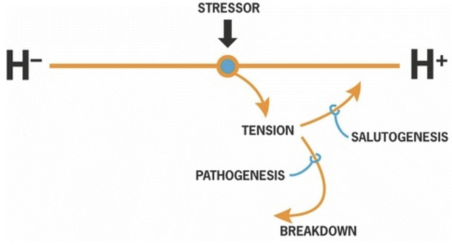
Human health should not be categorised by a dichotomy (as in Figure 3), health should be defined as a way of maintaining a dynamic and stable state
The Feasibility of Salutogenic Theory in Product Design 847
Figure 3: Salutogenic (Aaron Antonovsky, 1996).
under a highly complex social super-system, health is a continuous model and each of us may be in a unique position (Aaron Antonovsky, 1996).
Antonovsky proposed the Salutogenic health promotion framework, which is centred on the sense of coherence (SOC) and involves three levels of awareness: meaningful, comprehensible and manageable. Good emotional, mental and physical well-being is maintained through the ability to adapt to changing life circumstances (Aaron Antonovsky, 1972, 1993b). The opposite is also true - forces that impede adaptability can have an etiological impact on illness. When demands exceed a person’s ability to cope, a person ‘succumbs to disease’ (Aaron Antonovsky, 1972, 1996).
The Salutogenic Health Promotion framework takes a healthful perspe- ctive as it relates to the ability of individuals and populations to increase control over and improve their health and well-being (Aaron Antonovsky, 1996). It is a research model for the study of human health and well-being as it focuses on positive health, creating a coherent living environment, enh- ancing socio-ecological health resources, and strengthening individual and group cohesion (McCoy Michael, 1984; Mittelmark et al., 2017).
PRODUCT DESIGN Product semantics is the study of the symbolic qualities of man-made objects in their context of use, and the application of this knowledge to industrial design (Carbon, 2019; McCoy Michael, 1984).
Most modern design approaches do cover issues related to human intera- ction, but the systems and underlying concepts are lacking in terms of the role and influence of human cognition and emotional-cognitive processing in the design of objects (Carbon, 2019).
Good design results from an understanding of new technologies and psych- ology, so good design must achieve good communication, i.e. the transfer of information between machines and humans (Donald A. Norman, 1988).
Muller & Pasman, 1996, divided the typological model and product design into three main specific correspondence categories, prototype-function, behavioural-typical-use, and solution-typical-form (Muller & Pasman, 1996) (Figure 4).
848 Liu and Cai
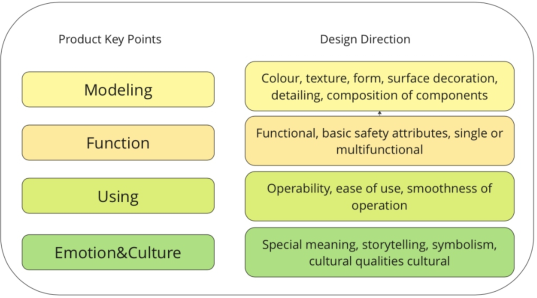
Figure 4: Producy key points & design direction.
1. Prototype-function, product function and product semantics. 2. Behavioral typology - use, which refers to product mechanisms and human factors engineering aspects. 3. Typical-form solutions, where the design of a product’s appearance inclu- des basic modelling principles and color schemes, as well as production and materialrelateIn.
2004, Norman explored human cognition from a psychological perspe- ctive and deduced three levels of product design after Norman proposed three levels of brain thinking:
1. Instinctive level design: refers to the shape of the product’s appearance, which is the user’s instinctive perception of the product, and the insti- nctive design has a direct emotional connection (Donald Arthur Norman, 2004); 2. Behavioural hierarchy: This refers to the functional usability and effi- ciency of the product, as good behavioural design must include four elements: functionality, understanding, practicality and bodily sensation (Donald Arthur Norman, 2004); Reflective design: This refers to the emotional impact that a product has on the user, and determines the overall impact that the user has on the product.
In 2007 Lin proposed another three levels of product design:
1. the tangible level, which includes the attributes of colour, texture, shape, surface decoration, line, detailing and composition of the components, and is the most direct interpretation of the product (Rungtai Lin, 2007) 2. Behavioural level: covering attributes such as functionality, operability, ease of use, safety and integration (Rungtai Lin, 2007) 3. Intangible level: including products with special meanings, product sto- ries, products with emotions, products with cultural characteristics, etc., so that products The product is rich in content, telling its own story and touching consumers(Rungtai Lin, 2007).
The Feasibility of Salutogenic Theory in Product Design 849
In 2003, Leong & Clark proposed a framework for the study of product design, which consists of an external level, an intermediate level and an inter- nal level. In terms of levels, the external level includes: tangible, material; the middle level refers to: the use of behaviour; and the internal level inclu- des: ideological, intangible spirit, with the three levels forming an integrated design dew point. (Benny Ding Leong & Hazel Clark, 2003).
2000jordan proposes that in product development, design should meet the needs of the user, so the design of the toilet should also have three levels, from top to bottom are functional, usability, pleasure, which is the meaning of the design is to express the product should correspond to its value of existence, to meet the psychological needs of the user as the main purpose.
According to the above academic research, the different elements of pro- duct design can be divided into different levels. The specific elements of product design can be summarised as shape, function, use and emotion, where the different elements contain different product design directions (as in Figure 4).
CONTRAST & DISCOVERY We can see from the three levels of soc and the finished product level that people interact with each other in the same way as they do with the world or the product. People’s perceptions and thoughts can be summarised into three levels:
1. the external and existential perception of things and their properties; 2. the ability to use and manipulate things; 3. the mental interaction between things and people.
Perceptions have a strong influence on health promotion and whether the use of a product’s shape and its culture can influence cognitive beauty and at the same time have an impact on people’s health is considered to be of high relevance when comparing the literature.
CONCLUSION
At the heart of the health promotion concept is the SOC triplet, which is not a methodology but a generalised summary. The SOC, like the design elements, is achieved through integration with human cognition. Health promotion theory and its application to architecture, interior design and spatial design have not been discussed in the context of products. Health is a topic that has always been of greater concern to people, and if a product meets the requi- rements of health promotion assessment, it will make the interaction with people during the use of the product comfortable and healthy. This article only proposes a combination of concepts, from the application of psycho- logical cognition in product design and the cognitive relevance of SOC in health promotion, to suggest that there is a strong correlation and that more research and discussion can be done in thefuture.
850 Liu and Cai
REFERENCES
Antonovsky, A. (1979). Health, Stress and Coping. Antonovsky, Aaron. (1972). BREAKDOWN: A NEEDED FOURTH STEP IN THE CONCEPTUAL ARMAMENTARIUM OF MODERN MEDICINE* (Vol. 6, p. 537444). Vol. 6, p. 537444. Pergamon Press. Antonovsky, Aaron. (1987). Unraveling the mystery of health: How people manage
stress and stay well. Antonovsky, Aaron. (1993a). COMPLEXITY, CONFLICT, CHAOS, COHERE- NCE, COERCION AND CIVILITY. Sot. Sci. Med., 37(8), 969–981. Antonovsky, Aaron. (1993b). Some Salutogenic Words of Wisdom to the Conferees. Antonovsky, Aaron. (1993c). The structure and properties of the sense of coherence
scale. Social Science & Medicine, 36(6), 725–733. https://doi.org/10.1016/0277- 9536(93)90033-Z. Antonovsky, Aaron. (1996). The salutogenic model as a theory to guide health promotion (Vol. 11). University Press. Retrieved from University Press website: https://academic.oup.com/heapro/article/11/1/11/582748. Benny Ding Leong, & Hazel Clark. (2003). Culture-Based Knowledge Towards New
Design Thinking and Practice: A Dialogue. Design Issues, 19(3), 48–58. Carbon, C. C. (2019). Psychology of Design. Design Science, 5, e26. https://doi.org/ 10.1017/dsj.2019.25 Golembiewski, J. (2012). Salutogenic design: The neural basis for health promoting
environments Mental health and Architecture View project BCII at UTS View project. Retrieved from https://www.researchgate.net/publication/255971085. Hawkins, D. I., & Mothersbaugh, D. L. (2010). Consumer behavior : building marketing strategy. McGraw-Hill Irwin. McCoy Michael. (1984). Definig a new functionalism in design. 3(3), 16–19. Measuring, ∼, & Antonovsky, A. (1990). A SOMEWHAT PERSONAL ODYSSEY
IN STUDYING THE STRESS PROCESS. In STRESS MEDICINE (Vol. 6). Mittelmark, M. B., Bauer, G. F., Vaandrager, L., Pelikan, J. M., Sagy, S., Eriksson, M., … Magistretti, C. M. (2017). The Handbook of Salutogenesis Second Edition. Muller, W., & Pasman, G. (1996). Typology and the organization of design kno-
wledge. Design Studies, 17(2), 111–130. https://doi.org/10.1016/0142-694X (95)00030-U Norman, Donald A. (1988). The design of everyday things. Norman, Donald Arthur. (2004). Emotional Design: Why We Love (or Hate) Everyday Things Design View project. Retrieved from https://www.researchgate.net/p ublication/224927652. Rungtai Lin. (2007). Transforming Taiwan Aboriginal Cultural Features into
Modern Product Design: A Case Study of a Cross-cultural Product Design Model. International Journal of Design, 1(2), 47–55.
LISTED IN THE AHFE DIGITAL BOOKSTORE CATALOGUE
Explore the complete digital volume
Ergonomics In Design
Read this individual research paper free through the original publisher, or explore the full digital proceedings book.
ISBN 978-1-958651-53-7
Explore this ISBN in the AHFE Bookstore ↗Listed in the July 2026 bookstore catalogue; search by ISBN to confirm current availability · Digital book purchase optional