Shuo-fang Liu, Ping Hsun Hsieh, An Yu Su, Yi Chieh Wu (2024). Optimization of English Learning App Interfaces through Contextual Learning. In: Training, Education, and Learning Sciences. AHFE Open Access, vol. 155, pp. 72–81. https://doi.org/10.54941/ahfe1005392
English, as one of the predominant global languages, holds a significant position in cross-cultural communication. English learning apps serve as convenient platforms for autonomous learning, allowing users to engage in language acquisition anytime, anywhere. Currently, the primary user demographic of English learning apps consists of young individuals, who often encounter psychological stress due to content overload and high cognitive load resulting from complex interfaces during their learning journey.Creating a comfortable learning environment can help alleviate anxiety and stress for learners. Therefore, this research aims to optimize and design the user interface of English learning apps with a focus on contextual learning. The objective is to reduce the difficulty of interface usage and minimize cognitive load during the learning process, ultimately enhancing the effectiveness of English learning apps.This study employs the Quality Function Deployment (QFD) research method to explore design elements related to the user interface of English learning apps. The optimization of the English learning app interface will involve iterative design, incorporating user trials and feedback evaluations to refine the interface. During the user needs exploration phase, a combination of literature review and semi-structured interviews with users will be utilized to understand their requirements. Data integration will be facilitated through affinity diagrams, and expert panel meetings will aid in transforming design elements and establishing a relationship matrix to derive the final design elements.In the experimental evaluation phase, the target audience will experience the optimized English learning app interface. Subsequent user interviews will be conducted to gather feedback on interface usage, forming the basis for the conclusive results of this study. This approach ensures the research's reference value and accuracy. The study anticipates that interface design centered around contextual learning will serve as a core reference for future research in the field.
In recent reports, the proliferation of mobile phones is extremely high, with nearly three-quarters (73%) of the global population owning a mobile phone (moda.gov.tw, n.d.). The number of users accessing the internet through their phones is also substantial. With an extremely high mobile phone usage rate among the Taiwanese population, the younger demographic has become accustomed to receiving news and information through mobile devices and using them for daily activities such as internet browsing, entertainment, learn- ing, and communication. This study aims to leverage the most popular digital
Optimization of English Learning App Interfaces Through Contextual Learning 73
terminal among adolescents, namely the mobile phone. By providing learning information through this platform and utilizing an improved user interface and enhanced app performance, the goal is to gradually attract and cultivate enthusiasm among young individuals for English learning.
The use of mobile language learning apps provides learners with various benefits, such as improving concentration or delivering learning information while engaged in other activities. However, the quality of language learning apps varies, and not every app necessarily offers optimal learning content (Rosell-Aguilar, 2018). Nevertheless, the gains for learners using mobile language learning apps have been validated and practiced. The anytime, anywhere accessibility is considered the most significant advantage com- pared to traditional learning media, as the days of app usage accumulate, the accumulated fragmented time becomes substantial, ultimately reflected in the learning effectiveness, particularly in terms of vocabulary acquisition (Wu, 2015).
In language learning, the key to deciding whether to engage in learning is motivation, in previous research, the self-determination theory has been mentioned as having a significant impact on learning autonomy; Intrinsic motivation, derived from the joy of engaging in the activity, is crucial, as making choices within this enjoyable experience brings people more pleasure (Busse and Walter, 2013). We aim to incorporate interesting scenarios in the learning process to enhance user motivation.
In past studies focusing on the effectiveness of text-only versus text with images/videos in learning, it has been observed that learning with images or videos yields greater effectiveness compared to pure text learning; Moreover, concerning memory retention rates, learning with text and images surpasses learning with text and videos or pure text alone (Chun and Plass, 1996). In addition to viewing images, reading text is also a crucial factor in foreign language learning; Through thematic reading comprehension, learners may gain high-quality vocabulary development (Elgort and Warren, 2014). In the studies by Martin-Chang, Sandra Lyn, and others, it was also found that chil- dren achieve more effective outcomes in a contextual environment compared to isolated word training (Martin-Chang, Levy and O’Neil, 2007). With the current advanced state of generative AI drawing and highly efficient image production, there is a significant increase in the possibility of producing a large number of learning images that match expected scenarios. Therefore, this study approaches interface and functionality planning with the anticipa- tion that its outcomes can provide design guidelines and research references for the future development of scenario-based English learning apps.
To better cater to the intended user base, this study is conducted based on Quality Function Deployment (QFD). QFD serves as an analytical method widely applied in product development and manufacturing, emphasizing integrative approaches, it centers on capturing the Voice of the Customer (VOC) and utilizes quantitative calculations to prioritize design requirements, thereby connecting customer and supplier perspectives (Griffin and Hauser, 1992). As an overall concept, QFD rapidly spread from its origin in Japan to various parts of the world by the late 1960s, it has accumulated a substantial number of use cases and, as a proactive customer-centric tool, promises to bring about good objectivity and operability (Chan and Wu, 2002).
Regarding the Analysis of Existing Apps Three experts participated in this study, all of whom were previously involved in research related to English learning apps. They specialize in English learn- ing, design methodologies, QFD, and design expertise. Additionally, each expert has conducted research on interface design for English learning apps and optimization of learning methods. All three experts are proficient in the QFD analysis method.
In the early stages of this study, we conducted an analysis of the product features and prominent characteristics of 10 highly downloaded and well- rated English learning apps. Subsequently, we extracted basic user require- ments for English learning apps and employed Quality Function Deployment (QFD) to analyze the relationship and weights between user requirements and app design. The research analysis table was then compared for further examination.
Table 1. Statistics of app features and quantities.
Table available in the original PDF paper.
App Features Number of Apps Spell Check 7 Learning Achievement Report 7 Part-of-Speech Example Sentences 6 Check-in 6 Vocabulary Quiz 5 Chinese-English Translation 4 Share Learning Records 4 Translation Practice 4 Listen and Choose the Chinese Translation 4 Wrong Answer Integration 3 Read and Choose the Chinese Translation 3 Speaking Test 3 Game-based Learning 3 Multimedia Integration 3 Expansion and Extension 2 Listening Training 2 Prefixes and Suffixes 1 Chinese-English Example Sentences 1
In Table 1, it can be observed that among the English learning apps with higher user numbers, there is an ample supply of more traditional features. There are a greater number of apps that provide common functionalities such as vocabulary testing, learning reports, and other commonly seen features. Moreover, apps are more inclined to develop various testing functions rather than more engaging memory aids. Breakthroughs in image-text contextual learning are relatively rare, and the lack of development in this area may lead to limited learning options for users accustomed to this type of learn- ing. Additionally, over an extended period, this deficiency could indirectly contribute to a reduction in the diversity of English learning apps.
Optimization of English Learning App Interfaces Through Contextual Learning 75
Table 2. Statistics of app interface types.
Table available in the original PDF paper.
Interface Types Number of Apps Clean Interface 6 Complex Interface 4 Gamified Interface 3
In Table 2, it’s noted that the quantity of gamified interfaces may overlap with other quantities. Through this table, it is observed that current English learning apps in terms of interface design can generally be categorized into three types: Type 1 features a simple and user-friendly interface, reducing the load outside of learning for a less burdensome user experience. Type 2 involves a large amount of information, a higher level of interface com- plexity, and provides more comprehensive single-interface function choices. Type 3 represents the relatively unique gamified interface, as gamified English learning apps have emerged today, replacing traditional testing formats with innovative learning validation methods, attempting to penetrate the market through a more lively approach.
Quality Function Deployment for App Design
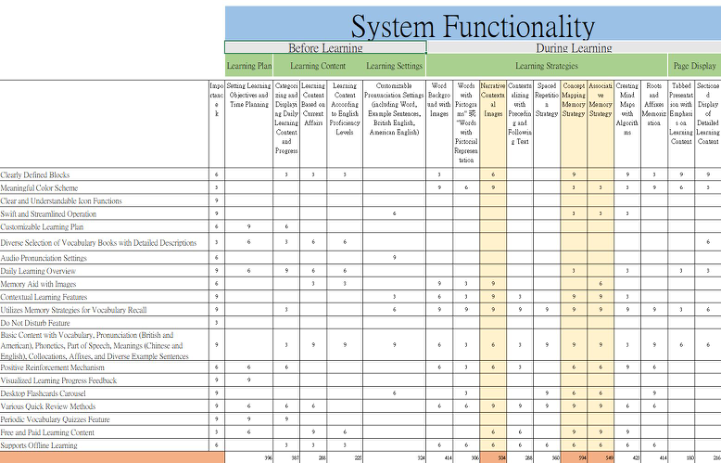
Figure 1: The house of quality of system functions.
Comparing the results of the house of quality with existing apps, it was found that the resources provided by existing apps for the image-text learn- ing method with higher memory retention rates were relatively insufficient. Users and experts in interviews expressed higher expectations and demands for this aspect of functionality. After calculating the requirements and designs,
we reached the same conclusion. In terms of associative categorization and better support for image-based learning, which involves a softer form of learning assistance, we obtained higher importance scores after weighting. Common learning support features may not necessarily satisfy consumers’ optimal preferences.
It is worth mentioning that after calculations, we found a disparity between the desired app functionalities by consumers and the current direction of app development. In our QFD analysis, we proposed many traditional English learning features, such as text (non-image) context, vocabulary quizzes, and various review methods. However, after converting these into user require- ments, the weighted scores were not as high. This leads to the speculation that although there is continuous innovation in English learning apps, there is a lack of apps that truly meet consumers’ needs.
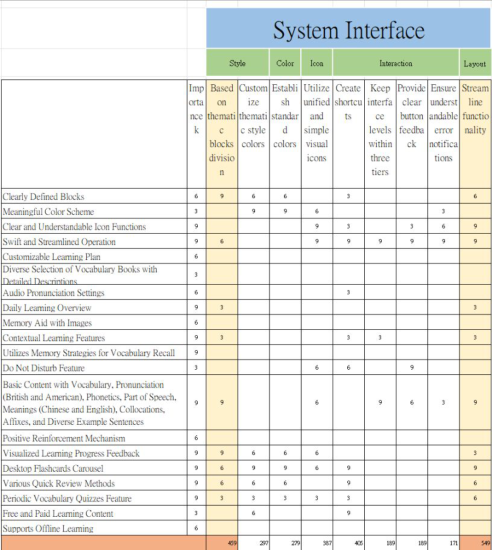
Corresponding to the system functions is the system interface. We also conducted a QFD analysis for the system interface, using the same user requirement importance to calculate the design requirement weights. We found that in the new-style English learning apps we envisioned, which focus on the learning experience, there is a higher demand for interface simplicity. Additionally, thematic categorization is crucial for situational English learn- ing, while system-level details obtained lower scores in importance, indicating a lower relationship with the overall experience. As long as it does not make the user feel complicated, less consideration can be given to low-level system features and touch feedback design items.
Figure 2: The house of quality for system interface.
Optimization of English Learning App Interfaces Through Contextual Learning 77
After the QFD analysis, the prioritized design elements for this project include Narrative Contextual Images (504pt), Concept Mapping Memory Strategy (594pt), Associative Memory Strategy (549pt), Based on thematic blocks division (459pt), and Streamline functionality(549pt).These require- ments are the highest-ranking design elements we identified through calcula- tions, so we’ve chosen them as the main core for design improvement in this study.
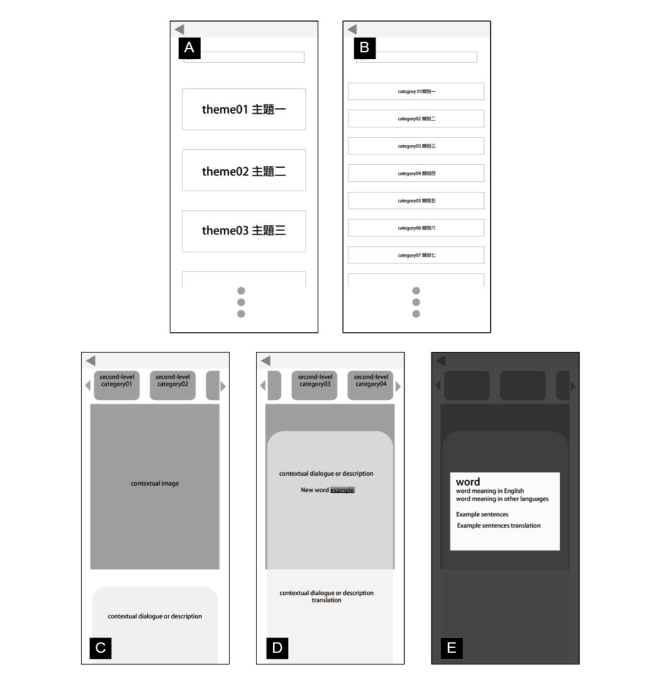
Design of the Situational English Learning App In developing the situational English learning app, we will prioritize the design requirements with higher scores and validate them using the redesigned interface of the situational English learning app.This study inte- grated and designed the interface of a mobile-based situational English learn- ing app through QFD. The reference layout is set for iPhone 13 (2532×1170 pixels), and the design and presentation were conducted using the Figma front-end design simulation program. The following is the layout distribution of the app displayed in the later stages.
Figure 3: App design: (A) first layer interface (B) second layer interface (C) third layer interface (D) second third layer interface (E) vocabulary popup.
In this prototype app demonstration, the functionality of selecting themes and categories, the display of the relationship between text and images, and the word popup window are showcased. Images (A) and (B) represent the first and second-layer category selection, while image (C) demonstrates the default appearance after entering the text page. The image will be displayed in the center, and the text is a draggable box with its initial position towards the side of the page. There will be a draggable third-layer theme selection box above the page. Image (D) shows that the text will be displayed with a 70% transparent background, and more challenging words will be marked with background color and underline. Clicking on them will open the word popup window represented by image (E), providing definitions including the word, English definition, Chinese translation, English example sentences, and the translation of example sentences into Chinese.
For example, in the Sports theme, the interface in image (B) will have options like Power Sports, Aerobic Exercise, Ball Sports, etc. Within the Power Sports theme, there will be topics like WRC, F1 Racing, MOTOGP, etc., for reference.
Validation of the APP’s Design This study conducted validation tests on 10 participants aged 19 to 30 with diverse backgrounds, having at least a college-level education, and having experience with or currently using English learning apps. Two of the par- ticipants are current English education professionals. The validation process included trying out the (1) prototype app at its current stage, (2) collect- ing participants’ evaluations of the image-based contextual English learning app through a Likert scale questionnaire (1=Strongly Disagree; 2=Disagree; 3=No Opinion; 4=Agree; 5=Strongly Agree), and (3) conducting in-depth interviews to gain insights into participants’ views on the prototype app.
Before the experiment, there will be a brief explanation, lasting about 5 minutes, of the expected functionalities of the app and the conceptual back- ground of this research. The participants will then use the prototype app for approximately 5 minutes without interference in terms of time and function- alities. After the trial, participants will fill out a questionnaire and undergo a brief interview to gather opinions and suggestions about the app’s usage.
The interviews were conducted with open-ended questions, allowing participants to provide feedback without specific prompts: Question 1: Additional comments on the interface of the app. Question 2: Additional comments on the concept of contextual learning in this app.
During the interviews, some users expressed both positive and negative opinions about the interface and learning methods. The researchers translated and recorded these opinions for systematic analysis. This section will separate interface feedback from suggestions regarding learning methods and provide a systematic explanation.
Questionnaire Results The questionnaire was divided into two parts: usability and design issues.
Optimization of English Learning App Interfaces Through Contextual Learning 79
Table 3. Questionnaire content and average scores.
Table available in the original PDF paper.
Part 1 Question Average Point
4.5
The application interface is easy to use. 3.9 The application provides easy-to-use touchscreen input. 4.5 The application offers step-by-step assistance. 3.6 The application helps with individuals in difficulties. 3.8 The application is difficult to use. 2.2 The application’s performance is poor. 2.0 The application enables me to learn English proficiently. 3.5 Using the application makes me feel confident. 3.5 The application helps me increase my vocabulary. 4.4 The application makes me more willing to learn English. 3.6 Part 2 Question Average Point The application provides navigation keys. 4.0 Icons and buttons in the application are easily recognizable, and icons maintain consistency.
3.9
The application’s button color scheme is simple and clean. 4.4 The screen color scheme of the application is simple and attractive. 3.3 The application provides useful instructions of text. 3.0 The application offers various learning methods, including contextual learning approaches.
Interview Results: Interface Suggestions Regarding the system interface, the most frequently mentioned opinions (3 out of 10) were:
(1) Users expressed a desire for the word definition pop-up in the text to cover a larger area, allowing users of different proficiency levels to use it according to their learning needs, facilitating the absorption of more vocabulary in a single text.
(2) Users suggested the addition of a voice playback feature to enhance usability and convenience in various contexts. Some users, from different perspectives during interviews, emphasized the need to optimize the reading interface for better readability. Some users suggested more intuitive ways to differentiate dialogue from different characters (originally using color cod- ing). A few users mentioned the desire for a more comprehensive app usage explanation and an auxiliary system for page navigation. Among the 10 interviewees, one suggested providing a customizable word definition pop- up page to better suit individual vocabulary memorization habits. One user expressed a preference for more aesthetically pleasing navigation keys, while another user found the current navigation keys less convenient. Another user suggested making the interface color scheme more conspicuous.
Interview Results: Learning Design Suggestions Some participants provided feedback outside of the interface, mainly cat- egorized as learning recommendations. These suggestions focus on how contextual learning can better align with their ideal usage scenarios. Apart from requests for more topics or additional content within a single topic, one
participant mentioned viewing this learning method as like reading a mag- azine, expressing a desire for higher frequency updates. Another participant suggested incorporating more context simulations relevant to daily life, such as dating or social gatherings, making the scenarios more practical for every- day use. In the opinion of an English education expert, there was a suggestion to include more traditional and widely known topics, such as world classics or themes that are easier to associate with.
CONCLUSION
This study gathered valuable insights and feedback from users through both opinions and questionnaire responses. The overall results were positive, but there are opportunities for improvement in details such as Interface details and learning materials. In terms of interface design, the users’ proficiency level emerged as a significant variable, with a focus on enhancing the effec- tiveness of word lookup through pop-up windows. Additionally, there was a recurring theme suggesting environment-oriented features, such as adding voice functionality for convenient use in various settings.
Regarding learning suggestions, participants expressed diverse opinions, emphasizing the importance of tailoring learning scenarios to individual pref- erences. The study revealed interesting insights into the varied expectations of users based on their personal lifestyles. The research made progress in align- ing with user needs, as participants provided specific feedback rather than general demands. The study confirmed that contextual learning approaches offer learners more choices and can provide assistance in various scenarios.
In conclusion, the research outcomes suggest that digitizing well- established learning methods, such as contextual learning, is feasible. Fur- thermore, integrating AI-driven illustrations, animations, and other digital enhancements could be a new dimension in this field.
ACKNOWLEDGMENT
Thank you to all research partners and supporters. The Consortium is funded by the National of Science and Technology Council (NSTC) (MOST 111- 2221-E-006-083-MY2). Thank you all.
REFERENCES
Busse, V. and Walter, C. (2013) ‘Foreign Language Learning Motivation in Higher Education: A Longitudinal Study of Motivational Changes and Their Causes’, Modern Language Journal, 97(2), 435–456. Chan, L. K. and Wu, M. L. (2002) ‘Quality function deployment: A literature review’,
European Journal of Operational Research, 143(3), 463–497. Chun, D. M. and Plass, J. L. (1996) ‘Effects of multimedia annotations on vocabulary acquisition’, Modern Language Journal, 80(2), 183–198. Elgort, I. and Warren, P. (2014) ‘L2 Vocabulary Learning From Reading: Explicit and
Tacit Lexical Knowledge and the Role of Learner and Item Variables’, Language Learning, 64(2), 365–414.
Optimization of English Learning App Interfaces Through Contextual Learning 81
Griffin, A. and Hauser, J. R. (1992) ‘Patterns of Communication Among Marketing, Engineering and Manufacturing - A Comparison Between 2 New Product Teams’, Management Science, 38(3), 360–373. Martin-Chang, S. L., Levy, B. A. and O’Neil, S. (2007) ‘Word acquisition, retention,
and transfer: Findings from contextual and isolated word training’, Journal of Experimental Child Psychology, 96(1), 37–56. moda.gov.tw. (n.d.). 家位展查-具作-位政府-核心|moda — 位展部Ministry of Digital Affairs. [online] Available at: https://moda.gov.tw/digital-affairs/digital-se rvice/operations/208 [Accessed 1 Feb. 2024]. Rosell-Aguilar, F. (2018) ‘Autonomous language learning through a mobile applica-
tion: A user evaluation of the <i>busuu</i> app’, Computer Assisted Language Learning, 31(8), 854–881. Wu, Q. (2015) ‘Designing a smartphone app to teach English (L2) vocabulary’, Computers & Education, 85, 170–179.
LISTED IN THE AHFE DIGITAL BOOKSTORE CATALOGUE
Explore the complete digital volume
Training, Education, and Learning Sciences
Read this individual research paper free through the original publisher, or explore the full digital proceedings book.
ISBN 978-1-964867-31-1
Explore this ISBN in the AHFE Bookstore ↗Listed in the July 2026 bookstore catalogue; search by ISBN to confirm current availability · Digital book purchase optional