Shuo-fang Liu, Cheng Ming Huang (2025). CareBox: A Smart Modular Meal Container Integrating Human Factors and Real-Time Feedback for Preventive Health and Balanced Diets. In: Human Factors in Design, Engineering, and Computing. AHFE Open Access, vol. 199, pp. 1653–1661. https://doi.org/10.54941/ahfe1006976
Noncommunicable diseases (NCDs)—including hypertension, diabetes, and cardiovascular disorders—account for more than 70% of global deaths. While some cases are hereditary, most are driven by modifiable lifestyle factors, especially unhealthy diet. Many people are diagnosed only after the optimal window for prevention has passed. Embracing the principle that prevention is better than cure, this work targets diet as a direct, scalable, and sustainable intervention to improve long-term health.We present CareBox, a smart modular meal container that promotes the widely recommended 2:1:1 plate ratio (vegetables: protein: whole grains) through real-time feedback and human-factors-informed design. Following a user-centered process, we conducted semi-structured interviews with 16 adults actively engaged in chronic-disease prevention. Key pain points emerged: the cognitive burden of calculating portion ratios and the lack of immediate, actionable feedback in existing tools. Findings were synthesized using the KJ method (affinity diagramming) and translated into functional and ergonomic requirements via Quality Function Deployment (QFD).Guided by these specifications, we developed a refined prototype with three detachable compartments, each embedded with a pressure/load sensor connected to an ESP32 microcontroller. The system provides real-time, color-coded LED feedback that simulates the intended product behavior: green for 75–100% target completion, yellow for 25–75%, and red for <25%, with automatic tare to deduct container weight. The form adopts a rounded, heart-shaped geometry for emotional engagement and features a leak-proof, portable structure designed for ease of use among middle-aged and older adults.A preliminary usability evaluation indicated that the screen-free LED feedback was intuitive, reduced the cognitive load of dietary monitoring, and increased users’ awareness of food proportions. CareBox illustrates how human factors engineering, IoT-based sensing, and behavior-change principles can be integrated into everyday health products. Future work will include longitudinal field studies with at-risk populations, integration of AI-based food recognition, and broader applications in preventive healthcare.
Noncommunicable diseases (NCDs) represent one of the most pressing challenges confronting contemporary global health systems. Dietary risk factors—encompassing high sodium intake, low whole grain consumption, and insufficient fruit intake—were associated with 11 million deaths and 255 million disability-adjusted life years (DALYs) in 2017 alone (Afshin et al., 2019). Specifically, inadequate dietary patterns account for more than half of cardiometabolic-related mortality, positioning nutrition as a paramount modifiable risk factor in disease prevention. Robust empirical evidence substantiates the efficacy of dietary interventions in chronic disease prevention and management. The landmark PREDIMED trial demonstrated that adherence to a Mediterranean diet supplemented with extra-virgin olive oil or nuts reduces the incidence of major cardiovascular events (Estruch et al., 2018). Similarly, the DASH (Dietary Approaches to Stop Hypertension) protocol has proven efficacious in blood pressure management (U.S. Department of Agriculture and U.S. Department of Health and Human Services, 2020). These findings underscore the effectiveness of structured dietary patterns in preventing chronic disease development and progression. Despite compelling evidence of efficacy, substantial barriers impede the real-world implementation of balanced dietary frameworks in daily life. Numerous individuals lack the requisite time, nutritional knowledge, or appropriate tools to accurately estimate food portions. Current portion control interventions—including divided plates and digital applications— typically necessitate manual data entry or furnish only retrospective feedback, rendering them inadequate for providing timely guidance during critical meal-preparation moments.
Dietary Intervention and Chronic Disease Prevention Extensive empirical research substantiates the efficacy of dietary modification in preventing and managing chronic conditions. The Global Burden of Disease Study 2017 conducted a comprehensive cross-national analysis of 195 countries spanning 1990–2017, identifying specific dietary risk factors—namely low whole grain intake, elevated sodium consumption, and diminished fruit intake—as leading contributors to mortality and disability (Afshin et al., 2019). Mediterranean and DASH dietary patterns have consistently demonstrated effectiveness across multiple clinical trials in preventing chronic disease (Estruch et al., 2018). Notably, a persistent gap exists in the literature: the pronounced disconnect between nutritional knowledge and actual implementation in daily practice. Although many individuals possess awareness of appropriate dietary recommendations, translating this knowledge into sustained behavioral change remains problematic. This gap has motivated researchers to investigate technological solutions capable of delivering real-time support and context-specific guidance during eating-related decisions.
Quality Function Deployment in Product Design Quality Function Deployment (QFD), initially developed by Yoji Akao in the 1960s (Akao, 1990), provides a systematic methodology for translating
CareBox: A Smart Modular Meal Container Integrating Human Factors 1655
customer requirements into engineering specifications. Recent comprehensive guidance on QFD application is available (Akao, 2024). The primary QFD instrument—the House of Quality—establishes a structured matrix linking customer requirements (“WHATs”) to technical characteristics (“HOWs”), enabling design teams to prioritize features that deliver maximum value to end-users. QFD has achieved widespread application in healthcare and product design contexts for improving service delivery, medical device design, and user satisfaction (Gremyr & Raharjo, 2013). Empirical research demonstrates that QFD enhances awareness of complex customer needs, provides traceability for improvement initiatives, and facilitates cross-functional team collaboration (Prasad, 1998). Nevertheless, QFD application in consumer health product development remains relatively limited, particularly within preventive health technology domains.
Human Factors Engineering and IoT-Based Health Devices Human factors engineering (HFE) focuses on optimizing user-device interactions to enhance safety, effectiveness, and user satisfaction. Poor interface design can precipitate use errors with potentially serious consequences. Foundational HFE principles encompass understanding user characteristics, designing for diverse operational contexts, and conducting iterative testing with representative user populations. IoT-based health monitoring devices have become increasingly prevalent, with expanding research elucidating how sensors, wireless connectivity, and visual feedback mechanisms support health-related behaviors. Color-coded visual indicators (green, yellow, red) have been demonstrated to effectively communicate status information comprehensibly across diverse user populations (VCC Lite, 2025). Behavior change interventions achieve maximum effectiveness when providing timely, contextually appropriate feedback. Real-time feedback mechanisms facilitate immediate behavioral adjustments, enabling individuals to achieve health objectives more effectively than retrospective reporting alone. Research by Western et al. (2022) demonstrated that technology-mediated real-time feedback substantially supports behavior change related to physical activity. These findings suggest that real-time feedback mechanisms harbor considerable potential within health domains.
Methodology
This investigation employed a user-centered design approach comprising three primary phases: (1) qualitative user research through semi-structured interviews; (2) requirements analysis and translation utilizing the KJ method (Wood, 1997) and Quality Function Deployment; and (3) prototype conceptual design. All research activities adhered to established ethical guidelines for human subjects research.
Participant Recruitment and Characteristics We recruited 16 adults (8 male, 8 female; age range: 35–68 years) actively engaged in chronic disease prevention through dietary self-management. Participant identification occurred through health-oriented community
1656 Liu and Huang
organizations, nutrition counseling centers, and Taiwan hospital wellness programs. Inclusion criteria specified: (a) absence of diagnosed chronic disease OR successful lifestyle management of one or more chronic conditions; (b) demonstrated interest in meal planning and portion control; and (c) willingness to discuss dietary experiences and perceived challenges openly.
Interview Protocol and Data Collection Procedures Semi-structured interviews of 45–60 minutes duration were conducted via face-to-face or video conference modalities. The interview guide contained open-ended questions organized into four thematic domains:
1. Current Dietary Habits: “Please describe a typical day of eating. How do you determine what and how much to consume?” 2. Challenges and Pain Points: “What difficulties do you encounter maintaining a balanced diet? What strategies or tools have you attempted?” 3. Existing Tools and Technology: “Have you utilized any applications, devices, or portion-control products? What aspects did you find beneficial or problematic?” 4. Ideal Solution Features: “If you could design a tool to support healthier eating, what capabilities would it possess? How would it integrate into your daily routine?” 5. Audio recording of interviews proceeded with participant consent, followed by verbatim transcription for analytical purposes.
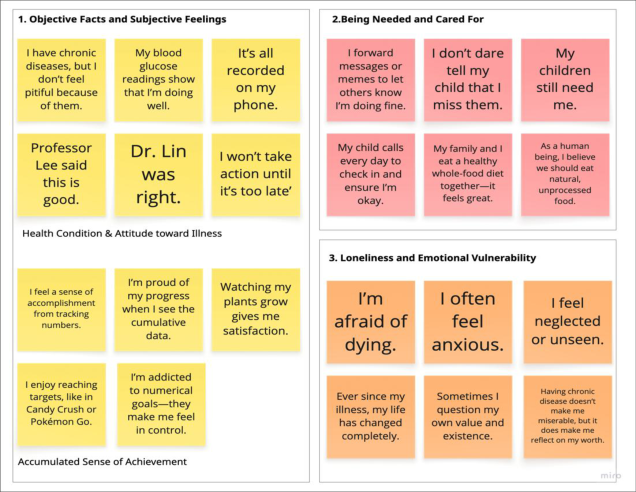
KJ Method Analysis Transcripts underwent analysis employing the KJ method, a structured technique for organizing qualitative data into meaningful clusters (Scupin, 1997). The analytical procedure encompassed: Data Extraction: Individual user statements, needs, and pain points were recorded on discrete cards or digital sticky notes.
Silent Grouping: Research team members independently grouped related cards according to natural affinities, without mutual discussion or influence.
Collaborative Refinement: Team discussion of groupings, clustering of similar themes, and identification of overarching patterns and interconnections.
Header Development: Descriptive labels synthesizing common needs and insights were assigned to each cluster.
Through this systematic process, the research team identified major themes and requirement domains emerging from the 16 interview transcripts.
CareBox: A Smart Modular Meal Container Integrating Human Factors 1657
Figure 1: CareBox KJ method analysis.
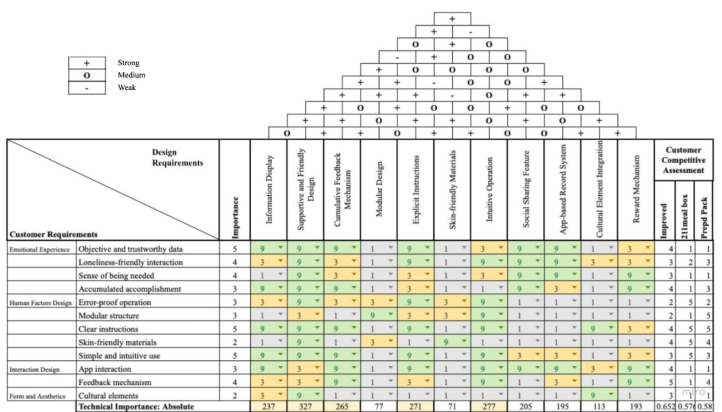
Quality Function Deployment (QFD) Application An expert panel was assembled to conduct QFD analysis based on user requirements identified through KJ method synthesis. The QFD analytical process encompassed:
Left Wall (User Requirements Prioritization): User needs derived from KJ analysis were prioritized according to mention frequency and perceived importance.
Ceiling (Technical Characteristics Definition): Engineering characteristics relevant to the product were systematically defined, including sensor accuracy, LED visibility, battery longevity, material durability, compartment dimensions, and cleaning accessibility.
Relationship Matrix Development: Correlation strength between each user requirement and technical characteristic (strong, medium, weak, or absent) was systematically assessed.
Competitive Analysis: Existing competitive products were benchmarked against user requirements and analytically compared.
Technical Priority Establishment: Technical priorities were established via weighted user requirements and competitive positioning analysis.
Through expert panel QFD discussions, five critical design factors emerged:
1. Information Display: Clear, real-time visual feedback enabling immediate user comprehension of system status 2. Supportive and Friendly Design: Product form and interaction interface incorporating affinity and supportive qualities, diminishing the clinical coldness of traditional medical devices
1658 Liu and Huang
3. Cumulative Feedback Mechanism: System capability to record and present user progress, providing sustained motivation 4. Explicit Instructions: Enabling user comprehension without complex learning requirements 5. Intuitive Operation: Minimized cognitive burden facilitating operation by users across all ages and technical competency levels.
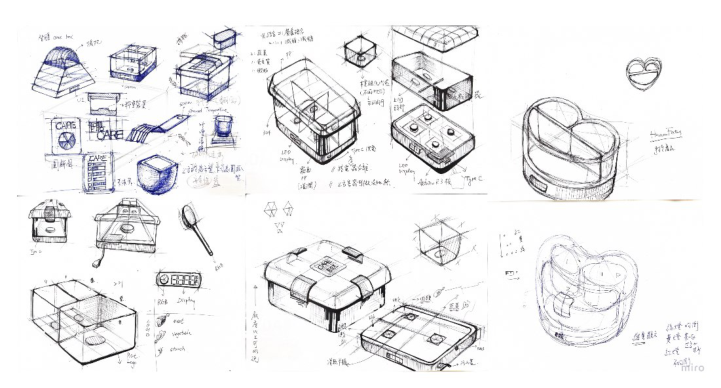
Figure 2: QFD of CareBox.Figure 3: Early-stage conceptual sketches of careBox.
CareBox: A Smart Modular Meal Container Integrating Human Factors 1659
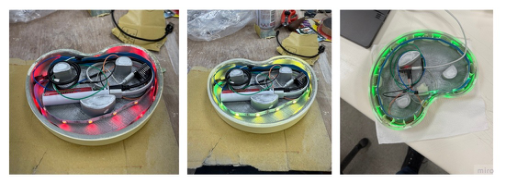
LED Feedback System Architecture Each compartment incorporates a tri-color (RGB) LED indicator positioned on the container exterior for optimal visibility. The color-coding schema follows established conventions:
Green: 75–100% of target weight achieved Yellow: 25–75% of target weight achieved Red: <25% of target weight achieved Target weight specification: 400 grams total (vegetables 200g, protein 100g, whole grains 100g), based on standardized adult portion guidelines.
Figure 4: LED feedback system.
Product Design Specifications CareBox’s physical design emphasizes user experience and human factors principles:
Morphological Design: Rounded, heart-shaped geometry evokes associations with health and care, reducing clinical appearance Material Composition: Food-grade polypropylene (PP) ensures durability, microwave compatibility, and cleaning accessibility; silicone gaskets provide leak-proof sealing
Dimensional Specifications: Compact design (approximately 220 × 180 × 60 millimeters) facilitates storage in standard lunch bags and refrigerator compartments Control Interface: Single power button serves as the primary control mechanism, eliminating complex configuration requirements.
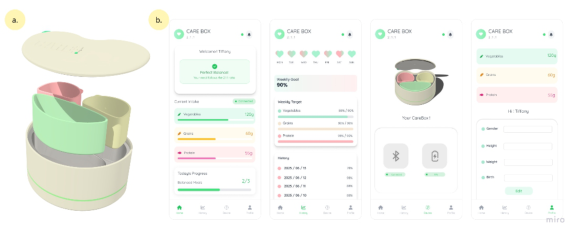
Figure 5: (a) 3D rendering model of CareBox and (b) app user interface.
1660 Liu and Huang
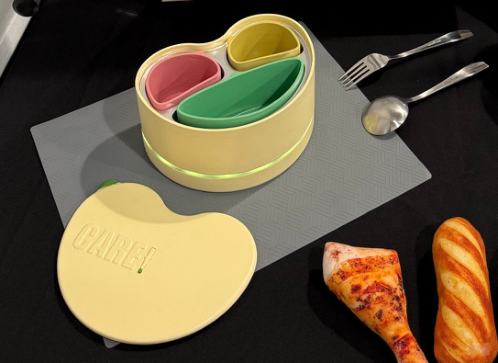
Figure 6: Functional prototype of careBox smart meal container.
CONCLUSION
Through systematic user-centered design methodology, this investigation successfully developed CareBox, an intelligent dietary assistance system integrating human factors engineering and IoT technology. Via KJ method interview analysis, we identified five principal deficiencies in extant dietary management tools: (1) elevated cognitive burden; (2) absence of real-time feedback; (3) insufficient portability; (4) complex information presentation; and (5) lack of emotional support. These findings directly informed five core CareBox design factors: information display, supportive and friendly design, cumulative feedback mechanism, explicit instructions, and intuitive operation. Systematic QFD analysis ensured that each design decision corresponded to authentic user requirements. Prototype demonstration validated design principle feasibility, establishing a foundation for subsequent comprehensive product development and IoT system integration. CareBox exemplifies how in-depth user research, systematic design methodology, and innovative technology integration can yield more effective and readily adopted health products within the preventive health domain. Future research should prioritize: (1) longitudinal usability evaluation with target populations; (2) clinical effectiveness validation; and (3) exploration of this design framework’s applicability to other health domains. Through such methodologies, preventive health technology can transition from laboratory environments to everyday life, ultimately empowering individuals to prevent chronic diseases and enhance quality of life.
REFERENCES
Afshin, A., Sur, P. J., Fay, K. A., Cornaby, L., Ferrara, G., Salama, J. S., Mullany, E. C., Abate, K. H., Abbafati, C., Abebe, Z., Afarideh, M., Aggarwal, A., Agrawal, S., Akinyemiju, T., Alahdab, F., Bacha, U., Bachman, V. F., Badali, H., Badawi, A., … Murray, C. J. L. (2019). Health effects of dietary risks in 195 countries, 1990–2017: A systematic analysis for the Global Burden of Disease Study 2017. The Lancet, 393(10184), 1958–1972. https://doi.org/10. 1016/S0140-6736(19)30041-8
CareBox: A Smart Modular Meal Container Integrating Human Factors 1661
Akao, Y. (2024). Quality Function Deployment: Integrating Customer Requirements into Product Design (1st ed.). Productivity Press. https://doi.org/10.4324/ 9781003578833 Akao, Y., Akao, Y., & Akao, Y. (1990). Quality function deployment: Integrating
customer requirements into product design. Productivity Press. Estruch, R., Ros, E., Salas-Salvadó, J., Covas, M.-I., Corella, D., Arós, F., Gómez- Gracia, E., Ruiz-Gutiérrez, V., Fiol, M., Lapetra, J., Lamuela-Raventos, R. M., Serra-Majem, L., Pintó, X., Basora, J., Muñoz, M. A., Sorlí, J. V., Martínez, J. A., Fitó, M., Gea, A., … Martínez-González, M. A. (2018). Primary Prevention of Cardiovascular Disease with a Mediterranean Diet Supplemented with Extra- Virgin Olive Oil or Nuts. New England Journal of Medicine, 378(25). https: //doi.org/10.1056/NEJMoa1800389 Estruch, R., Ros, E., Salas-Salvadó, J., Covas, M.-I., Corella, D., Arós, F., Gómez-
Gracia, E., Ruiz-Gutiérrez, V., Fiol, M., Lapetra, J., Lamuela-Raventos, R. M., Serra-Majem, L., Pintó, X., Basora, J., Muñoz, M. A., Sorlí, J. V., Martínez, J. A., & Martínez-González, M. A. (2018). Retraction and Republication: Primary Prevention of Cardiovascular Disease with a Mediterranean Diet. N Engl J Med 2013;368: 1279–90. New England Journal of Medicine, 378(25), 2441–2442. https://doi.org/10.1056/NEJMc1806491 Gremyr, I., & Raharjo, H. (2013). Quality function deployment in healthcare: A literature review and case study. International Journal of Health Care Quality Assurance, 26(2), 135–146. https://doi.org/10.1108/09526861311297343 Prasad, B. (1998). Review of QFD and related deployment techniques. Journal
of Manufacturing Systems, 17(3), 221–234. https://doi.org/10.1016/S0278- 6125(98)80063-0 Scupin, R. (1997). The KJ Method: A Technique for Analyzing Data Derived from Japanese Ethnology. Human Organization, 56(2), 233–237. https://doi.org/10. 17730/humo.56.2.x335923511444655 U. S. Department of Agriculture and U. S. Department of Health and Human Services.
(2020). Dietary Guidelines for Americans, 2020–2025. https://www.dietaryguide lines.gov/ U. S. Food and Drug Administration / U. S. Department of Health and Human Services. (n.d.). Human Factors and Medical Devices. https: //www.fda.gov/medical-devices/device-advice-comprehensive-regulatory-ass istance/human-factors-and-medical-devices Western, M. J., Standage, M., Peacock, O. J., Nightingale, T., & Thompson, D.
(2022). Supporting Behavior Change in Sedentary Adults via Real-time Multidimensional Physical Activity Feedback: Mixed Methods Randomized Controlled Trial. JMIR Formative Research, 6(3), e26525. https://doi.org/10. 2196/26525 Wood, L. E. (1997). Semi-structured interviewing for user-centered design. Interactions, 4(2), 48–61. https://doi.org/10.1145/245129.245134
LISTED IN THE AHFE DIGITAL BOOKSTORE CATALOGUE
Explore the complete digital volume
Human Factors in Design, Engineering, and Computing
Read this individual research paper free through the original publisher, or explore the full digital proceedings book.
ISBN 978-1-964867-75-5
Explore this ISBN in the AHFE Bookstore ↗Listed in the July 2026 bookstore catalogue; search by ISBN to confirm current availability · Digital book purchase optional