Shuo-Fang Liu, An Yu Su, Yi Chieh Wu, Meng Hsuan Lee (2023). Quality Function Deployment to combine with Service Design to optimize the English vocabulary learning app's usage experience. In: Usability and User Experience. AHFE Open Access, vol. 110, pp. 409–415. https://doi.org/10.54941/ahfe1003215
As mobile technology develops, more people are using their smartphones to learn English vocabulary, and smartphone apps can improve English vocabulary learning effectiveness. When evaluating how to use an app, the process and user experience are equally as crucial as the actual product. Research has also revealed that using applications is not straightforward and that the user interface is not sufficiently clear. Service design, which aims to generate creative service processes, is focused on interdepartmental teams developing procedures based on the needs of learners. Quality Function Deployment is an effective technique for transforming customer requests into product design specifications through a multi-level examination of the product. This study combines a User Journey Map with the Quality Function Deployment to more precisely identify and fix issues with the use of English vocabulary learning applications. The user's thoughts and feelings are expressed in a timeline through the visualization of the use process, user demands are assessed in a hierarchical manner, and important design aspects in the use process are recognized. This is a novel technique to meet fresh learning opportunities and offer fresh viewpoints on the interface's user flow.
The development of technology continues to change our learning life, and the popularity of digitalization has led to a gradual shift to Mobile Learning(ML) (Hao, Lee, Chen, & Sim, 2019). ML is the use of mobile devices to learn at any time and in any context (Zhang & Zuo, 2019). ML is gradually expan- ding into our lives (Chen & Chung, 2008). The use of mobile technology in education has increased, especially in English language education (Ramos Acosta, Guzmán, Rivera, & Bustillo, 2017). WU’s (2015) research is effective by installing apps on mobile devices and using them for English language lear- ning (Wu, 2015). Vocabulary is the foundation for learning a language well (Hong, Hwang, Tai, & Chen, 2014), and most language learners will start
with vocabulary. While mobile learning is convenient, there are some pro- blems with it, such as low learning outcomes, short-term memory of learned vocabulary, and other applications that distract the learner (Klimova, 2019).
Therefore, the purpose of this study is to use Quality Function Develo- pment (QFD) as a tool for product optimization and upgrade, and combine it with User Journey Map (UJM) to present the interaction and experience process of users learning English vocabulary learning apps in different stages in a visual way, so that each stage can be evaluated and improved.
RELATED WORKS English Language Learning
As a medium of information transmission, English is an integral part of lear- ning and life (Chen & Chung, 2008). Of the 2.5 billion English speakers in the world, only 400 million were born in an English-speaking country (EF English Proficiency Index, 2021, p. 4).
The EF English Proficiency Index (EF EPI) is an annual report published by EF Education that ranks the English language proficiency and mastery of each participating non-native-speaking country in the world based on the average English proficiency of adults around the world. The latest version of the 11th edition of the report shows that 2 million people, with a median age of around 26 years, participated in the English proficiency assessment, covering 112 countries and territories (EF English Proficiency Index, 2021, p10). According to the Top Ranked IOS App Store Apps by Appfigures, a mobile developer reporting platform, English learning-related apps make up a large portion of the free app downloads in the education category and are ranked relatively high in Grossing (Appfigures, 2023). This indicates that the demand for apps for English language learning is increasing.
Development and Behavior of Mobile Learning The development of mobile technology provides a lot of convenience for lan- guage learning. The media tools used to develop language learning using mobile technology include computers, multimedia phones, audio players, etc., among which mobile devices are the most convenient tools (Chinnery, 2006). It is common for university students in developed countries to own mobile devices (Klimova, 2019). Mobile devices include smartphones, tablets, and wearable devices, among others. Learning with mobile devices is Mobile Learning (ML), and it is the future trend (Zou & Li, 2015). With the popu- larity of the Internet, the behavior of ML has changed. Before the Internet became widespread, teachers sent language learning content to students’ cell phones via text messages, and students received the text messages and enga- ged in learning behavior that became mobile learning (Kennedy & Levy, 2008). After the Internet became widespread, watching instructional videos, listening to learning-related audio, or reading e-books on the Internet became ML (Kukulska-Hulme, 2016).
Quality Function Deployment to Combine With Service Design 411
METHODOLOGY
This study will use the UJM and the QFD. The UJM and unstructured inte- rviews will be used to understand the user requirements for the English vocabulary learning app, and the user requirements for each stage will be organized according to the stages of the UJM, and then the QFD team will transform the design elements, evaluate the relationship matrix, and weight the total score of the design elements to propose optimization strategies for the English vocabulary learning app.
User Journey Map The UJM is a visual representation of a user’s experience when interacting with a product or service in stages so that each moment of the journey can be individually evaluated and improved (Bruce Hanington, 2012, p95), and its mapping includes Touch Point, Stage, Think, Purpose and Emotional Jour- ney. In Moretti’s (2021) study, an application was used to explore the user experience using different UJM to understand user usability (Moretti, Baum, Wustmans, & Bröring, 2021). In this study, four interviewees were invited to draw the UJM. The interviewees will draw the above four sections using their usual English vocabulary learning apps to understand the problems and emotions of the users at each stage of the process.
Quality Function Development QFD is a quality engineering tool that translates customer requirements into product design requirements, component characteristics, process require- ments, and production requirements through multi-level interpretation and analysis, and is used to guide the robust design and quality assurance of products (Shao, 2004, p.1). Usually, there are four parts, the first is the identi- fication of user requirements: this study will invite 4 interviewees to conduct semi-structured interviews to understand the user requirements of current users, and through the KJ method, combined with UJM and literature rese- arch, summarize and organize user requirements in stages; The second is the establishment of design elements and the relationship between design ele- ments: through the established user requirements into design elements and the evaluation of the direct relationship between design elements. The third is the quantitative assessment of quality house elements: through the QFD group to evaluate the relationship matrix. The fourth key design element to establish: through the weighting method to calculate the importance of design elements, to get the key design elements.
RESULT AND DISCUSSION
The interviewees were all learners who had used the English vocabulary app for learning, had used it for 2–7 years, were between the ages of 20-36, and all had a master’s degree or higher in education.
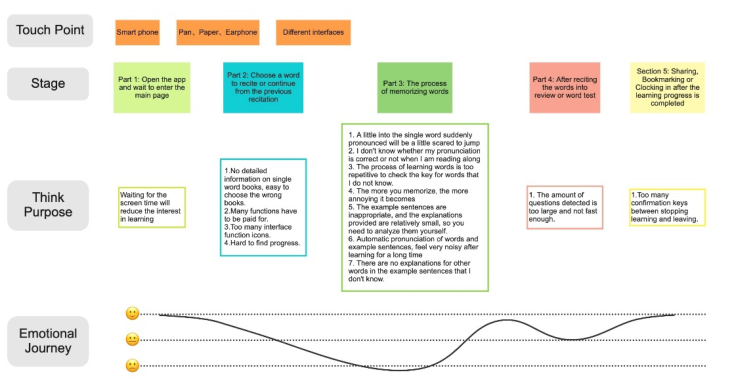
The integration of UJM is shown in Figure 1.
Figure 1: User journey map integration.
Touch Point: This study integrated the UJM of four interviewees, all of whom used smartphone applications to learn English vocabulary; a few interviewees used paper, pen, or headphones for learning.
Stage: According to the contents drawn by the interviewees, they were divided into five stages for summarizing and organizing.
Think purpose: In the five stages, interviewees encountered different problems and organized them separately.
Emotional journey: We learned that the interviewees were usually in a rela- tively good mood at the beginning of the study, and their mood decreased as the time of vocabulary learning increased, and then increased as the vocabu- lary learning was about to be completed; however, there were small ups and downs in their mood during the test stage, and finally their mood was the best after they finished the task of memorizing the vocabulary.
This study organized the results of UJM’s think purpose and unstru- ctured interviews to understand the different problems faced in the five stages, mainly focusing on the second and third parts. And according to the summarized user requirements, build a quality house Figure 2.
For the first part, interviewees wanted to be able to open the app quickly and enter the study without waiting too long.
In the second part, before entering the home page and starting to memo- rize the vocabulary, the users wanted a simple interface and a clear layout of functions, which meets the efficiency of interaction between users and smart- phones and satisfies the interface design principles (Ishaq, Rosdi, Zin, & Abid, 2020). Therefore, among the key design elements, “Reasonable functi- onal integration” and “Clearly defined interface area” scored relatively high; facing the challenges of mobile English learning, some optimization strategies given in Zhang’s (2019) study also emphasized the importance of personali- zed learning (Zhang & Zuo, 2019). The key design element of “Personalize your study habits” also becomes very important for the different learning habits of users in memorizing vocabulary.
Quality Function Deployment to Combine With Service Design 413
Figure 2. Five stages of quality house.
Figure available in the original PDF paper.
The third part, relatively, is also the time when the interviewees are in the worst mood during the whole process of usage. In language learning, a bad mood affects the information learned and thus the effectiveness of langu- age learning (Hong, Hwang, Tai, & Chen, 2014). It is important to promote interest and confidence in learning English vocabulary at this stage. Gamifica- tion can enhance students’ interest and performance in learning and motivate them to learn (Ramos Acosta, Guzmán, Rivera, & Bustillo, 2017). Therefore, among the key design elements, a “Gamified way to memorize vocabulary”is very important. When learning English on a smartphone using an app, atten- tion is easily distracted by multiple other tasks, resulting in inadvertent loss of information while receiving it (Chen & Yan, 2016). Although the score of “Set up no disturb function” is not high in the third part of the key design elements, it still has value.
In the fourth part, during the detection phase of vocabulary, users do not always have enough time to complete a measurement, so it is important to allow users to customize the amount of content to be detected, which is also in line with personalized learning (Zhang & Zuo, 2019).
In the fifth part, the three key elements of the gamification construct are activity type, reward mechanism, and tracking mechanism (Ramos Acosta, Guzmán, Rivera, & Bustillo, 2017). “Check in or accumulate points”belongs to a type of reward mechanism that facilitates users’ persistence in learning.
CONCLUSION
According to this study, users of English vocabulary learning applications are more concerned with meeting their specific requirements and seeking a positive learning experience. The following are some of the key design features of QFD: “Set up customizable word book,” “Personalize your study habits,” “Add fixed collocation usage and Various example sentences,” “All words in the interface can be clicked to search for the meaning of the word,” “Set up no disturb function,” “Automatic sound switch setting,” “Gamified way to memorize vocabulary,” and “All words in the interface can be clicked to search for the meaning of the word.”
UJM separates the entire usage process into stages so that QFD can inve- stigate the user requirements of each stage in more depth and concentrate more on the user requirements of each detail. UJM and QFD work toge- ther to delvep deeper into user requirements. For a thorough study, the QFD concentrates on the stages of inadequacies. Additionally, it enables QFD to evaluate many stages to comprehend the salient features of the overall usage while concentrating on weak stages for an in-depth examination.
Efficient interface interaction can increase learners’ interest in learning (Ishaq, Rosdi, Zin, & Abid, 2020), and the use of language learning stra- tegies can also increase the effectiveness of language learning (Kennedy & Levy, 2008). To find a more relaxing and fun approach to learning a language, the future study may assess the efficiency of learning using vari- ous language strategies or attempt to optimize interface interactions more specifically.
Quality Function Deployment to Combine With Service Design 415
REFERENCES
Appfigures. (2023). Top apps. Retrieved from https://appfigures.com/top-apps/iosapp-store/united-states/iphone/top-overall Bruce Hanington (2012). Universal Methods of Design: 100 Ways to Research Com-
plex Problems, Develop Innovative Ideas, and Design Effective Solutions. Beverly: Rockport Publishers. Chen, C.-M., & Chung, C.-J. (2008). Personalized mobile English vocabulary learning system based on item response theory and learning memory cycle. Computers & Education, 51(2), 624–645. doi:10.1016/j.compedu.2007.06.011. Chen, Q., & Yan, Z. (2016). Does multitasking with mobile phones affect learning? A review. Computers in Human Behavior, 54, 34–42. doi:10.1016/j.chb.2015.07.047 Chinnery, G. M. (2006). EMERGING TECHNOLOGIES Going to the MALL:
Mobile Assisted Language Learning. Language Learning & Technology, 10, 9–16. EF English Proficiency Index 2021. (2022, 04, 07). Education First. Retrieved from https://www.ef.com/assetscdn/WIBIwq6RdJvcD9bc8RMd/cefcom-epi- site/reports/2021/ef-epi-2021-english.pdf Hao, Y., Lee, K. S., Chen, S.-T., & Sim, S. C. (2019). An evaluative study of a mobile application for middle school students struggling with English vocabulary learning. Computers in Human Behavior, 95, 208–216. doi:10.1016/j.chb.2018.10.013. Hong, J.-C., Hwang, M.-Y., Tai, K.-H., & Chen, Y.-L. (2014). Using calibra-
tion to enhance students’ self-confidence in English vocabulary learning rele- vant to their judgment of over-confidence and predicted by smartphone self- efficacy and English learning anxiety. Computers & Education, 72, 313–322. doi:10.1016/j.compedu.2013.11.011. Ishaq, K., Rosdi, F., Zin, N. A. M., & Abid, A. (2020). Usability and Design Issues of Mobile Assisted Language Learning Application. International Journal of Advanced Computer Science and Applications, 11. Kennedy, C., & Levy, M. (2008). L’italiano al telefonino: Using SMS to support beginners’ language learning. ReCALL, 20(3), 315–330. doi:10.1017/s0958344008000530 Klimova, B. (2019). Impact of Mobile Learning on Students’ Achievement Results.
Education Sciences, 9(2). doi:10.3390/educsci9020090 Kukulska-Hulme, A. (2016). Personalization of language learning through mobile technologies. Cambridge University Press. Moretti, D. M., Baum, C. M., Wustmans, M., & Bröring, S. (2021). Applica-
tion of journey maps to the development of emergent sustainability-oriented technologies: Lessons for user involvement in agriculture. Business Strategy & Development, 5(3), 209–221. doi:10.1002/bsd2.192 Ramos Acosta, L., Guzmán, J. G., Rivera, C., & Bustillo, J. (2017). Benefits of using a mobile application in learning a foreign language. Sistemas y Telemática, 15(40), 55–68. doi:10.18046/syt.v15i40.2391 Wu, Q. (2015). Designing a smartphone app to teach English (L2) vocabulary.
Computers & Education, 85, 170–179. doi:10.1016/j.compedu.2015.02.013 Shao Jiajun (2004). Quality function deployment. Beijing: China Machine Press. Zhang, Y., & Zuo, L. (2019). College English Teaching Status and Individualized Teaching Design in The Context of Mobile Learning. International Journal of Emerging Technologies in Learning (iJET), 14(12). doi:10.3991/ijet.v14i12.10704 Zou, B., & Li, J. (2015). Exploring mobile apps for English language teaching
and learning. Paper presented at the Critical CALL–Proceedings of the 2015 EUROCALL Conference, Padova, Italy.
LISTED IN THE AHFE DIGITAL BOOKSTORE CATALOGUE
Explore the complete digital volume
Usability and User Experience
Read this individual research paper free through the original publisher, or explore the full digital proceedings book.
ISBN 978-1-958651-86-5
Explore this ISBN in the AHFE Bookstore ↗Listed in the July 2026 bookstore catalogue; search by ISBN to confirm current availability · Digital book purchase optional