Shuo-Fang Liu, Peng Ni, Shiyu Wang (2023). Highway work zone warning system design based on drivers' requirements. In: Human Factors in Transportation. AHFE Open Access, vol. 95, pp. 402–412. https://doi.org/10.54941/ahfe1003825
With the full coverage of the highway network in each country, the workload of highway construction and maintenance is getting bigger and bigger. The establishment of highway work zones has brought a more complex road environment for motorists. A large number of injuries and fatalities occur in work zones, of which about 60% are estimated to be road drivers. Many accident analysis studies have also shown that these accidents are mainly caused by driver's own human factors and inadequate road safety facilities. In order to reduce the occurrence of these accidents, some advanced technologies are being applied to traffic warning facilities. However, the real needs of drivers, who are the actual recipients of the warnings, are not fully considered in the warning design. Therefore, in this study, a Quality Function Deployment (QFD) approach is used to systematically analyze the user requirements and to design the actual design requirements of the traffic warning system in the work zone in conjunction with the emerging warning technologies. The new warning system design is expected to reduce work zone accidents caused by human factors because its requirements are based on real drivers' requirements. To achieve a human-centred safety design. In this study, two steps are taken. First, user requirements were obtained by interviewing driving experts. Second, the design requirements of the intelligent warning system were analysed and prioritized using a QFD method, resulting in the output of key design requirements.
The development of society has increased people’s travel needs, and the con- struction and development of highway network has become the top priority of each country’s infrastructure. In the face of the large number of roadw- ork tasks, the problems in highway construction zones are becoming more prominent. Many national and regional government reports also indicate the highway work zone safety risks: The US Federal Highway Administra- tion (FHWA) reports that for every $112 million worth of road construction spending in 2020, there will be one work zone fatality; 2020 The total num- ber of injuries and fatalities in highway construction zones in 2020 is 857 (FHWA, 2021); the Taiwan Highway Administration (THA) reported 63 crashes involving construction vehicles from January to July 2022 (THA, 2022a). In addition to crashes, traffic congestion is also a significant problem
Highway Work Zone Warning System Design Based on Drivers’ Requirements 403
in work zones. Information from the National Work Zone Clearinghouse shows that about 10% of traffic congestion is caused by work zones, resul- ting in user delay costs of about $4.6 billion and delay times of about 1.75 billion hours (Work Zone Safety Information Clearinghouse, 2021). The pla- cement of road construction zones has a significant impact on travel time and travel costs for transit users, and increases their risk of travel.
Government agencies have taken some measures to address the existing work zone problem, but the number of driver fatalities remains high each year (Brad Sant, 2014). A growing body of research suggests that the primary cause of work zone crashes is driver human factors (Pigman and Agent, 1990; Li and Bai, 2008a). Existing studies have also begun to introduce new safety technologies for work zones, such as Awolusi and Marks (2019), who analy- zed and evaluated work zone intrusion alarm systems based on radar sensors, pneumatic sensors, and motion sensors, and showed that these systems can provide additional safety protection for workers in work zones, but these systems suffer from false alarms However, these systems suffer from false alarms, long setup times, alignment difficulties, and passive triggering after collisions. In terms of traffic congestion, it has been shown that the use of systems that coordinate the speed of traffic through work zones can make oscillating traffic flows more stable and can reduce emissions (Learn et al., 2018). Many studies of accident analysis have shown that the most direct way to reduce accidents is to improve existing forms of traffic control (Ha TJ and Nemeth ZA, 1995; Li and Bai, 2008b). With the future popularity of automated driving, the possibility of human negligence leading to work zone crashes will be reduced (Dehman and Farooq, 2021). For current drivers, there is a consensus to provide more information and reasonable transmission and warning (Bai, Yang and Li, 2015). However, for the design of warning systems, few studies have taken the actual needs of drivers as the starting point. The real needs of users can be explored and incorporated into the design to improve the quality of information. Therefore, exploring the actual needs of drivers in the work area and proposing the design requirements for improving the current work area warning system from the needs will hope- fully provide a new direction for the future development of the highway work area problem. In order to achieve this goal, the difficulties to be overcome in this study will consist of the following two points.
1) Semi-structured interviews to obtain user requirements for drivers pas- sing through the work zone. 2) Translating driver user requirements into traffic alert system design Work Zone Safety Issues and Current Solutions
The spatial definition of a road work zone refers to the traffic control area drawn for road construction. The traffic control zone is centered on the work area and extends upstream and downstream of the lane for a certain distance, in which various traffic control facilities are placed to maintain the safety of vehicles and personnel in the construction area and to reduce the inconveni- ence and danger of vehicles and personnel caused by the construction. The traffic control zone usually consists of five sections: front warning section,
front gradient section, buffer section, work section, and back gradient section (Bureau of Highways, 2022).
FHWA (2012) statistics indicate that congestion due to construction zones accounts for 10% of all roadway congestion in the U.S. and is the fourth leading cause of congestion on all roads. The cost of traffic congestion across the United States is approximately $460 million per year, resulting in 175 million hours of wasted time. In addition, a study by Metrolinx (2008) shows that the cost of traffic congestion in Toronto and Hamilton is estimated at $6 billion per year based on 2006 travel data and is expected to increase to $15 billion in 2031. Taipei is the most congested city in Taiwan, with people spending an average of 80 hours per year on traffic congestion (TOMTOM Traffic Index, 2021).
For road users, the creation of work zones not only brings increased travel time and extra travel costs, but also increases the risk of users traveling on the road. Highway work zones account for an average of 2 deaths and 101 inju- ries per day (FHWA, 2013). Although it has been shown in several studies that the majority of work zone crashes are primarily due to driver human factors (Pigman and Agent, 1990; Li and Bai, 2008a), work zone settings undeniably increase the number of driving situations that require judgment and avoidance by road users during travel, and these situations increase the likelihood of collisions In the study by Debnath, Blackman, and Haworth (2015), the majority of traffic participants felt that existing static warnings were not sufficient to improve work zone safety. Many studies on accident analysis also point out that the most direct way to reduce accidents in work zones is to improve the existing form of traffic control (Ha TJ and Nemeth ZA, 1995; Li and Bai, 2008a). For current drivers, it is the consensus of current research to provide more diverse information delivery and warnings, such as “variable message signs”, “speed enforcement feedback”, and “por- table vibration belts” (Fontaine, Carlson and Hawkins Jr., 2000; Bai, Yang and Li, 2015). In terms of accident types, Garber and Zhao (2002) found in their statistics of work zone crashes that the main type of collision occurring in work zones was rear-end, followed by vehicle sideslip, and such statistics are also consistent with the findings of Pigman (1990) and others.
The establishment of road work zones usually occupies drivers’ road resou- rces, which makes it necessary for them to make “emergency lane changes” or “speed reduction” on the road sections where work zones are designated. These ad hoc driving behaviors and driver neglect of existing warning signs often result in work zone crashes. A number of studies have shown that the primary cause of work zone crashes is the human factor of the driver (Pigman and Agent, 1990; Li and Bai, 2008b). Existing roadway warning devices con- sist mainly of moving traffic signals to warn drivers of roadway work zone traffic conditions. However, in a study by Debnath, Blackman, and Haw- orth (2015), it was found that most traffic participants did not consider the existing static warnings to be sufficient to improve work zone safety. Many studies on accident analysis also point out that the most direct way to reduce work zone accidents is to improve the existing form of traffic control (Ha TJ and Nemeth ZA, 1995; Li and Bai, 2008a). The consensus of current resea- rch is to provide more diverse messages and warnings to current drivers, such
Highway Work Zone Warning System Design Based on Drivers’ Requirements 405
as “variable message signs”, “speed enforcement feedback”, and “portable vibration belts” (Fontaine, Carlson and Hawkins Jr., 2000; Bai, Yang and Li, 2015). However, few studies have investigated the design of warning systems from the perspective of drivers’ actual needs. With the rapid development of technologies such as “artificial intelligence”, “autonomous driving”, and “high-speed communication” in recent years, traditional work zone warning systems are expected to deliver warning information in a more intelligent way.
Research Methodology and Framework Quality Function Deployment (QFD) was introduced by Yoji Akao in Japan in 1967 (Mizuno, Akao, & Ishihara, 1994; Prasad, 1998), and is a structured cognitive transformation method mainly used in total quality management analysis to integrate tools for marketing, development, design, and manufa- cturing. It is a structured cognitive transformation method that is mainly used for total quality management analysis to integrate tools for marketing, deve- lopment and design, and manufacturing. QFD has been widely used in the product design and development process, and Liu and Zhou (1996) showed that QFD can be used in the early product development process to intro- duce products with higher customer satisfaction.The core part of the QFD method is the establishment of a quality house. The QFD technique is used to convert user requirements into design requirements, design requirements, etc., and then improve engineering and manufacturing to achieve product quality requirements.
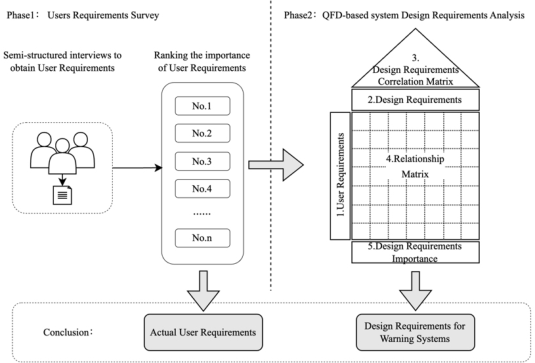
In order to complete the design of the intelligent warning system based on the actual driver needs, as shown in Figure 1, this study will be executed in two phases. In the first stage, the initial user requirements were obtained through semi-structured interviews, and then the importance of user require- ments was determined by a QFD expert panel, which was used as the output of the first stage of the real driver requirements survey. In the second stage, the QFD method was used to transform the real driver requirements from the first stage into the critical design requirements for the warning system, which was the output of the second stage. By combining these two phases, this study will obtain the collated driver needs for the warning system and what critical design requirements will be included in the warning requirements to meet the driver needs to support future work zone safety studies. This summary will then describe the two phases of the experiment in detail.
Phase I: User Requirements Survey Six respondents were invited before the semi-structured interview, among whom should have some experience in highway driving. In order to ensure the completeness of the user needs collection, the driving experience of the respondents should also be differentiated. The gender of the subjects inclu- ded both males and females, and their age ranged from 20 to 50 years old. The spatial distribution of driving in the work area was mapped. The spa- tial distribution of work zone driving consisted of nine segments, namely, “further front segment”, “work zone approaching segment”, “work zone
Figure 1: Research flowchart.
queuing segment”, “front warning segment”, “front gradient segment”, “buffer segment”, “work zone segment”, “back gradient segment”, “back gradient segment”, and “work zone ending segment”. The participants were invited to share their driving experience and user requirements in each of these 9 stages. After the semi-structured interviews, the user requirements of the six first testers were compiled. The contents of the compilation were ran- ked in order of importance of user needs by expert evaluation, which was used as input for the second stage of QFD and discussion of the actual needs.
An expert team is formed to conduct interviews before and after the requi- rement collection, and the importance of the user requirements collected from the interviews is subsequently evaluated. The expert panel in this study consi- sts of four researchers whose areas of expertise will include industrial design and road driving.The panel of experts will evaluate the importance of each user’s needs and use five levels of scores: 1, 3, 5, 7, 9 to express the importa- nce rating of each expert. The weight of each user requirement is calculated and the importance is ranked according to the weight.
Phase 2 QFD-Based System Design Requirements Analysis The user requirements of the driver generated in Stage 1 will be used as input in this stage. In this stage, the QFD method will be used to systematically transform the driver requirements into the design requirements of the war- ning system and analyze them. This phase will consist of the following five steps.
Step 1 Input user requirements: In this study, the user requirements obtai- ned in the first stage are used as input for this step, and the importance of user requirements derived from steps 1–6 is set to Ki for subsequent quantitative analysis of the relational matrix. The lower the value of user requirements Ki, the less it affects the operation of the requirements, and the higher the value of Ki, the higher the impact of the requirements.
Highway Work Zone Warning System Design Based on Drivers’ Requirements 407
Step 2 Establishing design requirements: Combining the user require- ments inputted in the quality house, the expert team corresponds to the design requirements for establishing an intelligent warning system as the ceiling of the quality house.
Step 3 Relationship matrix: This part is located in the main body of the room of the quality house, and is to analyze the degree of relationship betw- een the driver’s needs and the design requirements of the intelligent warning system using the relationship matrix. This part of the relationship matrix mainly presents the relationship between user needs and design requirements rij ( i = 1, 2,... m, this is the user needs item; j = 1, 2,... n, this is the design requirements item), when the intersection of the corresponding user needs and design requirements of the relationship between the weaker, that is The intersection corresponds to the degree of relationship rij value is lower; if the rij value is higher, that the intersection corresponds to the user needs and design requirements of the interrelationship between the requirements of the closer.
Step 4 Matrix of correlations between design requirements: this part of the performance is located in the roof of the quality house, mainly to under- stand the correlation or influence between the design requirements, can be presented through the interaction matrix of their correlation and correlation strength.
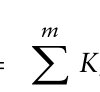
Step 5 Evaluate the importance of design requirements: finally, the impor- tance of design requirements between each design requirement and user requirements will be calculated in this section, as shown in Equation (1)
Equation reproduced from the original PDF.
Ki = importance of user requirements rij = the relationship between user needs and design requirements Finally, the results of the two phases of the study were analyzed and discus- sed to draw the conclusion of this study. In order to satisfy the research objectives of this study, the work area traffic warning system was redesigned to solve the existing traffic safety problems around the work area by taking the driver’s user needs as the starting point.
Actual Driver Needs The results of the interviews were compiled into 14 user needs of drivers, and experts were invited to evaluate and calculate the user weights. As shown in Table 1, the highest ranked driver need was “real-time information”, with a relative weight of 11%. Many respondents indicated that the information provided by existing road information systems or warning systems is not timely, resulting in a low probability that drivers will take it into account when considering their routes, which is why most drivers are trying to plan their routes in a timely and reasonable manner when alternative routes are available. The lack of timely information also prevents drivers from being prepared to change lanes further ahead or to face a work zone, so that they
Table 1. User requirements code table (compiled for this study).
Table available in the original PDF paper.
User Requirements(URs) Code List 1 The immediacy of the message 2 Learn about the fastest driving options 3 Inform about lane closures 4 Understand work zone pass times 5 Diversion guidance 6 Multi-sensory alerts 7 Improve concentration 8 Good placement of facilities 9 Reduce the complexity of surrounding traffic 10 Understand work zone distances 11 Understand speed limits 12 Ensure workers do not leave the work area 13 Alerting the end of the work zone 14 Speeding requirements
can change lanes when they encounter a work zone. The second most impor- tant need was “knowing the quickest travel option,” with a relative weight of 10.4%. In this requirement, all six respondents indicated that the most important information they would like to receive while driving is the quickest travel option, which they believe will reduce their travel time and traffic con- fusion in the work zone. The third and fourth of the top five user needs were specific messages that drivers would like to receive during alerts, including “information about lane closures” and “knowing when to pass through the work zone”, which respondents said would improve their understanding of the work zone and help them pass through it better. In the fifth place, “diver- sion guidance”, the most important part of this demand was met in the “work zone queuing area”, “front warning section”, “front gradient section”, and some respondents said that if they could get the work zone information in the “further front section”, it would ease the road traffic pressure in the near work zone.
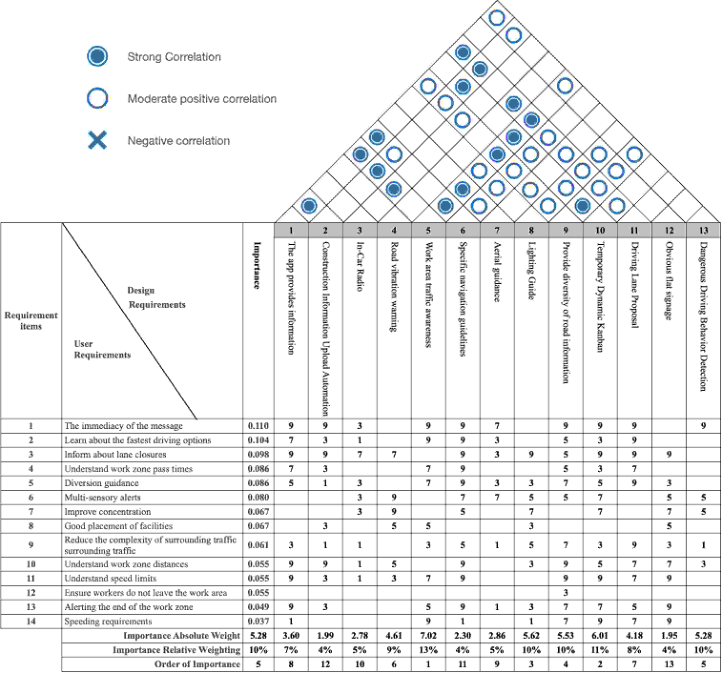
Design Elements of the Warning System In the first stage, the study systematically collected the actual needs of drivers for the intelligent warning system in the work area through interviews and analysis, and used them as input for this stage of QFD. The QFD house was built according to the research steps. The results are shown in Figure 2. First, the expert team established 13 design requirements corresponding to the 14 requirements inputted, namely “cell phone app to provide information”, “construction information upload automation”, “in-vehicle broadcasting”, “road vibration warning”, “work zone traffic condition awareness”, “spe- cific navigation guidance”, “aerial guidance”, “light guidance”, “providing road condition information diversity”, and “temporary dynamic signage”. “The system also includes “temporary dynamic signage”, “lane suggestions”, “visible flat signs”, and “dangerous driving behavior detection”.
Highway Work Zone Warning System Design Based on Drivers’ Requirements 409
Table 2. User requirements evaluation table (compiled for this study).
For these 13 design requirements, experts were invited to evaluate the degree of relevance of the 14 user requirements they corresponded to. The evaluation was done by using five scores of 1/3/5/7/9, and the larger the value, the higher the relevance of the two corresponding items. The reason for using odd numbered columns is to widen the calculation gap between the releva- nce and to make the results clear. After the expert evaluation calculation, the importance ranking of the design requirements was obtained.
The first of the top five design requirements, “specific navigation guida- nce”, is targeted at the user requirements where drivers mention that they want to get more basic information about the work area in the warning system (e.g., closed lanes, length of work area closure, etc.), so that drivers can make better driving choices through the information provided by the warning system and reduce their risk and time through the work area. The second “lane recommendation” is a design requirement created to meet the driver’s needs for “diversion” and “reducing the complexity of surrounding traffic”. This will also reduce the pressure on drivers to choose their lane of travel, allowing them to focus more on driving in the work area and reducing road risk. The third place of “providing road information diversity” empha- sizes the need to provide drivers with detailed information about themselves (e.g., remaining passing time, distance, etc.). Through these detailed perso- nalized information, it will reduce drivers’ anxiety when encountering work zones, improve the quality of driving after encountering work zones, and reduce the impact of work zones on the general road users. The fourth place, “Temporary Dynamic Signage”, is designed to meet the driver’s desire for a warning system that is not limited to static patterns, but can be combined with LED displays to provide more sensory warnings, thus enhancing their concentration on driving. The fifth last design requirement was “cell phone app for information”, which is a good way to satisfy drivers’ need for real- time information by posting or providing information through cell phone
Figure 2: QFD alert system design requirement analysis diagram.
apps. Effective integration of work zone alerts into the navigation software interface would enhance the needs of many drivers, providing them with com- prehensive information about the work zone and helping them understand the quickest driving options. In this study, the top five design requirements were analyzed as key design requirements, but the rest of the design requi- rements also have some importance and can be selected for use or derived when considering the design of a smart alert system.
CONCLUSION
This study takes the improvement of existing work zone warning systems as the starting point, and applies semi-structured interviews and QFD methods to investigate the actual needs of drivers for warning systems and the design requirements of new intelligent warning systems. Therefore, this study fir- stly explores the literature to understand more about the basic conditions of the work area and the problems faced by drivers in the work area, and also reviews the existing common work area warning devices. The study then used semi-structured interviews to obtain real driver needs. The final
Highway Work Zone Warning System Design Based on Drivers’ Requirements 411
analysis revealed that the top five driver needs were “real-time information”, “understanding the quickest travel option”, “informing about lane closures”, “understanding work zone passage time”, and “diversion guidance”, which will hopefully help other researchers in the future and serve as a reference for developing warning devices that meet driver needs.
Secondly, the QFD method was used to list and analyze the design requi- rements of intelligent warning systems that corresponded to the needs of drivers. The top five design requirements were identified as key design requirements, namely “specific navigation guidance”, “lane suggestion”, “diversity of road condition information”, “temporary dynamic signage”, and “mobile app information”. The above design requirements will be used as the key design requirements for the subsequent research and development of the intelligent warning system, and the rest of the design requirements will be selected for the development of the intelligent warning system.
Finally, the results of this study can also show that the road work area pro- blem will have the opportunity to welcome more diverse solutions with the advancement of technology. In order to meet the new era of user needs, syste- matic extraction and analysis of user needs and design requirements should become more important in this discipline.
REFERENCES
Bai, Y., Yang, Y. and Li, Y. (2015) ‘Determining the effective location of a portable changeable message sign on reducing the risk of truck-related crashes in work zones’, Accident Analysis & Prevention, 83, pp. 197–202. Available at: https://do i.org/10.1016/J.~AAP.2015.07.024. Brad Sant (2014) WORK-ZONE SAFETY: Intrusion alert | Roads and Bridges. Avai-
lableat: https://www.roadsbridges.com/safety/work-zone/article/10646453/work -zone-safety-intrusion-alert (Accessed: 3 October 2022). Bureau of Freeway (2022) ‘Traffic Control Regulations for the Construction of the Highway, Ministry of Transportation and Communications, Taiwan, R. O. C. 111, Revision 2’. Available at: https://www.freeway.gov.tw/Publish.aspx?cnid= 1502&p=1160 (Accessed: 9 October 2022). Debnath, A. K., Blackman, R. and Haworth, N. (2015) ‘Common hazards and
their mitigating measures in work zones: A qualitative study of worker perce- ptions’, Safety Science, 72, pp. 293–301. Available at: https://doi.org/10.1016/ J. SSCI.2014.09.022. Dehman, A. and Farooq, B. (2021) ‘Are work zones and connected automated vehicles ready for a harmonious coexistence A scoping review and research agenda’, Transportation Research Part C: Emerging Technologies, 133(Novem- ber), p. 103422. Available at: https://doi.org/10.1016/j.trc.2021.103422. FHWA (2012) ‘2012 Urban Congestion Trends’. Available at: www.roads.maryland.
gov/OOTS/2012_Maryland_State_HIghway_Mobility_Report.pdf (Accessed: 21 October 2022). FHWA (2013) ‘Tips for Driving in Work Zones’. Available at: www.fhwa.dot.gov/ workzones (Accessed: 6 October 2022). FHWA (2021) FHWA Work Zone Facts and Statistics - FHWA Office of Operations.
Available at: https://ops.fhwa.dot.gov/wz/resources/facts_stats.htm (Accessed: 3 October 2022).
Fontaine, M. D., Carlson, P. J. and Hawkins Jr., H. G. (2000) ‘Evaluation Of Traffic Control Devices For Rural High-Speed Maintenance Work Zones: Second Year Activities And Final Recommendations’. Available at: https://doi.org/10.21949/ 1503647. Garber, N. J. and Zhao, M. (2002) ‘Distribution and characteristics of crashes at dif-
ferent work zone locations in Virginia’, Transportation Research Record, (1794), pp. 19–28. Available at: https://doi.org/10.3141/1794-03. Ha TJ and Nemeth ZA (1995) ‘Detailed study of accident experience in construction and maintenance zones’, Transportation research record, 1509, pp. 38–45. Available at: http://www.safetylit.org/citations/index.php?fuseaction=citations. viewdetails&citationIds=citjournalarticle_688355_38 (Accessed: 28 November 2022). Learn, S. et al. (2018) ‘Freeway speed harmonisation experiment using connected
and automated vehicles’, IET Intelligent Transport Systems, 12(5), pp. 319–326. Available at: https://doi.org/10.1049/IET-ITS.2017.0149. Li, Y. and Bai, Y. (2008a) ‘Comparison of characteristics between fatal and injury accidents in the highway construction zones’, Safety Science, 46(4), pp. 646–660. Available at: https://doi.org/10.1016/J. SSCI.2007.06.019. Li, Y. and Bai, Y. (2008b) ‘Development of crash-severity-index models for the
measurement of work zone risk levels’, Accident Analysis & Prevention, 40(5), pp. 1724–1731. Available at: https://doi.org/10.1016/J. AAP.2008.06.012. Liu, H. and Zhou, X. (1996) ‘A systematic planning approach to implementing total quality management through quality function deployment techni- que’, Computers & Industrial Engineering, 31(3–4), pp. 747–751. Available at: https://doi.org/10.1016/S0360-8352(96)00236-7. Mizuno, S., Akao, Y. and Ishihara, K. (1994) The Customer Driven Appro-
ach to Quality Planning and Deployment. Minato, Tokyo: Asian Productivity Organization. Pigman, J. G. and Agent, K. R. (1990) ‘Highway Accidents in Construction and Maintenance Work Zones’, Transportation Research Record: Journal of the Transportation Research Board, 1270, pp. 12–21. Prasad, B. (1998) ‘Review of QFD and related deployment techniques’, Journal
of Manufacturing Systems, 17(3), pp. 221–234. Available at: https://doi.org/10. 1016/S0278-6125(98)80063-0. TOMTOM Traffic Index (2021) Traffic congestion ranking | TomTom Traffic Index. Available at: https://www.tomtom.com/trafficindex/ranking/?country=HK, IN, ID, IL, JP, KW, MY, PH, QA, SA, SG, TW, TH, AE (Accessed: 4 October 2022). THA (2022) ‘Global Information Website of the Bureau of Freeway, Ministry of
Transportation and Communications - Pay attention to construction information and vehicles to ensure the safety of national roads’, Bureau of Freeway, Ministry of Transportation and Communications. Work Zone Safety Information Clearinghouse (2021) Work Zone Data — Work Zone Safety Information Clearinghouse. Available at: https://workzonesafety.o rg/work-zone-data/ (Accessed: 3 October 2022).
LISTED IN THE AHFE DIGITAL BOOKSTORE CATALOGUE
Explore the complete digital volume
Human Factors in Transportation
Read this individual research paper free through the original publisher, or explore the full digital proceedings book.
ISBN 978-1-958651-71-1
Explore this ISBN in the AHFE Bookstore ↗Listed in the July 2026 bookstore catalogue; search by ISBN to confirm current availability · Digital book purchase optional