Fabian Schlichtherle, Wolfram Remlinger (2023). Enhancing User Acceptance of Shared Automated Vehicles – An exploratory Study on Mobility Behavior and Attitude towards Automated Mobility Concepts. In: Human Factors in Transportation. AHFE Open Access, vol. 95, pp. 110–120. https://doi.org/10.54941/ahfe1003797
Institute for Engineering Design and Industrial Design IKTD, Chair of Interior Design, Engineering, University of Stuttgart, 70569 Stuttgart, Germany ↗
Shared automated vehicles (SAVs) own the potential to contribute significantly to a reduction in urban traffic by reducing the share of motorized private transport in the modal split. Due to high traffic loads in cities, rapid introduction of SAVs is highly desirable. In order to enable the introduction of new, automated mobility concepts successfully, understanding mobility behavior as well as user needs is crucial. As part of the research project SAVeNoW, funded by the German Federal Ministry for Digital and Transport, this work aims to identify relevant patterns in mobility behavior as well as attitudes towards automated mobility concepts. Therefore, we conducted an online survey in the city of Ingolstadt.The promising effects of shared automated mobility concepts only hold true, if they are able to attract users from the motorized private transport sector. Otherwise, there is a high risk of pure cannibalization of public transportation by SAVs. It is therefore of utmost importance to precisely understand user needs and requirements long before the implementation of shared mobility services. This paper offers insights from an online-based survey on the aforementioned issues. Previous studies already investigated users' perspectives on shared automated mobility. The presented sample however stands out due to having been obtained in the city of Ingolstadt, which has an unusual high private car density. Results from this sample are crucial to understanding the desires of a car centric community regarding automated mobility concepts.An online survey was chosen as method to obtain relevant mobility data. The online link to the survey was distributed via e-mail and reached students and employees from the Technical University Ingolstadt of Applied Sciences as well as a group of senior citizens who gave their consent to participate in scientific studies. Furthermore, posters and flyers promoting the survey’s QR code were placed in the city’s public parking garages as well as in the public transport busses in order to generate a diverse sample of participants. The online-questionnaire took roughly 20 minutes to complete and included four sections: demographic data, mobility demographic data, mobility behavior and attitude towards autonomous driving and future mobility concepts.N = 85 participants completed the questionnaire. The assumption of strong car ownership was confirmed. Notable reasons for car ownership were higher flexibility as well as shorter trip duration. This falls in line with previous research. Stated reasons against the use of public transport like high prices and low availability could be overcome with SAVs. Generally, participants are strongly willing to use automated shuttle busses. Readiness to share rides with others is most firmly influenced by familiarity with fellow riders, followed by sharing the same employer or neighborhood i.e. destination. Besides ticket price, general availability and route network, interior related features like privacy, cleanliness and availability of seats as well as WiFi and itinerary information can be considered as important factors towards the decision to use such mobility concepts. Results indicate that SAVs are a welcome mobility alternative, but may need to be reconsidered in their current design.
Over the last decades, urban traffic has become an increasingly relevant factor in cities and it has turned from a mere development-enabling feature to an ever-important element for urban growth control (Gao and Zhu, 2022). Despite its key role, today traffic in urban areas also poses a progressively surging amount of challenges, such as air pollution as a result of congestion or lack of space due to growing demand for parking lots (Pavone, 2015). In this context, automated driving is regarded as a disruptive technology that is expected to make a significant contribution to solving these problems. Shared automated vehicles (SAVs) are considered as part of this solution. In a mobility-on-demand context, they are expected to be operated by either municipal or private mobility service providers. With the ability to bundle multiple trips from different users with flexible pick up times and points as well as destinations in a ride pooling setting, they might function as an amendment to local public transport (PT) (Krueger et al. 2016) and therefore position themselves between PT and private transport (Wintersberger et al. 2019). However, the advancing technical development of SAVs alone does
Enhancing User Acceptance of Shared Automated Vehicles 111
not sufficiently ensure their successful implementation. When it comes to introducing automated mobility concepts, a large number of factors and stakeholders must be taken into account since a careless launch of SAVs could reverse their positive effects (Lang et al. 2020; Stocker and Shaheen, 2017). User acceptance is one of these important factors (Wintersberger et al. 2019). One goal of the research project SAVeNoW, in the context of which this work was developed, is to increase the acceptance of SAVs by investigating user needs and requirements.
User acceptance plays a crucial role not just in automated driving, but also in nearly every domain of technology. A solid body of research that addresses user acceptance-related factors in SAVs already exists. In the past, literature reviews have sought to gain a deeper understanding of this topic and have been performed by Azad et al. (2019) as well as Pigeon et al. (2021). Furthermore, Nordhoff et al. (2019) developed a prediction model for automated vehicle acceptance based on a review of existing literature.
According to Pigeon et al. (2021), two relevant clusters can be distinguished with regard to the acceptance of SAVs. These are firstly the user- oriented factors, which describe the attributes of SAVs and corresponding mobility services that are necessary for certain user groups. Furthermore, there are individual factors that originate from the respective users themselves and hence influence their perspective. Approximately twice as many user- oriented as individual factors were identified by the authors. On the basis of this groundwork, this study aims to assess current mobility behavior as well as attitudes regarding automated mobility concepts in the city of Ingolstadt which has the highest car density of all major Bavarian cities (ingolstadt.de, 2018) and can therefore be regarded as a car centric community.
METHOD
We chose to acquire data by using an online questionnaire. The survey link was promoted mainly in two ways. First, we distributed an invitation to the survey via e-mail to students and employees from the Technical University of Ingolstadt of Applied Sciences. This also included a small group of senior citizens, who voluntarily participate in scientific studies. Second, we placed advertisement for the survey in a parking garage in Ingolstadt as well as in some busses of the city’s PT company INVG. This was done in order to improve the quality of the sample and to not solely include participants with a technological or scientific background.
The questionnaire consisted of four sections, namely (1) demographic data, (2) mobility demographic data, (3) mobility behavior and (4) attitude towards autonomous driving and future mobility concepts. Although the vehicle concepts addressed in the study are strictly speaking automated models according to SAE J3016, they were referred to as autonomous in the questionnaire, as this is the more common colloquial term. The questions regarding sections (2) and (3) exclusively referred to the participants’ current mobility situation and no projections were asked towards the possible use of future vehicle concepts in these parts of the questionnaire. Section (4) then
112 Schlichtherle and Remlinger
focused solely on participants’ opinion of automated mobility concepts that are not yet available.
The survey language was German. It took approximately 20 minutes to complete the questionnaire and participants received no compensation. The question types used were single-choice, multiple-choice and free-form text fields. Five-point Likert scales were used whenever a rating of preferences was needed. Difference analyses were performed using Mann-Whitney U-tests. Some questions required participants to state reasons for or against certain mobility concepts. In this case, a predefined set of statements containing the most likely reasons was presented and participants were able to select as many statements as they wished or alternatively use the option “other”to state their own reasons.
RESULTS
86 data sets were initially recorded. The answers of one participant had to be excluded because in this particular case it could not be assumed that the questions were answered in a serious manner. This led to a total of N = 85 data sets.
(1) Demographic data The sample’s demographic composition shows that n = 50 (59.00 %) participants were male and n = 35 (41.00 %) were female. The mean age was M = 28.61 years (SD = 12.77 years) with a median age of Md = 24.00 years and years of age ranging between 15 and 70. The age distribution was as follows: 15–25 (n = 51; 60.00 %), 26–35 (n = 16; 18.82 %), 36–45 (n = 7; 8.24 %), 46–55 (n = 6; 7.06 %), 56–65 (n = 2; 2.35 %) and 66 or older (n = 3; 3.53 %). The majority of participants (n = 49; 57.65 %) stated that “university student”described their current professional status best, followed by “employed”(n = 26; 30.59 %). The remaining answers were “high school student” (n = 5; 5.88 %), “retired” (n = 3; 3.53 %), as well as “in job training” and “on parental leave” with n = 1 mention each (1.18 %).
(2) Mobility demographic data and (3) mobility behavior The two dominating types of vehicles owned by the sample were bicycle (n = 70; 82.35 %) and car (n = 62; 72.94 %). Considering only students, n = 35 (71.43 %) owned a car. Car ownership in non-students was at n = 27 (75.00 %). Other less dominant vehicles were motorcycle (n = 21; 24.71 %) and E-bike, pedelec or E-scooter (n = 12; 14.12 %). The number of participants owning none of the listed private modes of transport was n = 6 (7.06 %).
Regardless of previously stated private vehicle ownership, the participants answered the question “How often do you use the following modes of transport?” followed by a multiple-choice selection including private car, motorcycle, E-bike, pedelec or E-scooter, car sharing and public transport. Response options ranged from never to very frequently on a five-point Likert scale. Responding with never led to follow up questions on reasons against that specific mode of transport whereas any answer indicating at least a rare use of the respective item resulted in participants being asked to state their motives in favour of that mode. This approach was chosen in order
Enhancing User Acceptance of Shared Automated Vehicles 113
to give participants the option to state their reasoning for a specific mode of transport even if they do not own but only occasionally make use of it. Table 1 provides an overview of the number and proportion of participants who use a particular car-related mode of transport at least rarely (Pro) or never (Con), as well as the most frequently stated reasons in each case. The modes of transport represented here are all car related. Reasons for or against motorcycles, bicycles or E-bikes are not reported for clarity as well as for the assumption that private car related reasoning provides the most informative arguments with regard to possible use of SAVs in the future.
Notable answers in the other-categories for or against the different mobility concepts are as follows. In favour of private car usage, the argument
Table 1. Usage of different car-related means of transport as well as reasoning.
Table available in the original PDF paper.
114 Schlichtherle and Remlinger
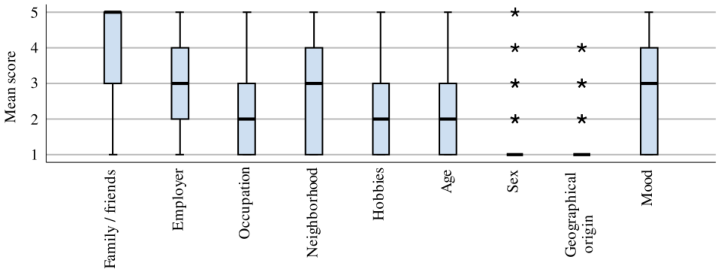
that PT is too expensive compared with an individually owned car was mentioned by n = 6 participants. Another n = 4 mentions referred to the poorly developed regional PT network. When it comes to reasons against the use of car sharing, n = 9 participants additionally stated a lack of need to use such services. Not owning a valid driver’s licence was brought up by an additional n = 4 participants. When stating reasons against carpooling, n = 3 mentions stating lack of flexibility were given. In the case of carpooling, participants were asked which shared characteristics of potential passengers would increase their willingness to share a ride. Participants’ evaluation of the specified attributes can be taken from Figure 1.
Regarding the characteristic sex, female participants showed a significantly greater increase in their willingness to share a ride when the potential passenger is also female (Mdmale = Mdfemale = 1.00, U = 571.00, p < 0.001, r = 0.40).
Following the same logic as the previous table, Table 2 shows the number and proportion of participants who use PT at least rarely (Pro) or never (Con), as well as the most frequently stated reasons in each case.
The most frequently mentioned other reasons in favor of PT can be summarized as having no other option due to lack of another mode of transport (n = 5) or using PT as an alternative to bicycle or walking in case of bad weather (n = 3). Notable mentions for other reasons not to use PT were that it is more time consuming than other transportation alternatives (n = 3).
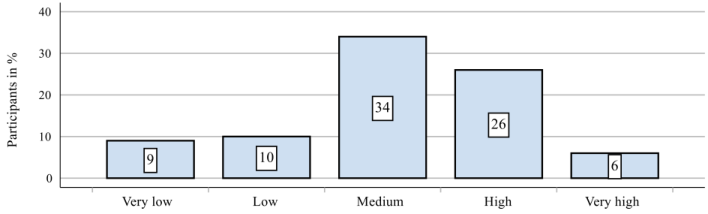
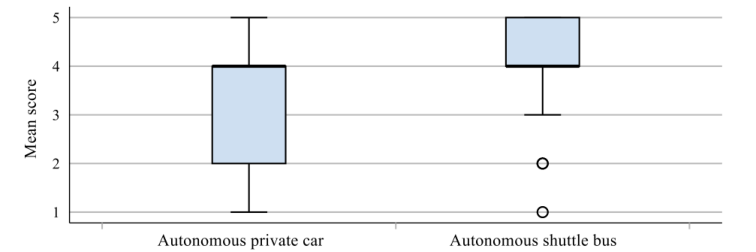
(4) Attitude towards autonomous driving and future mobility concepts Participants were asked to self-assess their level of knowledge on autonomous vehicles on a scale from 1 (very low) to 5 (very high). The mean value was M = 3.12 (SD = 1.06) and the distribution of answers can be taken from Figure 2. The question of whether the use of an autonomous private vehicle or an autonomous shuttle bus (ASB) would be considered in the future, provided the technology is available, was answered with a mean value of M = 3.27 (SD = 1.30) for the autonomous private vehicle and M = 4.08 (SD = 1.00) for the ASB. The result is visualized in Figure 3.
Figure 1: Ratings of the extent to which shared passenger characteristics increase the willingness to carpool.
Enhancing User Acceptance of Shared Automated Vehicles 115
Table 2. Usage of PT as well as reasoning.
Table available in the original PDF paper.
Figure 2: Participants’ self-assessed level of knowledge on autonomous vehicles.Figure 3: Participants’ willingness to use future autonomous mobility concepts.
With regard to the question what reasons respondents have to intent or not intent the use of future autonomous mobility concepts, selectable reasons were presented. These were either in favor of the concepts if a tendency towards using them was indicated, against these concepts if a
116 Schlichtherle and Remlinger
tendency towards not using them was indicated and both, for and against these concepts if respondents indicated that they were undecided (n = 11 for autonomous private car and n = 3 for ASB). This resulted in a number of statements for or against a mobility concept exceeding the total sample of N = 85. Since this no longer allows a meaningful interpretation of the proportion of Pro and Con values, the responses of undecided participants were eliminated from this information. They are still represented in the proportions of specific reasons however (see Table 3).
Noteworthy mentions in the respective other-categories of ASB were sustainability (n = 4) as an argument for the use of ASBs as well as concerns regarding the availability of ASB-services at the place of residence (n = 2) and security concerns in a driverless vehicle (n = 2) as Con-arguments.
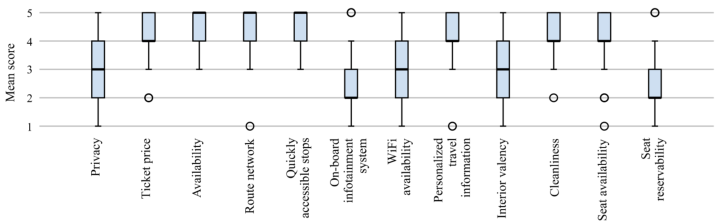
Participants were then presented a set of attributes. These included both, features of an ASB as well as characteristics of an ASB service. Participants were then asked to rate how important each of the features were to them. The results can be seen in Figure 4.
At the end of the questionnaire, participants were asked about the maximum passenger capacity an ASB should offer in a free-form text field. The assessments of n = 78 participants were usable and resulted in Md = 20. The answers ranged from 4 to 130 and n = 23 (29.48 %) participants stated a number of 30 or more.
Table 3. Intent to use future autonomous mobility concepts as well as reasoning.
Table available in the original PDF paper.
Enhancing User Acceptance of Shared Automated Vehicles 117
Figure 4: Participants’ importance rating of different ASB features.
DISCUSSION AND CONCLUSION In this section, the aforementioned results of the online survey are discussed. First, findings are debated following the logical order of the questionnaire. Afterwards, general implications and consequences are considered.
(1) Demographic data Slightly more male than female participants completed the survey. Additionally, there is an obvious overrepresentation of young people under the age of 25. This is clearly due to the partial recruitment of participants from a technical education environment and is also reflected in the current professional status of the respondents, the majority of which are students. Even though the sample cannot be regarded as representative for the general population of Ingolstadt, the results are still valuable since young people are found to be more open-minded towards automated driving (Stegmüller et al. 2019) and might therefore be among the first customers of shared automated mobility concepts.
(2) Mobility demographic data and (3) mobility behavior Despite the sample, which tends to be young and student, car ownership is strong. This supports the notion of Ingolstadt as a car centric community. Car-ownership in non-students is above the national average of around 69 % for the city size category of Ingolstadt (Nobis and Kuhnimhof, 2018). However, especially the share of car owners among students, which does not deviate much from the overall value, is remarkable, considering the overall German average for car ownership in university students falls short of 50 % (Hartmann et al. 2020). Consistency with mobility surveys on the other hand is found in the low usage rate of car sharing (Nobis and Kuhnimhof, 2018).
The most frequent reasons for car use, more flexibility and shorter travel times, already hint towards some important characteristics that service providers of shared automated mobility will have to offer. This also accounts for the most common reason against PT, the lack of availability in the respondents’ residence. The fact that only a potential passenger working for the same employer but not in the same job is raising participants’ willingness to carpool is equally indicating that the thought of possible detours and associated time loss influences judgment on mobility concepts. Furthermore, the importance rating of ASB features shows that priority is clearly on service attributes like ticket price or availability. These aspects
118 Schlichtherle and Remlinger
influence acceptance and were identified as user-oriented factors by Pigeon et al. (2021). While vehicle interior related factors like privacy or valency seem to play a subordinate role in our results, their importance should not be neglected. Shared automated mobility providers have the potential to eliminate frequently mentioned disadvantages of PT like high costs or poor availability by saving on driver salaries and offering a flexible on-demand service while maintaining advantages like not having to find a parking space and being able to make use of the journey time. Likewise, the benefits of motorized individual transport such as reaching a destination faster and a higher level of privacy can be achieved by limiting passenger capacity and creating vehicle interiors that are sensitive to passenger needs. Research in this area, e.g. regarding differences in seating environment needs and their dependence on trip duration (Kipp et al. 2022), should be intensified. Different interior comfort levels can influence whether the service tends to attract passengers from PT or from the private transport sector. Therefore, more attention must be paid to comfort aspects of SAV interiors and current models need to be reconsidered in terms of their design as recommended in Dorynek et al. (2021).
The willingness to share a ride with other passengers through carpooling increases significantly more in females than in males when the potential passenger is of the same gender. The effect size can be considered as moderate. Even though willingness in this case remains relatively low for both genders, as implied by equal medians, this could be further indication that the need for in-vehicle security of different societal groups must be taken more into consideration when designing future driverless mobility concepts as suggested by previous research (Salonen, 2018; Schuß et al. 2021).
(4) Attitude towards autonomous driving and future mobility concepts The self-assessed level of knowledge about autonomous vehicles corresponds to the tech-savvy tending sample. The attitude towards the future use of ASBs can be described as very positive, which falls in line with Azad et al. (2019) who describe that this tends to be the case with younger people.
A considerable amount of participants (29.48 %) expressed an unreasonable maximum number of passengers that an ASB should hold. In this survey, we purposefully avoided priming subjects with e.g. pictures of or explanatory text about the vehicles under consideration. This question implicitly aimed at respondents’ mental representation of SAVs and the result supports the proposal from Hyde (2017) that participants might have a faulty comprehension of the technology in question. From the fact that almost one in three respondents stated an unreasonable passenger capacity, it can be concluded that far more has yet to be done in order to help people realistically understand the use cases of an SAV. Additionally, this is another reason to suspect that the importance of privacy might currently be undervalued by participants. Future research should place special emphasis on the accurate representation and explanation of the vehicles and business concepts being examined to avoid misunderstandings. This could be achieved e.g. by using virtual reality as a demonstrative method in studies.
Enhancing User Acceptance of Shared Automated Vehicles 119
ACKNOWLEDGMENT
This work was funded by the Federal Ministry for Digital and Transport as part of the research project SAVeNoW (FKZ: 01MM20012M).
REFERENCES
Azad, M., Hoseinzadeh, N., Brakewood, C., Cherry, C. R., Han, L. D. (2019). Fully Autonomous Buses: A Literature Review and Future Research Directions. Journal of Advanced Transportation 2019, 1–16. Dorynek, M., Winkler, J., Brettschneider, S., Weinmann, P., Bengler, K. (2021). How
Long Do We Have to Wait for Ergonomic Autonomous On-Demand Mobility? A Benchmark and Expert Study about Shuttles in Europe. In: Peoceedings of the 27th ITS World Congress 2021, 2397–2411. Gao, Y., Zhu, J. (2022). Characteristics, Impacts and Trends of Urban Transportation. Encyclopedia 2 (2), 1168–1182. Hartmann, S., Knappe, A., Seegers, P. (2020). Zwischen Handlungsbereitschaft und Besorgnis. Auswirkungen der Corona-Pandemie auf die studentische Nutzung öffentlicher und privatwirtschaftlicher Mobilitätsangebote. Hyde, S. (2017). Attitudes to autonomous vehicles. Wokingham, Berkshire, United
Kingdom. Published project report / TRL PPR PPR823. ingolstadt.de (2018). Hohe Pkw-Dichte in Ingolstadt. Zahl der Zulassungen steigt kontinuierlich. Stadt Ingolstadt. Kipp, M., Guo, C., Bengler, K. (2022). Evaluation of the Seating Environment of an
Autonomous Taxi on User Needs – An Online Survey Investigation. In: Human Factors in Transportation, 13th International Conference on Applied Human Factors and Ergonomics (AHFE 2022), July 24-28, 2022. AHFE International. Krueger, R., Rashidi, T. H., Rose, J. M. (2016). Preferences for shared autonomous vehicles. Transportation Research Part C: Emerging Technologies 69, 343–355. Lang, N., Hermann, A., Hagenmaier, M., Richter, M. (2020). Can Self-Driving Cars
Stop the Urban Mobility Meltdown? Boston Consulting Group. Nobis, C., Kuhnimhof, T. (2018). Mobilität in Deutschland - MiD Ergebnisbericht.
Studie von infas, DLR, IVT und infas 360 im Auftrag des Bundesministers für Verkehr und digitale Infrastruktur (FE-Nr. 70.904/15). Bonn, Berlin. Nordhoff, S., Kyriakidis, M., van Arem, B., Happee, R. (2019). A multi-level model on automated vehicle acceptance (MAVA): a review-based study. Theoretical Issues in Ergonomics Science 20 (6), 682–710. Pavone, M. (2015). Autonomous Mobility-on-Demand Systems for Future Urban
Mobility. In: Maurer, M., Gerdes, J. C., Lenz, B., Winner, H. (Eds.). Autonomes Fahren. Berlin, Heidelberg, Springer Berlin Heidelberg, 399–416. Pigeon, C., Alauzet, A., Paire-Ficout, L. (2021). Factors of acceptability, acceptance and usage for non-rail autonomous public transport vehicles: A systematic literature review. Transportation Research Part F: Traffic Psychology and Behaviour 81, 251–270. SAE J3016. Taxonomy and Definitions for Terms Related to Driving Automation
Systems for On-Road Motor Vehicles. Warrendale, PA, United States. Salonen, A. O. (2018). Passenger’s subjective traffic safety, in-vehicle security and emergency management in the driverless shuttle bus in Finland. Transport Policy 61, 106–110. Schuß, M., Wintersberger, P., Riener, A. (2021). Security Issues in Shared Automated
Mobility Systems: A Feminist HCI Perspective. Multimodal Technologies and Interaction 5 (8), 43.
120 Schlichtherle and Remlinger
Stegmüller, S., Werner, M., Kern, M., Birzle-Harder, B., Götz, K., Stein, M. (2019).
Akzeptanzstudie “ROBOCAB”. Fraunhofer IAO. Stocker, A., Shaheen, S. (2017). Shared Automated Vehicles: Review of Business Models. Discussion Paper No. 2017–09. International Transport Forum. Wintersberger, P., Frison, A., Thang, I., Riener, A. (2019). Mensch oder Maschine?
Direktvergleich von automatisiert und manuell gesteuertem Nahverkehr. In: Riener, A., Appel, A., Dorner, W., Huber, T., Kolb, J. C., Wagner, H. (Eds.). Autonome Shuttlebusse im ÖPNV. Analysen und Bewertungen zum Fallbeispiel Bad Birnbach aus technischer, gesellschaftlicher und planerischer Sicht. Berlin, Heidelberg, Springer Berlin Heidelberg, 95–113.
LISTED IN THE AHFE DIGITAL BOOKSTORE CATALOGUE
Explore the complete digital volume
Human Factors in Transportation
Read this individual research paper free through the original publisher, or explore the full digital proceedings book.
ISBN 978-1-958651-71-1
Explore this ISBN in the AHFE Bookstore ↗Listed in the July 2026 bookstore catalogue; search by ISBN to confirm current availability · Digital book purchase optional