Miriam Schäffer, Souren Kosejian, Marat Nikita Pak, Wolfram Remlinger (2026). Identification of Preferred Relaxation and Sleeping Postures in Highly Automated Vehicles. In: Intelligent Human Systems Integration (IHSI 2026): Disruptive and Innovative Technologies. AHFE Open Access, vol. 200, pp. 548–558. https://doi.org/10.54941/ahfe1007113
The advancement of automated driving technologies to SAE-Level 4 introduces new opportunities for optimizing vehicle interiors for relaxation and sleep. As the driver is no longer required to permanently monitor the driving process, the in-vehicle time can be repurposed for rest and recovery, especially on long-distance journeys. Although the automated driving system in SAE-L4 independently carries out the driving task, manual driving will still be necessary. Therefore, the cockpit layout of these vehicles must still enable safe manual driving. Current vehicle interiors, and especially driver cockpits, are not designed for relaxation and sleeping. Adaptations of the vehicle interior creating an appropriate environment are needed to relax and to sleep in a small space such as a vehicle’s interior.In this contribution, preferred relaxing and sleeping postures in vehicles are identified to derive comprehensive ergonomic and safety-related requirements for the design of highly automated vehicles. The goal is to establish interior concepts that not only provide comfort but also meet safety standards and accommodate varied user needs. This includes a comprehensive literature review, expert interviews, observational studies conducted in a recliner within a vehicle environment, and the analysis of existing solutions for relaxation and sleep in transportation modes. Additionally, a biomechanical simulation of posture scenarios using RAMSIS simulation tool is employed to visualize sleeping postures within vehicle interiors. Particular attention is paid to the conflict between ergonomic comfort and safety requirements, especially in the context of take-over situations, where users may need to resume vehicle control under certain edge cases.The findings indicate that relaxation and sleep postures are significantly influenced by ergonomic design, seat configurations, and spatial constraints within the vehicle. Key ergonomic requirements for optimal comfort include support for the head, neck, lower back, and legs, as well as adjustable seating options to accommodate side, back, and reclining positions. Special emphasis is placed on leg support and adjustable footrests to maintain comfort and reduce fatigue during extended periods of relaxation or sleep. Furthermore, the study reveals significant discrepancies between perceived and actual ergonomic effectiveness of current seat designs, especially in reclining configurations.Based on the results, specific design recommendations are proposed to enhance sleeping comfort in SAE-Level 4 vehicles. These include optimized seat adjustability, improved head, neck, and leg support, modular seat configurations that support dynamic posture changes, as well as enhanced safety mechanisms. The contribution concludes that addressing these requirements is critical to making sleep a viable and comfortable option during automated driving, ultimately contributing to enhanced well-being and travel experience for passengers.Acknowledgements: This research was supported by Federal Ministry for Economic Affairs and Climate Action in the national research project SALSA.
MOTIVATION Automated driving at SAE-Level 4 (L4) (SAE J3016, 2021) allows the driver, from a legal perspective, to permanently and continuously turn their attention away from the task of driving and engage in non-driving related activities (NDRA) if automated driving is available on the selected road. The prospect of sleeping or deeply relaxing while in transit stands out as particularly valuable—especially for long-distance commuters, business travellers, and shift workers. However, contemporary vehicle cockpits are not optimized for these passive use scenarios. Traditional seating configurations are designed primarily for active driving or upright passenger postures, offering limited adaptability for reclining, relaxing, or sleeping. Cockpits in SAE-L4 vehicles also have the characteristic that they must be designed for comfortable and safe exercise of both, more intense NDRA (compared to SAE-L3) and the manual driving task. Furthermore, sleep is a complex physiological, highly sensitive state that demands specific environmental and ergonomic conditions—requirements that conflict with many current vehicle safety and design standards. The aim of this research is to develop design principles and
Identification of Preferred Relaxation and Sleeping Postures 549 requirements for future HAV interiors that accommodate diverse user needs, support healthy resting postures, and provide a viable option for sleep during travel without compromising safety.
RELATED WORK AND BACKGROUND Fundamentals of Sleep and Postural Ergonomics
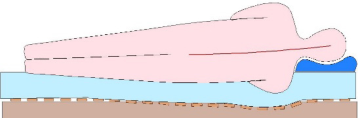
Sleep is a vital biological function necessary for physical and cognitive regeneration. It is regulated by circadian rhythms and influenced by both physiological processes and environmental conditions. The physical sleep environment and consequently the body posture plays a crucial role in sleep quality (Roach et al., 2018; Hüter-Becker et al., 1999). Research has shown that postural support, pressure distribution, thermal conditions, and minimization of external disturbances are key factors for achieving restorative sleep (Hüter-Becker et al., 1999). Especially the postural support plays a crucial role, as different sleeping positions, such as supine (back), lateral (side), and prone (stomach) positions, each have distinct ergonomic requirements (see Figure 1). Among these lateral sleeping positions are most commonly preferred, followed by supine and prone positions (depending on which study is referred to), with each posture demanding specific support measures to ensure optimal comfort and spinal alignment (Vink et al., 2025; Hüter-Becker et al., 1999). Supine sleepers, for example, need a lower pillow height than lateral sleepers to ensure natural alignment of the spine.
Figure 1: Supine (left) and lateral sleeping position (right) (ErgoProTech).
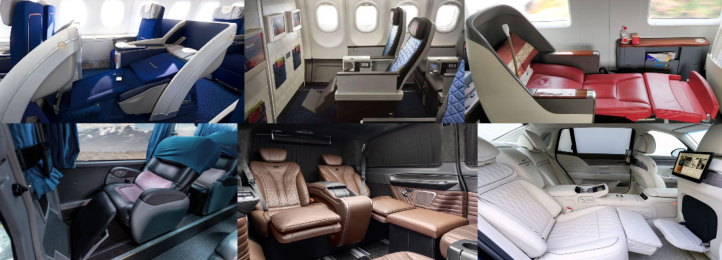
Sleep and Relaxation in Mobile Environments Existing studies on sleep in transportation contexts, such as airplanes, trains, and buses highlight common challenges related to restricted space, seat angle limitations, inadequate neck and lumbar support, pressure distribution, and noise or vibration exposure (see Figure 2). Sleep in upright positions, typical of standard transport seating, has been shown to negatively affect sleep architecture by reducing REM (Rapid Eye Movement) sleep and increasing awakenings (Caballero-Bruno et al., 2024; Roach et al., 2018). Despite incremental advances like reclining seats in business class or noise-cancelling environments in premium rail cabins, optimal sleep conditions remain rare. In vehicles, especially those designed for manual driving, space constraints and upright seat geometry often inhibit relaxation.
Comparisons across different transport modes also suggest that lie-flat configurations significantly improve sleep quality and comfort metrics, particularly in terms of deep sleep and reduced arousals (Caballero-Bruno et al., 2024; Parida et al., 2019a; Roach et al., 2018; Rosekind et al., 2000).
Figure 2: Various passenger seats in sleeping position (from left to right in rows: Lufthansa, Delta, Chinese high-speed train (reisetopia.de), Cruz del Sur, Mercedes- Benz, Genesis).
Interior Design Constraints in SAE-Level 4 Vehicles While SAE-L4 automation removes the necessity for continuous driver supervision, it does not eliminate the need for occasional manual control. Consequently, interiors must strike a balance between technical conditions for relaxed postures and the reengagement capability in take-over situations (Schäffer et al., 2025). This duality introduces conflicting design requirements. Safety systems, such as seatbelts and airbags must remain effective in reclined positions, while seats and controls must accommodate both relaxed and alert states. Moreover, anthropometric variability among users further complicates the development of universally effective relaxation configurations.
Emerging use cases for automated vehicles, such as overnight commuting services, autonomous ride-sharing, and business-class-style long-distance travel, necessitate interiors that support transitions between activity states. Concepts like seats that promote the Zero Gravity position, derived from NASA studies, have demonstrated potential benefits in reducing musculoskeletal strain and improving perceived comfort (Parida et al., 2019b). However, real-world implementation faces technical and regulatory hurdles, including space utilization, crashworthiness, and thermal control. The integration of adaptive systems like dynamically adjustable seat geometries and personalized environmental controls offers promising avenues for future development.
METHODOLOGY
To comprehensively identify ergonomic and safety-related requirements for sleeping and relaxing in SAE-L4, a multi-step methodological approach was employed.
A comprehensive literature review was conducted to evaluate existing research on sleep physiology, seating ergonomics, vehicle interior design, and user behaviour in automated vehicles. Key studies from transportation psychology, human factors, and biomedical research were analysed to understand the multifaceted aspects of sleep quality and posture.
Six semi-structured interviews were conducted with subject matter experts in the fields of automotive design, ergonomics, human factors, sleep medicine,
Identification of Preferred Relaxation and Sleeping Postures 551 biomechanics, safety engineering, and the aviation sector. Five of the six experts come from the automotive industry, while one representative each from the aviation industry and academia was also involved. The interview guidelines focused on identifying key design conflicts, safety concerns, and practical challenges associated with sleeping in vehicles. Expert responses were thematically coded and used to extract common requirements and conflict areas.
In order to gain a deeper understanding of the relaxation and sleeping positions realistically required by users, an empirical posture analysis was carried out on the basis of the results of the expert interviews through a subject study (n = 2). Participants were asked to adopt relaxing and sleeping postures in both an adjustable recliner chair and driver seat of a Hyundai Ioniq 5, both electrically adjustable. Photographic and video data were collected to document head, neck, torso, and limb positions across multiple reclining angles. Postures were analysed to determine biomechanical feasibility, joint loading, and comfort preferences.
The collected data were further analysed using RAMSIS. This allowed for the visualization of anthropometrically accurate human models in various sleep-related postures within vehicle interior constraints. Spatial demands, joint angles, and clearance requirements were quantified to inform seating system design.
RESULTS
The data from all methodological steps were consolidated to derive a comprehensive set of design principles. These principles balance the trade-offs between comfort, biomechanical support, safety requirements, and practical packaging constraints in the limited interior volume of vehicles.
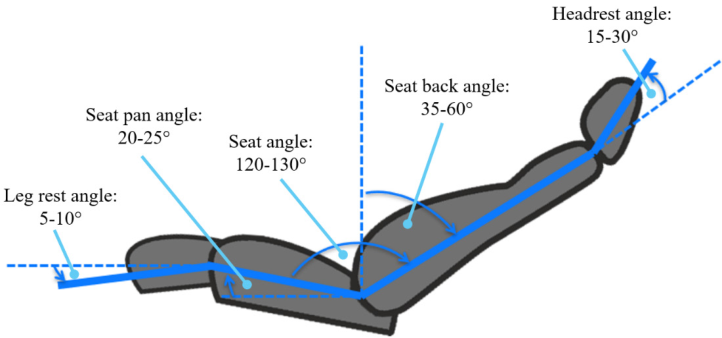
Expert Interviews The experts emphasized the importance of ergonomically optimized seating solutions to ensure occupant comfort and safety in highly reclined or lying positions (see Figure 3). Central recommendations included adjusting backrests closer to horizontal, allowing occupants to fully extend their legs, and providing adjustable headrests. A significant scenario identified by experts was reclining the backrest significantly while raising the seat cushion to improve comfort and ergonomics.
Additional ergonomic recommendations highlighted by experts include the integration of lateral supports to ensure stability, particularly in lateral sleeping positions, and the incorporation of armrests to enhance overall comfort. Notably, two experts specifically proposed relocating the backrest pivot point closer to the occupant’s actual hip rotation point, to better support the natural alignment of the spine. The implementation of lumbar supports was also consistently emphasized as vital for maintaining spinal curvature.
Furthermore, leg supports were frequently cited as crucial, particularly for occupants adopting lateral sleeping positions. Experts repeatedly stressed the importance of comprehensive leg support mechanisms, including lateral
support to minimize discomfort and enhance relaxation effectiveness during prolonged periods of sleep or rest.
Experts underscored the necessity for novel restraint systems, as conventional seatbelts become less effective when occupants adopt significantly reclined or lateral lying postures. Occupant monitoring and adaptive seating adjustments were also highlighted as essential for safely managing transition scenarios from automated to manual driving, where rapid occupant re- engagement with driving tasks may be required.
A key aspect in this context is the distinction between the need of a short nap and restful sleep lasting several hours: As already explained above, the latter may demand for changes in the body position and/or a horizontal lying surface, which entails significant modifications to the cockpit design.
Figure 3: Requirements for comfortable resting in current vehicle seats in supine position and in lateral position according to the experts.
Identification of Preferred Relaxation and Sleeping Postures 553 Subject Study
The two test subjects had the following anthropometric characteristics: 1) female, height 1600 mm (14th percentile), torso length 770 mm, weight 57 kg; 2) male, height 1830 mm (57th percentile), torso length 950 mm, weight 100 kg.
When reclining, the recliner chair provided a comfortable position. The padding and an adjustable backrest and leg rest allowed the user to adopt an almost horizontal posture. This helped to distribute pressure evenly along the back. The generous width of the recliner chair also provided sufficient room for movement at the sides.
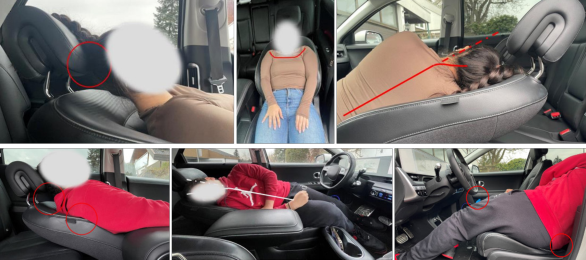
On the vehicle seat, however, the supine position proved to be significantly less comfortable (see Figure 4). Since vehicle seats are designed for an upright posture while driving, the seat geometry reaches its functional limits when lying. Seat contours that support the body when sitting upright lead to pressure points and insufficient support when lying down, especially in the lower back area. This is also consistent with the findings from the expert interviews. In addition, lateral movement is restricted by the side bolsters. There is also a gap in the neck area due to the receding headrest in the reclined seating position, and an unfavourable shift in the body’s centre of gravity occurs. This results in an unstable and tiring reclining position. Further, the current seat kinematics cause the upper body clothing being “pulled” uncomfortably during the backrest reclining process.
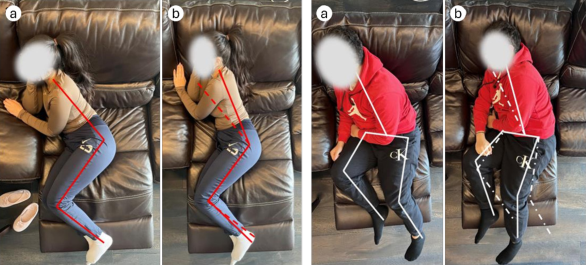
Figure 4: Limitations of current vehicle seats (here: Hyundai Ioniq 5) for reclined backrests in supine and lateral position.Figure 5: Body postures in lateral resting position with backrest in upright position (a)) and in reclined position in the recliner chair enabling more comfortable, straighter posture (b)).
In the lateral position, both the reclining chair and the vehicle seat showed comparable levels of inadequate comfort. In both cases, the head bent and asymmetrical stress occurred in the pelvic and lumbar areas. In the reclining chair, however, the padding had a positive effect on the shoulder area (see Figure 5). In the vehicle, on the other hand, the lack of flexibility and narrow seat contour had a negative effect on the shoulder area. The supine position in the recliner was therefore perceived as the most comfortable posture.
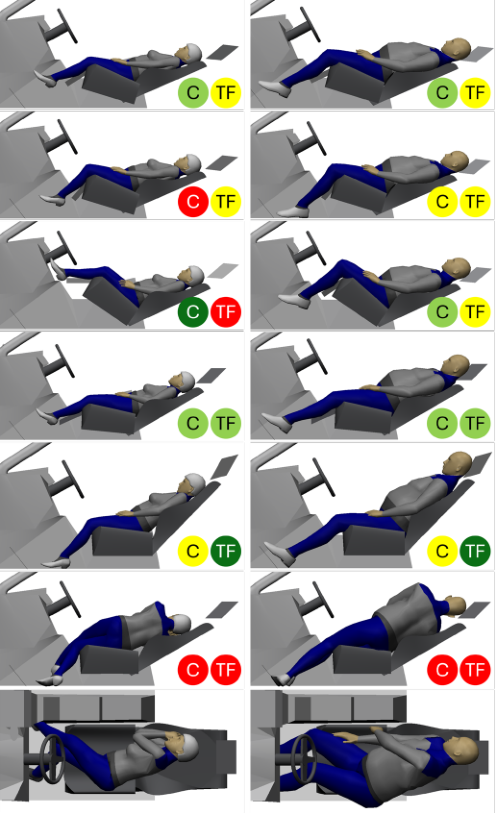
Identified Relaxing and Sleeping Postures Twelve primary posture configurations were identified based on the expert interviews, the subject study, and a RAMSIS analysis. An excerpt of the RAMSIS analysis of a 5th percentile female (corpulence: middle; for comparison test subject body height: 14th percentile) and a 95th percentile man (corpulence: high; for comparison test subject body height: 57th percentile) is visualized in Figure 6. The postures include fully reclined supine lying positions, semi-reclined backrest, seat pan, and leg rest adjustments designed to achieve a Zero Gravity posture, and lateral lying positions. The postures were assessed qualitatively based on the results of the literature research, the expert interviews, and the analysis of the subject study in terms of comfort (C) and technical feasibility in the vehicle interior (TF); ratings ranging from not fulfilled = 1 (red) to fully fulfilled = 4 (dark green). Fully reclined positions generally yielded the most favourable biomechanical alignment for spinal support but required significant longitudinal space.
Key Ergonomic Requirements Following requirements emerged as central principles for optimal resting postures on automotive seats:
Adaptive headrests to accommodate variable neck angles in reclined postures.
Adequate support for the cervical spine, especially in lateral positions.
Adjustable lumbar support to maintain natural spinal curvature.
Modular seat adjustability and lumbar support to allow seamless transitions between upright, reclined, and lying configurations.
Sufficient lateral body support to prevent torso rotation and instability.
Integrated leg and foot support to minimize lower extremity strain.
Continuous seat surface without disruptive gaps between seat elements.
Different seat material hardnesses/paddings to avoid local pressure peaks, especially in lateral lying postures, and ergonomically accommodate the natural shoulder line (e.g., in the shoulder area).
Safety-Related Challenges Safety analyses highlighted critical conflicts between occupant protection and relaxed postures:
Reduced effectiveness of conventional seatbelts in deeply reclined positions and risk of submarining (sliding under seatbelt during crash).
Airbag deployment trajectories potentially misaligned with occupant head and torso positions, further challenges for lateral lying positions.
Increased kinematic variability in lateral lying positions during crash scenarios.
Possible solutions are:
Novel restraint systems capable of securing occupants across multiple reclined and lying configurations. (One expert stated that the conventional three-point belt is not considered as optimal solution for reclined backrest configurations, as it is perceived as uncomfortable and disruptive.)
Challenges in sensor-based occupant monitoring for posture detection and adaptive safety adjustments.
Figure 6: Visualization and assessment of identified resting body postures in RAMSIS.
LIMITATIONS AND DISCUSSION Empirical data were collected in controlled environments rather than in real driving conditions, limiting validity of the observed posture preferences and ergonomic assessments, as dynamic vehicle motion, vibrations, road noise, and external disturbances influence resting positions. Nevertheless, the predominance of lateral lying positions aligns with established findings in sleep research, emphasizing the importance of lateral support and leg elevation for musculoskeletal relief and circulation. Zero Gravity postures enable natural inclination towards positions that minimize spinal loading and promote even pressure distribution. These preferences suggest that future seat systems must go beyond simple recline functions and offer multi- axis adjustability with integrated lower body support structures.
The subject study confirms that conventional seating architectures, derived from driver-centric designs, are fundamentally insufficient for accommodating restful postures. Key ergonomic needs such as uninterrupted seat surfaces, integrated leg and footrests, and highly adjustable head and neck support must be central to design considerations. Furthermore, modularity and user- driven configurability emerge as essential, enabling personalized adaptation for various body sizes, sleep preferences, and journey lengths. The small sample size may not fully capture the wide inter-individual variability in body dimensions, sleep preferences, sleeping habits, postural behaviours, and cultural, demographic, and gender-related factors across different user groups.
While digital human modelling using RAMSIS provided valuable insights into spatial and biomechanical requirements, certain aspects such as soft tissue deformation, subjective comfort perception, and long-term musculoskeletal effects remain beyond the simulation’s current capabilities. Nevertheless, the digital simulation highlights the significant spatial demands of extended recline angles, suggesting that interior layouts in HAV may need to sacrifice traditional seating density in favour of fewer but more flexible passenger modules.
Finally, the study focused on ergonomic and safety aspects during stationary or steady-state autonomous operation. Take-over situations require robust detection and transition protocols to ensure safe and timely reengagement, and represent important areas for future research. To address this, vehicle interiors must integrate advanced alert systems, progressive warnings, and strategically timed activation procedures to facilitate safe transitions. Moreover, dynamic seat positioning and posture adjustments could further enhance occupant readiness by gradually bringing passengers into safer, more alert postures during anticipated take-overs.
CONCLUSION AND OUTLOOK The findings provide insights into the complex interplay between comfort, biomechanics, and safety when designing sleep- and relaxation-capable driver seats. The identified postures and ergonomic requirements largely confirm prior studies but extend the existing knowledge. Conventional vehicle seating architectures are fundamentally unsuitable for accommodating
Identification of Preferred Relaxation and Sleeping Postures 557 extended periods of rest or sleep, particularly in fully autonomous driving scenarios where manual driving duties are no longer required. Key ergonomic requirements include comprehensive head, neck, lumbar, and leg support, modular and highly adjustable seating configurations, as well as uninterrupted seating surfaces to avoid localized pressure points. Digital simulation revealed the significant spatial demands of reclined and side-lying postures, suggesting that future vehicle interiors may require radical rethinking of traditional seat layouts and packaging concepts. Critical conflicts between occupant protection and relaxed postures are underscoring the need for innovative restraint systems and adaptive safety technologies.
Future research should focus on longitudinal real-world field studies within fully automated test vehicles, integrating physiological sleep monitoring, occupant kinematics analysis, and adaptive safety system development. Furthermore, interdisciplinary collaboration across vehicle design, ergonomics, sleep medicine, and automotive safety engineering will be critical to fully realize the potential of sleep-enabled autonomous mobility.
ACKNOWLEDGMENT
This research was supported by the German Federal Ministry for Economic Affairs and Energy (BMWE) in the national research project SALSA.
REFERENCES
Caballero-Bruno, I., Lingelbach, K. Wohllebe, T. et al. (2024). Sleep quality and comfort in fully automated vehicles: A comparison of two seat configurations, Applied Ergonomics, Volume 114, 104137. doi.org/10.1016/j.apergo.2023.104137 ErgoProTech. Ergonomie, die Leitidee unserer Philosophie: Unterfederung mit
„aufgelöster Oberfläche“. https://ergoprotech.de/egonomie-philosophie/, last accessed on 16/10/2025. Hüter-Becker, A., Schewe, H., Heipertz, W. (1999). Physiotherapie. Biomechanik, Arbeitsmedizin, Ergonomie. Thieme Verlag, Stuttgart. ISBN 3-13-101251-X Parida, S., Mallavarapu, S., Abanteriba, S. et al. (2019a). Seating Postures for
Autonomous Driving Secondary Activities. In: Chen, YW. et al. (eds) Innovation in Medicine and Healthcare Systems, and Multimedia, Vol. 145, Springer, Singapore. doi.org/10.1007/978-981-13-8566-7_39 Parida, S., Mallavarapu, S., Abanteriba, S. et al. (2019b). User-Centered-Design Approach to Evaluate the User Acceptance of Seating Postures for Autonomous Driving Secondary Activities in a Passenger Vehicle. In: Ahram, T. et al. (eds) Human Systems Engineering and Design. IHSED 2018. Advances in Intelligent Systems and Computing, Vol. 876, Springer, Cham. doi.org/10.1007/978-3-030-02053-8_5 Roach, G. D., Matthews, R., Naweed, A., Kontou, T. G., Sargent, C. (2018). „Flat-
out napping: The quantity and quality of sleep obtained in a seat during the daytime increase as the angle of recline of the seat increases“, Chronobiology international, Vol. 35, No. 6. doi.org/10.1080/07420528.2018.1466801 Rosekind, M. R., Gregory, K. B., Co, E. L. et al. (2000). “Crew Factors in Flight Operations XII: A Survey of Sleep Quantity and Quality in On-Board Crew Rest Facilities,” National Aeronautics Space Admin., Ames Res. Center, Moffett Field, CA, USA.
SAE J3016 (2021). Taxonomy and Definitions for Terms Related to Driving Automation Systems for On-Road Motor Vehicles.Warrendale, PA, United States. Schäffer, M., Remlinger, W. (2025). “Central Research Questions for Driver
Take-Overs in SAE-Level 4 Automated Driving”, 16. Uni-DAS e.V. Workshop Fahrerassistenz und automatisiertes Fahren, Irsee. Vink, P., Vledder, G., Smulders, M., Song, Y. (2025). “How do we sleep? Towards physical requirements for space and environment while travelling”, Applied Ergonomics, Volume 122, 104386. doi.org/10.1016/j.apergo.2024.104386
LISTED IN THE AHFE DIGITAL BOOKSTORE CATALOGUE
Explore the complete digital volume
Intelligent Human Systems Integration (IHSI 2026): Disruptive and Innovative Technologies
Read this individual research paper free through the original publisher, or explore the full digital proceedings book.
ISBN 978-1-964867-76-2
Explore this ISBN in the AHFE Bookstore ↗Listed in the July 2026 bookstore catalogue; search by ISBN to confirm current availability · Digital book purchase optional