Matthias Wiedemann, Wolfram Remlinger, Klaus Bengler (2021). Application of Galvanic Vestibular Stimulation for the Evaluation of Vehicle Settings in a Fixed-Base Simulator. In: Advances in Human Aspects of Transportation: Part II. AHFE Open Access, vol. 16. https://doi.org/10.54941/ahfe100665
Driving simulation is a well probed and accepted technology for virtual development in automotive engineering. In the usual driving task visual perception is the most important factor. However, for the evaluation of vehicle settings in the field of driving dynamics it is essential, not only to generate realistic visual, but also vestibular cues for the driver. Therefore, dynamic driving simulators are usually applied, though they are a costly investment.Galvanic Vestibular Stimulation (GVS) creates the impression of accelerations by influencing the human equilibrium organ. In flight and driving simulation successful implementations of GVS systems already exist, mainly with the focus on reducing simulator sickness or to improve driver’s adaption to the simulator.Here, a concept for linking a GVS system with a fixed-base driving simulator is introduced. First, the adaption of the GVS system to individual preferences is conducted. In a second step, the evaluation in terms of objective driving behavior and subjective survey data is investigated to describe the influence of the GVS induced acceleration perception. Experiments are run for the driver as well as the passenger role. As a result the experiment should prove, whether the user is enabled to differentiate between various vehicle settings in the field of driving dynamics, as it would be possible in a dynamic driving simulator.
Virtual development is assumed to be the key factor for further success in automotive engineering during the next years. Ongoing diversification to meet customers’ expectations of an individual, personalized car increases the demand of testing procedures. Physical experiments however require the time-consuming and cost-intensive assembling and testing of prototype vehicles. The application of virtual tools has the potential to meet this increasing challenge in many ways.
First conceptual questions can already be discussed in the very early states of the development process in which prototype vehicles are not available at all. Furthermore positive influences are generated for following steps in development. In foreseeable future there will still be the need of physical testing procedures. However, by an improved system knowledge gained in the virtual world, the number of tests can significantly be reduced, while quality and informative value rise.
Today’s development process in automotive engineering is focused on customer relevant properties of the vehicle. Several hundred features and qualities of a new model have to be appraised by its designing engineers. The appropriate virtual methods last from computational fluid dynamics simulation to finite element methods. As the features of a car often are highly emotional, engineers need the possibility to get a subjective impression as well. Hence, not only objective calculation methods are needed but also tools for subjective experience have to be developed. High resolution 3D-models are state of the art for the visualization of design relevant questions. A high number of other vehicle properties can be illustrated in a driving simulator.
HUMAN PERCEPTION OF DRIVING DYNAMICS Visual Perception
Certainly, visual perception is the most important information in the driving task. Most references mention numbers around 90%, but it is uncertain, whether the ratio between visual and other cues can be quantified at all (Sivak, 1996).
Vision is especially needed to percept the absolute position of the vehicle (e.g. speed, yaw angle or side slip angle), the relative movement on the road (e.g. relative speed, yaw angle offset or track offset) and to interact with other traffic participants (Wolf, 2009; Schimmel, 2010). According to Schimmel (2010) for evaluating properties in the field of driving dynamics, speed, radius of curvature, side slip angle, yaw angle and the steering wheel angle are the most important information, that have to be presented as an optical cue.
For a simulator this means, that special effort has to be made in the configuration of displays or projection systems for features as brightness, contrast, field of view or resolution. In simulators, that are state of the art, most of these challenges are already solved. For instance in terms of resolution typical simulator values already are close to the limit of human visual acuity (Greenberg and Blommer, 2011).
Auditory Perception In usual road traffic the aural sense should not be underestimated. The sound of other traffic participants especially in city conditions can help to give orientation in complex traffic situations. Also warning strategies of driving assistance systems often use auditory cues. In the context of vehicle development auditory perception is especially important for questions of sound design or to avoid noise as a consequence of vibrations.
However, in the field of driving dynamics auditory perception seems to have a subordinated role. Certainly, the wheel and driving noise can help engineers, but Schimmel (2010) remarks that track engineers usually do not take them into account.
Haptic Perception Haptic perception denotes the combination of proprioceptive and tactile perception. The first one is important to control the input in human machine interfaces, primary the steering wheel, throttle, clutch or brake pedal. Latter for instance helps to perceive vibrations in the vehicle with high sensitivity. For the evaluation of driving dynamics haptic cues are an important information for the driver. Differences in steering wheel angle, steering wheel torque as well as braking response cannot be assessed without them.
To generate the best possible feeling of immersion in a driving simulator, today force feedback steering wheels or hardware-in-the-loop simulations of braking pedals are state of the art.
Vestibular Perception In a vehicle longitudinal, lateral and vertical as well as roll, pitch and yaw accelerations occur. The human equilibrium organ consists of three semicircular canals to detect angular movement and the otolith organ to perceive linear accelerations and gravity. This complex system is very sensitive in detecting variations. For angular accelerations threshold values around 2-4°/s² are mentioned in a wide range of experiment settings (Tomaske, 1983). In the case of lateral accelerations threshold values even as low as 6.5cm/s² can be found (Kingma, 2005).
Accelerations as a response of steering wheel or brake inputs are important cues to evaluate cornering abilities and braking performance. Schimmel (2010) points out, that especially lateral, longitudinal and yaw accelerations have a strong influence on the perception of vehicle properties.
DRIVING SIMULATION IN THE VIRTUAL DEVELOPMENT PROCESS Demands on Simulators
Driving simulation is an accepted and well probed technology within the virtual development process. In the fields of driver assistance systems or functional interior design mainly fixed-base simulators are used. For analyzing driving dynamics or comfort, such as steering or suspension settings, more sophisticated, dynamic simulators with a motion platform are applied.
Depending on these diverse use cases different approximations to reality are necessary. Negele (2007) uses two generally accepted models to arrange a classification. The first is the three-layer model of the driving task, in which the primary task itself is divided in the navigation, vehicle guidance and stabilization layer (Donges, 1978; Bubb, 2003). The combination with Rasmussen’s model of human behavior (Rasmussen, 1983) leads to different demands on driving simulators.
Figure 1: Scheme to classify driving simulators. (Adapted from Negele, 2007)
Figure available in the original PDF paper.
Whenever there is enough time or the task is not directly linked to driving, some simplifications can be made, as there is the possibility of mental compensation for the driver. For time-critical and skill-based tasks however the whole range of cues for human perception has to be reproduced in high quality. (Negele, 2007; Advani and Hosman, 2001)
In the case of the evaluation of driving dynamic properties this means, that almost no simplifications of reality are possible.
Overview of Technical Solutions As pointed out before, for the evaluation of driving dynamics properties vestibular, proprioceptive and tactile cues are important. For each of them a wide range of technical solutions in simulators was created, lasting from large and cost intensive systems to small but still very effective improvements.
From the very beginning the aim of driving and flight simulation was to represent movements as realistically as technically possible. With the invention of the Stewart platform motion in six degrees of freedom (DOF) was made applicable (Stewart, 1966). As humans do not recognize tilt angles up to 25°, as long as the movement is slow enough, it is possible to use a part of gravity for the impression of accelerations, e.g. centrifugal accelerations by tilting the motion platform (Negele, 2007; Hosman and Advani, 2001). Nevertheless this technique is not always able to reach the values of the real acceleration. Therefore scaling factors in the motion cueing algorithms, which control the platform movement, have to be implemented.
Today’s large simulators use redundant systems to provide best possible vestibular cues. The probably best known example is the combination of the Stewart platform with lateral and/or longitudinal displacement systems like in the Renault, Toyota or National Advanced Driving Simulator. Those simulators in research and automotive development are able to present lateral and longitudinal accelerations at least during the normal driving task without scaling. These abilities of course come with the disadvantage for the operating company to be a costly invest.
Usually Stewart platforms are only suitable for representing motion at low frequencies. Therefore other systems additionally have to be integrated in a simulator to close the gap to reality. Noise Vibration Harshness (NVH) describes occurring vibrations in the vehicle in the transition range between auditory and haptic perception, around 20 to 100 Hz. In driving simulation this usually undesired effect is necessary for a better immersion. Berberich, Gebhard, Bohlen, Danninger and Lienkamp (2012) introduce a technical solution for high and low frequencies by integrating actuators into the steering column and seat rail. Their results show that in the range from 20 up to 60 Hz realistic excitations can be achieved.
Latency Time Entire immersion cannot be achieved by presenting perfect cues for each sensory channel itself. Coordination and synchronization of the different pieces of perceptual information is of outstanding significance. A perfect steering wheel feeling with realistic forces, restoring torque and elasticity becomes worthless if the image generation is not able to show the effects on the screen in real time without noticeable latencies.
Stoner, Fisher and Mollenhauer (2011) assume latency times to be the “most important measure of simulator performance.” At the same time it seems to be complex to calculate the effect on the driver, as there is a lack of explicit numbers (Kemeny, 2001; Stoner, Fisher and Mollenhauer, 2011).
GALVANIC VESTIBULAR STIMULATION Functionality
As explained before, the human equilibrium organ is divided into the semicircular canals for detecting circular motion and the otolith organ to percept linear accelerations. In the canals the movement of hair cells is essential for the transduction of the stimulus into a neuronal signal. The hair cells’ receptors are situated along the circumferential axis of the particular canal. Depending on the spatial orientation of the semicircular canals the acceleration perception results in the specific direction. (Fitzpatrick and Day, 2004; Goldstein, 2008)
While the horizontal canal responds to yaw, the other two canals (anterior and posterior canal) are tilted at 45° to the sagittal (frontal) axis and therefore detect both, roll and pitch movements (Fitzpatrick and Day, 2004).
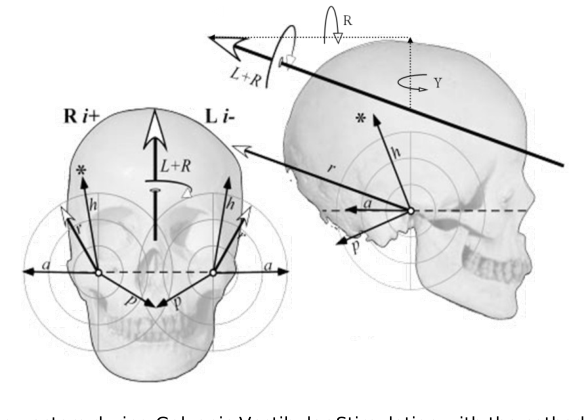
Galvanic Vestibular Stimulation (GVS) creates a virtual signal of head movement by applying a small current to the head at the position of the mastoid with the help of two electrodes. The physiological effect is a bypass of the transduction in the hair cells resulting in a direct activation of the nerve. (Fitzpatrick and Day, 2004) By this method however, all three semicircular canals and the otolith organ are stimulated at the same time, as “unlike a natural stimuli, GVS has no direction” (Fitzpatrick and Day, 2004). As a consequence of the special spatial orientation of the semicircular canals and the mirror inverted structure of the left and right equilibrium organ some of the effects neutralize each other. In result, Fitzpatrick and Day (2004) describe an impression of rotation around an axis of 27.1° from a horizontal line as the calculated effect for the semicircular canals. The effects for the otolith organ in terms of linear accelerations however show no clear results.
Still their conclusion is that test persons during GVS use will percept strong roll and slight yaw accelerations towards the side of the cathode.
Figure 2: Resulting vectors during Galvanic Vestibular Stimulation with the cathode on the left (L i-) and the anode on the right (R i+) side. Vectors of anterior, posterior and horizontal canal (a, p, h), resulting vectors of left and right canals (r), vector sum of left and right side (L+R) with its roll (R) and yaw (Y) components. (Adapted from Fitzpatrick and Day, 2004)
In the meantime even more complex systems were realized. In 2011 a GVS system with the ability to simulate accelerations in all directions was protected by patent (Cevette, Stepanek and Galea, 2011). This is made possible by varying the number and positions of the electrodes.
Application in Flight and Driving Simulation The possibility to create impressions of acceleration with comparatively low effort, makes this technology interesting for the application in flight and driving simulation.
Moore, Dilda and MacDougall (2011) describe the use of GVS in a spaceflight simulator to create the feeling of spatial disorientation after a spaceflight. The previous problem in this simulator was the lack of realism during the landing approach of the space shuttle. While in real conditions landing speed usually was too high, simulator Human Aspects of Transportation II (2021) landings were conducted perfectly by the pilots. Therefore a GVS system was used to rebuild the impression of reentering the earth’s gravitational field. Pseudorandom stimuli influenced the sense of balance and lowered the pilots performance, resulting in significantly more realistic landings.
Another well-known use case is the reduction of the simulator sickness syndrome by GVS. The application of GVS in this context was already patented by Mark in the United States in 1985 (Mark, 1985).
Reed-Jones, Reed-Jones, Trick and Vallis (2007) evaluated a GVS system in different conditions by measuring subjective as well as objective data. Their finding was that the use of GVS significantly reduces motion sickness and disorientation. In terms of objective driving behavior it could be shown that steering variability is reduced. Furthermore there is an increase in speed during curved driving. According to Reed-Jones et al. (2007) this effect points out that the task of curve driving is easier to handle for the test persons with GVS than in usual simulator conditions and therefore shows that driving behavior becomes more realistic.
CONCEPTUAL DESIGN OF THE APPLICATION OF A GALVANIC VESTIBULAR STIMULATION SYSTEM Aims of the Project
As several studies show, GVS is able to generate a realistic feeling of accelerations. The aim here is not to investigate details of physiological function of the stimulation as in medical research, but the possibility of using it in the virtual development process of automotive engineering.
Improvements by the help of GVS can only be achieved, when the technology offers the possibility of reliable and valid decisions on vehicle settings. Therefore it is especially important to investigate the driver’s feeling in terms of subjective driving impression and the ability to identify and separate different settings of the vehicle. Furthermore the analysis of objective driving behavior and comparison to data from real vehicles is necessary.
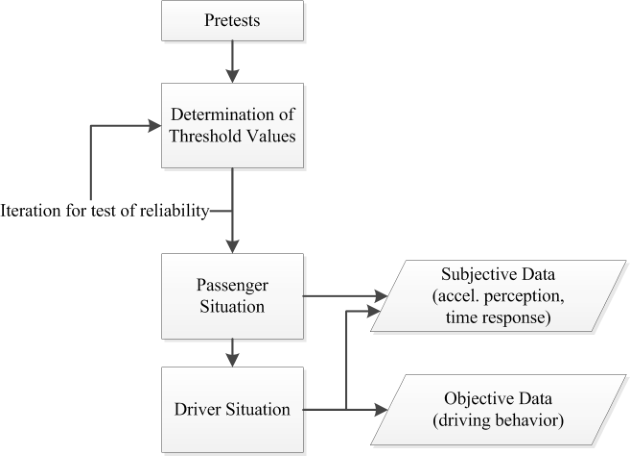
Experimental Design Fig. 3 illustrates the experimental design. After some pretests the evaluation is conducted for the passenger as a well as the driver role. The analysis of threshold values can already give evidence for the reliability of the GVS system. Validity in terms of driving behavior is tested by comparison with real vehicle data.
Figure 3: Experimental design and resulting data
Technical Implementation The hardware of the used GVS system consists of two electrodes, which are connected to a receiver unit. The associated transmitter is connected to a PC-system. The current can be varied by the help of a rotary potentiometer at the receiver unit (max. 1.6mA, DC). The Audi simulators use the software veDYNA (TESIS DYNAware) for calculating vehicle dynamics. The occurring lateral accelerations are read out by the GVS software tool, low-pass filtered and send to the transmitter unit in real-time.
Conclusions from Pretests For the realization of the experiment pretests with four participants were conducted. First, the basic question, whether centrifugal forces can be felt in the right way was investigated. The test persons sat on the passenger seat and were asked to name the direction of the curve while having their eyes closed. Previous to the test drive the highest possible lateral acceleration of 10 m/s² was applied to the GVS system. The participants then had the possibility to adapt the intensity of current to personal preferences.
Correct answers were given in 64.3% of the trials. However there were no mismatches, all other curves just stayed unperceived. The directions of curves with maximal lateral accelerations of 5m/s² or higher were entirely detected. This leads to the conclusion that the chosen intensity of current and thereby stimulation was possibly too weak. None of the participants used a higher current than 0.5 mA. In comparison Reed-Jones et al. (2007) report to have used a current of 0.6-1.25 mA. The main reason for the test persons not to decide for a higher intensity was a prickle and an irritation of the skin at the position of the electrode. Other phenomena were a metallic taste or the feeling of disorientation.
As a consequence the fixation of the electrodes has to be optimized to improve the current flow. For further testing, different types of electrodes, varying in size and form, are applied.
Subjective Evaluation As the pretests already show, the use of GVS has a strong personal component. The same current intensity does not correspond to the same intensity of acceleration perception. This implicates the question how experiment results especially in the case of subjective answers can be made comparable.
First, it is important to adapt the system to the individual threshold values. For safety reasons the current intensity has to stay beyond the pain threshold. As the highest occurring acceleration in the driving dynamics model is limited to 10 m/s², this value is used when test persons are asked to set the highest tolerable current intensity. The perception threshold is determined by a staircase procedure for the variation of the current intensity at an acceleration of 2 m/s². As discussed before, the perception threshold for lateral accelerations in clinical testing conditions is much lower. Otherwise, the threshold in a vehicle probably lies higher as there are several other interference factors. On the simulated test track in each curve lateral accelerations of at least 2 m/s² occur at normal driving speed.
Beside the threshold values other individual influences have to be investigated. It is uncertain whether for each test person the intensity of left or right site stimulation is the same. Consequently, all measurements must take this into account. Furthermore, the manner how the acceleration feeling occurs has to be tested. As discussed above, GVS mainly creates a feeling of roll and slight yaw movement. The conformity with real centrifugal forces must be analyzed in a survey. In addition, the time response between the acceleration perception and the physically correct point in time can influence the level of realism. As well this effect is subject to research.
Objective Evaluation Objective data for the evaluation of driving behavior is recorded. As the aim of the project is to improve the drivers’ ability to differentiate vehicle settings in a simulator, realistic steering wheel or braking inputs are a basic requirement.
The used test track is a precise, laser scanned simulation of a real track, hence several data sets of real driving exist. These can be used to compare for example steering behavior like steering variability or frequencies and specify the level of realism. With the help of the findings of Reed-Jones et al. (2007) it is as well possible to cross check both results.
CONCLUSIONS
Galvanic Vestibular Stimulation is a well investigated technology in medical research. First successful applications in the field of flight and driving simulation support the thesis of a higher level of realism in driving behavior. Pretest results show individual differences in the perceived strength of the stimulation. Therefore, as a first step, individual threshold values have to be determined. In a second step the subjective and objective data is analyzed in both, passenger and driver situation. If an improvement in comparison to a usual fixed-base simulator is observed, GVS systems can be a helpful technology in the virtual development process in automotive engineering.
REFERENCES
Advani, S. and Hosman, R. (2001), “Integrated motion cueing algorithm and motion-base design for effective road vehicle simulation”, Proceedings of the driving simulation conference 2001, pp. 263-271. Berberich, T., Gebhard, P., Bohlen, S., Danninger, O., Lienkamp, M. (2012), “A new approach to the presentation of vibration
phenomena in vehicles“, Proceedings of the FISITA 2012 World Automotive Congress, F2012-J08-002. Bubb, H. (2003), “Fahrerassistenz primaer ein Beitrag zum Komfort oder für die Sicherheit?“, in: Der Fahrer im 21.Jahrhundert, VDI-Berichte Nr. 1768, Duesseldorf. Cevette, M., Stepanek, J., Galea, A. (2011), “Galvanic vestibular stimulation system and method of use for simulation,
directional cueing, and alleviating motion-related sickness”, United States Patent Application Publication, US 2011/0029045 A1. Donges, E. (1978), “Ein regelungstechnisches Zwei-Ebenen-Modell des menschlichen Lenkverhaltens im Kraftfahrzeug”, in: Human Aspects of Transportation II (2021)
Zeitschrift für Verkehrstechnik 24, pp. 98-112. Fitzpatrick, R., Day, B. (2004), “Probing the human vestibular system with galvanic stimulation”, in: Journal of Applied Physiology 96: 2301-2316. Goldstein, E.B. (2008), “Wahrnehmungspsychologie: Der Grundkurs”, Spektrum Akademischer Verlag, Berlin, ISBN 978-
3827417664. Greenberg, J., Blommer, M. (2011), “Physical Fidelity of Driving Simulators”, in: Handbook of Driving Simulation for Engineering , Medicine and Psychology: 7-1 – 7-24. Kemeny, A. (2001), “Recent developments in visuo-vestibular restitution of self-motion in driving simulation”, Proceedings of
the driving simulation conference 2001, pp 15-18. Kingma, H. (2005), “Thresholds for perception of direction of linear acceleration as a possible evaluation of the otolith function”, BioMedCentral Ear, Nose and Throat Disorders 5:5. Mark, H. (1985), “Vestibular Stimulation Method”, United States Patent, 4558703. Moore, S.T., Dilda, V., MacDougall, H.G. (2011), “Galvanic vestibular stimulation as an analogue of spatial disorientation after
spaceflight“, Aviation, Space, and Environmental Medicine, Vol.82, Num.5, pp. 535-542. Negele, H.J. (2007), “Anwendungsgerechte Konzipierung von Fahrsimulatoren für die Fahrzeugentwicklung”, doctoral thesis, Technische Universität München. Rasmussen, J. (1983), “Skills, Rules, and Knowledge; Signals, Signs, and Symbols, and Other Distinctions in Human
Performance Models”, IEEE Transactions on Systems, Man, and Cybernetics, Vol. SMC-13, No. 3, pp. 257-266. Reed-Jones, R.J., Reed-Jones, J.G., Trick, L.M., Vallis, L.A. (2007), “Can Galvanic Vestibular Stimulation Reduce Simulator Adaptation Syndrome?”, in: Proceedings of the 4th International Driving Symposium on Human Factors in Driver Assessment, Training, and Vehicle Design: Driving assessment 2007, Iowa City, University of Iowa, Public Policy Center, pp. 534-540. Schimmel, C. (2010), “Entwicklung eines fahrerbasierten Werkzeugs zur Objektivierung subjektiver Fahreindrücke“, doctoral
thesis, Technische Universität München. Sivak, M. (1996), "The information that drivers use: is it indeed 90% visual?", Perception 25(9), pp. 1081-1089. Stewart, D. (1966), “A platform with six degrees of freedom”, The Institution of Mechanical Engineers Proceedings 1965-66, 180 Part 1 (15), pp. 371-386. Stoner, H., Fisher, D., Mollenhauer, M. (2011), “Simulator and Scenario Factors Influencing Simulator Sickness”, in: Handbook
of Driving Simulation for Engineering, Medicine and Psychology: 14-1 – 14-24. Tomaske, W. (1983), “Einfluss der Bewegungsinformation auf das Lenkregelverhalten des Fahrers sowie Folgerungen für die Auslegung von Fahrsimulatoren”, doctoral thesis, Hochschule der Bundeswehr Hamburg. Wolf, H. (2009), “Betrachtung des Lenkgefühls beim Führen eines Kraftfahrzeugs unter besonderer Berücksichtigung
ergonomischer Erkenntnisse und Methoden“, doctoral thesis, Technische Universität München.
LISTED IN THE AHFE DIGITAL BOOKSTORE CATALOGUE
Explore the complete digital volume
Advances in Human Aspects of Transportation: Part II
Read this individual research paper free through the original publisher, or explore the full digital proceedings book.
ISBN 978-1-4951-2098-5
Explore this ISBN in the AHFE Bookstore ↗Listed in the July 2026 bookstore catalogue; search by ISBN to confirm current availability · Digital book purchase optional