Grzegorz Dobrzyński, Włodzimierz Choromański, Iwona Grabarek (2021). Analysis of Ride Comfort on the Stairs Climbing Wheelchair. In: Advances in Human Aspects of Transportation: Part II. AHFE Open Access, vol. 16. https://doi.org/10.54941/ahfe100674
The paper presents an issue from the field of disabled people transport - analysis of ride comfort on the stairs climbing wheelchair. These studies were carried out in a simulation environment, and on a model prototype in the laboratory. The study was conducted for the author's design of a stairs climbing wheelchair and a wheelchair which is available in the commercial offer.
Contemporary systems of computer stimulation allow to conduct experiments with some models of vehicles at the construction stage. The possible influence on people who would use such a model of vehicle is analyzed at this stage. There are some research works, which provide wheelchairs and tools research experience from motor vehicle traffic issues (Quaglia et al., 2009), (Suyang Yu et al., 2010). Restricting the area of research to the publications that concern only simulation models of wheelchairs that overcome barriers(obstructions) one can only find few R&D centers in the world of interest in the subject matter. The authors of this thesis in their previous publications (Choromanski et al., 2009), (Choromanski et al., 2007), (Dobrzynski, 2010), (Dobrzynski and Choromanski, 2010), (Choromanski et al., 2010), (Choromanski et al., 2012) have presented their own innovative design solutions and the results of the follow-up work were the basis for the development of the patent application.
In other research centers/scientific centres some authors from the USA in their thesis (Ding and Cooper, 2005) regularize the issue of new wheelchair design with have some special capabilities. In addition to defining the current situation, they suggest new directions of inquiry. An example of a computer analysis using simulation tools and optimization of design parameters to the real model are the development of the University of Castilla-La Mancha Campus, Ciudad Real, Spain. This is an example of a complex approach towards solving a scientific problem in terms of building/constructing a new means of transport. Research works (Morales et al., 2006), (Gonzalez et al., 2008), (Morales et al., 2007) present further steps of analytical considerations for static and dynamic models. The effect of various parameters of the control system and its impact on a person using the wheelchair have also been analyzed. A similar problem analysis methodology was adopted in the research center in Italy. The concept of a wheelchair overcoming the obstacles/barriers presented in the research work (Quaglia et al., 2011) is significantly different but the scope and problem analysis tools are very close.
The thesis (Ito, 2009), (Sugahara et al., 2011) present different design solutions of wheelchairs overcoming the obstacles (stairs climbing wheelchair) with an emphasis on analytical and experimental considerations. The authors from Japan have presented a very unique solution of a vehicle driven by the power of hand muscles. The Taiwan Human Aspects of Transportation II (2021) authors in their thesis (Lawn and Ishimatsu, 2003) presented a mechanically complex design where they limited the analysis of overcoming the obstacles only to conditions of keeping the static stability. A similar approach was also presented in the thesis (Chun-Ta et al., 2008).
It was the subject of research that differentiated all the above mentioned works. Each of the research centers offered their design concepts and led the research for them. Despite the work on different structures, researchers pursue their projects in a similar range, using similar methods of analysis and simulation tools.
The purpose of the simulative research presented in thesis was an analysis of the features of a model with the regard to its dynamic characteristics in terms of a ride comfort. The subject of simulation was the implementation of the task of the entry stairs and analysis of the ride comfort. This work was carried out for the simulation model EXPLORER wheelchair which is in the commercial offer.
THE SIMULATIVE INVESTIGATION OF PROTOTYPE DYNAMICS While building a nominal prototype model for the purpose of analyzing the dynamics simulation nominal in terms of overcoming the obstacles such as stairs climbing, the following simplifications were made. The wheelchair prototype is defined in 3 dimensions and has a symmetrical construction in relation to the vertical of the XY plane. The location of the model will be determined in terms of inertial frame of reference OXYZ associated with ground like in the Fig. 1.
The nominal model structure consists of one-box three-dimensional rigid elements, with the bulk parameters. The human model reflects the solid lump of defined parameters, named on the dummy/manikin. The model of the frame and the seat of the wheelchair represents one item that reflects also the bulk parameters of other parts connected to the frame, such as batteries, actuators, electronic module, front wheels, gears, etc. The leveling skid is connected on one end by a pair of rotational kinematic frame of the trolley. The other end of the bars shall be based on the ground. Windmill rolling is connected, in the middle of its length by a pair of rotational kinematic frame of the trolley. The ends of the arms of a windmill will alternately be based on ground. The rear wheels in its axis are connected with the frame by a pair of rotational kinematic. In rotating pairs listed above there is no friction. The structure of the model together with indications was presented on Fig. 1.
Fig. 1. The nominal model to study the dynamics of the overcoming obstacles
Due to the fact that in the process of overcoming obstacles like stairs, front wheels do not come into contact with the ground, they were not treated as a separate part, and mass parameters were attached to the frame.
Model of Contact Wheels, Skids and a Windmill with the Ground Contact phenomena in dynamic passes decide, inter alia, the stability of motion, the intensity of use of the material- support, ability to change the direction of movement, etc. (Blundell and Harty, 2004). In this chapter, these phenomena will have a significant impact on the simulation results of overcoming obstacles. Look at the modeling issues contact phenomena have been assuming that the wheelchair is modeled as a mechanical discreet. This limits the scope of the applicability of the model to a relatively low frequency. At work examined the scope of the: 0.44- 89,09 Hz.
A simplified model of the ground was adopted– it is rigid and consists of flat elements reflecting the floors and surfaces. During normal overcoming of the obstacles there are: hitting, rubbing and slippage. All of these phenomena must be reflected in the modeled system to properly put the actual mileage. Contact model shown below will be used to describe this phenomenon between the ground and the:
rear wheels (right and left),
rolling the Windmill (Windmill arm right and left),
leveling skid To describe the normal forces occurring in the contact with the ground such equation was taken:
Equation available in the original PDF paper.
where: y – is the distance between the axis of the wheels and the ground,
y – current speed changes the distance between the axis of the wheels and the ground, R – is radius of the wheels,
k – modulus of elasticity, e – exponent of elasticity,
c – the damping factor.
The normal force is potęgowo-squrely proportional to values and proportional to the speed of this strain. In the present analysis the deformation must be understood as deflection through the item when in contact with the ground. The nature of the component of normal force elasticity depends on the value of the exponent power and for the value of e = 1 its increment is proportional to the deformation, for e<1 it reflects its course < so called soft elasticity and for e>1 is tough elasticity (Documentation - MD.Adams) Process of attenuation depends on the values of the deflection d with a value which is the damping coefficient changes course (c) during a transitional period (Fig. 2). In addition to the transition period, the item will come in contact, normal suppression component is null and the value of the damping for the deformation of the larger value (d) retains a fixed maximum value.
Fig. 2. Dependence of the Suppression of deformation (deflection) p where p = R-y (Documentation - MD.Adams) In this, the model to reflect the phenomena of friction coefficient of friction course is variable characteristics Fig. 3. The characteristics of this it is included both a static coefficient of friction and dynamic.
Rys. 1 Fig. 3. Process according to the coefficient of friction of sliding velocity Vp (Documentation - MD.Adams) where:
[Equation or mathematical symbol available in the original paper PDF]s – static friction coefficient,
[Equation or mathematical symbol available in the original paper PDF]d – the dynamic friction coefficient,
vs – the threshold speed for [Equation or mathematical symbol available in the original paper PDF]s,
vd – the threshold speed for [Equation or mathematical symbol available in the original paper PDF]d,
vp – sliding velocity at the point of contact. The Program has a contact model indicated Adams and it was used in the analysis (Documentation - MD.Adams). Contact Model will be used to describe the phenomena in the simulation model, for which parameters were nominal and they are presented in previeous work (Dobrzynski, 2013). That characteristics have been the subject of analysis of variants in which the simulation results were compared for their different values. More broadly they were described at thesis (Dobrzynski, 2013).
The Simulation Model of the Human Body and the Model of the Wheelchair-Person Configuration The simulation model used in the research was simplified to a rigid body. Similar simplification were used in the thesis (choromanski, 2009). In addition, the guidelines used in the standard PN-ISO 7176-11 wheelchairs: the dummies dedicated to research (PN-ISO 7176-11:1998) and anthropometry of adult population for the purpose of Polish design (Batogowska and Słowikowski, 1994) were used in these measurements. The works mentioned above contain a description of the geometry of the dummy and their weight, but does not provide information about the position of the Centre of gravity and moments of inertia. This information is necessary for the proper construction of a simulation model of the human body.
To build a solid multisegmental model the dummy representing the human figure and give its parts uniformly distributed mass, corresponding to the human body the Software CATIA V5R20 and in particular the Ergonomics Design & Analysis were used. This tool has an in-built anthropometrical parameters library with the ability to alter them.The Model generated by this tool can be used to determine the spatial structure analyses for ergonomic workplace.
Portions of this dummy such as thighs, drumsticks and shoulders do not have independent parameters. All the dummy has assigned to the mass and the position of the center of gravity, but does not have information about the moments of inertia.
To specify them additional geometric models that correspond to the indicated portions have been built. The guidelines were taken from standards (PN-ISO 7176-11:1998). It indicates the value of the dummies’ mass used in research and how to place the dummy in the wheelchair. There are three components of the construction of the model and their individual weight: body, thighs, drumsticks. There have been chosen three variants of the model with the masses: 50 kg, 100 kg and women's and the selected variants correspond to: 5 centile for women (48 kg), 50 centile for men (76 kg) and 95 centile for men (98 kg) according to (Batogowska and Słowikowski, 1994). These values are within the tolerances specified by the standard.
The dummy Model of mass parameters in line with variations, was introduced in the form of one section of the mechanism, which has been given a model binding.
The standard (PN-ISO 7176-11:1998) provides general guidelines for the placement of dummies on the wheelchair, in order to carry out the research. The body block must be located as close as possible to the backrest of the seat, in an equal distance from each of its sides. The rear edge of the legs has a overlap with the rear edge of the footrest. According to those guidelines, each of the models was placed on his seat of the wheelchair according to the indicated Fig. 4.
Fig. 4. The user coordinate system for the model definition dummy for his seat
While building a connection to the elastic-suppressant of the body block with the wheelchair seat the thesis (Gągorowski, 2009) was used. The same parameter values were used for all variants of the mass of the dummy. In the software used here, there is a possibility to build more complex human models, as well as different seat connections models. Because of the complexity of such activities and the fact that in this analysis the first and foremost goal was to recognize the problem of overcoming the obstacles the identified models had no complex details. The use of a one-block model, prevents also the possible assessment of vibration propagation in different parts of the body.
SIMULATION STUDIES The purpose of the study on the simulation studies concerning the task of climbing the stairs, trolley-man was the analysis of dynamic phenomena. On its basis there was an attempt to assess the applications of the proposed concept as the means of transport. Simulation Model built in MD. Adams (Fig. 5.). In accordance with the assumption adopted for the nominal model, five parts of a related relevant constraints have been built.
Fig. 5. Simulation Model prepared in MD. Adams
The equations of motion integration GSTIF method-SI2 developed by C. W. Gear have been used. It uses the Backward Differentiation Formula (reverse method differentiation). This is the method for integrating with variable row, variable step and is dedicated to solving stiff differential equations systems (Documentation - MD.Adams).
Determination of Acceleration Model Elements One of the essential features of the simulation model is the ability to determine the acceleration of vibrations, which are its elements. As the most important, from the point of view of effects on humans, the contact area of the trunk with the seat wheelchair (Grabarek, 2009), (Grabarek, 2008). The Fig. 6 shows the process changes the weighted vibration acceleration in X, Y, Z directions which affect the dummy model.
Fig. 6. Process changes, vibration acceleration in X, Y, Z directions which affect the dummy Presented characteristics allows you to assess the nature and parameters of the Dunnage between the seat and the stroller frame. The results obtained have been exported accelerations to the DASYlab to analyze vibrations affecting
human model in the course of the entry staircase, which will assess the comfort (Kardas-Cinal, 2010), in accordance with ISO 2631-1: 1997.
Analysis of Vibrations Affecting Humans in the Course of the Entry Stairs Tests carried out at this stage of the development of the concept of design allow you to assess the impact of driving conditions on a moving truck. This is the use of simulation for virtual prototype testing. Analysis of vibrations affecting humans in the course of the entry stairs made it possible to assess comfort, in accordance with ISO 2631-1: 1997 Mechanical Vibration and Shock-Evaluation of Human Exposure to Whole-Body Vibration-General Requirements (ISO 2631-1:1997).
This standard applies to the measurements of vibration and transient, contemplated in 3 aspects: the harm, nuisance and comfort. It includes the following parameters of vibration: vibration acceleration value impact (equivalent to speed up or adjusted), the period of oscillation frequency in the series tripples or octave and the direction of impact. Accelerations are analysed in Cartesian coordinates XYZ, which determines the starting place of penetration of vibrations to the body. The Y direction is determined by the spine. In this thesis only the method of evaluation of ride comfort has been used. The analysis was limited to a single measuring point, located on his seat at the transmission of vibrations at the trunk of the dummy.
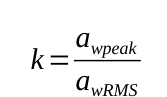
Method involves registering fixed time passes accelerations in three directions, in the accepted measurement point. The entry must contain data from a representative period, but its length is not strictly defined. Then the nature of the assessment should be carried out on an interim basis on the basis of the model vibration on the crest factor.
Equation reproduced from the original PDF.
where: awpeak– peak value of the weighted vibration acceleration in m/s2
aw RMS – effective value weighted vibration acceleration in m/s2 Depending on the result obtained, other values of the weighting factors are applied. In case it is from 1 to 9, the coefficients are used. When it is 9 or more some additional factors are used. Signal for each axle is then divided into frequency bands one-third. Process each band is multiplied by the corresponding weighting factor specified in the standard. For each band the value of the effective (RMS) is calculated . Then the value of successful bands for the three directions are summed up in vector, and the result is the basis for the comparison with the threshold values.
The next step was to calculate the value of the coefficient of the Summit. Its value amounted to 1.34, so in the next step the basic values of the weighting factors were used. A tool was built to calculate the weighted RMS value of the frequency.
In accordance with the guidelines measuring point corresponding to the site of penetration of vibrations in the human body was set. The point is associated with the domain seat wheelchair and it is located at the base of the dummy's torso. In signal analysis the phenomena occurring in 1 second was omitted, because they are associated with a model stabilization in the early stage of simulation.
Value weighted RMS acceleration in the tripple waves have been presented at the Fig. 7.
weighted root -mean-square acceleration, m/s 2
1
2
4
5
8
Frequency band [Hz]
Fig. 7. Effective value of vibration acceleration recorded at the measuring points
The calculated value of weighted acceleration effect, accident frequency, have been referred to the comparative value of the threshold (Fig. 7.). The accelerates in 0,63Hz have the greatest value and in reference to the comparative value of the threshold they are with the border ranges conditions comfortable and slightly uncomfortable. The results for the remaining bands are at the limit of comfort.
The results of these analyses allow to conclude that the proposed working method of the wheelchair overcoming the stairs does not carry negative consequences in terms of ride comfort. Simplification applied at this stage of the simulation understood as the recognition of the model as a solid, rigid, could have caused an increase in the maximum values of the vibration acceleration.
EXPERIMENTAL RESEARCH OF THE PROTOTYPE WHEELCHAIR "WEKTOR" In the following part of the work analyses the comfort analysis is presented for the prototype wheelchair. This design was developed with the participation of the authors of this paper, and is part of the patent application (Choromanski et al., 2010). In laboratory studies there has been an attempt to evaluate the ride comfort of the person moving on wheelchair prototype named "vector". The results of this analysis were compared to the results obtained for a tracked EXPLORER. This is a truck manufactured by Italian company TGR. This vehicle has two settings. To move around the level in the system used three wheels, two of which are driven by the rear and the front is responsible for broadcasting. The stairs and passes through tracks with independent drive to any of them, allowing you to beat any type of stairway.
The ride comfort analysis carried out for the presented prototype of a wheelchair is presented further in the paper. This design was developed with the participation of the authors of this paper, and is a part of the patent application (Choromanski et al., 2010). In laboratory studies there has been an attempt to evaluate the ride comfort of the person moving on wheelchair prototype called "WEKTOR". The results of this analysis were compared to the results obtained for a caterpillar track EXPLORER. This is a truck manufactured by Italian company TGR. This vehicle has two settings. To move around the flat surface it uses the three wheels system, two rear wheels are driven and the front one is responsible for giving directions. However, in order to go on stairs it moves by independently driven caterpillars, allowing to overcome any type of stairs.
In order to register vibrations three-axis accelerometers were used that were also linked to the registration system. A three-axis sensor was placed in the middle of the seat, in a place assumed as resultant reaction of a seat on a passenger. The location of the accelerometer with directions of action is shown in Fig. 8.
Fig. 8. Location and directions of triaxial acceleration sensor action line
Due to the nature of the direction of movement for the further analysis signals recorded in Y, and Z directions were use, where the greatest energy values were observed in Z direction. After having placed the sensor in the selected measurement point (Fig 8) wheelchairs were loaded with a mass of 75 kg. The distribution of weights at the approximate way allowed to replace the human model.
For each of the wheelchair the stage of entry and exit were registered separately. The tested wheelchairs have a different method of surmounting stairs and time of this task depends on many factors. For the purposes of this research work , it was based on the assumption that the operating range is more important which is understood as a job to perform, that is, the ability to overcome the 4 steps and not the time of analysis. The measuring signal was recorded since the moment of switching on the drive on the stairs mode until the moment of reaching the final part of the stairs and switching into the drive on horizontal surfaces mode.
The Fig. 9. below shows the timing of vibration during the entry on stairs. The Explorer wheelchair needed 42 seconds to overcome these stairs while the Wektor 54 sec. the comparison of vibration acceleration time passes have shown differences of maximum values for both.
Fig.9. Timing of vibration during the entry on the stairs
The carried out analysis of vibrations affecting humans in the course of the entry stairs has allowed an assessment of comfort that is compatible with ISO 2631-1: 1997 Mechanical Vibration and Shock-Evaluation of Human Exposure to Whole-Body Vibration-General Requirements (ISO 2631-1:1997). To analyze the results the algorithm described earlier have been used. These results are described in the chart Fig. 10.
0,25 0,20 m/s2
weighted root-mean-square acceleration,
1
2
4
5
8
Frequency band [Hz]
Fig. 10. RMS-adjusted values of the vibration acceleration chart for Explorer and Wektor wheelchairs The chart shows the value of the weighted vibration acceleration RMS for Explorer and Wektor wheelchairs. The comparison of the calculated values from the comparative values of the threshold acceleration showed that the author's concept of getting results in terms of comfort and a stroller Explorer in the low frequency reaches values of slightly uncomfortable. The results indicate the validity of the assumptions of the method of overcoming stairs used in the construction of Wektor. This copyright method gives better results than commercial and recognized construction of Explorer wheelchair.
SUMMARY AND CONCLUSIONS The thesis presented the issues related to the analysis of the model’s dynamics of a wheelchair overcoming obstacles. Simulative studies has been shown together with experimental vibrational impacts on a person moving on the wheelchair. The results obtained have enabled the verification of simulation studies in terms of ride comfort. The use of simulation allows to shorten the development time and to reduce costs associated with prototyping. Another important issue of simulative studies was the simulation model validation studies, which helped to evaluate the compliance of the simulated processes with in reality. Simulation results were compared with the results of the tests on the prototype by obtaining quality compliance in terms of ride comfort.
The conclusions related to the structure of the wheelchair concern on the one hand, ride comfort and on the other hand, the way how to steer it. The completed research/studies and the evaluation of their results have shown that the simulation model design provides sufficient comfort when driving in conditions that may occur during the actual operation. It is worth underlining that the applied simplification of the framework of the cart, as perfectly solid rigid, as well as the way the dummy was designed may have an impact on the change in the value of the transferred acceleration of the dummy.
ACKONWLEGMENT The described research was financed from the ECO-Mobility project WND-POIG.01.03.01-14-154/09. The project was co-financed from the European Regional Development Fund within the framework of Operational Programme Innovative Economy
REFERENCES
Batogowska A., Słowikowski J., (1994), "Anthropometric atlas for the adult poulation of Poland for design purposes", Institute of Industrial Design, Warsaw. Blundell M., Harty A., (2004), „The Multibody Approach to Vehicle Dynamics”, Elsevier Butterworth-Heinemann, Burlington-
Oxford, UK. Choromanski W., G. Dobrzynski, J. Kowara, (2009), The dynamics of a mechatronic wheelchair with the function of overcoming physical obstacles; Proceedings of IAVSD 2009 - 21st International Symposium on Dynamics of Vehicles on Roads and Tracks, 17 – 21 August 2009, KTH, Stockholm, Sweden, CD - volume I, p.143-146. Choromański W., Dobrzyński G., Kowara J., (2007); "Simulation Studies of New Solutions of Wheelchairs". Archives of
Transport, vol. 19, issue 3, Warszawa 2007, str. 31-37. Choromański W., Dobrzyński G., Potyński A., (2010), zgloszenie patentowe pt.: „Środek transortu”, zgłoszenie patentowe nr P.393063; z dn. 26.11.2010r. BIULETYN URZĘDU PATENTOWEGO Nr 12 (1003) z dnia 4.06.2012 r. Choromański W., Fiok K., Dobrzyński G., (2012), "Optimizing the lever propelling system for manual wheelchairs", Bulletin of
the Polish Academy of Scienses – Technical Sciences, December 2012, pp. 793-800. DOI: 10.2478/v10175-012-0092-8 Chun-Ta Chen; Hoang-Vuong Pham, (2008); "Enhanced development and stability analysis of a new stair-climbing robotic wheelchair," Advanced robotics and Its Social Impacts, 2008. ARSO 2008. IEEE Workshop on , vol., no., pp.1-6, 23-25 Aug. 2008 Ding, D.; Cooper, R.A.; (2005) "Electric powered wheelchairs," Control Systems, IEEE , vol.25, no.2, pp. 22- 34, April 2005,
doi: 10.1109/MCS.2005.1411382 Dobrzyński G., Choromański W.; (2010), Wózek inwalidzki z opcją jazdy po schodach – metodyka konstruowania, Acta Mechanica Et Automatica, rok: 2010, Vol. 4, no. 2, s. 37-42. Dobrzyński G., (2010); Badania symulacyjne i eksperymentalne wózka inwalidzkiego z opcją jazdy po schodach jako elemetu
systemu transportu osób niepełnosprawnych. Materiały konferencyjne „Transport XXI wieku”, Białowieża 21- 24.09.2010r. Dobrzyński G., (2013), Doctoral thesis: "Synthesis of the mechatronic wheelchair properties as a part of the transport systems for people with disabilities", Faculty of Transport of Warsaw University of Technology, defence of doctoral thesis: 25.01.2013, [access on 10.04.2013 at: http://bcpw.bg.pw.edu.pl/publication/4062] Documentation „Online Help” - MD.Adams Gągorowski A.(2009), Metoda syntezy mechatronicznych siedzisk pojazdów z punktu widzenia minimalizacji oddziaływania
drgań na człowieka. Rozprawa Doktorska, Politechnika Warszawska 2009 rok.
Gonzalez A., E. Ottaviano, M. Ceccarelli; (2008), On the kinematic functionality of a four-bar based mechanism for guiding wheels in climbing steps and obstacles, Mechanism and Machine Theory, Volume 44, Issue 8, August 2009, Pages 1507- 1523, ISSN 0094-114X, 10.1016/j.mechmachtheory.2008.12.004. Grabarek I. (2009), „Ergonomia – technika i technologia – zarządzanie” : Metodyczne aspekty diagnozowania ergonomicznego
układu operator – pojazd szynowy – otoczenie. /pod red. Marka Fertscha, Wydawnictwa Politechniki Poznańskiej, Poznań 2009, s. 59-68. Grabarek I., (2008) „Zasady ergonomiczne w projektowaniu układów operator-pojazd”. Wydawnictwo BEL Studio Sp. z o.o.
ISBN 83-89968-28. ISO 2631-1:1997 - Mechanical Vibration and Shock - Evaluation of Human Exposure to Whole-Body Vibration -- General Requirements. Ito, T.:(2009) "Simulation-Based Study Using a Stair Climbing Wheelchair," Modelling & Simulation, 2009. AMS '09. Third
Asia International Conference on , vol., no., pp.537-542, 25-29 May 2009; doi: 10.1109/AMS.2009.89; URL: http://ieeexplore.ieee.org/stamp/stamp.jsp?tp=&arnumber=5072044&isnumber=5071935. Kardas-Cinal Ewa: (2010), Ride comfort for various passenger positions in a railway vehicle - simulation study, Archives of Transport, Volume 22, Number 2/2010, p. 189-199, Versita, Warsaw, 2010. URL: http://versita.metapress.com/content/L5574X15L782G225 Lawn, M.J.; Ishimatsu, T.: (2003) "Modeling of a stair-climbing wheelchair mechanism with high single-step capability," Neural
Systems and Rehabilitation Engineering, IEEE Transactions on , vol.11, no.3, pp.323-332, Sept. 2003. doi: 10.1109/TNSRE.2003.816875. URL: http://ieeexplore.ieee.org/stamp/stamp.jsp? tp=&arnumber=1231243&isnumber=27583 Morales R., A. González and V. Feliu: (2007) Mechanical and Kinematics Design Methodology of a New Wheelchair with Additional Capabilities, Bioinspiration and Robotics: Walking and Climbing Robots, Book edited by: Maki K. Habib, ISBN 978-3-902613-15-8, pp. 544, I-Tech, Vienna, Austria, EU, September 2007. Morales R., V. Feliu, A. González, P. Pintado: Coordinated Motion of a New Staircase Climbing Wheelchair with Increased
Passenger Comfort, Proceedings of the 2006 IEEE International Conference on Robotics and Automation, Orlando, Florida - May 2006, pp 3995-4001. PN-ISO 7176-11:1998 Wózki inwalidzkie - Manekiny do badań. Work by multiple authors edited by Włodzimierz Choromański, (2009) "Transport of the disabled – innovative wheelchairs for persons with motor disabilities", Publishing House of Warsaw University of Technology, Warsaw 2009. Quaglia G., Walter Franco, Riccardo Oderio: (2009), Wheelchair.q, a mechanical concept for a stair climbing wheelchair,
Proceedings of the 2009 IEEE, International Conference on Robotics and Biomimetics, pp. 800-805, December 19 -23, 2009, Guilin, China. Quaglia G., Walter Franco, Riccardo Oderio: Wheelchair.q, a motorized wheelchair with stair climbing ability, Mechanism and Machine Theory, Volume 46, Issue 11, November 2011, Pages 1601-1609, ISSN 0094-114X, 10.1016/j.mechmachtheory.2011.07.005. (http://www.sciencedirect.com/science/article/pii/S0094114X1100139X) Sugahara, Y.; Yonezawa, N.; Kosuge, K.: "A novel stair-climbing wheelchair with transformable wheeled four-bar linkages,"
Intelligent Robots and Systems (IROS), 2010 IEEE/RSJ International Conference on , vol., no., pp.3333-3339, 18-22 Oct. 2010. doi: 10.1109/IROS.2010.5648906; URL: http://ieeexplore.ieee.org/stamp/stamp.jsp? tp=&arnumber=5648906&isnumber=5648787 Suyang Yu, Ting Wang, Xiaofan Li, Chen Yao, Zhong Wang and Di Zhi: Configuration and Tip-Over Stability Analysis for Stair-Climbing of a New-Style Wheelchair Robot, Proceedings of the 2010 IEEE, International Conference on Mechatronics and Automation, pp. 1387-1392, August 4-7, 2010, Xi'an, China.
LISTED IN THE AHFE DIGITAL BOOKSTORE CATALOGUE
Explore the complete digital volume
Advances in Human Aspects of Transportation: Part II
Read this individual research paper free through the original publisher, or explore the full digital proceedings book.
ISBN 978-1-4951-2098-5
Explore this ISBN in the AHFE Bookstore ↗Listed in the July 2026 bookstore catalogue; search by ISBN to confirm current availability · Digital book purchase optional