Iwona Grabarek, Wlodzimierz Choromanski (2021). Ergonomic Issues in the Design of Innovative Means of Transport and Transportation Systems. In: Advances in Human Aspects of Transportation: Part II. AHFE Open Access, vol. 16. https://doi.org/10.54941/ahfe100672
This article focuses on the design of ‘a driver-passenger’ interface for two types of vehicles (Eco-car and PRT system). However, this solution has different purposes in each case. The Eco-car is driven by a human, so the issues under consideration are as follows: driving of the vehicle by upper limbs only and adaptation of key elements of the interface to the individual features of the driver. The PRT system itself combines some features of individual and public transportation. Despite the fact that the vehicle is not driven directly by the passenger, the passenger’s influence on the vehicle operations is much stronger than in conventional means of public transportation in urban areas. This article deals with the innovative design of such an interface. This research has been carried out as part of the ‘Eco-Mobility’ project, 85% co-funded by the European Regional Development Fund under the Operational Program-Innovative Economy.
Degradation of quality of life in urban areas results from i.e. increasing transport congestion, alarming air pollution levels or degradation of ‘acoustic climate’ in urban areas. These factors imply new challenges for designers of means of transportation and transportation systems. The scientific research is focused on a number of issues:
search for design solutions that would allow minimum energy consumption, minimum emissions and the use of new material technologies including recycled materials
other organizational methods of vehicle use including vehicle sharing
adaptation of vehicles for senior individuals with limited physical capabilities as well as for disabled individuals in wheelchairs
designing new means of transportation and transportation systems that allow human-free operations (APM systems / Automated People Mover, ATS / Automated Transit System, ATN / Automated Transit Network). These systems strive for combining the advantages of public and individual transportation.
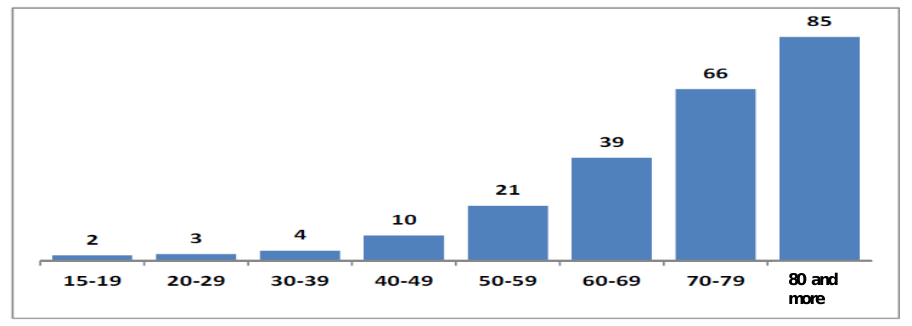
NEW DESIGN PHILOSOPHY IN MEANS OF TRANSPORTATION AND TRANSPORTATION SYSTEMS Ageing societies in industrialized countries are a common and permanent phenomenon particularly visible in Europe. 100 years ago, the population of Europe constituted 15% of the world´s total. By 2050, this share is forecasted to be three times less. (Leśnikowska-Matusiak, I., Wnuk, A, 2011). The cyclical European Demographic Report published by the European Commission describes demographic facts and trends in the E.U. member countries. The number of people aged over 65 among the total population is set to increase from 17, 1% in 2008 (84, 6 million) to 30% in 2060 (151 million). The number of people aged over 80 is forecasted to triple from 21,8 million in 2008 to 61,4 million people in 2060 (2009 Ageing Report, The European Parliament). The percentage of people with limited mobility in various age groups can be determined based on the 2000 GUS (Główny Urząd statystyczny – (Polish Central Statistical Office) data (Figure 1).
80 and more
Figure1. Percentage of people with limited mobility % /GUS 2010/
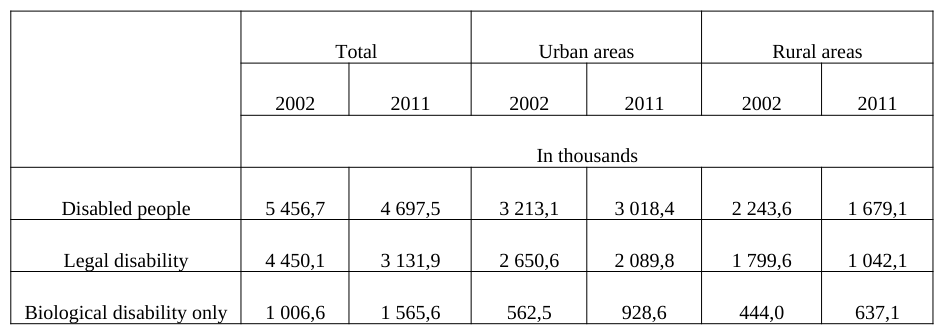
Disabled people are part of the group of people with limited mobility. There are two types of disability that are recognized in Poland: legal disability and biological disability. The legal disability is being evaluated by authorized institutions. The biological disability is one of the most important health aspects. This issue becomes more and more fundamental as life expectancy increases. The assessment for biological disability is based on criterion of limited ability to perform day-to-day physical activities that persists for six months or longer.
Table 1: Disabled people by disability level between 2002 and 2011 (GUS, Raport z wyników, Narodowy Spis Powszechny
Ludności i Mieszkań 2011)
The figures above can help the designers of transportation systems realize how challenging their tasks will be in the nearest future. This process should be intensified due to some other, equally important, challenges of today’s civilization such as: increasing transport congestion, alarming air pollution levels or strong degradation of ´acoustic climate´ in urban areas. Designing innovative transportation systems, in particular for urban areas and for people of various physical fitness levels, requires a different approach and a different design philosophy. Mobility, i.e. ability of people, machines, goods or ideas to move, is one of the fundamental features of the modern world. Mobility allows:
exploring the world
individual development
living social life.
The mobility of population increases in areas where transportation systems are made available. Accessibility primarily concerns people with reduced mobility, disabled people, elderly people, families with young children and young children themselves: they should have easy access to urban transport infrastructure. The social aspects of mobility in towns and cities present a challenge. Urban transport needs to be affordable also to people on low income. Citizens with reduced mobility and senior citizens expect increased and higher quality of mobility, as personal mobility is crucial to independence and freedom. Two design approaches (user-centered design and universal design) can potentially help meet expectations of people that use transportation systems in urban areas and increase their mobility.
What is the user-centered design? The key differentiating factor from other product-design philosophies is that the user-centered design tries to adapt the product to how users can, want or need to use it rather than forcing them to change their behavior to adjust to the product.
The International Usability Standard, ISO 13407, specifies the principles and activities that underlie the user- centered design:
The design is based on an explicit understanding of users, tasks and environments
Users are involved throughout design and development
The design is driven and refined by user-centered evaluation
The process is iterative
The design addresses the entire user experience
The design team includes multidisciplinary skills and perspectives.
The user-oriented design is always an iterative process that involves the testing of each introduced change. UCD can be seen as a specific philosophy of an organization, but also as an element of product life-cycle management. The ergonomic design approach is summarized in the principle of user-centered design. Both groups of rules have the same goal - to design equipment that will achieve the best possible fit between the users (drivers, passengers) and the equipment (vehicle) such as the users’ safety (freedom from harm, injury and loss) comfort, convenience, performance and efficiency are therefore improved.
The Universal Design is the design of products and environments that are to be:
Usable by all people to the greatest extent possible
Without the need for adaptation or specialized design.
The universal design principle stipulates that the primary solution must be designed to anticipate the needs of all users. One of the key goals of the universal design strategy is to promote equality and ensure full participation in social life to people with limited functions by eliminating the existing barriers and preventing new ones from arising. The universal design concept sets new ways of thinking. It is based on the equality principle to a larger extend than the concept of general availability for individuals with limited functions. Whereas general accessibility for disabled individuals can be achieved with sophisticated solutions, the concept of universal design is based on the principle that the basic functionalities and solutions will be designed to match the needs and capabilities of all potential users. Accessibility for all people should be seen as a starting point for the designer. Products and environment need to be designed to serve people of all ages, various capabilities and disability level. The key aspects that need to be considered here include ability to move, see, hear and perceive as well as environmental vulnerability. The key aspect of the universal design strategy is to always strive for better solutions.
Universal design strategy is innovative and can be defined with seven key rules:
Equitable use
Flexibility in use
Perceptible information
Simple, intuitive use
Low physical effort
Tolerance for errors
Size and space for approach and use. The Eco-Mobility project is aimed at designing innovative means of transportation. One goal of the project was to design the vehicles (the Eco-Car and PRT vehicle) in line with the two above mentioned design concepts, so that the vehicles are usable by users with various levels of physical ability.
The process of vehicle design begins with a discussion on the size and type of the vehicle and the number of occupants that the vehicle should accommodate. The very first step in designing a vehicle is to determine the user population(s) and their anthropometric and biomechanical characteristics. The anthropometric data of the user population will help determine various basic dimensions of the vehicle. The biomechanical data helps design the vehicle so that the users will not be required to exert or be subjected to forces that are above their tolerance or comfort levels (Bhise, 2012).
SPECIFIC FEATURES OF THE VEHICLE DESIGN The object of ergonomic design is always a system consisting of two key sub-systems: human and technical, i.e. system human-machine (Tytyk, 2001). Designing means of transport in line with the human’s psychophysiological requirements is crucial to their ergonomic quality. For most means of transportation the design is a two-way process. The designer needs to meet on the one hand, the requirements regarding the workplace of an operator (i.e. driver, pilot) and the passenger space on the other. Those two sets of requirements are not always in line with each other, but one area that is always common is ´transport safety´. Therefore, two systems are subject to analysis and design: the operator-means of transport system and the passenger – means of transport (Grabarek, 2009).
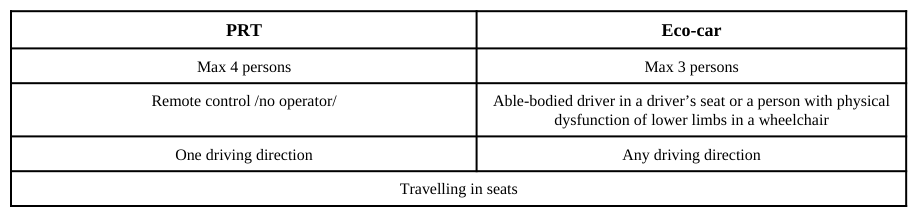
The defining ergonomic requirements for the newly-designed means of transport calls for a brief description. (Grabarek and Choromanski, 2012). The Personal Rapid Transit (PRT) – is a zero-emission, intelligent transportation system, combining features of individual and public urban transport (´point to point´ or ´door to door ´) that involves small, four-passenger, automated vehicles operating on a network of specially built guide ways – usually an overhead monorail track. A non-stop, point-to-point travel bypassing all intermediate stations is fully available for people with various levels of disabilities. In the system, humans are passengers and the automated vehicle requires some very simple actions from them including selecting the destination station on a touch screen. One innovative feature of the urban, electric Eco-car is that it can be used by both able-bodied and disabled people in wheelchairs. The special interior design, including the driver’s seat and control panel, allows a person with physical dysfunction of lower limbs to drive the car without the need to leave his or her wheelchair. In the Eco car, a human can play a role of the driver or a passenger.
Table 2: Initial assumptions on functionality of the PRT vehicle and the eco-car PRT Eco-car
THE ROLE OF INTERFACE IN INNOVATIVE MEANS OF TRANSPORT As mentioned above, both the Eco-car and PRT meet users’ expectations. Both systems are designed as a support to urban public transport systems and are to be available to the public. The authors of this article focus on solutions that allow a simple and intuitive use of both types of vehicles. In case of the Eco-car the following processes are subject to analysis: entering the interior, adjusting the control panel to the driver and the driving of the car. In the PRT the analysis of vehicle/human interaction is much more limited and the following systems are not subject to analysis: CAN network information systems aimed at supporting all power supply, vehicle propulsion system as well as vehicle management systems. The user’s interface (driver’s or passenger’s) channels communication between the user and the vehicle. For each of the considered cases, the scope of communication is different, but in each case the user was able to accomplish the following actions unaided:
Entering and exiting the cabin
Placing a wheelchair in the right position and locking it
Providing back support to a person in a wheelchair
Accessibility of the interface / control panel
Using of the interface / control panel.
Designing functional and ergonomic vehicles requires numerous analyses and extensive research i.e. surveys among disabled people acting as a group of experts. Building an intuitive interface that is optimal from the user’s perspective requires some proven solutions, including:
Effective communication of the system’s functionality
Informing the user about the status and all possible changes of the system
Care for user’s safety and error prevention
Supporting user’s autonomy and sense of control
Interface use - easy to learn and remember
Efficient system without delays The key rules for designing user’s interface include:
Layout – the interface should be divided into different areas responsible for specific functions
Keeping the user informed – the interface should inform the user on his/her current location and communicate additional key information
Esthetics – the interface should strike a balance between the amount of the information displayed and its visual attractiveness
User’s experience – the interface should be easy to learn for beginners and easy to use for experienced users
Consistency – the interface should be consistent in order to help the user anticipate the results of his/her actions
Optimum effort – the interface should allow to achieve the desired goal with as few steps as possible.
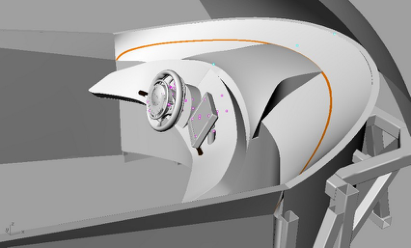
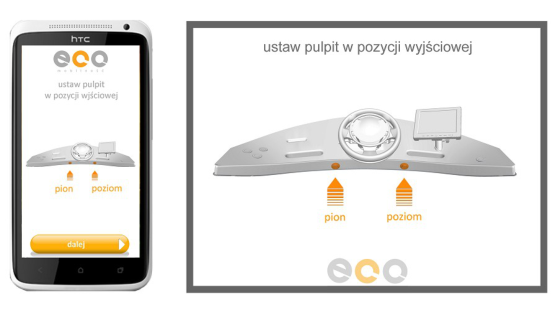
Eco-Car The innovative character of the electric Eco-car makes it usable by both able-bodied persons and disabled people in wheelchairs. Cabin design, and in particular the design of the driving seat and the control panel, makes it possible for a person with the physical dysfunction of the lower limbs to drive the car without the need to leave his or her wheelchair. People with higher levels of disability require an autonomous, ´driverless ´vehicle. Various ages and levels of disability determine the channels of communication between the user and the Eco-car. In the Eco-car, humans can play the role of a driver or a passenger. Whereas able-bodied people do not experience any serious barriers in driving a car, a disabled person in a wheelchair can only do it without assistance by having a remote control over actions that are necessary to set up the car before the driving starts. What is understood as a ´driver’s interface´ in the Eco-car is the system that consists of three key elements: remote control, touch screen mounted in the control panel and a multi-function driving wheel. The control panel is mobile and can be easily adjusted, which makes it possible for every driver to feel comfortable (see Figure 2).
a) b)
Figure 2. a) Design of the control panel area of the Eco-car b) Mock mobile desktop of the eco-car
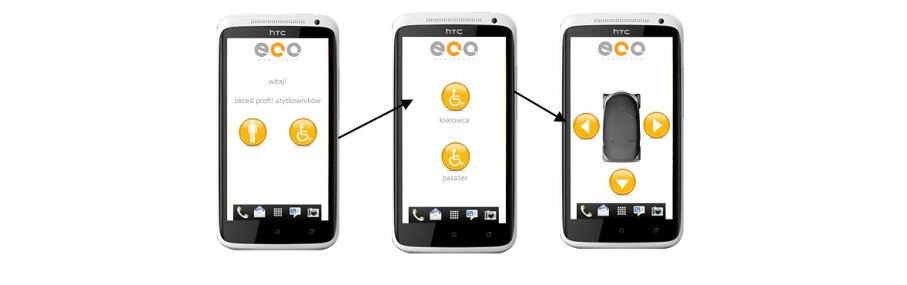
The remote control is the first device used by the driver to select a driving mode (specific configuration of the Eco- car). There are four different driving modes in the Eco-car:
Each mode requires different sequence of activities and commands prior to the starting of the car. While seated in its seat (or in a locked wheelchair), the driver can also use another element of the interface i.e. the touch screen mounted in the control panel.
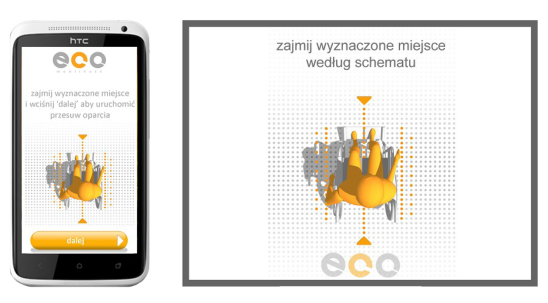
The selection of any mode by a disabled driver in a wheelchair requires a sequence of actions, including the reconfiguration of the interior, allowing to locate the wheelchair in the right position and lock it in. The support for the drivers´ back is provided by the standard drivers’ seat which has folded in the first place to allow space in front of the steering wheel for the driver’s wheelchair. All these actions, with the exception of entering the interior by the driver in a wheelchair, take place automatically after a certain command is selected on the remote control (see Figure 3).
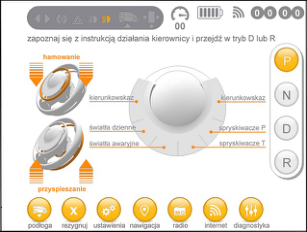
Figure 3. Sequence of screens showing selection of the user type /driver - kierowca; passenger – pasażer/ Mode selection: driver in a wheelchair – initiates the process of lowering the car’s floor to the ground level as well as folding and moving the standard driver’s seat inside the cabin. After the sequence is complete, one selected door opens. The figure below depicts the location of a locked wheelchair inside the cabin. The mode selection is available on the remote control or on the touch screen.Figure 4. Location of the wheelchair in the cab’s axis / position your wheelchair as shown on the diagram – zajmij wyznaczone miejsce według schematu/Figure 5. Desktop adjustment manual /set the desktop in the original position- ustaw pulpit w pozycji wyjściowej/ a) b)Figure 6. Consecutive screenshots from the touch screen: a) multifunctional steering wheel manual, b) screen appearing in the driving mode
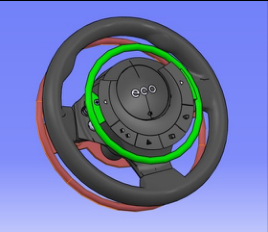
Legend: Refer to the service manual of the steering wheel and select mode D or R – zapoznaj się z instrukcją kierownicy I przejdź w tryb D lub R Turnsignal - kierunkowskaz Daytime / emergency lights - Światła dzienne /awaryjne Sprinklers - Spryskiwacz Breaking – hamowanie Accelerating - przyspieszanie Another element of the eco-car driver’s interface is the circular multifunctional steering wheel that allows the driving of the car with the upper limbs only /Figure 7/.
Figure 7. Circular multifunctional steering wheel
The steering wheel is one of the elements of the ´drive by wire´ system that was used in the Eco-car. This means that the traditional mechanical connections (between the steering wheel and the wheel turning mechanism or between the brake pedal and the wheel braking mechanism) were replaced by using electrical or electro-mechanical systems for performing various vehicle functions. This solution is a fundamental part of the design for the following reasons:
allows a significant increase of the usable space through the elimination of many mechanical systems
allows an easy connection of other steering mechanisms (e.g. a joystick)
allows the parameterization of the steering system (e.g. an analysis of ´steering system sensitivity´ – i.e. the variability in the ratio of the steering wheel rotation to the corresponding turning angle of the turning wheels
makes is easy to customize the steering system.
These advantages are however offset by some significant challenges, e.g.
reliability and safety issues
issue of synthesis of complex feedback loops: from the steering wheel to the turning wheels and from the turning wheels to the steering wheel.
All the issues mentioned above were subject to research within the ECO-Mobility project. The research focused in particular on the issue of the steering wheel coupled with the ´drive-by-wire´ system for drivers with disabilities. The in-depth analysis was presented in (Choromanski et al 2013). ´Steer-by-wire´ oversees turning wheels’ angles, enhances driving comfort and allows the intervention of the vehicle’s supervisory system irrespective of the driver. ´Brake-by-wire´ monitors the vehicle’s braking system and also allows the intervention of the supervisory system, irrespective of the driver, in order to adjust the braking forces on each wheel of the vehicle to the values that are appropriate given the current road conditions. The performed simulation results show that the vehicle is able to pass the standardized test often called the ´moose test´. It is assumed that the driver may, to some degree, have difficulties holding the steering wheel. Thus, the analysis of the turning velocity of the wheels should provide an answer to the question of how to adjust the maximum turning range of the steering wheel in the vehicle.
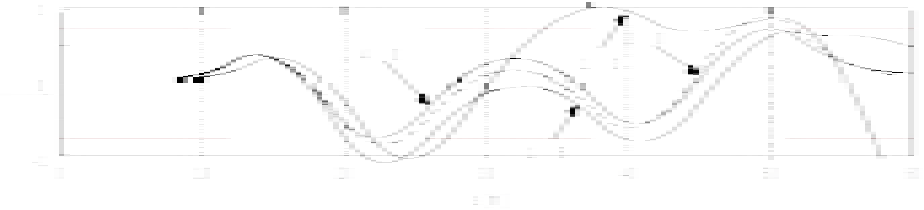
Figure 8. the results of driving simulation in the ´moose test´. Distance of the gravity center point of the car model from the road axis, for different preset values of the maximum speed of turning the steering wheel
Figure 8 shows the vehicle’s trajectory simulation results of the dynamics model. The “13” line indicates the distance of the vehicle’s gravity center point from the road axis, in the case of limitation to the maximum velocity of turning the front wheels to the value vs = 13 ⁰/s. In this case, it failed to keep the vehicle within the required distance range from the road axis. The “15” line shows the velocity vs = 15 ⁰/s, line “20” – velocity vs = 25 ⁰/s and line “40” – velocity vs = 40 ⁰/s. The results show that a steering velocity of at least vs = 40 ⁰/s is required for the positive test result. For a maximum turning angle of the front wheels αmax= 35 ⁰/s, to be achieved through a 1.25 rotation of the steering wheel, the wheel would have to be turned at a velocity of at least vk = 514 ⁰/s, and for a 0.5 rotation, just 206 ⁰/s. The result of a test is considered positive if the solution is contained between the two red lines (Figure 8). Only the trajectory corresponding to40 ⁰/s has the positive test result. Reducing this velocity requires increased sensitivity of the steering wheel e.g. adoption of the maximum front wheels turn corresponding to only one wheel rotation (and not 1.25, as assumed in the simulations performed).
Personal Rapid Transit Operations of a PRT vehicle are remotely controlled, and this process does not require human intervention. The main controlling device is a passenger interface, i.e. a touch screen. The passenger selects the final destination prior to departure. He or she can also change the selected destination during the trip, provided that the time needed for this task is shorter than the time to reach the destination. This restriction is implemented in the software. Moreover, in the interface case, four buttons are displayed: control center call- in order to obtain information, ALARM call, having priority among all signals reaching the center, as well as buttons to open and close the door.
The opening and closing of the vehicle’s door is done manually during the stop at a station. On selecting the destination and pressing the START button, the door closes and the ‘door buttons’ in the interface casing become inactive. After coming to the stop at the destination, a signal is generated that opens the door. The functionality of the interface depends on its layout within the cabin space, which makes PRT usable by people in various physical conditions. During the trip, the passenger and his/her wheelchair is secured in the vehicle axis (facing forwards or rearwards). From this position, he or she shall have good access to the interface. Ensuring access to the monitor/interface for smallest person sitting in a wheelchair, or C5 ♀, is in this case a necessary and sufficient condition. By installing two monitors on the opposite walls, operations using the right hand are allowed, depending on the location of the wheelchair in relation to the direction of driving. The intuitive interface depends on the graphic design, enabling:
the ability to detect information
the ability to distinguish information
the ability to recognize information content or meaning of the signal.
The ability to detect and differentiate information depends on the readability of the displayed content. Catering for information recognition leads to high intelligibility and an intuitive interface. Communication with the interface starts with the reading of information or questions transmitted by the device. In order to make it convenient for the user, appropriate parameters should be ensured:
typeface and font size
text layout
color, shape and size of display graphics
monitor brightness.
The Polish standard specifies the format for presenting the information (ISO 13407: 1999). The recommendations are aimed at assuring readability and legibility. It is, however, the users’ task to comprehend the displayed information. The intelligibility of the displayed image depends on:
the language in which text is displayed
proficiency in the use of interactive or multimedia devices.
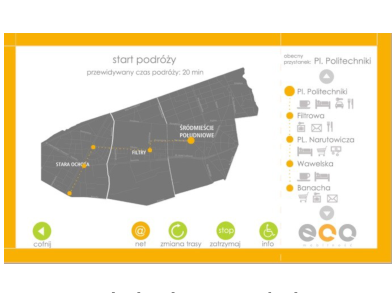
It is a valuable and widespread practice to allow the user to select the language of communication with the machine. Often elderly people may have a major problem handling multimedia devices. Accustomed to obtaining information in the form of text, they are not always able to digest information transmitted in other forms, such as graphic characters. The PRT interface uses both text and graphical elements (icons and symbols). One measure of the interface intuitiveness is the user’s ability to predict the system’s response to his or her actions. This results in a quick and convenient operation of the program and therefore, there is no need for further instructions or training. The interface design allows the passenger to choose his or her destination in several ways. A person who does not know the area in which the PRT system operates may be in the situation that he or she only knows the name of the destination station. By contrast, for people using the system on a daily basis, it may be the fastest way to choose the destination by pointing it on a map. Groups of the same elements are present on many screens and they are located in the same spots. Consistency regarding shape, color and position enhances the intuitiveness of the interface as a whole. A user seeing such an element expects that the next screen will display similar objects in similar positions and playing similar roles. These elements may include, for instance: header, commands UNDO, NEXT.
The interface consists of a number of screens: the welcome screen allowing the selection of the target stop in several ways, the screen to confirm the selection and the screen displayed while driving.
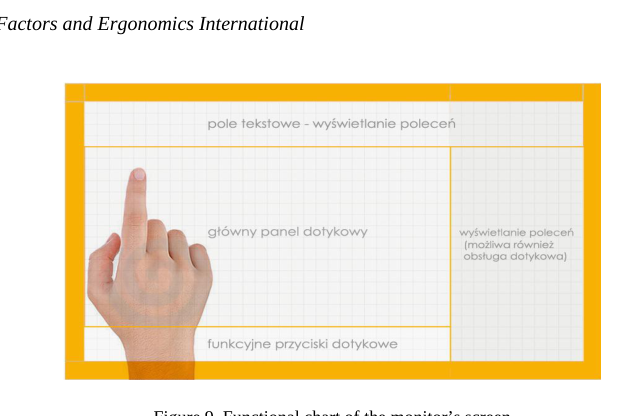
Figure 9. shows the localization of functional areas on the screen used in the PRT cabin. The darker area on the right hand side of the screen is easily available only for able-bodied passengers. This area can be used to display information. However, the basic commands should appear on the main touch panel, which is accessible to all users
Figure available in the original PDF paper.
Figure 9. Functional chart of the monitor’s screen
Legend: Text box – displaying commands – pole tekstowe – wyświetlanie poleceń Main touch screen – główny panel dotykowy Displaying commands (touch screen functionality also available) – wyświetlanie poleceń (możliwa również obsługa dotykowa) Functional touch buttons – funkcyjne przyciski dotykowe
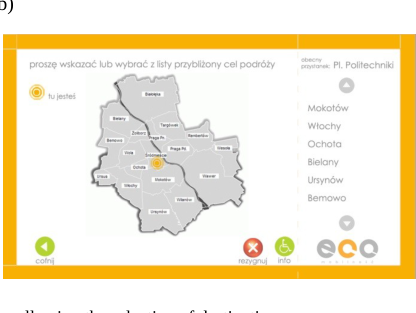
Figure 10 shows the screens that appear when selecting the destination.
a) b)
Figure 10. a) Welcome screen; b) Screen allowing the selection of destination
During the transit a passenger can observe the vehicle move on another screen (Figure 11). He or she can also obtain information on service points located in the vicinity of the stops or use online services. The option to change the route, i.e. the destination, is doable until the vehicle reaches a critical distance. If such decision comes at a time when the vehicle approaches the destination station, the passenger is being informed that it is not possible to make any changes at this stage.
Figure 11. Screen displayed en-route to the destination station
In the interface design process, research was also conducted on increasing its accessibility for people with various disabilities, not just physical. These have included vision impairment, color perception impairment or motor disorders. The results of this research will be addressed in upcoming solution proposals.
CONCLUSIONS
This article focuses on the design of a ’driver-passenger’ interface for two types of vehicles (Eco-car and PRT system). However, this solution has different purposes in each case. In case of the Eco-car, the vehicle is driven by a human, so the issues under consideration are as follows:
driving using upper limbs only (disability of lower limbs was assumed) which requires a proper cooperation of a specially designed steering wheel and a touch screen
adaptation of key elements of the interface to the individual features of the driver (e.g. regulated interface that allows a comfortable set up).
The ‘steer by wire’ solution adapter in the design of the vehicle has a fundamental impact on the interface design. This solution allows an additional adaptation of the vehicle steering performance to the individual features of a specific driver. It includes a variable responsiveness of the vehicle’s wheels to the steering wheel movement. In the case of the PRT system, the passenger interface has a different role. It allows selecting and changing the route at any moment, getting on and off and emergency evacuation. PRT vehicles can be considered a specific type of driverless car. The PRT system itself combines some features of individual and public transportation. Despite the fact that the vehicle is not driven directly by the passenger, the passenger’s influence on the vehicle operations is much stronger than in conventional means of public transportation in urban areas. The proposed solutions are intended for users with varying physical abilities. The new design philosophy, i.e.: the user-centered and universal designs are to meet the expectations of users of transport systems, in particular of public transport, and significantly increase the mobility of this group. By observing trends in car design, it can be argued that such solutions as proposed in this paper will be implemented in the near future.
ACKNOWLEDGMENTS
The authors would like to acknowledge that the above mentioned research was carried out as part of the ECO- Mobility project, co-funded by the European Regional Development Fund under the Operational Program Innovative Economy (UND-POIG.01.03.01-14-154) – Project Co-coordinator Prof. W. Choromanski
REFERENCES
Bhise, D. Vivek (2012),”Ergonomics in the Automotive Process”, CRC PRES, Taylor & Francis Group. Choromański W., Grabarek I., Kozłowski M., Ufnalski B., Barwicki M. (2013), “A new concept of electric eco-car”. Selected proceedings of International Conference WCTR 2013, Rio de Janeiro, (http://www2.wctr2013rio.com/proceedings). Communication from the Commission to The European Parliament, The Council, The European Economic And Social
Committee and the Committee of the Regions (Dealing with the impact of an ageing population in the E.U. (2009 Ageing Report), COM (2009) 180, Commission of the European Communities, Brussels. Grabarek, I.: ´Ergonomia środków transportu - rzemiosło, nauka, sztuka´. Prace Naukowe Transport, z.71, Warszawa 2009, s.57-
73. Grabarek, I., Choromański, W. (2012), ´Innovative environmental design in means and systems of transport with particular emphasis on the human factor´., in Advances in Human Aspects of Road and Rail Transportation, edited by Neville A. Stanton, CRS Press Taylor &Francis Group, pp.273-282, ISBN 978-1-4398-7123-2. ISO 13407: (1999), “Human- Centered Design Process for Interactive Systems”. Leśnikowska-Matusiak, I., Wnuk, A.(2011), ”Kierowanie pojazdem a starzejące się społeczeństwa”, Transport samochodowy,
No.1, pp.73-86. Tytyk E. (2001), ”Projektowanie ergonomiczne”, PWN, Warszawa.
LISTED IN THE AHFE DIGITAL BOOKSTORE CATALOGUE
Explore the complete digital volume
Advances in Human Aspects of Transportation: Part II
Read this individual research paper free through the original publisher, or explore the full digital proceedings book.
ISBN 978-1-4951-2098-5
Explore this ISBN in the AHFE Bookstore ↗Listed in the July 2026 bookstore catalogue; search by ISBN to confirm current availability · Digital book purchase optional