Martina Perišić, Vesna Spasojevic Brkic, Ivan Mihajlovic, Aleksandar Brkic, Nemanja Janev (2024). Excavators’ Cabins Ergonomic Design Influential Factors Modelling: Preliminary Study. In: Human Factors and Systems Interaction. AHFE Open Access, vol. 154, pp. 39–48. https://doi.org/10.54941/ahfe1005351
Excavator operators encounter demanding work environments with very high risks for discomfort, musculoskeletal disorders, and workplace accidents. In line with that, this study examines the relationship between ergonomic design influential factors using the structural model of excavator cabins design factors, using a sample of 32 excavator operators. Descriptive statistics were performed to describe the operator's age, height, weight, working experience, and excavator's lifespan. After that, the structural equations model was developed to describe the impact of latent variables related to ergonomic design of the cabin. This model was constructed by using 17 questions, which were categorized into 5 groups based on ergonomic design characteristics such as seat, armrests, commands, cabin, and working conditions. The findings indicate that the model exhibits favourable reliability and validity coefficients, a substantial effect size, and a satisfactory model fit. Further research is needed to increase the sample size, despite the preliminary nature of the current research and its satisfactory results.
Any heavy machinery operation has serious risks (Bedi et al., 2021; Kirin et al., 2021). Also, it is well known that human error accounts for almost 85% of all mining accidents (Patterson and Shappell, 2010). But, according to Akyeampong et al. (2014) and Reiman et al. (2016), researchers in the field of heavy machinery frequently concentrate on the technical components of the system while ignoring the human operator as a crucial component of the whole system. Understanding the complexity, effectiveness, and failures of heavy machinery can assist to improve production outcomes, enhance safety on mining sites and lower unforeseen and unnecessary expenses (Odeyar et al., 2022).
It is well known that operators of heavy mining vehicles are at a consider- able risk for discomfort, musculoskeletal disorders, and workplace accidents (Reiman et al., 2016). Numerous accidents are not unexpected given that it
appears heavy equipment is still not ergonomically suited to its users while operating in challenging conditions (Apud, 2012; Spasojevi´c Brki´c et al., 2015; Zunjic et al., 2015; Dempsey et al., 2018). When it comes to excava- tors, accidents occur even more frequently than in the other heavy machinery types (Jeon et al., 2013).
Due those facts the aim of this paper is to analyse and model exava- tors’ cabins ergonomic design influential factors. The first part of this paper describes previous research, and after that methodology based on structural equations modelling and its results are given. Finally, conclusions are drawn, the shortcomings of this research are described and further directions for future research are given.
PREVIOUS RESEARCH Work as an excavator’s operator is strenuous and physically challenging. The functioning of the equipment and the working environment subject the exca- vator operator to a variety of risks. In addition to significantly improving the operator’s working conditions, a well-designed cabin has an impact on site safety when heavy machinery is used (Spasojevi´c Brki´c et al., 2015). Only 6.4% of the mining sector and 15.8% of the construction industry, accord- ing to Eger et al. (2011), have self-reported ergonomics practice adoption. Boudreau-Trudel et al. (2014) underline how difficult it is to enhance safety and ergonomics in the field of heavy machinery.
A poor design of the cabin or poor working procedures could result in oper- ators’ awkward postural requirements, such as static sitting, while the opera- tor is performing their duties in the cabins (Schneider et al., 2001; Kittusamy and Buchholz, 2004; Waters et al., 2008; Zunjic et al., 2015; Jeripotula et al., 2020; Sadeghi et al., 2021). In addition to these risks, operators’ working conditions may also involve shift and prolonged work, whole-body vibra- tion, psychosocial factors, dust, exhaust gases, noise, extreme temperatures, and time constraints (Kittusamy and Buchholz, 2000, 2004; Viswanathan et al., 2006; Jorgensen et al., 2007; Joy and Middendorf, 2007; Kurtz et al., 2012; Lutz et al., 2015; Sun and Azman, 2018). Additionally, the operator’s annoyance is connected to the body’s sitting position and the repetitive nature of the tasks done, which put an undue strain on the muscular and skeletal systems (Kittusamy, 2003; Darabad et al., 2017; Afshari et al., 2018; Pałega and Rydz, 2018). Furthermore, several studies have demonstrated that oper- ators experience whole-body vibration, which when coupled with hunched over posture, increases lower back pain, resonance excitation of the individ- ual, and communication problems (Hoogendoorn et al., 2000; Kittusamy and Buchholz, 2004; Kurtz et al., 2012; Caffaro et al., 2016; Chi et al., 2017). It is clear that cabin design, work requirements, and operators’ anthropomet- ric measurements influence operator posture (Spasojevi´c Brki´c et al., 2015). When in an uncomfortable position, backrests and armrests are unlikely to be utilized on purpose even when they are there (Munro et al., 2021). However, checklists for the evaluation of the cabin design are not frequently found in the literature. A relatively small number of tools for assessing the design of
Excavators’ Cabins Ergonomic Design Influential Factors Modelling: Preliminary Study 41
construction or mining equipment cabins exist, and one of them for construc- tion machines was created by Kittusamy (2003). Recently, Spasojevi´c Brki´c et al. (2023) considerably updated that list in a way that made it useful for mining equipment.
METHODOLOGY AND RESULTS The research was conducted on the sample of 34 excavator operators (N). Data regarding their age, height, weight, working experience, and the excava- tor’s lifespan was collected. The mean value (mean), median (Med), minimum (Min), maximum (Max), standard deviation (SD), coefficient of variation (CV), and standard error (SE) were calculated as an initial step. The outcomes are presented in Table 1.
Table 1. Descriptive statistics of the excavator operators.
Table available in the original PDF paper.
Variable N Mean Med Min Max Variance SD CV SE Operator’s age 34 34.2647 34.00 19 53 84.3824 9.1860 26.80889 1.5754 Operators’ height 34 179.1471 180.00 166 187 31.0383 5.5712 3.10985 0.9554 Operators’ weight 34 89.2941 90.00 60 135 261.4866 16.1706 18.1093 2.7732 Working experience 34 10.6765 9.50 1 33 101.0134 10.0505 94.1373 1.7236 Excavator’s lifespan 34 6.0294 7.50 1 13 4.13767 4.1377 68.6248 0.7096
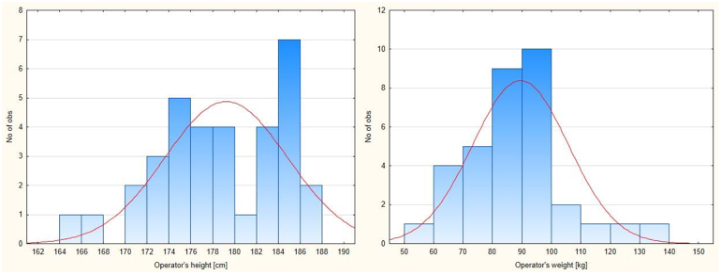
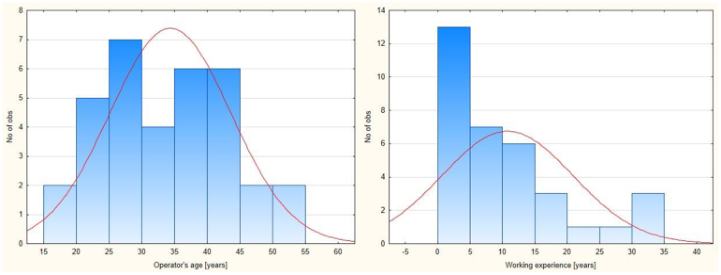
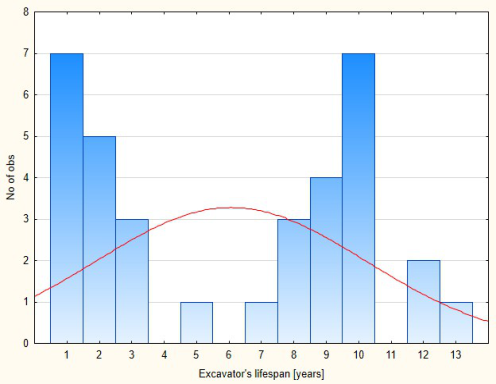
To gain a more comprehensive understanding of the data distribution, histograms were generated. The provided visual representation, depicted in Figure 1, illustrates the excavator’s operator height and weight. It is evident that the weight distribution spans from 60 to 135 kg which indicates a sig- nificant diversity in the weight of operators, while the height measurements range between 166 and 187 cm revealing the average height. Figure 2 per- tains operator’s age and work experience. It can be observed that a significant proportion of operators have a mixed-age demographic profile, and most of them possess brief professional experience. Figure 3 illustrates the lifespan of the excavator, where different lifespan can be seen, with a span from 1 to 13 years of usage.
Figure 1: Excavator operator’s height and weight.
42 Periši´c et al.
Figure 2: Excavator operator’s age and working experienceFigure 3: Excavator’s lifespan
In addition, excavator operators have been asked to fill the questionnaire proposed in Spasojevi´c Brki´c et al. (2023) which contained 17 questions regarding seat, armrests, commands and cabin ergonomic design character- istics, and working environment conditions, as presented in Table 2. Using the SMARTPLS 4 software, a structural model depicting the dependence and relationships between the 17 questions divided into 5 above mentioned cat- egories (constructs). In the applied social and behavioural sciences, the use of SMART PLS is appropriate when dealing with data that do not follow a typical multivariate distribution, require more complex models (many con- structs and many variables observed), are formative models, have “little” data, and/or are models with less established theoretical support. In these circumstances, variance-based structural equation modelling (VB-SEM) or partial least square models (PLS-SEM) are advised rather than covariance- based structural equation modelling (CB-SEM) or models based on maximum likelihood estimation (MLE) (Hair et al., 2014).
Excavators’ Cabins Ergonomic Design Influential Factors Modelling: Preliminary Study 43
Table 2. Questions used for data collection.
Table available in the original PDF paper.
No. Question Category/Construct Q1 Is the seat height adjustable? Seat Characteristics Q2 Can the seat be adjusted horizontally? Q3 Is the seat set at the correct height? Q4 Can the seat be reclined? Q5 Does the seat have lumbar support? Q6 Are there armrests? Armrests Characteristics Q7 Are the armrests adjustable? Q8 Are the armrests placed at the appropriate height? Q9 Can the location of the controls or handles be adjusted?
Cabin Characteristics
Commands Characteristics Q10 Can you easily reach controls or handles? Q11 Can you easily operate controls or handles? Q12 Is the cabin big enough for you (space that does not constrain you)?
Q13 Do you have sufficient visibility in all directions? Q14 Can you open/close the cabin door easily? Q15 Can you get in/out of the cabin easily? Q16 Due to poor working conditions, I often miss work (sick leave)
Working conditions Characteristics Q17 You don’t mind the exhaust gases of the machine you operate
To check if construct consists of proposed factors, reliability and valid- ity analysis is done. Table 3 provides a summary of constructs reliability and validity. Cronbach’s alpha values are greater than 0.7, indicating a high degree of reliability (Wong, 2013). In addition, the composite reliability (rho_a and rho_c) is very good, with a value between 0.717 and 0.99.
According to the Fornell and Larcker criteria (Henseler et al., 2009), it is recommended that the Average Variance Extracted (AVE) should exceed 0.5. As shown in Table 3, all AVE values in the proposed model are greater than 0.5. Additionally, the lowest AVE value observed in the proposed model is 0.531, while the highest is 0.952.
Table 3. Constructs’ reliability and validity - overview.
The coefficient of determination R-square values obtained in this study are highly favourable, ranging from 0.565 to 0.882. This finding suggests that all
44 Periši´c et al.
categories exhibit a moderate to strong effect size, as stated by Moore et al. (2011). Table 4 presents the R-square values for all latent variables.
Standardized Root Mean Square Residual (SRMR) values of 0.073 for the saturated model and 0.076 for the estimated model indicate a satisfac- tory model fit (Hu and Bentler, 1998). The Normed Fit Index (NFI) for the saturated model is 0.981 and for the estimated model it is 0.901, both of which are above 0.9, indicating a satisfactory fit (Lohmöller, 2013). Model fit parameters are presented at Table 5.
Table 5. Model fit.
Table available in the original PDF paper.
Saturated model Estimated model SRMR 0.073 0.076 Chi-square 242.597 243.097 NFI 0.981 0.901
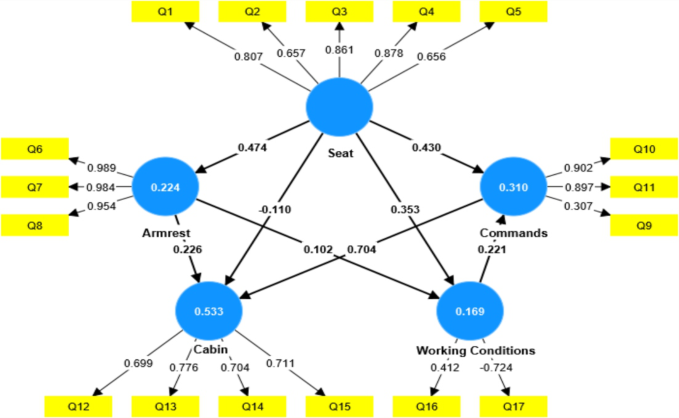
Lastly, Figure 4 displays the structural model with all factors’ loadings.
Excavators’ Cabins Ergonomic Design Influential Factors Modelling: Preliminary Study 45
CONCLUSION
Previous research show that excavator operators encounter demanding work environments with very high risks for discomfort, musculoskeletal disorders, and workplace accidents, whereas heavy equipment, and especially excavator, is still not ergonomically adjusted to its users while operating in challenging conditions. Anyhow, till now previous research concentrate on the technical components of the system while ignoring the human operator as a crucial component of the whole system. In that aim this research focuses to human factors issues in excavator operation.
This preliminary study involved the examination of 32 excavator oper- ators. The operators’ ages, heights, weights, working experience and the excavators’s lifespan varied significantly, as indicated by descriptive statis- tics. Additionally, it can be concluded that the majority of operators have limited experience in this field.
In addition, a structural model was developed and tested with a set of 17 questions using the software SMARTPLS and they were categorized into five distinct constructs. Reliability and validation analysis showed that all constructs have a high level of reliability based on the values of Cronbach’s alpha, composite reliability (rho_a), composite reliability (rho_c), and AVE. The R-square values show a moderate to strong effect size, which implies that the created model is satisfactory. Both saturated and estimated mod- els show a good fit, with values for SRMR of 0,073 and 0,076 respectively and values for NFI of 0,981 and 0,901, respectively. The structural equa- tions model obtained in this research proves that the cabin interior design is influenced mostly by commands characteristics, but also by seat and arm- rests characteristics. Working conditions quality is influenced mostly by seat design characteristics, but also by armrests design. There are also significant relationships between armrests, seat and commands characteristics. It is also evident that seat characteristics are connected to all other factors and that working conditions influence commands usage.
In conclusion, considering the preliminary stage of the study and the excel- lent outcomes seen, it is essential to augment the sample size substantially in future researches.
ACKNOWLEDGMENT
This research was supported by the Science Fund of the Republic of Serbia, #GRANT No. 5151, Support Systems for Smart, Ergonomic and Sustainable Mining Machinery Workplaces – SmartMiner and the Ministry of Science, Technological Development and Innovations contract no. 451-03-47/2023- 01/200105 from 03.02.2023. The authors also thank the respondents who filled out the questionnaires for their kind cooperation.
REFERENCES
Afshari, Davood. Mazloumi, Adel. Nourollahi-Darabad, Maryam. Nasl Saraji, Gabraeil and Rahimi Foroushani, Abbas. (2018). Effect of Neck Posture on Cervicothoracic Loads in Overhead Crane Operators. International Journal of Occupational Safety and Ergonomics Volume 27, No. 1, pp. 316–322.
46 Periši´c et al.
Akyeampong, Joseph. Udoka, Silvanus. Caruso, Giandomenico and Bordegoni, Monica. (2014). Evaluation of Hydraulic Excavator Human–Machine Inter- face Concepts Using NASA TLX. International Journal of Industrial Ergonomics Volume 44, No. 3, pp. 374–382. Apud, Elías (2012). Ergonomics in Mining: The Chilean Experience. Human Factors
Volume 54, No. 6, pp. 901–907. Bedi, J. K. Rahman, R. A. and Din, Z. (2021). Heavy Machinery Operators: Necessary Competencies to Reduce Construction Accidents. IOP Conference Series: Earth and Environmental Science Volume 641, No. 1, p. 012007. Boudreau-Trudel, Bryan. Nadeau, Sylvie. Zaras, Kazimierz and Deschamps, Isabelle.
(2014). Introduction of Innovative Equipment in Mining: Impact on Occupational Health and Safety. Open Journal of Safety Science and Technology Volume 4, No. 1, pp. 49–58. Caffaro, Federica. Cremasco, Margherita Micheletti. Preti, Christian and Cavallo, Eugenio. (2016). Ergonomic Analysis of the Effects of a Telehandler’s Active Sus- pended Cab on Whole Body Vibration Level and Operator Comfort. International Journal of Industrial Ergonomics Volume 53, pp. 19–26. Chi, Feng. Zhou, Jun. Zhang, Qi. Wang, Yong and Huang, Panling. (2017). Avoiding
the Health Hazard of People from Construction Vehicles: A Strategy for Con- trolling the Vibration of a Wheel Loader. International Journal of Environmental Research and Public Health Volume 14, No. 3, p. 275. Darabad, Maryam Nourollahi. Mazloumi, Adel. Saraji, Gabraeil Nasl. Afshari, Davood and Foroushani, Abbas Rahimi. (2017). Full Shift Assessment of Back and Head Postures in Overhead Crane Operators with and without Symptoms. Journal of Occupational Health Volume 60, No. 1, pp. 46–54. Dempsey, Patrick G. Kocher, Lydia M. Nasarwanji, Mahiyar F. Pollard, Jonisha P.
and Whitson, Ashley E. (2018). Emerging Ergonomics Issues and Opportunities in Mining. International Journal of Environmental Research and Public Health Volume 15, No. 11, p. 2449. Eger, Tammy. Stevenson, Joan M. Grenier, Sylvain. Boileau, Paul-Émile and Smets, Martin P. (2011). Influence of Vehicle Size, Haulage Capacity and Ride Control on Vibration Exposure and Predicted Health Risks for LHD Vehicle Operators. Journal of Low Frequency Noise, Vibration and Active Control Volume 30, No. 1, pp. 45–62. Hair, Joseph F., Black, William C., Babin, Barry J, and Anderson, Rolph E, ed. (2014).
Multivariate Data Analysis. Harlow: Pearson Education Limited. Henseler, J., Ringle, C. M., Sinkovics, R. R. (2009). “The Use of Partial Least Squares Path Modeling in International Marketing” in: New Challenges to International Marketing, R. Sinkovics, Rudolf, and N. Ghauri, Pervez (Eds.), Advances in International Marketing. Emerald Group Publishing Limited., pp. 277–319, Hoogendoorn, Wilhelmina E. van Poppel, Mireille N. M. Bongers, Paulien M. Koes,
Bart W. and Bouter, Lex M. (2000). Systematic Review of Psychosocial Factors at Work and Private Life as Risk Factors for Back Pain. SPINE Volume 25, No. 16, pp. 2114–2125. Hu, Li-tze and Bentler, Peter M. (1998). Fit Indices in Covariance Structure Modeling: Sensitivity to Underparameterized Model Misspecification. Psychological Methods Volume 3, No. 4, pp. 424–453. Jeon, Hyun Woo. Jung, In Su and Lee, Chan Sik. (2013). Risk Assessment for Reduc-
ing Safety Accidents caused by Construction Machinery. Journal of the Korean Society of Safety Volume 28, No. 6, pp. 64–72.
Excavators’ Cabins Ergonomic Design Influential Factors Modelling: Preliminary Study 47
Jeripotula, Sandeep Kumar Kumar. Mangalpady, Aruna and Mandela, Govinda Raj Raj. (2020). Assessment of Exposure to Whole-Body Vibration of Dozer Opera- tors Based on Postural Variability. Mining, Metallurgy & Exploration Volume 37, No. 2, pp. 813–820. Jorgensen, Michael J. Kittusamy, N. K. and Aedla, Pranathi B. (2007). Repeatability
of a Checklist for Evaluating Cab Design Characteristics of Heavy Mobile Equip- ment. Journal of Occupational and Environmental Hygiene Volume 4, No. 12, pp. 913–922. Joy, Gerald J. and Middendorf, Paul J. (2007). Noise Exposure and Hearing Conservation in U. S. Coal Mines—A Surveillance Report. Journal of Occupational and Environmental Hygiene Volume 4, No. 1, pp. 26–35. Kirin, Snezana. Sedmak, Aleksandar. Li, Wei. Brzakovi´c, Miodrag. Miljanovi´c, Igor.
Petrovi´c, Ana and Sedmak, Simon. (2021). Human Factor Risk Management Procedures Applied in the Case of Open Pit Mine. Engineering Failure Analysis Volume 126, p. 105456. Kittusamy, N. Kumar. (2003). A Checklist for Evaluating Cab Design of Construction Equipment. Applied Occupational and Environmental Hygiene Volume 18, No. 10, pp. 721–723. Kittusamy, N. Kumar and Buchholz, Bryan. (2000). Assessment of Ergonomic
Exposures among Operators of Construction Equipment. Proceedings of the Human Factors and Ergonomics Society Annual Meeting Volume 44, No. 29, pp. 173–176. Kittusamy, N. Kumar and Buchholz, Bryan. (2004). Whole-Body Vibration and Postural Stress among Operators of Construction Equipment: A Literature Review. Journal of Safety Research Volume 35, No. 3, pp. 255–261. Kurtz, Lawrence A. Vi, Peter and Verma, Dave K. (2012). Case Study. Journal of
Occupational and Environmental Hygiene Volume 9, No. 6, pp. D117–D122. Lohmöller, Jan-Bernd, ed. (2013). Latent Variable Path Modeling with Partial Least Squares. Springer Science & Business Media. Lutz, Eric A. Reed, Rustin J. Lee, Vivien ST. and Burgess, Jefferey L. (2015). Occupa-
tional Exposures to Emissions from Combustion of Diesel and Alternative Fuels in Underground Mining—A Simulated Pilot Study. Journal of OCCUPATIONAL and Environmental Hygiene Volume 12, No. 3, pp. 18–25. Moore, David., Notz, William I, and Fligner, Michael A, ed. (2011). The Basic Practice of Statistics, 6th Edition. WH Freeman. Munro, D. Mark. Govers, Megan E. and Oliver, Michele L. (2021). Physical Demands
of Overhead Crane Operation. International Journal of Industrial Ergonomics Volume 86, p. 103200. Odeyar, Prerita. Apel, Derek B. Hall, Robert. Zon, Brett and Skrzypkowski, Krzysztof. (2022). A Review of Reliability and Fault Analysis Methods for Heavy Equipment and Their Components Used in Mining. Energies Volume 15, No. 17, p. 6263. Pałega, M and Rydz, D. (2018). Work Safety and Ergonomics at the Workplace an
Excavator Operator. Trans Motauto World Volume 3, No. 1, pp. 25–29. Patterson, Jessica M. and Shappell, Scott A. (2010). Operator Error and System Deficiencies: Analysis of 508 Mining Incidents and Accidents from Queensland, Australia Using HFACS. Accident Analysis & Prevention Volume 42, No. 4, pp. 1379–1385. Reiman, Arto. Sormunen, Erja and Morris, Drew. (2016). Ergonomics in the Arctic –
a Study and Checklist for Heavy Machinery in Open Pit Mining. Work Volume 55, No. 3, pp. 643–653.
48 Periši´c et al.
Sadeghi, Sanaz. Soltanmohammadlou, Nazi and Rahnamayiezekavat, Payam.
(2021). A Systematic Review of Scholarly Works Addressing Crane Safety Requirements. Safety Science Volume 133, p. 105002. Schneider, Scott P. Kittusamy, N. Kumar and Buchholz, Bryan (2001). An Ergonomic Evaluation of Excavating Operations: A Pilot Study. Applied Occupational and Environmental Hygiene Volume 16, No. 7, pp. 723–726. Spasojevi´c Brki´c, V. K. Klarin, M. M. and Brki´c, A. Dj. (2015). Ergonomic Design
of Crane Cabin Interior: The Path to Improved Safety. SAFETY SCIENCE Volume 73, pp. 43–51. Spasojevi´c Brki´c, Vesna. Misita, Mirjana. Periši´c, Martina. Brki´c, Aleksandar and Veljkovi´c, Zorica. (2023). Validating Measurement Structure of Checklist for Evaluating Ergonomics Risks in Heavy Mobile Machinery Cabs. MATHEMAT- ICS Volume 11, No. 1, p. 23. Sun, Kan and Azman, Amanda S. (2018). Evaluating Hearing Loss Risks in
the Mining Industry through MSHA Citations. Journal of Occupational and Environmental Hygiene Volume 15, No. 3, pp. 246–262. Viswanathan, M. Jorgensen, M. J. and Kittusamy, N. K. (2006). Field Evaluation of a Continuous Passive Lumbar Motion System among Operators of Earthmoving Equipment. International Journal of Industrial Ergonomics Volume 36, No. 7, pp. 651–659. Waters, Thomas. Genaidy, Ash. Viruet, Heriberto Barriera and Makola, Mbulelo.
(2008). The Impact of Operating Heavy Equipment Vehicles on Lower Back Disorders. Ergonomics Volume 51, No. 5, pp. 602–636. Wong, Ken Kwong-Kay. (2013). Partial Least Squares Structural Equation Modeling (PLS-SEM) Techniques Using SmartPLS. Marketing Bulletin Volume 24, No. 1. Zunjic, Aleksandar Brkic, Vesna Spasojevic. Klarin, Milivoj. Brkic, Aleksandar and
Krstic, Dragan. (2015). Anthropometric Assessment of Crane Cabins and Recom- mendations for Design: A Case Study. Work Volume 52, No. 1, pp. 185–194.
LISTED IN THE AHFE DIGITAL BOOKSTORE CATALOGUE
Explore the complete digital volume
Human Factors and Systems Interaction
Read this individual research paper free through the original publisher, or explore the full digital proceedings book.
ISBN 978-1-964867-30-4
Explore this ISBN in the AHFE Bookstore ↗Listed in the July 2026 bookstore catalogue; search by ISBN to confirm current availability · Digital book purchase optional